Easter Family Festival at the Clinton Center today from 10am to 2pm

easterheroThe Clinton Presidential Center will host its 10th annual Easter Family Festival on Saturday, April 4, patterned after the popular “White House Easter Egg Roll.” The festival will include Arkansas’s largest “green” egg hunt, as well as a variety of free activities, entertainment, and prizes.
Easter Family Festival
Saturday, April 4, 2014
10 a.m. – 2 p.m.
Clinton Presidential Park
1200 President Clinton Avenue
Rain Date
Sunday, April 5
1-4 p.m.
Along with the egg hunt for children (using eco-friendly eggs), FREE activities for children of all ages will include FREE photos with the Easter Bunny! Photos will be posted on clintonpresidentialcenter.org and will be available for downloading.

Little Rock Look Back: Special Election to finish funding Robinson Auditorium construction

jtrma-c.jpgThough Joseph Taylor Robinson Memorial Auditorium opened in February 1940, there was still money that needed to be raised to finish the construction and the building’s furnishing.  Ten days after the auditorium opening, the City Council approved an ordinance to call a special election on April 2, 1940, for the purposes of approving bonds for three separate projects.  One of these was for $30,000 for the completion of the auditorium; the bonds would not require any additional tax levy.

At the same meeting, a letter was read from the Young Men’s Business Association expressing support for the auditorium in the election, which was to be held in conjunction with the annual municipal general election. The Auditorium Commission had previously asked the City Council to consider issuing the bonds to pay for additional equipment for the building.  In their request to the aldermen, the members stressed that due to the current bond structure, these new bonds would not necessitate any tax increase.

The campaign for the new bonds used a similar structure and message as the 1937 election to build the auditorium.  There were newspaper ads by the steering committee (this time simply called the Citizen’s Committee and led by Omar Throgmorton) and support from civic organizations.  One thing very different from the 1937 campaign was the presence of an actual building.  On Sunday, March 31, just two days before the election, there was an open house for the public to explore the edifice.  From 1:00 p.m. to 9:00 p.m., members of various Little Rock Boy Scout troops led 4,000 visitors on tours of the auditorium.  Visitors were shown all over the building; one scout calculated that the walking tour equated to two miles.  Though most people were from Little Rock, the guest registry indicated visitors from California and Pennsylvania.

On April 2, 1940, Little Rock voters approved the new bonds 1,413 to 423.  Every precinct in every ward of the city voted in favor of the new bonds.  Shortly after the election, the bonds were issued.  The auditorium construction which had first been broached in 1904 was now completed in 1940.

Leocadia Zak of USTDA will lead discussion on international trade at Clinton School

LzakToday at 12 noon at the Clinton School, Leocadia Zak will participate in a discussion on international trade and economic developement.

She is the director of the U.S. Trade and Development Agency, which helps U.S. businesses create jobs through the export of their goods and services for priority infrastructure projects in emerging economies. USTDA links U.S. companies to export opportunities by funding project planning activities, pilot projects, and reverse trade missions while creating sustainable infrastructure, development, and economic growth in partner countries. For the sixth year in a row, USTDA’s export multiplier increased in FY 2014 — for every dollar the Agency programmed, an unprecedented $76 in U.S. exports were generated.

Zak will participate in a discussion on international trade and economic development, including President Obama’s trade policy agenda and trends in emerging markets, moderated by former Arkansas Economic Development Commission director Grant Tennille.

Leocadia I. Zak was appointed by President Obama and confirmed by the United States Senate as the Director of the U.S. Trade and Development Agency, which helps U.S. businesses create jobs through the export of their goods and services for priority development projects in emerging economies. USTDA links U.S. companies to export opportunities by funding project planning activities, pilot projects and reverse trade missions while creating sustainable infrastructure and economic growth in partner countries. For the sixth year in a row, USTDA’s export multiplier increased in FY 2014 — for every dollar the Agency programmed, an unprecedented $76 in U.S. exports were generated. Further, the $5.8 billion in new exports identified last year brings USTDA’s total exports generated to over $51 billion.

Prior to joining USTDA, Ms. Zak was a partner in the Washington and Boston offices of Mintz, Levin, Cohn, Ferris, Glovsky and Popeo, P.C., practicing in the areas of corporate, municipal and international finance. Ms. Zak was also an Adjunct Professor of Law and has taught International Project Finance at the Boston University School of Law, Morin Center for Banking and Financial Law Studies and at the Georgetown University Law Center.

Ms. Zak received her B.A. from Mount Holyoke College and her J.D. from Northeastern University School of Law.

Legacies & Lunch Examines Arkansas’s Free Black Expulsion of 1860    

legaciesIn 1860, Arkansas became the only state to prohibit free blacks from residing within its borders. What happened to those who left? Dr. Brian Mitchell will discuss this little-known chapter of Arkansas history at Legacies & Lunch, the Butler Center’s monthly lecture series, on Wednesday, April 1, from noon-1 p.m., in the Main Library’s Darragh Center, 100 Rock Street.

Brian Mitchell is a researcher, social policy analyst, and historian at the University of Arkansas at Little Rock. He is currently developing a database identifying free blacks expelled from Arkansas in 1860 and writing a narrative detailing their experiences.

Legacies & Lunch is free, open to the public, and sponsored in part by the Arkansas Humanities Council. Attendees are invited to bring a sack lunch; drinks and dessert are provided. For more information, call 501-918-3033.

Little Rock Look Back: Open House at Robinson Auditorium

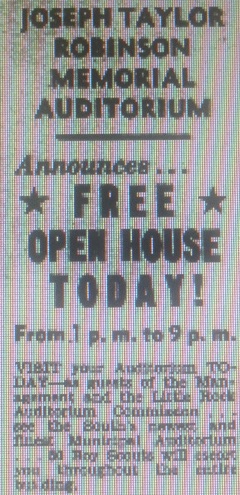
open house adOn March 31, 1940, the City of Little Rock and the Auditorium Commission threw open the doors of Joseph Taylor Robinson Memorial Auditorium to the public for an open house.

The building had officially opened in February 1940, and events had been taking place in the lower level since October 1939. But this was the first time that the public could tour the entire facility from top to bottom.

The event took place on a Sunday from 1pm to 9pm.  Curiously, it took place two days before a special election to approve the bonds to finish the auditorium. Though no one at the time was cynical enough to comment on the connection.

Members of various Little Rock Boy Scout troops led 4,000 visitors on tours of the auditorium.  Visitors were shown all over the building; one scout calculated that the walking tour equated to two miles.  Though most people were from Little Rock, the guest registry indicated visitors from California and Pennsylvania.  Among the last guests to sign the register were Mayor J. V. Satterfield and his family.

The idea for the open house had first been floated in December by Alderman E. W. Gibb after taking a tour of the construction site. He had enthusiastically professed that everyone should be able to tour and see what a magnificent structure it was going to be.  Mayor Satterfield had to tamper the alderman’s enthusiasm. Hagreed with Mr. Gibb that it was a fine building but stated that a public open house could not be scheduled for a few weeks because there was still much work to be done.  Mayor Satterfield noted that the seats in the music hall were going to have to be removed and then reinstalled because they needed to be anchored bette

Little Rock Look Back: B47 Bomber explodes over Little Rock

An LRPD officer talks to bystanders next to a piece of debris

An LRPD officer talks to bystanders next to a piece of debris

The peaceful morning of March 31, 1960, was interrupted by a horrendous noise over Hillcrest around 6:00am.  A six-engine B47 from the Little Rock Air Force Base exploded mid-air.

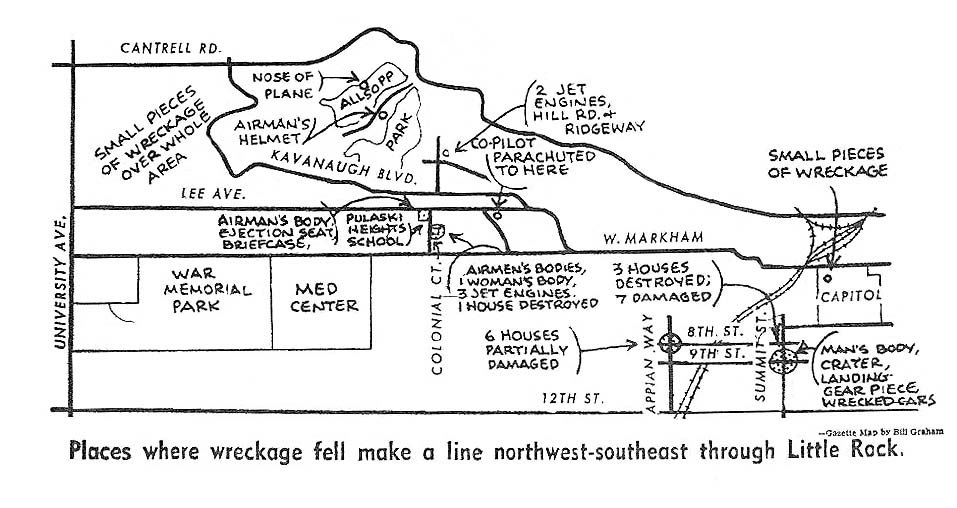
Flaming debris fell from Allsopp Park all the way to the State Capitol grounds and stretched from Cantrell to 12th Street.  Other debris was found as far away as the Country Club of Little Rock.  The next day the Arkansas Gazette ran a map which showed the extent of the damage.

Three airmen died in the explosion and two civilians were killed when debris fell on their homes.  The only survivor from the crew, 1st Lieutenant Thomas Smoak, was found dangling from a tree in his parachute at Kavanaugh and Martin.  He was treated by a nurse, Jimmye Lee Holeman, in whose yard he had landed.

Many vehicles and homes were damaged, some were destroyed by debris.  The damage estimate was put around $4 million.

Police and fire crews were quickly on the scene to secure impacted areas, fight fires and rescue injured persons.

The Strategic Air Command’s edited account of the incident noted:

A B-47 was climbing after takeoff in day VFR weather.  At about 15,000 feet, the copilot suddenly realized that the aircraft was in a very steep left bank, that the nose was well below the horizon, and that the airspeed was excessive.  He pulled the throttles to idle, punched the interphone button and shouted at the aircraft commander.

Almost immediately, the nose came up, the wings leveled, and the aircraft disintegrated.  In the cockpit section, which had separated intact from the rest of the aircraft, the copilot tried to eject, but the clamshell initiator pin had not been removed.  The copilot then unfastened his seat belt.  The canopy blew off at about 10,000 feet.  The unconscious copilot was thrown out at 4,000 feet and his parachute opened automatically.

The aircraft commander ejected at 2,000 feet, but his parachute had been fused by fire and he died upon impact.  The fourth man was found near the wreckage and did not survive.  The navigator was killed in his position.  The falling wreckage killed two civilians and caused serious damage to property.”

Those who perished were Captain Herbert Aldridge, Lieutenant Colonel Reynolds Watson, Staff-Sergeant Kenneth Brose, and civilians Alta Lois Clark and James Hollabaugh.

Arkansas Gazette map of debris and damage

Arkansas Gazette map of debris and damage

Little Rock Look Back: LR Mayor Werner Knoop

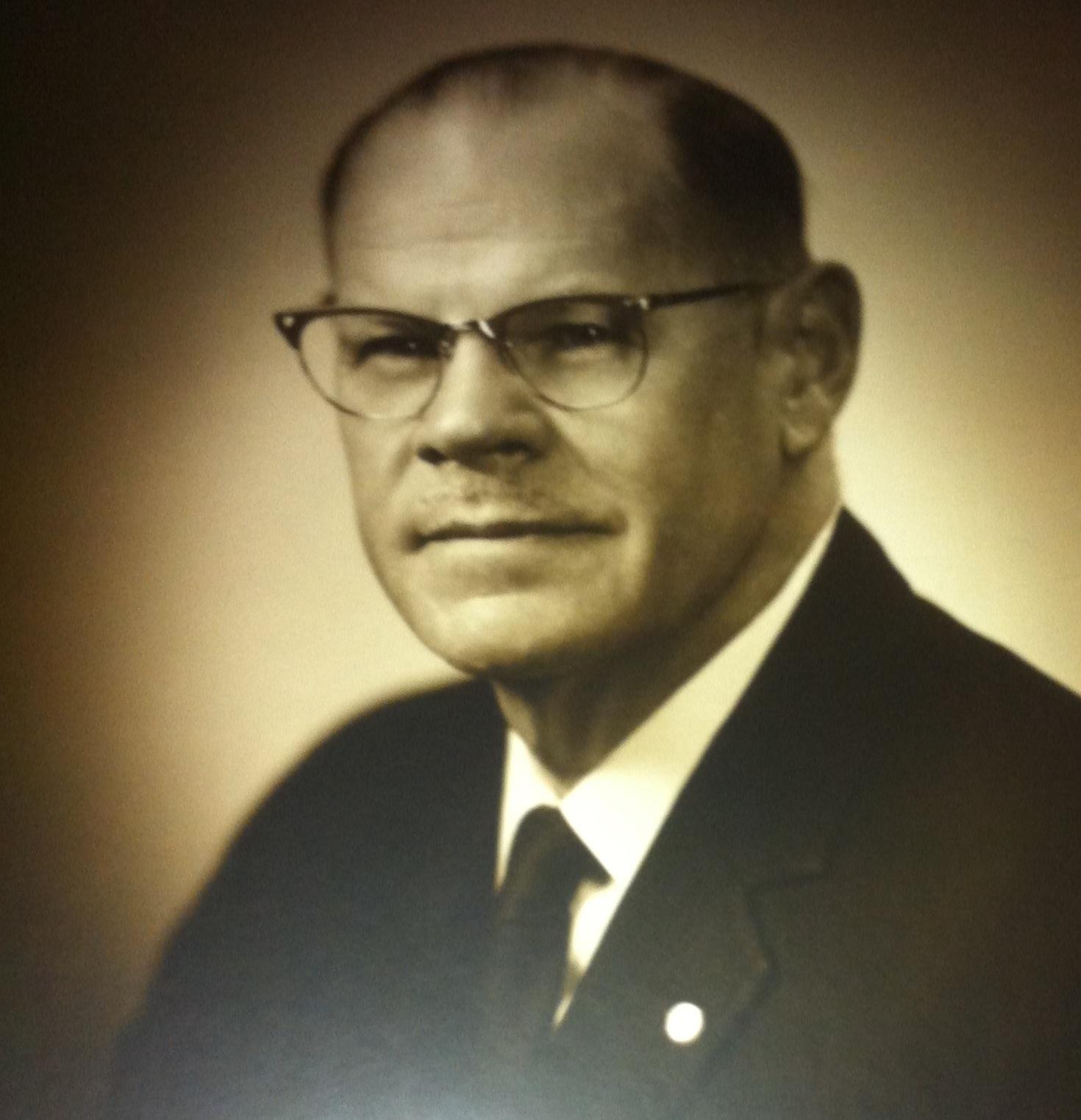
Mayor KnoopTo Little Rock citizens under a certain age, the name Knoop means Knoop Park — a picturesque park tucked away in a pocket of Hillcrest.  There are, however, still many who remember Werner C. Knoop as a business and political leader who helped shape Little Rock as a modern city.

Knoop was born on March 30, 1902.

In 1946, Knoop joined with Olen A. Cates and P. W. Baldwin to form Baldwin Construction Company in Little Rock.  Knoop had previously founded Capital Steel Company and established his business reputation there.  From 1945 through 1951, he served on the Little Rock School Board.

Following a series of political scandals, efforts were undertaken for Little Rock to shift from Mayor-Council to City Manager form of government.  Even before the desegregation of Little Rock Central put the city in the eyes of the world, an election for new leaders had been set for November 1957.  Knoop was on a “Good Government” slate and was one of the members elected.

At the first meeting of the new City Board, Werner C. Knoop was chosen by his fellow directors to serve as Little Rock Mayor.  Knoop served as Mayor until December 1962.  For the first several months in office, Little Rock had no City Manager so Knoop oversaw the transition of City staff as the forms of government changed.

Though City Hall generally stayed out of school district matters, that did not mean that the public viewed the two entities separately.  In September 1959, the Baldwin Construction offices were bombed as part of a series of terrorist activities protesting the desegregated reopening of all Little Rock high schools.
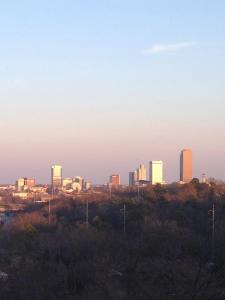
Downtown LR as viewed from Knoop Park

Downtown LR as viewed from Knoop Park

After two terms on the City Board, Knoop decided against seeking a third term.  He concluded his elected public service on December 31, 1962.  Following his time on the City Board, Knoop did not retire from Civic Affairs.  In 1970, he served as Chairman of the Little Rock Chamber of Commerce.   The previous year he served as President of the Arkansas Chapter of Associated General Contractors.

Mayor Knoop died in July 1983.  He is buried at Roselawn Memorial Park next to his wife Faith Yingling Knoop, a renowned author.

In the 1930s, Knoop moved into an Art Moderne house on Ozark Point in Hillcrest.  It was adjacent to Little Rock Waterworks property which was developed around the same time.  Eventually much of the land was deeded to the City for creation of a park.  In 1989, it was named in tribute to long-time neighbor Knoop in honor of his lifetime of service to Little Rock.