
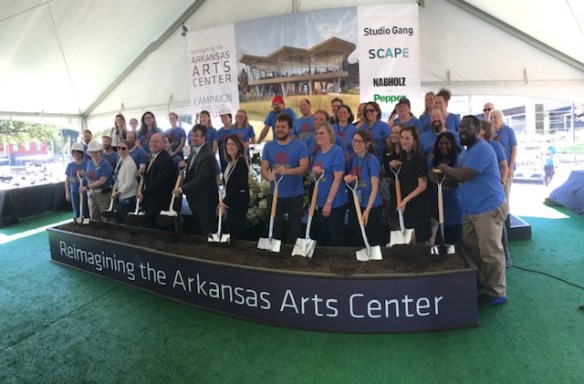
The Arkansas Arts Center (AAC) held a mid-morning Groundbreaking Ceremony on Tuesday, October 1, to commemorate the beginning of construction of its stunning, reimagined Arts Center.
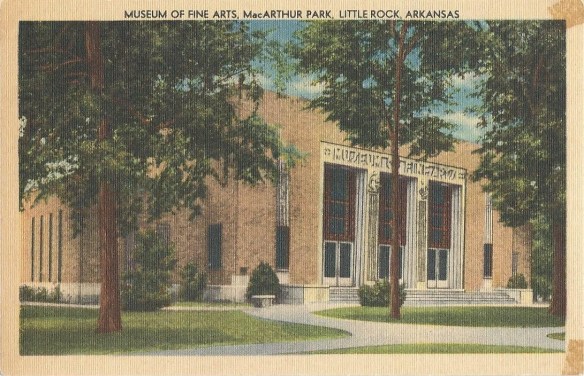
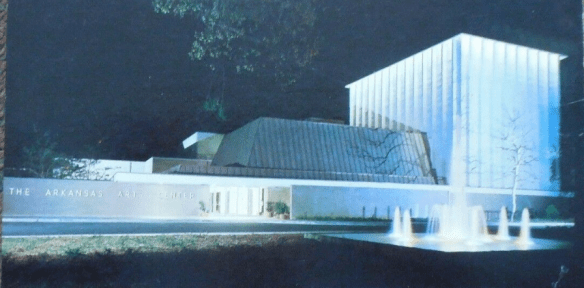
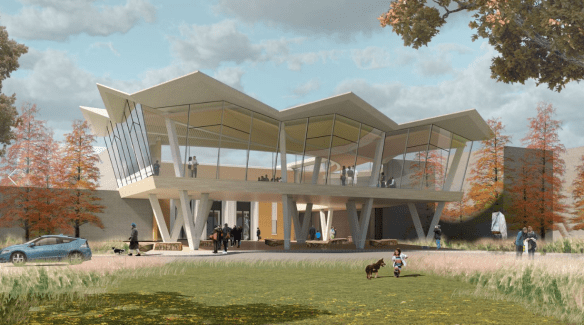
Upon completion in 2022, the current facility will be entirely transformed through an exciting design by renowned architect Jeanne Gang and her practice, Studio Gang. The project also includes a landscape design that will connect the AAC with the surrounding MacArthur Park, by award-winning designer Kate Orff and SCAPE. Both Jeanne Gang and Kate Orff are MacArthur Fellows who have received prestigious “Genius Grants” from the John D. and Catherine T. MacArthur Foundation.
“As we gather to commemorate the beginning of construction, today marks a major step forward toward ensuring that the Arkansas Arts Center is an important and flourishing cultural resource now and in the future,” said Campaign Co-Chair Warren Stephens. “This is a truly historic day in the life of our city, state, and region.”
“Today, we commit to ensuring that the Arkansas Arts Center will be a cultural beacon for the region, showcasing art that educates, inspires, provokes, and beautifies our lives. All people, from young to young at heart, will gather here as a community to celebrate, learn, and cross boundaries,” said Arkansas Arts Center Executive Director, Dr. Victoria Ramirez. “The project embraces the Arkansas Arts Center’s rich history and looks forward to a future that exceeds our expectations. I am honored to be working with all of you to make this vision a reality.”
Architects Jeanne Gang and Kate Orff spoke at the Groundbreaking Ceremony, relaying key points about the project’s design and impact.
“The design for the reimagined Arkansas Arts Center features new and renovated spaces for gathering and community events to create dynamic connections among the state-of-the-art galleries and exhibitions, renovated Museum School, and upgraded Children’s Theatre,” said Jeanne Gang, Architect and Founding Principal of Studio Gang. “One of our main goals for the project is to allow the architecture to invite interaction, discovery, creativity, and learning.”
“The site design will provide a seamless transition between the Arkansas Arts Center and MacArthur Park,” said Kate Orff, Founder of SCAPE. “With native plantings, a tree canopy, walking paths, and a great lawn for events, the landscape design will provide useable and accessible space for visitors, and create a true ‘Arts Center in the Park’.”
The project is made possible through Reimagining the Arkansas Arts Center: Campaign for Our Cultural Future, a $128 million fundraising campaign, which will fund the new Arts Center for the 21st Century, and provide support for transition, opening, and endowment. At the Groundbreaking Ceremony, Campaign Co-Chairs Harriet and Warren Stephens announced that the Campaign has now raised more than $122.7 million of its $128 million goal to-date.
The campaign includes a commitment of $31,245,000 from the City of Little Rock, which is being generated through a hotel-tax revenue bond. Lead donors include Windgate Foundation, Harriet and Warren Stephens, the State of Arkansas, and Winthrop Rockefeller Charitable Trust. The Campaign now has twenty-two “21st Century Founders” – donors who are contributing gifts of $1 million to $35 million. Thirty-two families and foundations are now leadership donors to the campaign, having given between $100,000 and $1 million. There are many others who have donated gifts, as well.
“We remain incredibly grateful to all of the donors to-date, the City of Little Rock, and the State of Arkansas for saying ‘yes’ to Art, and to the Arkansas Arts Center,” said Campaign Co-Chair Harriet Stephens. “The project is grand in scope and impact and will need the participation of many to reach an ambitious goal. As we anticipate the Grand Opening in 2022, we look forward to involving many more people in the campaign.”
AAC Board of Trustees President, Merritt Dyke, and Little Rock Mayor, Frank Scott, Jr. also spoke to commemorate the occasion. Harriet and Warren Stephens, Dr. Victoria Ramirez, Jeanne Gang, Kate Orff, Merritt Dyke, and Mayor Frank Scott, Jr. were then joined by AAC Foundation Board Chair, Robert W. Tucker for the ceremonial groundbreaking. The celebration included performances by the Parkview Arts and Science Magnet Jazz Ensemble, the Episcopal Collegiate School Choir, and the Episcopal Collegiate Percussion Band for the capacity crowd.
During construction, the Arkansas Arts Center has moved from its current facility in MacArthur Park into a temporary location at the Riverdale Shopping Center at 2510 Cantrell Road in Little Rock. Classes, education programs, and performances will continue at the temporary location from Fall 2019 through the new Arts Center’s planned Grand Opening in 2022.




 The year 2019 marks the 200th anniversary of the great botanist and naturalist Thomas Nuttall’s year-long journey of discovery through the Arkansas Territory, present day Arkansas and Oklahoma.
 Little Rock Culture Vulture