
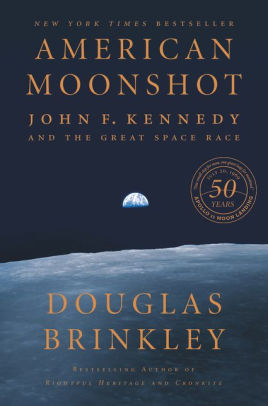
 After the fiftieth anniversary of the first lunar landing passes, the award-winning historian and perennial New York Times bestselling author takes a fresh look at the space program, President John F. Kennedy’s inspiring challenge, and America’s race to the moon.
“We choose to go to the Moon in this decade and do the other things, not because they are easy, but because they are hard; because that goal will serve to organize and measure the best of our energies and skills, because that challenge is one that we are willing to accept, one we are unwilling to postpone, and one we intend to win.”—President John F. Kennedy
On May 25, 1961, JFK made an astonishing announcement: his goal of putting a man on the moon by the end of the decade. In this engrossing, fast-paced epic, Douglas Brinkley returns to the 1960s to recreate one of the most exciting and ambitious achievements in the history of humankind. American Moonshot brings together the extraordinary political, cultural, and scientific factors that fueled the birth and development of NASA and the Mercury, Gemini and Apollo projects, which shot the United States to victory in the space race against the Soviet Union at the height of the Cold War.
Douglas Brinkley is the Katherine Tsanoff Brown Chair in Humanities and Professor of History at Rice University, a CNN Presidential Historian, and a contributing editor at Vanity Fair. In the world of public history, he serves on boards, at museums, at colleges, and for historical societies.The Chicago Tribune dubbed him “America’s New Past Master.” The New-York Historical Society has chosen Brinkley as its official U.S. Presidential Historian.
All Clinton School Speaker Series events are free and open to the public. Reserve your seats by emailing publicprograms@clintonschool.uasys.edu or by calling (501) 683-5239.
After the fiftieth anniversary of the first lunar landing passes, the award-winning historian and perennial New York Times bestselling author takes a fresh look at the space program, President John F. Kennedy’s inspiring challenge, and America’s race to the moon.
“We choose to go to the Moon in this decade and do the other things, not because they are easy, but because they are hard; because that goal will serve to organize and measure the best of our energies and skills, because that challenge is one that we are willing to accept, one we are unwilling to postpone, and one we intend to win.”—President John F. Kennedy
On May 25, 1961, JFK made an astonishing announcement: his goal of putting a man on the moon by the end of the decade. In this engrossing, fast-paced epic, Douglas Brinkley returns to the 1960s to recreate one of the most exciting and ambitious achievements in the history of humankind. American Moonshot brings together the extraordinary political, cultural, and scientific factors that fueled the birth and development of NASA and the Mercury, Gemini and Apollo projects, which shot the United States to victory in the space race against the Soviet Union at the height of the Cold War.
Douglas Brinkley is the Katherine Tsanoff Brown Chair in Humanities and Professor of History at Rice University, a CNN Presidential Historian, and a contributing editor at Vanity Fair. In the world of public history, he serves on boards, at museums, at colleges, and for historical societies.The Chicago Tribune dubbed him “America’s New Past Master.” The New-York Historical Society has chosen Brinkley as its official U.S. Presidential Historian.
All Clinton School Speaker Series events are free and open to the public. Reserve your seats by emailing publicprograms@clintonschool.uasys.edu or by calling (501) 683-5239.
 “Someone will say ‘if you just stop traveling the country talking about race, racism will go away.’ That doesn’t even make stupid sense. The reality is that we won’t be who we need to be until we are mature enough to have the most difficult conversations about race.”
 Angie Maxwell and Todd Shields will speak tonight about their book The Long Southern Strategy tonight (September 19) at 6pm. The program, a joint presentation of the Clinton School and Clinton Foundation, will take place in the Great Hall of the Clinton Presidential Center.
 Join the Old State House Museum on Thursday, Sept. 19, from 12 to 1 p.m., as Tom Hill discusses the origins and history of Hot Springs National Park, the first area in the United States to be federally protected for its natural features, with a particular emphasis on the experiences of African Americans.
 On September 18, 1948, the Arkansas Razorbacks took on Abilene Christian and won the game by a score of 40 to 6. It was the first game of the season, and the Razorbacks went into the game ranked #13. They maintained that ranking for four weeks before falling out of national standings. The team ended up with a season record of five wins and five losses. Playing four of their games at War Memorial that season, they were two and two in Little Rock. They were one and two in Fayetteville and amassed a 2-1 record on the road.
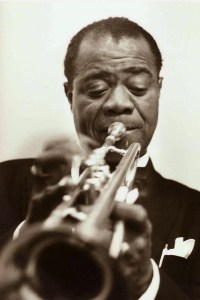 As the Civil Rights movement started taking hold in the mid-1950s, many African American entertainers were vocal in their support. Louis Armstrong generally stayed silent. Until, that is, September 17, 1957.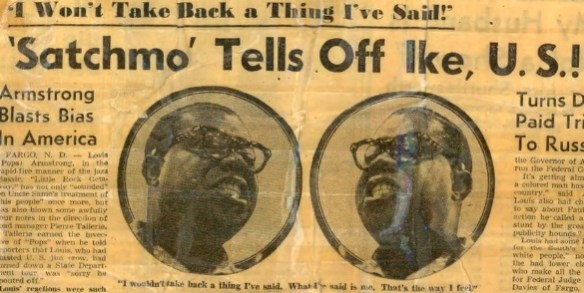
 The Arkansas Arts Center presents Ansley West Rivers tonight as part of its Distinguished Lecture Series.
 Little Rock Culture Vulture