
Little Rock Look Back: Mardi Gras in the Rock–1870s edition

In the post-Civil War era, Mardi Gras was a major event in Little Rock.  By the 1870s, newspapers would have stories for several days about preparations for parties and parades which would be followed by coverage summarizing the events.

For instance, the Ash Wednesday 1877 edition of the Arkansas Gazette carried a front page story that discussed Mardi Gras in New Orleans and Memphis.  Inside the paper there were a series of stories about the downtown Little Rock Mardi Gras parade.  It started at Markham and Rock Streets.  Because of the crowd assembled for it, organizers had to reroute the parade that afternoon.  Among the entries were the Fat Men’s Club, Butchers’ Benevolent Association (which rode on horses), the Mystic Krewe, and several trade groups.  In addition there were many people who marched along in masks.  The unnamed writer bemoaned the fact that the masked revelers’ clothing had no theme.

On Thursday, February 15, 1877, there were stories about some of the Mardi Gras balls which had taken place two nights earlier.  The paper’s deadline probably was earlier than the parties ended, which is why they were not in the paper until two days later.  Among the various events were the Knights of Pythian Ball at the Grand Opera House, the aforementioned Fat Men at a special pavilion set up in the Main Street Cotton Shed, the Mystic Krewe at O’Haras Hall, and the Cosmopolitans at Concordia Hall.  There were other events that the writer was not able to attend due to lack of time.

Some of the venues also played host to balls in advance of Mardi Gras.  The February 10 Gazette previews some events set for Friday and Saturday night.

By the start of the 20th Century, Mardi Gras was no longer a major social event in Little Rock.  But while it lasted, it was quite the production.  It appealed to all classes and races of Little Rock’s citizenry. Though most of the events were segregated, the parade did allow for African Americans to participate as well as the white revelers.
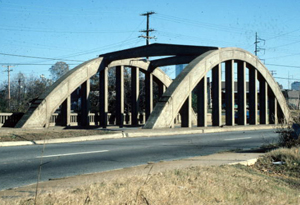
A Lincoln Viaduct Portrait

Photo courtesy of the Arkansas Historic Preservation Program

Since today is Abraham Lincoln’s birthday, it is a good day to pay tribute to the Lincoln Avenue Viaduct.  This arched bridge is traversed by thousands of cars each day, with most having no idea the name of the structure.  The Lincoln Avenue Viaduct is the arched bridge connecting LaHarpe with Cantrell Road which (literally) bridges downtown with the west along Highway 10.

The Lincoln Avenue Viaduct is a reinforced concrete rainbow arch bridge. It was opened at 2:05 p.m. on Friday, December 28, 1928, and, despite later alterations, it remains particularly well-preserved. The Missouri Pacific Railroad Company, considered the most important railroad company in the state, constructed the bridge amid a series of improvements in Little Rock made necessary by the damage wrought by the infamous spring floods of 1927.

Though the bride was constructed by the railroad, the City had to give authorization to do so, this was accomplished by the passing of Ordinance 4,335, at the May 28, 1928, City Council meeting.

Lincoln Avenue was one of several names for stretches of Highway 10 in Little Rock. By the 1960s, the areas west of the Lincoln Avenue viaduct were all renamed Cantrell in honor of the man who had developed much of the area west of the Heights. The longest stretch of the road already carried that name. There had been an effort to rename Highway 10 (including sections named Lincoln, Q, and Cantrell) in Little Rock for Senator Joseph Taylor Robinson in 1930. He declined the offer because he did not want to diminish the contributions of Mr. Cantrell.  Over time the entire stretch bore the name Cantrell.

The stretches east of the viaduct which involved a couple of names were renamed La Harpe Boulevard in honor of the French explorer who first saw the Little Rock. (La Harpe was originally an extension of Riverfront Drive. But with changes to development along the Arkansas River and the coming of I-30, the streets were reconfigured significantly in the 1950s and early 1960s.)

Though the street has been renamed, the bridge still carries the name of the 16th President of the United States.

Rock the Oscars: Nine from Little Rock

On April 5, 1965, the Academy Award for Best Documentary, Short Subject went to the film “Nine from Little Rock.”

Narrated by Jefferson Thomas, Charles Guggenheim’s documentary looks at the nine African-American students who enrolled in Little Rock Central High School in 1957. Thomas, one of the students reflects on the state of race relations in the seven years that had elapsed (up to 1964).  The film also focuses on Ernest Green, Elizabeth Eckford and Thelma Mothershed.

Guggenheim both directed and co-wrote the film. The latter credit was shared with Shelby Storck, who also produced the film.   The film had been commissioned by George Stevens, Jr., for the United State Information Agency.

The Oscar that night was Guggenheim’s first of four.  His others would be for: 1968’s “Robert Kennedy Remembered” (Live Action Short), 1989’s “The Johnstown Flood” (Documentary Short) and 1994’s “A Time for Justice” (Documentary Short).  His son Davis Guggenheim won the Oscar for Documentary, Feature for An Inconvenient Truth.

The film was digitally restored by the Motion Picture Preservation Lab for the 50th anniversary of its win for Best Short Documentary at the 1965 Academy Awards.  It is available for purchase on DVD and can also be viewed in its entirety on YouTube

Little Rock Look Back: Bombing of the Carlotta Walls Home

On February 9, 1960, a bomb was detonated at the home of Carlotta Walls. One of the Little Rock Nine as a sophomore, she was now in her senior year at Little Rock Central High.  This followed the September 1959 Labor Day bombings in Little Rock.

The bomb went off at approximately 11:00pm.  The blast could be heard for two miles from the house (located at 1500 S Valentine St.). Carlotta’s mother, Juanita, and sisters were at home with her, though her father, Cartelyou, was at his father’s house at 3910 West 18th Street.  Thankfully all members of the family were not physically harmed.  Two sticks of dynamite were used for the bomb.  The blast removed brick and broke three windows in the Walls house.

According to media accounts, this bombing was the first in the United States directed at a student since the 1954 US Supreme Court decision in Brown v. Board of Education.  As such, it made national headlines.  Carlotta was not deterred.  She had no thought of dropping out of school.

Reaction in the community including the Women’s Emergency Committee deploring the action and the NAACP being outraged.  The Little Rock School District only stated that it was a matter for the police.  The Chamber of Commerce was concerned about the impact it would have on attracting industry.

The FBI came in to investigate in addition to the Little Rock Police Department.  Two African Americans, Herbert Monts and Maceo Binns, Jr., were convicted for causing the bombing. Binns’ conviction was thrown out because it was proven he was coerced into a confession.  Monts served twenty (20) months of a five year sentence.  The supposed motive was to build sympathy for the African American community.  Carlotta Walls LaNier has stated that she did not believe the men bombed her house.

Monts has petitioned the Arkansas Parole Board for a pardon. It is scheduled to be reviewed in September 2018.


Rock the Oscars: Opening of the Clinton Presidential Center

Probably the largest gathering of Oscar winners and Oscar nominees in Little Rock’s history took place in November 2004.

Though some Oscar winners and nominees had been present for the Clinton election night parties in 1992 and 1996, the opening of the Clinton Presidential Center brought luminaries from Hollywood en masse.

Among those present were Oscar winning actors Barbara Streisand, Robin Williams, and (of course) Arkansan Mary Steenburgen.  Future Oscar winner Morgan Freeman was also in attendance. Among the Oscar nominees who were present were Bono and The Edge (who performed at the ceremony) and Alfre Woodard.

Senator John Glenn, who had been featured as a character in the Oscar winning film The Right Stuff was also present for the festivities.  Former Vice President Al Gore did not actually win an Oscar for An Inconvenient Truth (the documentary awards go to the director), but was closely identified with this Oscar winning documentary.

There were plenty of rumors about other Oscar winners and nominees in town, though they were not true.


Little Rock Look Back: Civic Leader John Herndon Hollis

On February 5, 1870, future Little Rock alderman and acting mayor John Herndon Hollis was born shortly before his family moved to what is now Cleveland County. His parents were originally from Georgia and came from prosperous and longtime families there.
The Hollis family came to Arkansas after the Civil War and settled in Union County. A portion of that county was carved off and became Dorsey County (named after a Republican US Senator from Arkansas) but was renamed Cleveland County after Grover Cleveland was elected President. Cleveland was the first Democrat to be elected President in over 20 years. This name change also reflected the political shift in Arkansas from the Reconstruction-led Republican politics to the Democratic Party politics which would dominate for the next century.

John Herndon Hollis was one of six children, and the only one with a middle name. Herndon had been his mother’s maiden name. As one of his brothers described their childhood in Cleveland County, “they all went to country schools in their home neighborhood, worked hard on the farm in the summertime, and were inside their little Methodist Church every time the doors were open.”

Around 1900, Hollis and his new wife Malinda M. “Linda” Taliaferro Hollis (formerly of Rison) moved to Little Rock.  Together the couple had six children. In Little Rock, Hollis worked in the banking industry. For years he worked for People’s Building and Loan Association.

Hollis was first elected to the Little Rock City Council in April 1904. He would serve as one of the Aldermen from the city’s Fourth Ward until April 1918.  This was on the western border of Little Rock at the time. The family lived at 1510 S. Schiller, which is one block east of Central High, though at the time neither the school nor its predecessor (West End Park) existed.  From 1907 until 1913 he also served on the Little Rock School Board.

In April 1908, at the first City Council meeting in the new City Hall, Mayor W. E. Lenon announced his resignation. Because the resignation was effective immediately, there was a vacancy in the office of mayor.  Hollis was selected by his colleagues to serve as acting mayor until a successor could be elected. So from April 1908 through June 1908, Hollis was the City’s chief political and executive leader.

Though he was never formally mayor (and did not resign his position as alderman), since 1908, Hollis’ name has appeared on the list of mayors of Little Rock. The reason seems to be as a sign of respect since there was a vacancy.

There previously had been acting mayors when the mayor would be absent on business or due to illness. But in those instances, the mayor had not resigned. This is the only instance in Little Rock history when a mayor resigned immediately with no successor in place. So John Herndon Hollis holds a unique role in Little Rock history.

After leaving the City Council, Hollis remained active in civic affairs.  He co-chaired a successful campaign in 1929, to raise a tax for a variety of civic issues.

Hollis’ wife died in 1920.  He later married Ann Jewell of Little Rock (who was a cousin of his first wife). They were married until his death on October 23, 1941.  Ann Hollis lived in Little Rock until her death in 1980.  The Hollis family is entombed in the mausoleum at Mount Holly Cemetery.

Both of John Herndon Hollis’ wives are distant cousins of the Culture Vulture, so he is particularly fond of John Herndon Hollis.

Little Rock Look Back: Aluminum Bowl

Aluminum_Prog_f

Courtesy of Paul Edwards to the Encyclopedia of Arkansas History and Culture

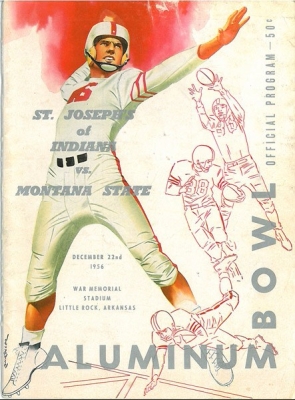
On December 22, 1956, Little Rock played host to the first (and only) Aluminum Bowl.  It was the NAIA national championship game between Montana State University and St. Joseph’s College (of Indiana).  This was the first time the NAIA had a football championship.

Originally the game was set to be played in Shreveport, Louisiana.  But because some NAIA schools were integrated, it was forbidden by a state law passed by the Louisiana legislature.  The Little Rock Chamber of Commerce and others worked to bring the game to War Memorial Stadium.  Because of the importance of the aluminum industry in Central Arkansas, the name Aluminum Bowl was chosen.  Both ALCOA and Reynolds were major sponsors of the event.

The game, which was aired on CBS TV and radio, was played on a rain-soaked muddy field and turned into a defensive slugfest. Both teams only got close to scoring once.  The score ended up a 0 to 0 tie.  Both teams were declared co-champions.  The rain kept the crowds away as only 5,000 people showed up leaving 33,000 empty seats in the stadium.  Miss Arkansas Barbara Banks, who had been wearing a dress made entirely out of aluminum, spent the game covered up to keep the dress dry.

The next year, the game went to Saint Petersburg, Florida, where it was rechristened the Holiday Bowl.  The Little Rock outing would mark the only appearance by either team in the NAIA championship game.  Both teams subsequently switched to NCAA competition.  As of the spring of 2017, St. Joseph’s has suspended operations because of financial shortcomings.

It has been said that Little Rock leaders had wanted to get the Aluminum Bowl game to showcase that Little Rock was a progressive Southern city when it came to race relations. By 1956 the buses and the public library were integrated.  However, both teams were faced with their African American players having to stay at separate hotels while in Central Arkansas (one in Little Rock, the other team in Hot Springs).

For more on the Aluminum Bowl, visit the Encyclopedia of Arkansas History and Culture.