
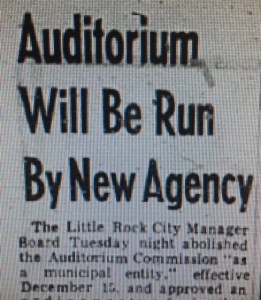
 On November 16, 1971, the City of Little Rock Board of Directors abolished the Auditorium Commission which oversaw Robinson and transferred duties to the Advertising and Promotion Commission. This was done with the full support of both commissions. The transfer took place immediately, with all assets and loose ends to be wrapped up by December 15, 1971.
With the adoption of a hospitality sales tax, by state statute, Little Rock had to have an A&P Commission. By 1971 plans were afoot to use the A&P tax to build a conference center using some of the existing space in Robinson and adding space. It did not make sense to have two separate commissions overseeing the same building.
For the Auditorium Commission members, it was possibly a relief. For years, overseeing the building had been a quiet duty. But with the social changes of the 1960s, they had been confronted ending the policy of segregation as well as changes in content and subject matter of acts booked at Robinson. Being agents of social change was doubtful what any of them had envisioned when they joined the commission. Emily Miller had been a member of the body since January 1940 and others had been on it for many years.
Transferring Robinson to the A&P Commission ushered in a new era for the building. It saw increased booking of meetings which led to a better revenue stream. The use of the A&P tax would mean the opportunity to give the building an upgrade from 1972 to 1974.
Robinson would eventually prove to be inadequate for all of Little Rock’s needs, which led to the creation and subsequent expansion of Statehouse Convention Center. But the action 45 years ago today set the stage for the transformation Robinson has undergone as it reopened last week.
 53 years ago tonight, on November 15, 1966, Carol Channing opened a six day stint in HELLO, DOLLY! at Robinson Auditorium. She would play 8 sold out shows over those six days.
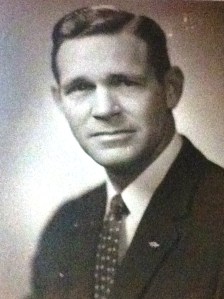 Future Little Rock Mayor Woodrow Wilson Mann was born on November 13, 1916, in Little Rock. His tenure at Little Rock mayor was tumultuous from both things of his doing as well as events that catapulted him onto the international scene.
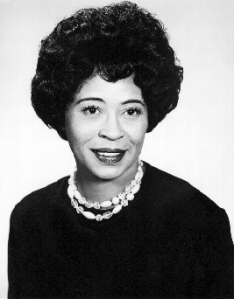 Daisy Lee Gatson Bates and her husband were important figures in the African American community in the capital city of Little Rock. Realizing her intense involvement and dedication to education and school integration, Daisy was the chosen agent after nine black students were selected to attend and integrate a Little Rock High School.
 On November 11, 1941, Adams Field was dedicated in Little Rock. The ceremony marked the official opening of the airport’s first administration building. It also marked the official naming of the building in memory of George Geyer Adams.
 On November 11, 1976, the curtain went up on the first Arkansas Repertory Theatre production. It was the Kurt Weill-Bertolt Brecht musical The Threepenny Opera. Rep founder Cliff Baker directed the show and played the leading role of Macheath aka Mack the Knife.
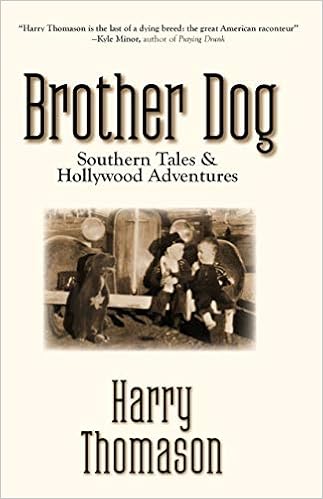 Producer and native Arkansan Harry Thomason will discuss his new book Brother Dog: Southern Tales & Hollywood Adventures today (November 10) at 3pm at the Clinton Presidential Center Great Hall. The program is a partnership of the Clinton School of Public Service, Clinton Foundation, and Central Arkansas Library System.
 Little Rock Culture Vulture