
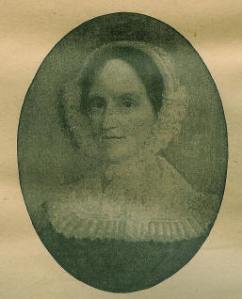
LR Women’s History Month: Eliza Cunningham

Eliza CunninghamEliza Wilson Bertrand Cunningham was the First Lady of Little Rock.  She literally was the first lady and the founding mother.

She became the first permanent female resident when she joined her husband Matthew Cunningham in Little Rock.  She gave birth to Chester Ashley Cunningham, the first baby born in Little Rock, as well as several other children with Cunningham.  When he became the first Mayor of Little Rock, she was the first First Lady of Little Rock. They hosted the first Little Rock Council meeting at their house on what is now the block downtown bounded by Third, Main, Fourth and Louisiana Streets.  Her son Charles P. Bertrand, from her first husband, later served as Mayor of Little Rock, making her the only woman to be married to a Mayor and be mother of a Mayor.

Born in Scotland in December 1788, she emigrated with her parents to the United States as a young girl.  In 1804 or 1805, she married a French businessman, Pierre Bertrand in New York City.  She lived in New York City, while he traveled to his various business ventures.  He never returned from a trip to his coffee plantation in Santo Domingo and was presumed to have died in 1808 or 1809.  She and Bertrand had three children, Charles Pierre, Arabella and Jane. (Jane may have died in childhood, because records and lore only indicated Charles and Arabella coming to Little Rock with their mother.)

Eliza married Dr. Matthew Cunningham in New York City.  He later moved to Saint Louis and settled in Little Rock in early 1820.  Eliza and her two children came to Little Rock in September 1820.  In 1822, she gave birth to Chester Ashley Cunningham, the first documented baby born in Little Rock.  (There are unsubstantiated reports that at least one slave child may have been born prior to Chester.)  She and Matthew also had Robert, Henrietta, Sarah and Matilda.  The latter married Peter Hanger, after whom the Hanger Hill neighborhood is named.

Dr. Cunningham died in June 1851.  Eliza died in September 1856. They and Chester (who died in December 1856) are buried in the Hanger family plot at Mount Holly Cemetery.

Black History Month Spotlight – Politics and Law

Mahlon Martin Jr., City Manager Bruce T. Moore, Honorable Lottie Shackelford, Charles Bussey Jr.

Mahlon Martin Jr., City Manager Bruce T. Moore, Honorable Lottie Shackelford, Charles Bussey Jr.

The new Arkansas Civil Rights History Audio Tour was launched in November 2015. Produced by the City of Little Rock and the University of Arkansas at Little Rock allows the many places and stories of the City’s Civil Rights history to come to life an interactive tour.  This month, during Black History Month, the Culture Vulture looks at some of the stops on this tour which focus on African American history.

The Arkansas Civil Rights Heritage Trail was launched in 2011 by the UALR’s Institute on Race and Ethnicity.  Each year, a theme is chosen to honor a particular group of people who were active in Arkansas’s civil rights movement.  Year by year, the trail grows.  The plan is that over time the trail will stretch from the current starting point at the Old State House, down West Markham Street and President Clinton Avenue to the Clinton Presidential Library and Museum, and then back up the other side of the street to opposite the Old State House.

Politics and Law have been two central pillars in civil rights struggles.

The honorees contributed to those struggles in Arkansas in a number of ways. Annie Mae Bankhead was a community activist in Little Rock’s black College Station neighborhood; Charles Bussey was Little Rock’s first black mayor; Jeffery Hawkins was unofficial mayor of Little Rock’s black East End neighborhood; I. S. McClinton was head of the Arkansas Democratic Voters Association; Irma Hunter Brown was the first black woman elected to the Arkansas General Assembly; Mahlon Martin was Little Rock’s first black city manager; Richard L. Mays and Henry Wilkins III were among the first blacks elected to the Arkansas General Assembly in the twentieth century.

Lottie Shackelford was Little Rock’s first black woman mayor; Wiley Branton was head of the Southern Regional Council’s Voter Education Project in the 1960s; William Harold Flowers laid the foundations for the Arkansas State Conference of NAACP branches; Scipio Africanus Jones defended twelve black prisoners after the 1919 Elaine Race Riot; Olly Neal was the first black district prosecuting attorney in Arkansas; and John Walker for over five decades has been involved in civil rights activism in the courts.

The app, funded by a generous grant from the Arkansas Humanities Council, was a collaboration among UALR’s Institute on Race and Ethnicity, the City of Little Rock, the Mayor’s Tourism Commission, and KUAR, UALR’s public radio station, with assistance from the Little Rock Convention and Visitors Bureau.

Little Rock Look Back: Leap Day City Council meetings

CLR Leap Day 1932February 29 may come around only once every four years, but it is even rarer for the City of Little Rock to have City Council or City Board meetings on that date.

The most recent official meeting on a Leap Day was on February 29, 1932.  Mayor Horace A. Knowlton presided with all sixteen Aldermen present.  Among the items discussed were regulating of junk dealers, taxes on slot machines, a building condemnation, and setting a license fee for bowling alleys.

There were several issues related to cemeteries discussed throughout the evening.  One forbade any new burials in a section of Oakland Cemetery while another sought to prohibit the creation of any new cemeteries within the City limits.  The Council also passed a motion instructing the Mayor to notify the State Board of Health that the City was “seriously objecting and would strenuously oppose the establishment of a [new] Cemetery within the present boundaries of the City of Little Rock.”  The final cemetery issue was the acceptance of the annual report of the Mount Holly Cemetery Association.

That night the Council also passed a resolution to name the city government hospital as “Little Rock City Hospital.” The purpose of the name was to “clearly designate said hospital to the citizens of Little Rock as the hospital owned and operated by the City of Little Rock.”

The issue which seems to have taken up most of the time was overriding a Mayoral veto of a resolution opposing the firing of a firefighter.  The motion to sustain the veto ended in a tie. After the Mayor promised to rehire the firefighter as soon as a vacancy occurred, on alderman changed his vote and the veto was sustained.

The only other City Council meeting on a February 29 was in 1892.  Mayor H. L. Fletcher presided over the meeting.  The main focuses of that meeting were to discuss boundaries of various sewer districts, pay the monthly bills, approve the relocation of a house from 9th Street to the corner of 12th Street and Commerce Street and to bring certain City criminal penalties in line with a new state law.

Black History Month Spotlight – Healthcare Pioneers

UALR Trail HealthcareThe new Arkansas Civil Rights History Audio Tour was launched in November 2015. Produced by the City of Little Rock and the University of Arkansas at Little Rock allows the many places and stories of the City’s Civil Rights history to come to life an interactive tour.  This month, during Black History Month, the Culture Vulture looks at some of the stops on this tour which focus on African American history.

The Arkansas Civil Rights Heritage Trail was launched in 2011 by the UALR’s Institute on Race and Ethnicity.  Each year, a theme is chosen to honor a particular group of people who were active in Arkansas’s civil rights movement.  Year by year, the trail grows.  The plan is that over time the trail will stretch from the current starting point at the Old State House, down West Markham Street and President Clinton Avenue to the Clinton Presidential Library and Museum, and then back up the other side of the street to opposite the Old State House.

Healthcare

Healthcare has long been a civil rights issue. In the age of segregation, many blacks were denied healthcare by white physicians and hospitals under Jim Crow laws. African American physicians-such as Cleon A. Flowers, Sr., and John Marshall Robinson-played important roles in serving the black community. Nurse Lena Lowe Jordan founded the Lena Jordan Hospital in Little Rock in the 1930s. Edith Mae Irby desegregated the University of Arkansas Medical School in Little Rock in 1948. Dr. Irby paved the way for other black students and professors at the school. Thomas A. Bruce promoted access to quality healthcare to the underserved. Henry W. Foster became dean of Meharry Medical College in Tennessee. Billy Ray Thomas and Phillip Leon Rayford worked to increase underrepresented groups in the medical profession. Samuel Lee Kountz pioneered organ transplants. Joycelyn Elders, a UAMS graduate and director of the Arkansas Department of Health, served as the surgeon general of the United States during the presidency of Bill Clinton.

The app, funded by a generous grant from the Arkansas Humanities Council, was a collaboration among UALR’s Institute on Race and Ethnicity, the City of Little Rock, the Mayor’s Tourism Commission, and KUAR, UALR’s public radio station, with assistance from the Little Rock Convention and Visitors Bureau.

Little Rock Look Back: NINE FROM LITTLE ROCK wins Documentary Oscar

AMPAS Nine from LROn April 5, 1965, the Academy Award for Best Documentary, Short Subject went to the film “Nine from Little Rock.”

Narrated by Jefferson Thomas, Charles Guggenheim’s documentary looks at the nine African-American students who enrolled in Little Rock Central High School in 1957. Thomas, one of the students reflects on the state of race relations in the seven years that had elapsed (up to 1964).  The film also focuses on Ernest Green, Elizabeth Eckford and Thelma Mothershed.

Guggenheim both directed and co-wrote the film. The latter credit was shared with Shelby Storck, who also produced the film.   The film had been commissioned by George Stevens, Jr., for the United State Information Agency.

The Oscar that night was Guggenheim’s first of four.  His others would be for: 1968’s “Robert Kennedy Remembered” (Live Action Short), 1989’s “The Johnstown Flood” (Documentary Short) and 1994’s “A Time for Justice” (Documentary Short).  His son Davis Guggenheim won the Oscar for Documentary, Feature for An Inconvenient Truth.

The film was digitally restored by the Motion Picture Preservation Lab for the 50th anniversary of its win for Best Short Documentary at the 1965 Academy Awards.  It is available for purchase on DVD and can also be viewed in its entirety on YouTube

Black History Month Spotlight – Downtown Desegregation

Ozell Sutton, one of the honorees

Ozell Sutton, one of the honorees

The new Arkansas Civil Rights History Audio Tour was launched in November 2015. Produced by the City of Little Rock and the University of Arkansas at Little Rock allows the many places and stories of the City’s Civil Rights history to come to life an interactive tour.  This month, during Black History Month, the Culture Vulture looks at some of the stops on this tour which focus on African American history.

The Arkansas Civil Rights Heritage Trail was launched in 2011 by the UALR’s Institute on Race and Ethnicity.  Each year, a theme is chosen to honor a particular group of people who were active in Arkansas’s civil rights movement.  Year by year, the trail grows.  The plan is that over time the trail will stretch from the current starting point at the Old State House, down West Markham Street and President Clinton Avenue to the Clinton Presidential Library and Museum, and then back up the other side of the street to opposite the Old State House.

Downtown Desegregation

In January 1963, Little Rock set in motion a process that ended segregation in its downtown businesses.  Following student sit-ins coordinated by the Student Nonviolent Coordinating Committee and Philander Smith College students, in November 1962 white businessmen and merchants formed a secret Downtown Negotiating Committee to set out a timetable for change in consultation with black community representatives.  On January 1, 1963, lunch counters in downtown Little Rock began to serve black customers on an equal basis.  Downtown hotels desegregated their facilities.  Drinking fountains and restrooms had their “White” and “Colored” signs removed.  In June, movie theaters desegregated.  In October, city restaurants desegregated.  That same year, Robinson Auditorium, the Arkansas Arts Center, and city parks desegregated.  In April 1963, in Jet magazine, James Forman, executive secretary of the Student Nonviolent Coordinating Committee, hailed the city as “just about the most integrated…in the South.”

The app, funded by a generous grant from the Arkansas Humanities Council, was a collaboration among UALR’s Institute on Race and Ethnicity, the City of Little Rock, the Mayor’s Tourism Commission, and KUAR, UALR’s public radio station, with assistance from the Little Rock Convention and Visitors Bureau.

Black History Month Spotlight – Freedom Riders and Sit-In Demonstrators

UALR Trail Sit inThe new Arkansas Civil Rights History Audio Tour was launched in November 2015. Produced by the City of Little Rock and the University of Arkansas at Little Rock allows the many places and stories of the City’s Civil Rights history to come to life an interactive tour.  This month, during Black History Month, the Culture Vulture looks at some of the stops on this tour which focus on African American history.

The Arkansas Civil Rights Heritage Trail was launched in 2011 by the UALR’s Institute on Race and Ethnicity.  Each year, a theme is chosen to honor a particular group of people who were active in Arkansas’s civil rights movement.  Year by year, the trail grows.  The plan is that over time the trail will stretch from the current starting point at the Old State House, down West Markham Street and President Clinton Avenue to the Clinton Presidential Library and Museum, and then back up the other side of the street to opposite the Old State House.

Freedom Riders and Sit-In Demonstrators

In 1961, the Freedom Rides spread across the South to place pressure on local communities and the federal government to implement court-ordered desegregation of bus terminal facilities.  Little Rock’s first Freedom Riders, a contingent of five members of the St. Louis branch of the Congress of Racial Equality, arrived on the evening of July 10 at the Mid-West Trailways bus station at Markham and Louisiana.  A plaque there marks the site and tells the story of the Little Rock Freedom Rides.  The pressure exerted by the Freedom Rides, together with an Interstate Commerce Commission order to desegregate, led to the integration of all Little Rock’s bus terminals on November 1, 1961.  Five markers also commemorate Philander Smith College students involved in sit-in demonstrations between 1960 and 1962, as well as members of the Arkansas Student Non-violent Coordinating Committee.  SNCC was active in Arkansas from 1962 to 1967.

The app, funded by a generous grant from the Arkansas Humanities Council, was a collaboration among UALR’s Institute on Race and Ethnicity, the City of Little Rock, the Mayor’s Tourism Commission, and KUAR, UALR’s public radio station, with assistance from the Little Rock Convention and Visitors Bureau.