William-Adolphe Bouguereau’s ADMIRATION at the Arkansas Arts Center through May 15

Now through May 15, the Arkansas Arts Center has a special piece of artwork on display!

William-Adolphe Bouguereau’s Admiration is in the Ted and Virginia Bailey Gallery.

Adoring young women gather around the youthful, winged figure of Cupid, the Roman god of love. The immortal boy playfully points his amorous arrow at a lovely maid who clasps her bosom as if the dart of love has, indeed, struck home. The beautifully crafted painting, its figures rendered with ideal proportions in flawless perspective, was clearly produced by a master. This painting by William-Adolphe Bouguereau displays the results as his training in the highest academic manner of the mid-19th century at the École des Beaux-Arts in Paris and other academies.

William-Adolphe Bouguereau, French (La Rochelle, France 1825 – 1905, La Rochelle, France), Admiration, 1897, oil on canvas, 58 x 78 in., Bequest of Mort D. Goldberg to the San Antonio Museum of Art, 59.46.

In 1850, the young artist won the Premier Grand Prix de Rome, the top academic art prize of the day, which enabled him to study classical art in Rome for four years. This began his career as the leading French academic artist of his day; he triumphantly exhibited year after year in the massive annual exhibition known as the Salon. While classical subject matter was supposedly the most proper and edifying material an academic artist of the 19th century could portray, Bouguereau’s success arose at least partially from his ability to infuse a sense of naughty fun into his classical nude figures. That is certainly on display in this delightfully sensual image, which was a success both at the Paris Salon of 1899 and the Paris Exposition Universelle of 1900.

This great neoclassical painting comes as a special loan from the San Antonio Museum of Art in exchange for an earlier loan from the Arkansas Arts Center of its 1914 Cubist masterpiece, Dos Mujers, painted by Diego Rivera when the Mexican artist was working in Paris early in his career. Admiration will be accompanied by a related drawing by Bouguereau. The painting and drawing will be complemented by a selection of academic figure drawings from the Arkansas Arts Center’s acclaimed collection of original works on paper. These will allow viewers to see how academic artists drew to study the figure so they could achieve the mastery we see in Bouguereau’s painting.

Sandwich in History at Waldo E. Tiller House today at noon

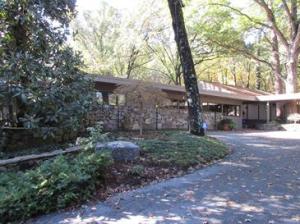
ahpp WaldoTillerHouseThe Arkansas Historic Preservation Program’s next “Sandwiching in History” tour will visit the Waldo E. Tiller House at 35 Sherrill Road in Little Rock beginning at noon today, (March 4).

Completed in 1954, the Tiller House was designed by Little Rock architect Dietrich Neyland, who worked for the firm of Ginocchio, Cromwell & Associates. The home’s modern design was inspired by the work of Neyland’s mentor, internationally-known architect Richard Neutra. Waldo Tiller was president of the Tiller Tie & Lumber Company. He also served as president and later, executive secretary, of the Arkansas Forestry Association. The Tiller House was remodeled in 2007 to provide necessary updates while preserving the home’s unique, Mid-Century Modern character.

The “Sandwiching in History” tour series targets Pulaski County structures and sites. The noontime series includes a brief lecture and tour of the subject property. Participants are encouraged to bring their lunches with them. The American Institute of Architects offers one HSW continuing education learning unit credit for members who attend a “Sandwiching in History” tour.

The tour is free and open to the public. For information, call the AHPP at (501) 324-9880, write the agency at 323 Center St., Suite 1500, Little Rock, AR 72201, send an e-mail message to info@arkansaspreservation.org, or visitwww.arkansaspreservation.org.

The AHPP is the Department of Arkansas Heritage agency responsible for identifying, evaluating, registering and preserving the state’s cultural resources. Other agencies are the Arkansas Arts Council, the Delta Cultural Center in Helena, the Old State House Museum, the Mosaic Templars Cultural Center, the Arkansas Natural Heritage Commission and the Historic Arkansas Museum.

Little Rock Look Back: William Marmaduke Kavanaugh

CLR KavanaughOn March 3, 1866, William Marmaduke Kavanaugh was born in Alabama. He later moved with his family to Kentucky before coming to Little Rock as a newspaper reporter.

Kavanaugh served as editor and manager of the Arkansas Gazette before entering politics.  From 1896 until 1900, he served as Pulaski County Sheriff, which at the time also included the duties of tax collector.  From 1900 until 1904, he was County Judge of Pulaski County.  In that capacity he helped wrangle several cities, railroads and trolley lines to create a compromise which lead to the completion of the Third Street Viaduct which connected Little Rock with Pulaski Heights. It is still in use today.

After leaving his post as County Judge, he had a varied career in banking and business interests.

When Senator Jeff Davis died in early January 1913, he left the last few weeks of his term incomplete as well as the new term he was set to start in March 1913.  There was much interest in who would fill the remainder of Davis’ current term, because that person might be the frontrunner to also fill out the new term.  (This was at the time that the U.S. Senators were still selected by state legislatures.) Defeated Governor George Donaghey appointed J. N. Heiskell to fill out the term. But once the Arkansas General Assembly convened in mid-January, they overrode Donaghey’s appointment and replaced Heiskell with Kavanaugh.

Kavanaugh served in the Senate from January 29, 1913 until March 3, 1913.  He was succeeded by Joseph T. Robinson who had only recently taken office as Governor.  Speculation was that Kavanaugh would not want the full six year term, so that he was acceptable choice to all of the politicians jockeying for the full appointment.  From 1912 until 1915, he was an Arkansas member of the Democratic National Committee.

Another interest of Kavanaugh’s was baseball.  He served as president of the Southern Association minor league starting in 1903.  The baseball field in Little Rock situated at West End Park was named Kavanaugh Field in his honor.  It stood until the 1930s when it was replaced by what is now known as Quigley Stadium.  (In 1927, Little Rock High School had opened on the land which had been West End Park.)

Kavanaugh died on February 2, 1915 at the age of 48.  He is buried in Oakland Cemetery.

Prospect Road was renamed Kavanaugh Boulevard in his memory.

LR Women’s History Month – Adolphine Krause Fletcher

CLR Adolphine Krause FletcherIn 1878, Adolphine Krause Fletcher became First Lady of Little Rock when she married John Gould Fletcher, who was then serving as mayor.  Though records are incomplete, this may well be the first and only time that a sitting mayor has been married while in office.

She was born September 3, 1854, the daughter of John and Fredericka Krause.  Her father had immigrated from Denmark and her mother had come from what is now Germany.  Adolphine had at least two older sisters – Clara and Johanna.  When the girls were small children, their father died.  While all three girls reached adulthood, Clara died in 1866.  By the time Adolphine married Mayor Fletcher, her mother had died.  It is expected that Adolphine was introduced to her future husband by her sister Johanna. She was married to Peter Hotze, who was a business partner of Mayor Fletcher’s.

Adolphine and John Gould Fletcher had five children, three of whom survived to adulthood – Adolphine, Mary and John Gould.  (The Fletcher family often used the same names in subsequent generations and never distinguished among different people with the uses of Senior, Junior, Third, etc.)

In 1889, the Fletcher family moved in to what is now known as the Pike-Fletcher-Terry House. It stayed in the family until the 1970s, when Adolphine’s two daugthers deeded it to the City of Little Rock for use by the Arkansas Arts Center.

Mrs. Fletcher saw to it that each of her children were well-educated, even if she restricted them to spending most of their time at the family manse. The three were surrounded with literature and books on topics of the day.  She brought in tutors to teach them German and Latin.  At a time when few females were educated, the Fletcher girls were sent to college.

Though her children and husband traveled, Mrs. Fletcher never ventured from Arkansas. She was, however, enthralled by images of the upper classes from the North, about which she read in magazines. She dressed her children inappropriately for the warmer Arkansas climate but in clothing inspired by etchings from New York, Philadelphia, Boston, and other northern cities.  She also apparently did not care for many of her husband’s more rural relatives. As soon as Adolphine was old enough to act as hostess, Mrs. Fletcher would stay in her room and send her daughter downstairs to receive guests.

Her two passions were gardening and music.  She had the glass conservatory installed on the southeast corner and spent countless hours there cultivating plants which were not native to Arkansas.  She also spent many hours playing piano and singing — everything from popular music to classical songs. She regaled her children with stories about a tutor who had encouraged her to become an opera singer.  She tried to teach her son how to play the violin, but his father would not allow it.

It appears that most her her life was spent focused on her gardening, music and children.  In May 1910, Adolphine Krause Fletcher died and was buried at Mount Holly Cemetery alongside her husband.  Her parents and sisters are also buried in that cemetery.


LR Women’s History Month – Adolphine Fletcher Terry

adolphine

Photos from the collection of the Butler Center for Arkansas Studies

Adolphine Fletcher Terry was born on November 3, 1882 to former Little Rock Mayor John Gould Fletcher and his wife Adolphine Krause Fletcher.

Raised in Little Rock, in 1889 she moved into the Albert Pike House on East 7th Street, when her aunt transferred the title to her father. That house would be her primary residence the rest of her life.  Her sister Mary Fletcher Drennan never lived in Arkansas as an adult after marriage. Her brother John Gould Fletcher spent much of his adulthood in Europe before returning to Little Rock and establishing his own house, Johnswood.

At age 15, Adolphine attended Vassar. She later credited that experience as broadening her views on many issues.  After graduating at age 19, she returned to Little Rock.  Her parents both died prior to her 1910 wedding to David D. Terry, which took place at what was then known as the Pike-Fletcher House (and today is known as the Pike-Fletcher-Terry House).

She is perhaps best known today for establishing the Women’s Emergency Committee in 1958 and for her subsequent deeding of the family house to the City for use by the Arkansas Arts Center.  But her entire life was based on civic engagement.

She was instrumental in establishing the first juvenile court system in Arkansas and helped form the first school improvement association in the state. She was long an advocate for libraries, serving 40 years on the Little Rock public library board.  Through her leadership, the library opened its doors to African Americans in the early 1950s. Today a branch of the Central Arkansas Library System (the successor the Little Rock public library) is named after her.  Another branch is named after her Pulitzer Prize winning brother.

Adolphine formed the Little Rock chapter of the American Association of University Women, the Pulaski County tuberculosis association and the Community Chest.

In 1958, when the Little Rock public high schools were closed instead of allowing them to be desegregated again, she called Harry Ashmore the editor of the Gazette and exclaimed, “the men have failed us…it’s time to call out the women.”  With this, she formed the Women’s Emergency Committee to Open Our Schools. This group played a major role in getting the four high schools open the following year.

From 1933 to 1942, David Terry served in the U.S. Congress. During that time, Adolphine alternated her time between Washington DC and Little Rock. But she spent much time in Little Rock raising her five children.

After her husband’s death in 1963, she continued to remain active in civic affairs. In the 1960’s, she and her sister deeded the Pike-Fletcher-Terry House to the City of Little Rock for use by the Arkansas Arts Center upon both their deaths.  Following Adolphine Fletcher Terry’s death in 1976, Mary turned over the title to the City.

Adolphine Fletcher Terry is buried in Mount Holly Cemetery alongside her husband. Three of her children are also buried in that plot.  Her parents and brother are buried in a nearby plot.

Her son William Terry and his wife Betty continue to be active in Little Rock. Their daughters and their families also carry on Adolphine Fletcher Terry’s commitment to making Little Rock better.

Today at noon – Legacies and Lunch with Bobby Roberts

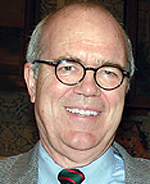
robertsThe Butler Center for Arkansas Studies and Clinton School of Public Service present today’s Legacies and Lunch program which features a conversation with Bobby Roberts.

Roberts has been the director of the Central Arkansas Library System (CALS) since 1989. During his tenure at CALS, it has been recognized as one of the premier library systems in the United States, noted for outstanding public service and innovative programming. Roberts is retiring from CALS on March 4. On March 2, he will talk with Clinton School of Public Service Dean Skip Rutherford at the Butler Center’s monthly Legacies & Lunch presentation series.

A native of Helena, Ark., Roberts became a historian and archivist, a writer of Civil War history, a university faculty member, and a member of Governor Bill Clinton’s staff before taking leadership at CALS. At Legacies & Lunch, Rutherford will interview Roberts about his interest in history and politics, the transformation of CALS, and what he sees for the future of the library system, the city of Little Rock, and the state of Arkansas. This special program is sponsored in part by the Arkansas Humanities Council.

Wednesday, March 2, 2016 at 12:00 Noon
CALS Ron Robinson Theater

Little Rock Look Back: Arkansas Territory created

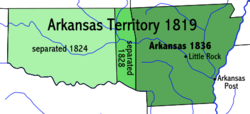
On March 2, 1819, the Arkansas Territory was authorized by an act of Congress, to take effect  on July 4, 1819.

The Arkansas Territory was created from the portion of the Missouri Territory. It originally encompassed all of what is now Arkansas and much of what is now Oklahoma. The westernmost portion of the territory was removed on November 15, 1824, a second westernmost portion was removed on May 6, 1828, reducing the territory to the extent of the present state of Arkansas.

The Territorial capital was Arkansas Post from July 1819 until June 1821. At that point in time it was moved to Little Rock. In 1819, there was no permanent settlement in Little Rock. It would my be until early 1820 that a permanent settlement would be established.  On 1818, the Quapaw Treaty had anticipated a future settlement in Little Rock.