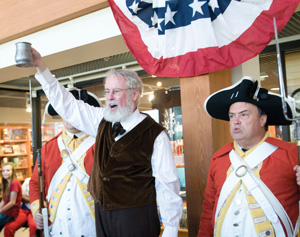
Book on Washington AR is focus of Old State House Museum Brown Bag today

OSH Brown Bag

Today at noon at the Old State House Museum, Josh Williams will be speaking on his recent book through Arcadia Publishing’s “Images of America” series entitled “Washington.” The book is a pictorial history of Washington, Arkansas located in southwest Arkansas.  His talk is part of the museum’s Brown Bag Lecture series.

Washington was home to James Black, maker of the first Bowie knife and saw visitors such as Davy Crockett, Jim Bowie & Sam Houston pass through.  After September 1863, it was the Confederate capital of Arkansas.

Josh Williams is the curator at Historic Washington State Park and has worked there since 2006. He graduated from John Brown University in Siloam Springs and attended graduate school at Louisiana Tech University and Louisiana State University. He also published another book through Arcadia Publishing on Hope, Arkansas. He is currently the president of the Arkansas Living History Association and has served on the boards of the Arkansas Museum Association and the Arkansas Historical Association.

Little Rock Look Back: Mayor Haco Boyd

BoydOn July 6, 1902, future Little Rock Mayor Haco O. Boyd was born in Leslie, Arkansas.  At the age of four, his family moved to Little Rock; he graduated from the Little Rock public schools.  He attended and graduated from Hendrix College.

In World War II, he was in the Army Air Corps.  He was a very decorated soldier earning two Purple Hearts, a Legion of Merit, and a Bronze star among other designations from the United States.  He also received high military honors from numerous European governments.  Boyd would remain in the Air National Guard and retired with the rank of Colonel in 1964.

As a businessman, he was a founder of Rebsamen Ford and then state manager of Benjamin Moore for Arkansas.  In 1952, he joined Union Life Insurance.  Throughout his career, he received most any recognition and honor and designation that the field of life insurance offered.

In November 1968, he won a three-candidate race for the Little Rock City Board of Directors. One of the candidates he defeated was former (and future) Director and Mayor Byron Morse.  In January 1969, he was selected to serve as Mayor of Little Rock.

One week later, Mayor Boyd and 70 others were on an Eastern Airlines plane headed for a life insurance convention in  Nassau, departing from Miami.  A passenger hijacked it and the plane was diverted to Cuba.   The next morning the passengers were returned to Miami and then sent to Nassau without incident. Once the media found out that one of the passengers was the Mayor of Little Rock, he was interviewed by numerous newspapers.

In other civic involvement, Boyd served on the Little Rock Airport Commission, including a term as chair.  He was also honored for his involvement with the Boy Scouts of America and Easter Seals.

In September 1923, Boyd married Mary Josephine “Polly” Goodrum.  They were married until her death in February 1977.  Haco Boyd died on March 27, 1988.  The couple are buried at Roselawn Cemetery.  They had two children and four grandchildren.

Little Rock Look Back: Mayor Buddy Benafield

BenafieldFuture Little Rock Mayor James Weldon “Buddy” Benafield was born on July 5, 1927 in Coy, Arkansas.  As a child he spent part of his time chopping cotton.  He graduated from England High School and then served in the U.S. Navy.  Following his stint in the military, he enrolled in Arkansas State Teachers College (now the University of Central Arkansas).

After college he returned to England.  From 1967 to 1974 he served as Mayor of England.  While in England, he also worked to establish a hospital there. While he was Mayor, Benafield also served as a legislative aide to Governor Dale Bumpers.

After moving to Little Rock, Benafield served as legislative aide to Governor Frank White.  He had been a donor to former Governor Bill Clinton, who had been defeated by White. Though a staunch Democrat, he remarked to the media at the time that he had been a friend of White’s and never declined a Governor’s request for help.

Long active in Democratic politics, he had served as Secretary of the State Democratic Party.  (One of his daughters, Dawne Benafield Vandiver has carried on the family tradition serving in several leadership positions in the State Democratic Party.  Most recently she was Executive Director of the party.)

In January 1982, Benafield was appointed to fill a vacancy on the Little Rock City Board of Directors. He ran for election to a full term in November 1982 and was reelected in November 1986.  From January 1983 to December 1984, Benafield served as Mayor of Little Rock.

After leaving the Little Rock City Board in January 1991, he has remained engaged in civic matters.  He served a term on the Arkansas Highway and Transportation Commission.  He was first appointed in January 1993 by Gov. Jim Guy Tucker to fill out the remainder of Rodney Slater’s term. Slater had resigned to to take a job in the Clinton Administration in Washington DC.  In 1995, he was reappointed, this time to a full ten year term.  This was only the second time a member of the Highway Commission had been reappointed.

Buddy Benafield is the only Little Rock Mayor to have also been a mayor of another Arkansas city.  He continues to be involved in farming and a variety of business ventures and has maintained his interest in politics.

Little Rock Look Back: Mayor Matthew Cunningham MD, a man of many firsts

M_Cunningham_fFuture Little Rock Mayor Dr. Matthew Cunningham was born on July 5, 1782, in Pennsylvania. After receiving his medical degree from the University of Pennsylvania, he ended up in New York City.  He also served in the Army during the War of 1812.

It was there he met and married a young widow, Eliza Wilson Bertrand. After a brief stint in St. Louis, Dr. Cunningham was one of the first settlers of Little Rock in February 1820. With his arrival, he became the first physician in Little Rock.

In September 1820, Mrs. Cunningham and her children joined him. She became the first female in the Little Rock settlement. Dr. and Mrs. Cunningham had a son, Chester, who was the first white baby born in Little Rock. (Though not supported by any public records, there is some unsubstantiated thought that one of the African-American slaves they had gave birth to a child before Chester was born.) The Cunninghams had several other children.  One daughter, Matilda, would marry Little Rock businessman Peter Hanger.  (The Hanger Hill neighborhood is named after Peter Hanger.)

In 1831, Dr. Cunningham was elected the first Mayor of Little Rock. He won the race 23 to 15 over Rev. W. W. Stevenson. The first City Council meeting took place at the Cunningham house on the block which is the southwest corner of what is now 3rd and Main Streets. Records are incomplete as to where on the block the Cunningham house was located, but a plaque is on 3rd Street near Main on the side of the Fulk Building which CJRW is now renovating for their future office space.

Dr. Cunningham served one year as Mayor. He lived until June 15, 1851 and is buried at Mount Holly Cemetery. His wife, son, and the Hanger family are buried next to him.

His stepson – Charles P. Bertrand – also served as Mayor of Little Rock.  Descendants of Dr. Cunningham still reside in Little Rock.

Revolutionary War battle in Arkansas

Colbert's_RaidBecause Arkansas was part of the Louisiana Territory, and under the Spanish flag, one does not think about there being any Revolutionary War battles being fought on Arkansas soil.  But on April 17, 1783, the British and Spanish skirmished at Arkansas Post.  Sometimes known as Colbert’s Raid, this was part of a four year campaign of intermittent efforts by the British to stop the Spaniards from funneling money and supplies to the colonists via the Mississippi River.

James Colbert, a former British Army captain, led a loose group of British mercenaries as well as anti-Spanish members of the Chickasaw tribe on a series of raids in Louisiana and the lower Mississippi area.  He targeted Fort Carlos at Arkansas Post because of its proximity to the Arkansas and Mississippi Rivers.

The Fort had 33 Spanish soldiers and four members of the Quapaw tribe.  Colbert had over 80 men with him.  After an initial attack on the Post, several residents made it to the Fort which was then attacked.  Expecting surrender (and indeed there had been a brief truce), instead a Spanish sortie of 14 faced the 82. Shouting Quapaw war cries and firing their muskets, under the cover of darkness, this sortie surprised and confused the Colbert party.  Convinced that a large collection of Quapaw was attacking them, they scattered and retreated.

Today, the National Park Service at Arkansas Post offers information on this battle, one of the last of the Revolutionary War (and a full 18 months after Cornwallis surrendered to Washington at Yorktown).

32nd Democrat-Gazette Pops on the River tonight with ASO and fireworks

popsonriverPops on the River, presented by the Arkansas Democrat-Gazette, is the state’s largest Fourth of July celebration and takes place this year on Saturday, July 4th in downtown Little Rock.

Pops on the River, in it’s 32nd year, is FREE to the public and will begin at noon outside the main gates of the First Security Amphitheater in the River Market Pavilions with a Kid’s Pavilion and Car Pavilion. The event will also have a marketplace with shopping, food trucks, a car show and other activities below the River Market Pavilions.

The event is free to the public and a portion of proceeds benefit a local charity. This year’s benefiting charity is Easter Seals of Arkansas. Pops on the River is also sponsored in part by the Little Rock Convention and Visitor’s Bureau, Chick-fil-A of Central Arkansas, Arkansas Flag and Banner and Landers FIAT.

There is a Military Appreciation Tent as well as musical performances throughout the day. The “Oh Say! Can You Sing?” finalists will also perform this evening.

Activities begin at noon.  Gates to the amphitheatre open at 5:30.  Chairs, blankets are encouraged. Open amphitheater seating is available, but limited. No coolers or outside food or drinks. No pets or fireworks allowed.

5:30pm – 9:30pm – Salute to the Troops. Sponsored by CHI St. Vincent (Riverfront Park) Record a video message to our men and women in the military in our Salute the Troops tent.

8:30pm – The Arkansas Symphony Orchestra (First Security Amphitheater) Conducted by Philip Mann. The Arkansas Symphony Orchestra performance is one not to miss.

9:30pm – Fireworks Celebrate our nation’s independence with the Pops on the River Fireworks finale – shot over the Main Street Bridge and visible to all of downtown Little Rock.


Frontier 4th at Historic Arkansas Museum today

FrontierFourthCelebrate Independence Day as it was celebrated on the Arkansas frontier. During the territorial and early statehood days of Arkansas, July 4 was THE holiday to celebrate.

Historic Arkansas Museum will be offering activities and demonstrations all day.  The afternoon activities include an old-time patriotic parade, 19th century music and encounters with people from the past.

Cheer “huzzah” during a reading of the Declaration of Independence by Congressman French Hill (around 3pm) and sign your own copy in the print shop. Watch out for Red Coats! This year marks the 240th anniversary of the start of the revolution. Watch a reenactment of two battles and a duel on the lawn near the farmstead.

Children can walk on stilts and play other pioneer games, and they’ll be invited to take up brooms and wooden rakes to train with the militia. They will also have the opportunity to create flags, streamers and signs to use in the parade.

Visit Historic Arkansas Museum for an afternoon of old-fashioned fun!

All activities are free and open to the public.