2014 Reel Civil Rights Film Festival continues with films, discussions today

lrff_film-projects_civil-rightsLittle Rock Central High School National Historic Site commemorates the 57th anniversary of the desegregation crisis in September with the Reel Civil Rights Film Festival featuring special guests, panel discussions, and a special commemoration to honor local educators and civil rights activists. All events at local venues are FREE and open to the public; reservations are required for the September 20th evening program and may only be secured by logging on to http://www.eventbrite.com and searching “Little Rock Film Festival” or “A Night with Oliver Stone and Peter Kuznick.”

Saturday, September 20, 12:00 p.m. – Riverdale 10 Movies (2600 Cantrell Road)
Been Rich All My Life

(Director: Heather MacDonald) –Been Rich All My Life follows the most unlikely troupe of tap dancers – the “Silver Belles,” five women aged 84 to 96. In their heyday they worked at some of Harlem’s most prestigious haunts, performing with legendary band leaders like Cab Calloway, Jimmie Lunceford and Duke Ellington. They met in the 1930’s as chorus dancers at the Apollo and the Cotton Club. When the big band era ended, and with it the need for show dancers, they all went into other work. They regrouped in 1985, put their shoes back on and —sassy as they ever were —are still performing regularly. They may not kick as high, but they are hip-swaying and show-biz savvy. These women will disrupt any notions you have of old age.

The film will be followed by a moderated discussion with Chief of Interpretation and Education Enimini Ekong and Lasker Bell.


Saturday, September 20, 2:30 p.m. – Riverdale 10 Movies (2600 Cantrell Rd)
Ending the Schoolhouse to Jailhouse Project

Motivational Educational Entertainment (MEE) was hired by the civil rights advocacy group, The Advancement Project, to conduct qualitative, focus group research over a two-month period, with African American and Caucasian parents and African American, Latino and Caucasian teachers for the Advancement Project’s Ending the Schoolhouse to Jailhouse Project. Fourteen focus groups were conducted in Philadelphia, PA; Jefferson County, CO; Jackson, MS; Houston, TX; and Miami, FL. The overall purpose of the research was to identify messages and strategies that can be used to motivate parents and teachers to advocate for changes in school disciplinary policies. The findings from this research were used to inform The Advancement Project and its community partners as they prepared a strategic communications plan to launch local advocacy campaigns designed to bolster existing efforts related to the Ending the Schoolhouse to Jailhouse Project.

The film will be followed by a moderated discussion and workshop with Dr. Joseph Jones, Founding Director of the Social Justice Initiative at Philander Smith College, and Ivan Juzang, Founder and President of MEE.

 

oliver_stoneSaturday, September 20, 6:00 p.m. –Little Rock Central High School (1500 S. Park Street)
A Night with Oliver Stone and Peter Kuznick
The ’50s: Eisenhower, The Bomb & The Third World

(Director: Oliver Stone;Series Writers: Oliver Stone, Matt Graham, Peter Kuznick) – There is a classified America we were never meant to see. From Academy Award®-winning writer/director Oliver Stone, The Untold History of the United States looks back at human events that at the time went under reported, but that crucially shaped America’s unique and complex history over the 20th century. This 60 minute episode examines: United States – Soviet relations post-World War II;Communism;nuclear rearmament;the Korean War;governmental policies toward the Third World;and the role played by President Dwight D. Eisenhower, including his orders to send the 101st Airborne to Little Rock, to enforce the Brown v. Board decision and prevent interference with court orders of integration.

The film will be followed by a moderated discussion between director Oliver Stone;Professor of History/Director of the Nuclear Studies Institute at American University and film/book co-writer Peter Kuznick;and Little Rock Film Festival executive director Craig Renaud. Dr. Eric Singer, Untold History’s principal researcher and coordinator of the Untold History Education Project, will also be in attendance.

Presenting Sponsor –Little Rock Film Festival

Premier Sponsor –Little Rock Central High School National Historic Site

Supporting Sponsors: arfilm|Arkansas Production Alliance, Central High Museum Inc., City of Little Rock, Conyers Institute of Public Policy, Jefferson National Parks Association, Little Rock Central High School, Little Rock Convention and Visitors Bureau, Little Rock School District, Marriott Little Rock, Mosaic Templars Cultural Center, Moses Tucker Real Estate, Riverdale 10 Movies, National Park Service, Sue Smith Vacations/Vacation Valet, North Point Toyota, University of Arkansas Clinton School of Public Service, Philander Smith College, Whole Hog Cafe –North Little Rock, Arkansas Education Television Network, and Arkansas Motion Picture Institute

Little Rock Look Back: John Elliott Knight, LR’s 18th Mayor

Jno E Knight sigOn September 20, 1816, future Little Rock Mayor John Elliott Knight was born in Newburyport, Massachusetts. In 1843 he married Hannah Donnell in New York, and came to Little Rock that same year.

Knight was editor of the Arkansas Democrat from 1846 to 1850. He was also associated with the Arkansas Gazette and published the short-lived Chronicle. In 1851, Knight served as Mayor of Little Rock. In 1855, he served as a member of the City Council.

In 1858 a song was published entitled “I Am Near to Thee” which featured music by Arkansan Benjamin Scull and lyrics by Knight.  The song was dedicated to Mary Woodruff.

During the Civil War, he served as a Colonel.  During the 1850, 1860 and 1880 census, he was listed as an attorney.

He had one daughter, Elizabeth Knight, who married James S. Pollock, a banker in Little Rock. Knight died in Little Rock, Arkansas, on October 28, 1901, and was buried in Mount Holly Cemetery. Elizabeth Knight Pollock died in 1910.

As an attorney and newspaper editor, John E. Knight collected documents about the settlement of Little Rock. Those papers are now part of a collection at the Arkansas History Commission.  The majority of these papers are from William Russell to Chester Ashley, pertaining to pre-emption claims in and around Little Rock. Other material concerns the 1819-1822 dispute related to the the New Madrid Certificate and pre-emption claims of James Bryant, Stephen F. Austin, and William M. O’Hara.

2014 Reel Civil Rights Film Festival starts with Student Films

lrff_film-projects_civil-rightsThough the Reel Civil Rights Film Festival commemorates a historic event, this year’s programming starts with an emphasis on the future.  The program starts at 6pm at the Riverdale 10 movie theatre.

The Youth Leadership Academy at the Little Rock Central High School National Historic Site is designed to develop young leaders with a focus on social justice, youth empowerment, volunteerism and stewardship for the National Park Service; Little Rock Central High School’s Civil Rights Memory Project immerses students in the oral history of civil rights and human rights through hands-on, intergenerational learning, requiring students to analyze causes and effects of historical events and also the resulting impact on both individuals in their families and institutions in our communities.

Films will be screened from collaborative work with the National Park Service; Arkansas Education Television Network; the Young Historians, Living History collaboration with the Smithsonian Institute, Smithsonian Asian Pacific American Center, Historic Arkansas Museum, Little Rock Central High School National Historic Site, Center for Asian American Media and Smithsonian Affiliations.

The films will be followed by a performance of the Memory Project’s Readers Theater and a moderated discussion with student filmmakers and Casey Sanders, Arkansas Education Television Network producer.

Presenting Sponsor –Little Rock Film Festival

Premier Sponsor –Little Rock Central High School National Historic Site

Supporting Sponsors: arfilm|Arkansas Production Alliance, Central High Museum Inc., City of Little Rock, Conyers Institute of Public Policy, Jefferson National Parks Association, Little Rock Central High School, Little Rock Convention and Visitors Bureau, Little Rock School District, Marriott Little Rock, Mosaic Templars Cultural Center, Moses Tucker Real Estate, Riverdale 10 Movies, National Park Service, Sue Smith Vacations/Vacation Valet, North Point Toyota, University of Arkansas Clinton School of Public Service, Philander Smith College, Whole Hog Cafe –North Little Rock, Arkansas Education Television Network, and Arkansas Motion Picture Institute
New Illustrated Arkansas History book launched tonight

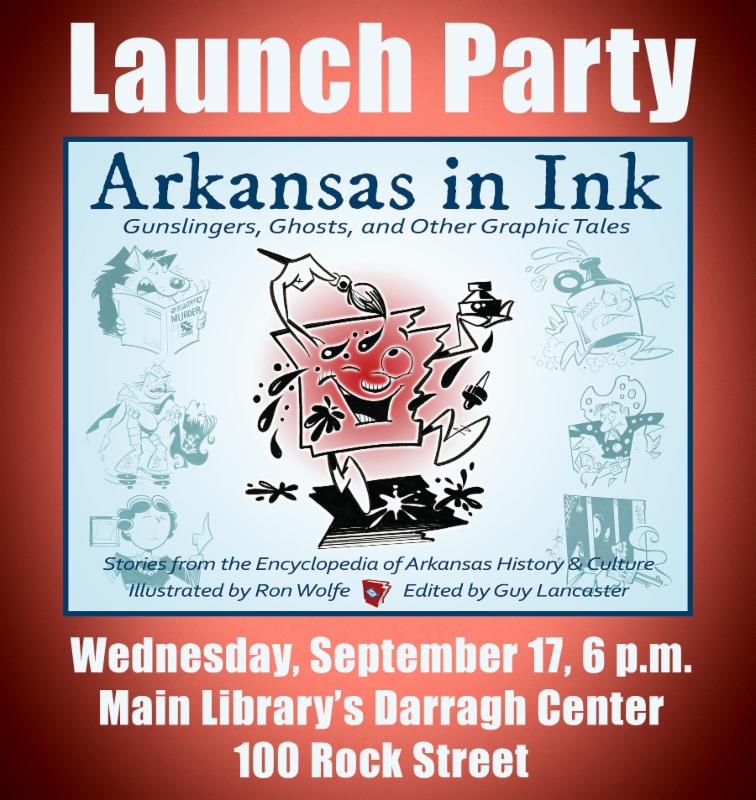
cals launchArkansas in Ink: Gunslingers, Ghosts, and Other Graphic Talesa special print edition of the Encyclopedia of Arkansas History & Culture (EOA), edited by Guy Lancaster and illustrated by Ron Wolfe, provides an entertaining look at Arkansas’s history through stories and cartoons.

It will take place in the Darragh Center inside the CALS main building on Rock Street.  The party will start at 6pm.

At the launch party, Lancaster and Wolfe will speak about the book and sign copies, which will be available for purchase at the event. A “drawing for a drawing” will also be held, in which one attendee will win a signed, framed, original illustration by Wolfe from the book. Beer, wine, and light refreshments will be served.

This event is free and open to the public. For more information, please contact 501-918-3033.

Trail of Tears Commemoration Day

Today is Trail of Tears Commemoration Day.  There were several different routes on the Trail of Tears.  Little Rock was one of the only places (if not the only one), in which each of the tribes passed through on the way out west.

Much research on the Trail of Tears has been conducted by the UALR Sequoyah National Research Center (SNRC).

The SNRC recently opened an exhibit entitled “Toy Tipis and Totem Poles: Native American Stereotypes in the Lives of Children.”

"Ten Little Indians" spinning top for SNRC exhibit

Ten little Indians spinning top; Photography by George Chambers

The exhibit runs through Dec. 19. Held in the Dr. J.W. Wiggins Native American Art Gallery, the purpose of the event is to create awareness of the variety of native cultures and the achievements of contemporary American Indians and Alaska Natives.

The exhibit comes from the Hirschfelder-Molin Native American Stereotypes Collection, a collection of more than 1,500 museum objects and archival documents, possibly the largest such collection in the world.

The items were donated to SNRC in 2012 by Arlene Hirschfelder and Paulette Molin, professional educators and authors with decades-long experience in Native American education and Native American studies. SNRC archivist Erin Fehr will curate the exhibit with Hirschfelder, Molin, and SNRC staff.

The exhibit will highlight the areas of the collection dealing with children and Native American stereotypes omnipresent in the lives of American children.

By examining childhood objects – dolls, toys, books, games, clothing, sports memorabilia – the exhibit will create awareness of the inculcation of the images and the difficulty of changing mainstream thinking about Native American stereotypes.

In addition to presenting the stereotypes themselves, positive images and responses from Native people will be presented as an alternative.

UALR’s Sequoyah National Research Center is dedicated to the collection and preservation of all forms of Native American expression. Located in the University Plaza, SNRC has served as an archive for Native Americans for more than 30 years. The gallery is open Monday through Friday from 8 a.m. to 5 p.m.

For more information contact Erin Fehr at ehfehr@ualr.edu or 501.569.8336.

Final Weeks to Visit Wilmot Ark at the Arkansas Arts Center

Susan Paulsen, Wilmot, 2011, photograph, courtesy of the artist

Susan Paulsen, Wilmot, 2011, photograph, courtesy of the artist

Wilmot is a little town in Ashley County, in southeast Arkansas. . . .A few years ago, Susan Paulsen set out to tell a kind of story, to chronicle a place in Arkansas through evocative photographs taken there over the course of many visits, in all seasons of the year. . . . Together, they form a picture of a place. For the artist, that place has a personal importance—part of her family comes from there, and for generations it has been a kind of homing place for them. Through her photographs of this particular place, she wants, as she has said, to make a sort of poem about all such places; to find commonalities among these individuals and people in other places. Her goal, from the outset, has been to evoke all the Wilmots, wherever they might be. But still there is this town, these people. . .”  –

From the essay by George T. M. Shackelford, Susan Paulsen: Wilmot.

The evocative visual poetry of Susan Paulsen: Wilmot comes to the Arkansas Arts Center in the form of more than 70 photographic prints and groupings of photographs that she took in Wilmot, Arkansas between 1995 and 2012. Most spectacularly, one large wall is covered by a grid of 90 photographs. Susan Paulsen: Wilmot was organized by Maison européenne de la photographie, Paris. The images are coming home to Arkansas for their American debut.

They will be on view in the Townsend Wolfe Gallery until September 28, 2014.

Sponsored by:

Brenda Mize
June and Edmond Freeman

Little Rock Look Back: Charles E. Taylor, LR’s 42nd Mayor

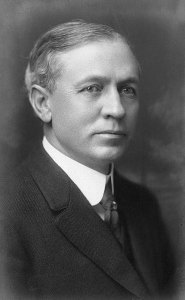
Mayor TaylorOn September 15, 1868, future Little Rock Mayor Charles E. Taylor was born in Austin, Mississippi.  After locating to eastern Arkansas, his family moved to Little Rock around 1880.

Taylor graduated from Scott Street High School in Little Rock and proceeded to work for various hardware stores and other businesses.  In 1895 he married Belle Blackwood, with whom he would have four children.

In 1910, Taylor announced his intention to run for Mayor of Little Rock.  Though he had never held elective office, he had been involved in several civic organizations.  Taylor was the main challenger to Alderman John Tuohey.  Seen as a reformer, Taylor initially lost to Tuohey.  But after an investigation of voter fraud and a subsequent runoff, Taylor was elected Mayor.

Upon taking office in August 1911, Mayor Taylor focused on improving health conditions in the city, upgrading the fire department and enhancing the overall moral tone of the city.

As a progressive of the era, he fought against gambling, drinking and prostitution.  He created a Health Department and enhanced the City Hospital.  His efforts led to a decrease in the death rate in Little Rock.  As Mayor, Taylor introduced motorized vehicles to the Fire Department.  He also led the City Council to establish building and electrical codes.  Mayor Taylor also oversaw the construction of the 1913 Beaux Arts Central Fire Stations (which today serves as the City Hall West Wing).

Under his leadership, the City of Little Rock annexed Pulaski Heights. One of the selling points to Pulaski Heights residents was Mayor Taylor’s ability to provide modern services such as paved streets, water mains, fire hydrants and street lights.

Though neither his 1911 Parks Master Plan nor his dreams for a civic auditorium came to fruition, they paved the way for future successes in both of those areas.

Funding for projects continued to be a problem throughout Mayor Taylor’s four terms in office.  He believed that one obstacle to city funding was the prohibition by the state constitution against cities issuing bonds.  Though that ban has since been lifted, Taylor tried three times unsuccessfully to get it changed while he was Mayor.

In April 1919, Taylor left office after having served eight years.  He was the longest serving Mayor of Little Rock until Jim Dailey served in the 1990s and 2000s.  Following several business ventures, Taylor moved to Pine Bluff and led their chamber of commerce from 1923 through 1930.

Mayor Charles E. Taylor died in Pine Bluff in 1932. He was buried at Oakland Cemetery in Little Rock.

During his time in office, Mayor Taylor was presented with an unofficial flag of Little Rock by a group of citizens.  During Mayor Dailey’s tenure, that flag was restored by some private citizens and presented to the City.  It is framed on the 2nd Floor of Little Rock City Hall.