Little Rock Look Back: Tom Prince – LR’s 67th Mayor

Mayor PrinceFuture Little Rock Mayor Tom Prince was born on August 13, 1949.  After graduating high school in 1967 (where he was on the state championship golf team), he attended the United States Naval Academy.  He later received his law degree from the University of Arkansas at Little Rock and began practicing law in Little Rock.

In 1984 he ran for the City of Little Rock Board of Directors and was elected.  In January 1985, he was selected by his fellow City Directors to serve as Mayor of Little Rock.  He served as Mayor until January 1987.  During his term in office, Arkansas celebrated its Sesquicentennial. Mayor Prince oversaw the City’s participation in the celebratory activities.  As Mayor he was also a strong advocate for expanding the city’s involvement in quality of life issues through enhanced parks and arts while maintaining a commitment to public safety and public works issues. After the completion of his four year term on the City Board, he did not seek a second term.

City of Little Rock races are non-partisan.  After leaving office, he became involved in Democratic Party politics.  In 1992, he campaigned for Bill Clinton’s presidential bid in Iowa and other Midwest states.  When his law partner, Sheffield Nelson, ran for Governor in 1994 as a Republican, Prince resigned from his Democratic Party positions and worked on the Nelson campaign.  In 1997, he was elected chair of the Pulaski County Republican Committee.  In 1998, he ran for the United States Senate as a Republican.

In 1999, Prince experienced a family tragedy and took a sabbatical from practicing law. In 2000, he moved to St. Louis to become general counsel for a securities firm located there.  Following several years with the securities firm, he joined a St. Louis law firm in private practice.  He remained in private practice in St. Louis through 2012.

A St. Louis Business Journal profile of Prince in 2010 highlighted his interests in single action shooting and in horseback riding.

It takes Different Spokes at the Old State House

spokes-small-wideDifferent Spokes is the newest exhibit at the Old State House Museum. The exhibit looks at the history of bicycling and places cycling in Arkansas within a worldwide historical context. Visitors will be able to view galleries of artifacts, historical pictures and video to learn the history of bicycles.

As cities and towns begin dedicated services and trails for cyclists, it’s important to note that the enthusiasm for bikes in Arkansas has roots that go back over 100 years,” said Old State House Museum Director Bill Gatewood. “The interest at the turn of the 20th century in bicycles was very similar to the one that we are seeing at the turn of the 21st century.”

While the exhibit mainly explores the technological advances of cycling in the past 130 years, Different Spokes also tells the story of competition, economics, and social life. The history of trail systems, cycling communities and history in Arkansas is explored in videos produced by the Old State House Museum. From an 1880 wooden bicycle built from white oak and agricultural implements to the world’s first carbon-fiber bicycles made by Brent Trimble of Berryville, Different Spokes contains artifacts that show this history from past to present. Gatewood says the Museum relied on contributions from the cycling community to present this story. The exhibit will remain on view to February 2016.

“I have not participated in any other exhibit that has had this kind of immediate response from the community,” Gatewood said. “The passion these people have for their pursuit is overwhelming, and I believe it will be reflected well in this exhibit.”

The Old State  House Museum is a division of the Department of Arkansas Heritage.

Little Rock Look Back: Nixon Resigns

RMN WDM

Nixon with Mills

Forty years ago today, Richard M. Nixon resigned as the President of the United States.  Five months earlier, in a press conference in Little Rock, Congressman Wilbur Mills predicted that Nixon would resign.  Mills, still chair of the House Ways & Means Committee, predicted that the resignation might be prompted by errors in his tax returns.  As part of investigations into Nixon resulting from Watergate, the President’s taxes were being reviewed by Congress.

Nixon had been the first Republican President since the Reconstruction era to win Arkansas and gain the state’s electoral votes in 1972.  The 1968 election cycle had seen third-party candidate George Wallace win the state’s votes though Nixon handily won that election too.

Little Rock weighed prominently in Nixon’s earlier career.  He was Vice President when Eisenhower sent the troops into Little Rock to ensure the Little Rock Nine would desegregate Central High School.  In a 1960 Presidential debate, he and Senator Kennedy were asked whether they would have sent in the troops.  Kennedy begrudgingly said that he would have, though he would have wished the situation were different.  Nixon did not really answer the question, but instead used it as an opportunity to point out that Senator Johnson, as Kennedy’s running mate, had actively opposed civil rights legislation at the time.

There are many other connections between Nixon and Little Rock.  During his Presidency he both relied up and clashed with Arkansas’ legislative giants: Mills, Senator J. William Fulbright and Senator John L. McClellan.  Hillary Clinton served on the staff of the House Judiciary Committee as it investigated Nixon.  It would be during Bill Clinton’s presidency that Nixon died.

Little Rock Look Back: William Ashley – LR’s 22nd & 24th Mayor

W E Ashley signature

On August 6, 1823, future Little Rock Mayor William Eliot Ashley was born in Little Rock.  He would go on to become the first Little Rock Mayor to be born in Little Rock.  Ashley was the son of Mary and Chester Ashley; his father would later serve as a U. S. Senator from Arkansas.  He was the second of the couple’s seven children.

Though he was raised in Little Rock, he did receive some schooling out of state. The State History Commission has correspondence between eleven year old William, studying in New York, and his father. Part of the letter is a request for money.

LR sealOn October 26, 1846, he married Frances Eliza Grafton at Christ Episcopal Church.  They were the first Little Rock residents to be married in that church.  The couple had five children, including triplets.  Only one of the children, Frances (who was one of the triplets) survived to adulthood.

Ashley was first elected Mayor of Little Rock in 1857. After completing a two year term, he was succeeded by Gordon N. Peay (another scion of a prominent Little Rock family).  In 1861, Ashley returned to the office of Mayor.  He was reelected to a third term in 1863.  In September 1863, following the defeat of Confederate troops by the Union forces at the Battle of Little Rock, the City of Little Rock ceased operations.  On September 21, 1863, Little Rock municipal government closed its doors, stopped collection of taxes and disbanded.  Thus Ashley’s third term ended.

In addition to his interest in local government, Ashley was a member of St. John’s College Board and a director of the newly-formed Little Rock Gas Company.

William Elliot Ashley died on August 16, 1868 at the age of 45.  He was buried in Mt. Holly Cemetery (which sat partially on land that had once belonged to his family). His parents, wife and children are all buried in Mt. Holly as well.

Interestingly, for someone who grew up in a prominent family, there does not appear to be a surviving likeness of Mayor Ashley – either in painting or photograph.  Several exist of his parents, but none of him.

Paul Laurence Dunbar School Neighborhood Historic District listed in the National Register of Historic Places.

dunbarimage2

Built as Paul Laurence Dunbar High School, this building is now known as Dunbar Middle School. It is the centerpiece of the Dunbar Neighborhood.

Earlier today, Little Rock Mayor Mark Stodola and Director of the Arkansas Historic Preservation Program Missy McSwain announced the listing of the Paul Laurence Dunbar School Neighborhood Historic District in the National Register of Historic Places and discuss what that means for the City of Little Rock.

This designation is the result of several years of hard work by members of the community.  This National Register listing formally documents the neighborhood’s history, development and contributions to the City of Little Rock.  It also provides an incentive in the form of rehabilitation tax credits for many of the properties within its boundaries.

Paul Laurence Dunbar School Neighborhood Historic District in Little Rock contains buildings dating to 1890. According to the National Register nomination, the district is representative of the evolution of a neighborhood from an integrated working and middle-class neighborhood in the late-nineteenth and early-twentieth century to a predominantly African-American working and middle-class neighborhood in Little Rock by the 1960s. Resources within the District reflect the varied architectural styles prevalent during the late nineteenth and early-to-mid-twentieth centuries. Properties in the district exhibit a broad mix of influences and architectural variants popular during the period, influenced by regional and ethnic traditions.

The National Register of Historic Places is the official list of the Nation’s historic places worthy of preservation. Authorized by the National Historic Preservation Act of 1966, the National Park Service’s National Register of Historic Places is part of a national program to coordinate and support public and private efforts to identify, evaluate, and protect America’s historic and archaeological resources.

Also at the press announcement, Hearne Fine Art unveiled a new sculpture, “Three Rings: Tribute to Isamu Noguchi.”


Little Rock Look Back: William G. Whipple – LR’s 34th Mayor

whippleOn August 4, 1834, future Little Rock Mayor William G. Whipple was born in Connecticut.  He attended school in Massachusetts and graduated from Wesleyan University. After studying law at Albany Law School, he moved to Milwaukee, Wisconsin.

In 1868, Whipple moved to Little Rock following the 1866 death of his first wife in Wisconsin. Long active in Republican politics, he quickly became involved in Little Rock’s political and social life.  Shortly after his arrival he was appointed United States Attorney and served three years.

In 1870, he married Mary S. Dodge, daughter of former mayor Roderick Lathrop Dodge MD.  They had one son Durand, who followed his father into the legal profession. The Whipples were active members of Trinity Episcopal Cathedral.

In 1887, Whipple was elected Mayor of Little Rock and was re-elected two years later.  Whipple’s mayoral administration introduced electric lighting to the city beginning on September 1, 1887, paved many streets with granite and macadam, created sixty miles of new brick and concrete sidewalks, and introduced a steam dummy railway.

In 1892, he ran for Governor of Arkansas as the Republican nominee but was unsuccessful.  In 1895, he sought a third term for Mayor but was defeated by James A. Woodson.

From 1897 to 1900, he served as register of the US Land Office in Arkansas.  Whipple, who had long practiced law, was appointed United States Attorney for the Eastern District of Arkansas in 1900.  He served in that capacity until 1913.

In July 1914, Mayor Whipple died.  He is buried at Oakland Cemetery in Little Rock.

Little Rock Look Back: Would Little Rock get a new City Hall and Auditorium in 1906?

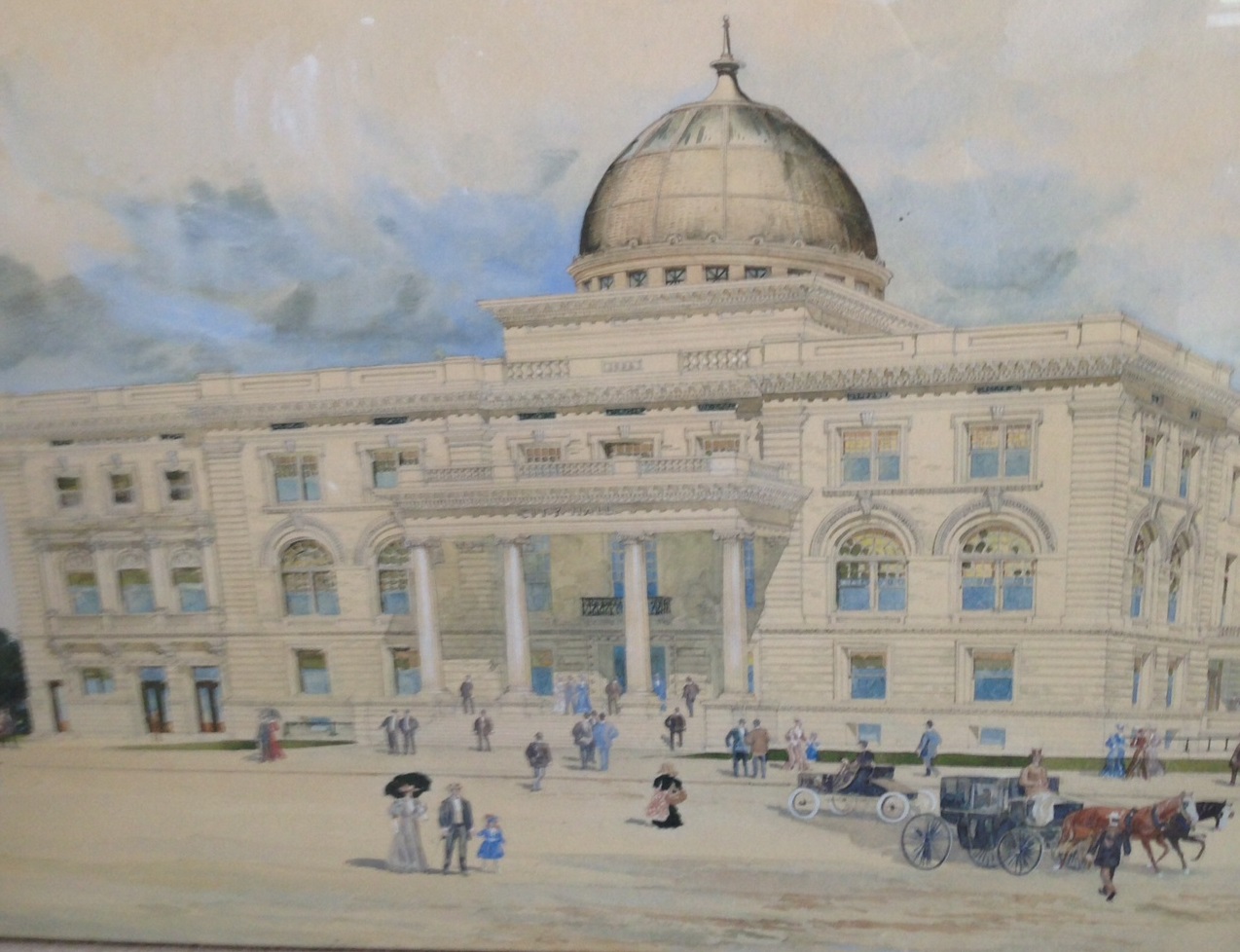
The 1906 plans for City Hall with the Municipal Auditorium on the left portion.

The 1906 plans for City Hall with the Municipal Auditorium on the left portion.

Last week: Little Rock Mayor Warren E. Lenon had been advocating for a new City Hall a municipal auditorium since shortly after taking office in April 1903. After plans were approved in July 1906, a group of citizens, led by Arkansas Gazette publisher J. N. Heiskell, filed suit to stop the City.

The closing arguments in the trial against plans for a new City Hall and auditorium complex had been heard on Monday, July 30.  The case was heard by Chancery Judge J. C. Hart.  Serving as an advisor to Chancellor Hart throughout the trial (though with no official legal standing) was Pulaski County Circuit Court Judge Robert J. Lea.  To accommodate the expected large attendance, the trial had been moved into his courtroom which was larger than Chancellor Hart’s.

On Friday, August 3, Pulaski County Chancery Judge J. C. Hart issued an injunction to keep the City from signing a contract for the construction of a city hall, jail and auditorium.  Chancellor Hart concurred with the plaintiffs that Arkansas’ constitution and laws dictated all taxation must be for public purposes.  He found there was nothing in Arkansas case law which defined an auditorium to be used for conventions as a public purpose.

As had been the case throughout the trial, the tone of the coverage of the decision differed greatly in the city’s two daily papers.  The subheading in the Democrat noted that the plaintiffs would be liable for any losses to the municipal government’s coffers due to a delay in commencing the construction if Little Rock eventually prevailed.  That fact is not mentioned by the Gazette.  Both papers did make note that Judge Lea agreed with the Chancellor’s decision.

For now, it looked as if the City of Little Rock would be stuck in the 1867 City Hall on Markham between Main and Louisiana.  Mr. Heiskell and his compatriots waited to see if the City would appeal the decision.

While August would be a quiet month publicly, work would go on behind the scenes.  More on that, in the future.