History of State Capitol is topic of noon talk today

irreverant_overview

The State of Arkansas turns 177 later this week.  A good way to mark this is to contemplate the building which has been the seat of government for over 100 of those years.

ad conclusio, per aspera; or, Two Architects, Six Governors, Dozens of Contractors, One Jailed Senator, Fifteen Years, and 2.23 Million Dollars Lead to What? is the name of a noontime conversation being hosted by the Central Arkansas Library System today, June 12.

The program, which will take place in the Arkansas State Capitol building in Room 272, will feature State Capitol historian David Ware.

It is being billed as “an irreverent overview of how the Capitol project survived.”  Construction of the Arkansas Capitol began in 1899 and stalled early due to problems with financing and failed deadlines.

With the support and vision from the project’s most emphatic backer, then-Governor George Donaghey, members of the Arkansas Legislature met for the first time in the chambers of the still-unfinished Capitol on January 9, 1911. Donaghey declared the building was “done enough” to accommodate the solons and state officers.

Bottled water and cookies will be provided; guests are invited to bring their own lunch.

June 11 Architeaser: Arkansas State Capitol

IMG_5768The dome of the Arkansas State Capitol Building is generally thought to be smooth – but as this photo shows, there are quite a few flourishes and architectural touches on the dome.   Built over 16 years (from 1899 to 1915) it had two architects of record (George R. Mann and Cass Gilbert) and was both championed and reviled by various Arkansas governors during the design and construction.

The cornerstone was laid on November 27, 1900. Since this was to be a “pay as you go” project, that slowed progress considerably.  When completed, it measured 440 feet along its north-south axis, and just over 195 feet from east to west.  From the ground to the top of the dome is 213 feet.  The building has nearly 287,000 square feet of offices.

The majority of the exterior of the Capitol is made of Batesville limestone.  The curved portions of the dome, however, are made of softer Indiana limestone.  Total construction cost was $2.2 million with today’s value of the building being $320 million.  The cupola is covered in 24 karat gold leaf.

Tomorrow there will be a lecture on the construction of the building.  More information on this will be in another entry.


QQA Preservation Conversation tonight

The Quapaw Quarter Association’s monthly award-winning Preservation Conversation series continues tonight.

QQA

The program takes place this evening at Curran Hall, 615 East Capitol Avenue. From 5 to 5:30 a reception will take place. The program will run from 5:30 to 6:30

This month Rachel Miller and Anita Reddig will discuss ASU’s Heritage Sites Program.  The program will focus on Arkansas State University’s four Arkansas Heritage Sites: Hemingway-Pfeiffer Museum in Piggott, the Historic Dyess Colony: the Boyhood Home of Johnny Cash, the Southern Tenant Farmers Museum in Tyronza, and the Lakeport Plantation in Lake Village.

Each site reflects the rich heritage and cultural diversity of the Arkansas Delta.  Rachel and Anita will discuss the historical and cultural significance and the development of each site, as well as the many educational opportunities these sites offer to the public.

The Quapaw Quarter Association’s mission is to promote the preservation of Little Rock’s architectural heritage through advocacy, marketing and education. Incorporated in 1968, the QQA grew out of an effort to identify and protect significant historic structures in Little Rock during the urban renewal projects of the early 1960s. Throughout its existence, the QQA has been a driving force behind historic preservation in Greater Little Rock.

LR Look Back: Mayor Ben D. Brickhouse

BrickhouseOn June 8, 1873, future Little Rock Mayor Ben D. Brickhouse was born in Virginia.  He moved to Texas as a child before his family settled in Arkansas.

His first job was with the Missouri Pacific Railroad.  He eventually attended law school at the University of Arkansas.  As an attorney, he remained interested in labor relations throughout the rest of his life.

In 1914, Brickhouse was elected to the Little Rock City Council.  He was reelected in 1916.  In 1918, he was appointed Labor Commissioner for the State of Arkansas by Governor Charles Brough.

Brickhouse was elected Mayor of Little Rock in 1919.  He was relected twice (1921 and 1923).  Prior to the change to the City Manager form of government in 1957, other Mayors would seek a third consecutive term, but none would be successful.

During Mayor Brickhouse’s tenure the City purchased the land to make Fair Park (now War Memorial Park).  He served as chair of the State Fairgrounds.

Brickhouse retired from public life in 1925 but returned in 1938 when he was elected to the Arkansas House of Representatives.  He was reelected in 1940.  On June 1, 1941, not long after the conclusion of the legislative session, Brickhouse died.

Actor Julie Adams – UALR Distinguished Alum – will speak on UALR campus today

julieadamsUALR’s 2013 Distinguished Alumna Julie Adams will return to campus for a one-on-one interview with Dr. Jay Raphael, chair of UALR Theatre and Dance, at 2 p.m. Friday, June 7 at the Haislip Arena Theatre.

A book signing will follow.

Adams landed her first leading role in the The Dalton Gang in 1949. After a series of Western films, Adams starred alongside James Stewart in Bend of the River. She became a Hollywood star following 1954’s Creature from the Black Lagoon.

Guests may purchase Adam’s memoir, The Lucky Southern Star: Reflections from the Black Lagoon, for $30 at the Bailey Alumni Center. Copies may also be reserved by calling 501.683.7208.

The book provides an in-depth look at Adam’s rise to stardom in Hollywood following her time in Depression-era Arkansas and graduation from then-Little Rock Junior College.

All are invited to attend, including those who met Adams at the awards luncheon in May.

Adams will make another appearance in Little Rock at the Old State House Museum for the opening reception of the new exhibit, Lights! Camera! Arkansas! The event will begin at 7 p.m. Friday, June 7.


LIGHTS! CAMERA! ARKANSAS! opens at Old State House

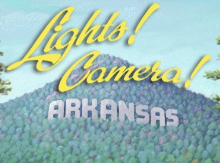
LCA_topThe Old State House Museum’s newest exhibit opens tonight.  Lights! Camera! Arkansas!  celebrates the connection between Arkansas and Hollywood on the silver screen and TV.

Artifacts related to films shot on location in the state, actors born in Arkansas, and literary figures whose works were the basis for films shot in Arkansas will be included in the exhibit. Visitors will see five galleries of costumes, scripts, film footage, awards, photographs, theater posters, and props. Documentary videos will add to their understanding and appreciation of Arkansas’s role in American film.

Visitors will be able to watch the videos in a newly-constructed theater room. The Old State House Museum commissioned original paintings of the state’s Hollywood-famous by House-of-Blues artists Patterson and Barnes. These fourteen portraits will portray Bronco Billy Anderson, Dick Powell, Alan Ladd, Gail Davis, Julie Adams, William Warfield, Louis Jordan, Johnny Cash, Glen Campbell, Levon Helm, Mary Steenburgen, Billy Bob Thornton, Lisa Blount, and Jeff Nichols.

The exhibit officially opens on Saturday, June 8.

New Johnny Cash stamp issued today by US Postal Service

cashstampJohnny Cash (1932-2003) is best remembered internationally as a country music artist, but we feel his influence just about everywhere—from rock and folk to blues and gospel. The Johnny Cash (Forever®) stamp is being issued this year as part of the exciting new Music Icons stamp series.

Resembling the appearance of a 45 rpm record sleeve, the square stamp features a photograph taken by Frank Bez during the photo session for Ring of Fire: The Best of Johnny Cash (1963). In the photo, Cash stares out at the viewer through a veil of shadow, his brooding expression fitting for an artist known to so many people simply as “the Man in Black.”

Cash found inspiration for his music in the stories of outlaws and laborers, and in his own life experience. A child of the Depression, he grew up in rural Arkansas, and the culture of that time and place—especially the Bible and gospel and country music—remained with him all his life. Themes of redemption, loneliness, love, loss, and death colored his music with a gritty realism that differed markedly from other socially conscious popular music. “I shot a man in Reno just to watch him die,” he sings famously in “Folsom Prison Blues.”

By the 1960s, Cash had become one of the top names in country music, with a string of hits that included “Cry, Cry, Cry,” “I Walk the Line,” and the Grammy award-winning “A Boy Named Sue.” Though his popularity waned in the 1970s and 1980s, Cash made a remarkable resurgence in the 1990s, culminating in several more Grammy awards. He was inducted into the Country Music Hall of Fame in 1980 and the Rock and Roll Hall of Fame in 1992.

Greg Breeding served as art director and designer for the stamp.

The Johnny Cash stamp is being issued as a Forever® stamp. Forever stamps are always equal in value to the current First-Class Mail® one-ounce rate.

Made in the USA.