
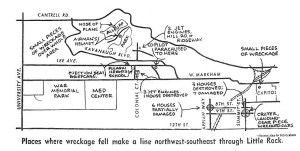
March 1960 B-47 explosion over Little Rock topic of discussion today

Arkansas Gazette map of debris and damage

The Arkansas Historic Preservation Program will host a free talk featuring Travis Ratermann, who will present a lecture on “A Living Hell: The Story of a B-47 Crash that Devastated Little Rock Neighborhoods.”

The lecture will happen today (September 8) at the Darragh Center at the main branch of the Central Arkansas Library Systems in downtown Little Rock.  It will begin at 2pm.

Travis has presented this paper to very positive reviews as it shares the history and retelling of a B-47, assigned to the Little Rock Air Force Base, that was torn apart over Little Rock, causing a debris field that stretched from Allsopp Park, all the way to what is now Arkansas Children’s Hospital. Travis will also discuss how this accident affected the community and the Air Force personnel involved in the aftermath of the tragic accident that took the life of all but one crew member, and the lives of two civilians on the ground.

Travis Ratermann is the Survey Historian for the Arkansas Historic Preservation Program, located in Little Rock, AR. He has a B.S. in Historic Preservation from Southeast Missouri State University and a M.S. in Historic Preservation from Ball State University. As the Survey Historian, Travis is involved with reviewing Residential and Commercial District Surveys throughout the state. Travis gathers information by surveying the property, completing site forms, taking photographs, and researching historical records of the property, to determine its authenticity and historical significance. His main focus is on documenting Arkansas’ current and former military installation including: Fort Chaffee, Pine Bluff Arsenal, Blytheville Air Force Base and former Shumaker Naval Ammunition Depot.


60 Years since the Labor Day bombings of 1959

ARKANSAS GAZETTE photos showing the exterior and interior of the LRSD building after the bomb blast.

On September 7, 1959, a peaceful Labor Day in Little Rock was shattered by the explosions of three dynamite bombs.

The locations were Fire Chief Gene Nalley’s driveway on Baseline Road at 10:20pm, Baldwin Company offices at Fourth and Gaines at 10:53pm (where Little Rock Mayor Werner Knoop was a partner–the company is now known as Baldwin Shell), and the School District offices at 10:58pm (then located at Eighth and Louisiana streets).

Given the three targets, it was fairly quickly assumed that there was a connection between the bombings and the lingering effects of the 1957 integration crisis. In light of that, police officers were stationed at the homes of all Little Rock City Directors and School Board members.

The investigation into the bombings turned up a purported fourth location for a bomb. That was the office of Letcher Langford. (Culture Vulture Editorializing Note:  This could have been a ploy to throw investigators off the scent. Langford was the only City Director who had been backed by segregationist candidates and had been openly hostile to the Women’s Emergency Committee — to the point of threatening them with legal action for not disclosing their membership rolls.)

Investigators determined that the bombing had been planned in late August by members of the Ku Klux Klan.  Five individuals were arrested.  They were J. D. Sims, Jesse Raymond Perry, John Taylor Coggins, Samuel Graydon Beavers, and E. A. Lauderdale.  The latter had twice been an unsuccessful candidate for the City Board of Directors.

Sims pleaded guilty and started serving a prison term later in September 1959.  Perry, Coggins and Beavers all went to trial in October and November.  Each was found guilty. Their terms ranged from three to five years.  Lauderdale was convicted, but appealed his decision. Though the Arkansas Supreme Court upheld the verdict against him, he did not start serving his sentence until the court decision in February 1961.

Governor Faubus commuted the sentences of Perry, Coggins and Beavers.  All three served less than six months.  Lauderdale’s sentence was reduced by Faubus so that he, too, was eligible for release after six months.  Sims, who was first to plead, served the longest: nearly two years.

Sadly, this would not be the last bombing in Little Rock tied to 1957. In February 1960, Carlotta Walls’ house was bombed.

Whole Lotta Shakin’ Goin’ On as Arkansas Rep presents MILLION DOLLAR QUARTET

Million Dollar Quartet, a Tony Award-winning smash hit Broadway musical, is the next production in The Rep’s 2019 Season. Tickets for the production, which runs Sept. 4-Oct. 6, are available at TheRep.org.

Based on the book by Colin Escott and Floyd Mutrux, Million Dollar Quartet chronicles the epic 1956 recording session of young rock ‘n roll stars Elvis Presley, Johnny Cash, Jerry Lee Lewis and Carl Perkins.

“It’s more than just a jukebox musical,” said Director Hunter Foster. “It’s a dramatic play. But, the music is still the star and by the end people are usually dancing in the aisles.”  Foster was an original cast member on Broadway.

Showcased hit songs include “Blue Suede Shoes,” “Fever,” “Walk the Line,” “Sixteen Tons,” “Who Do You Love?,” “Great Balls of Fire,” “Folsom Prison Blues,” “Whole Lotta Shakin’ Goin’ On,” “Hound Dog,” and more.

“All the music that audiences will hear is actually being played by the actors,” Foster said. “Most audiences can’t believe they are playing because they are so good! We’re bringing some of the best actor/musicians in the country to Arkansas.”

The Arkansas Rep cast includes Trent Rowland (Elvis Presley), Bill Scott Sheets (Johnny Cash), Skye Scott (Carl Perkins), Brandyn Day (Jerry Lee Lewis), Karack Osborn (Sam Phillips), Alyssa Gardner (Dyanne), Brian Wolverton (Jay Perkins) and David W. Lincoln (W.S. “Fluke” Holland).

The design and creative team includes Lauren T. Roark, costume designer; Erin Reed, associate costume designer; Adam Koch, set designer; Steven Royal, associate set designer; James Barry, music supervisor; Kirk Bookman, original lighting designer; Steve O’Shea, lighting designer; and Luke Mitchell, sound designer. The stage manager is Colin JB and Merit Glover is the assistant stage manager.

Tickets start at $20. Discounts are available for full-time students, season subscribers, seniors and military personnel. For complete information, visit TheRep.org.

The Arkansas Arts Center was formally established on Sept 6, 1960

Architectural model of the original Arkansas Arts Center which would open in 1963.

On Tuesday, September 6, 1960, the City of Little Rock Board of Directors adopted ordinance 11,111 which formally established the Arkansas Arts Center.

In July 1957, the City Council of Little Rock granted the Museum of Fine Arts the authority to solicit and receive funds for expanding that museum’s physical plant.  During that process, it had been decided that the museum needed an expanded mission and a new name.  By the summer of 1960, the museum supporters had raised sufficient funds to proceed with constructing the new facility.  Therefor the new ordinance was prepared and submitted to the City Board.  (In November 1957, the City Council had been replaced by a City Board.)

Ordinance 11,111 set forth that the Museum of Fine Arts would be known as the Arkansas Arts Center and that the previous museum’s board would serve as the board for the new museum.  The Board of the Arkansas Arts Center was given the authority to have the new building constructed in MacArthur Park and the existing building modified.  As a part of the planning for the new museum, the City committed $75,000 for the capital campaign.

The groundbreaking for the new museum would take place in August 1961.  Mayor Werner Knoop, who signed Ordinance 11,111, took part in the groundbreaking.

Media attending the September 6, 1960, City Board meeting were more interested in discussion about a potential leash law for dogs within the City limits.

The Oxford American welcomes new Jeff Baskin Writers Fellow KaToya Ellis Fleming

Image may contain: 1 person, text

Help the Oxford American welcome their new Jeff Baskin Writers Fellow, KaToya Ellis Fleming, at this special reception!

Tonight (September 6) from 4pm to 8pm, ESSE is opening up the museum free of charge and serving light refreshments during SoMa After Dark for this casual meet-and-greet.

Grab a snack, sign up to win a door prize from ESSE and the OA, and stay to hear KaToya do a brief reading from her work at 5:30 PM and again at 7:00 PM.

Sandwich in History at Ferncliff Camp today

Image may contain: tree, sky, plant, grass, outdoor, nature and water

You are invited to join the Arkansas Historic Preservation Program’s next “Sandwiching in History” tour, which will visit Ferncliff Camp and Conference Center at 1720 Ferncliff Road in Little Rock beginning at noon on Friday, September 6, 2019.

Currently sitting on approximately 1,200 acres, Ferncliff Camp and Conference Center began in the 1920s as a camp for some of Little Rock’s prominent families. Since the 1930s, the facility has been a camp and conference center owned by the Presbyterian Church (PCUSA). Ferncliff Camp and Conference Center offers retreat and meeting facilities along with recreational facilities and hiking trails.

Sandwiching in History tours are worth one hour of AIA continuing education credit. If you would like to receive email notifications of upcoming tours instead of postcards or need additional information, please contact Callie Williams, Education and Outreach Coordinator for AHPP, at 501-324-9880 or Callie.Williams@arkansas.gov.


September 5, 1961 – the Duke Ellington concert in Little Rock that wasn’t

Newspaper ad for the concert that was not to be

In August 1961, it was announced that Duke Ellington would perform in concert at Robinson Center.  He had previously played there in the 1940s and early 1950s.  His concert was set to be at 8:30 pm on Tuesday, September 5.

Due to the changes of times, the NAACP had a relatively new rule that they would boycott performers who played at segregated venues.  When it became apparent that Robinson would remain segregated (African Americans restricted to the balcony), the NAACP announced they would boycott any future Ellington performances if he went ahead and played Robinson.

The music promoters in Little Rock (who were white) petitioned the Robinson Auditorium Commission asking them to desegregate Robinson – even if for only that concert.  The Commission refused to do so.  Though the auditorium was finding it harder to book acts into a segregated house, they felt that if it were integrated, fewer tickets would be sold.

On September 1, 1961, Ellington cancelled the concert.

Robinson remained segregated until a 1963 judge’s decision which integrated all public City of Little Rock facilities (except for swimming pools).