On Lincoln’s Birthday – A Lincoln Viaduct Portrait

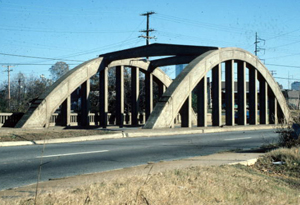
Photo courtesy of the Arkansas Historic Preservation Program

Since today is Abraham Lincoln’s birthday, it is a good day to pay tribute to the Lincoln Avenue Viaduct.  This arched bridge is traversed by thousands of cars each day, with most having no idea the name of the structure.  The Lincoln Avenue Viaduct is the arched bridge connecting LaHarpe with Cantrell Road which (literally) bridges downtown with the west along Highway 10.

The Lincoln Avenue Viaduct is a reinforced concrete rainbow arch bridge. It was opened at 2:05 p.m. on Friday, December 28, 1928, and, despite later alterations, it remains particularly well-preserved. The Missouri Pacific Railroad Company, considered the most important railroad company in the state, constructed the bridge amid a series of improvements in Little Rock made necessary by the damage wrought by the infamous spring floods of 1927.

Though the bridge was constructed by the railroad, the City had to give authorization to do so, this was accomplished by the passing of Ordinance 4,335, at the May 28, 1928, City Council meeting.

Lincoln Avenue was one of several names for stretches of Highway 10 in Little Rock. By the 1960s, the areas west of the Lincoln Avenue viaduct were all renamed Cantrell in honor of the man who had developed much of the area west of the Heights. The longest stretch of the road already carried that name. There had been an effort to rename Highway 10 (including sections named Lincoln, Q, and Cantrell) in Little Rock for Senator Joseph Taylor Robinson in 1930. He declined the offer because he did not want to diminish the contributions of Mr. Cantrell.  Over time the entire stretch bore the name Cantrell.

The stretches east of the viaduct which involved a couple of names were renamed La Harpe Boulevard in honor of the French explorer who first saw the Little Rock. (La Harpe was originally an extension of Riverfront Drive. But with changes to development along the Arkansas River and the coming of I-30, the streets were reconfigured significantly in the 1950s and early 1960s.)

Though the street has been renamed, the bridge still carries the name of the 16th President of the United States.
Rock the Oscars 2019: THE HANGING TREE

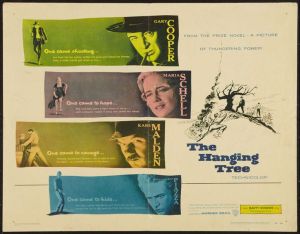
On February 11, 1959, THE HANGING TREE was released.  This film was the first Hollywood movie in with Little Rock native Ben Piazza appeared.  For the film, Piazza received a coveted “and introducing Ben Piazza” credit.

The movie starred Oscar winners Gary Cooper and Karl Malden, along with Maria Schell.  Future Oscar winner George C. Scott, was fifth billed for his scenery chewing role of a religious zealot.

The title song, “The Hanging Tree,” written by Jerry Livingston and Mack David, was sung by Marty Robbins in the film.  It was nominated for the Oscar for Best Song.

Filming began in June 1958 in Washington state.  Shooting took place from June through August 1958 mainly near Yakima, Washington.  The film was directed by Delmer Daves, who was probably best known as screenwriter of Love Affair and director of 3:10 to Yuma.  In conjunction with filming The Hanging Tree, Piazza appeared in a TV special on western movies.  Most of the others appearing in the special were well-established Hollywood western personalities including Little Rock natives Bronco Billy Anderson and Gail Davis.

The Hanging Tree had a budget of $1.35 million ($11.5 million today—about half of the typical modest film budget).  A good portion of this expense was the construction of a mining town.  Once production began, Daves became ill and had to be hospitalized for ulcers. Co-star Karl Malden was approached to complete the film.  He had recently finished his first directing assignment.  He had reservations, but agreed to direct because of support of Cooper. (There are discrepancies as to the length of time Daves was out of commission.)

Ben received positive notices.  One reviewer referred to him as being a “laconic, doe-eyed rebel.” Another said he was a “handsome and mean-looking boy…with curls like a golden poodle.”     Several reviewers referenced James Dean when discussing Piazza in a positive light.

The film was released to respectful notices in February 1959.  It earned around $2.2 million, which meant it turned a profit.

Rock the Oscars 2019: Opening of the Clinton Presidential Center

Probably the largest gathering of Oscar winners and Oscar nominees in Little Rock’s history took place in November 2004.

Though some Oscar winners and nominees had been present for the Clinton election night parties in 1992 and 1996, the opening of the Clinton Presidential Center brought luminaries from Hollywood en masse.

Among those present were Oscar winning actors Barbara Streisand, Robin Williams, and (of course) Arkansan Mary Steenburgen.  Future Oscar winner Morgan Freeman was also in attendance. Among the Oscar nominees who were present were Bono and The Edge (who performed at the ceremony) and Alfre Woodard.

Senator John Glenn, who had been featured as a character in the Oscar winning film The Right Stuff was also present for the festivities.  Former Vice President Al Gore did not actually win an Oscar for An Inconvenient Truth (the documentary awards go to the director), but was closely identified with this Oscar winning documentary.

There were plenty of rumors about other Oscar winners and nominees in town, though they were not true.

Rock the Grammys – Jimmy Driftwood

Image result for jimmy driftwoodThe 61st Grammy Awards are tonight.  Over the years, many Arkansans and those with Arkansas connections have been Grammy winners and nominees.

But the first Arkansan to win a Grammy took place at the second Grammy ceremony on November 29, 1959 – Jimmy Driftwood.

Born in Timbo as James Morris in 1907, he later studied what is now John Brown University before graduating with a teaching degree from what is now the University of Central Arkansas.

In his 20s, he alternated between teaching school and traveling the country as a drifter.  In 1936, he both got married and returned to Arkansas as well as wrote the song “The Battle of New Orleans” to help explain history to a class he was teaching.

By 1957, he had changed his name to Jimmy Driftwood, both publicly and legally.  That year, a Nashville, TN, song publisher learned of him and offered him his first record deal.  That first record did not sell particularly well.  But he did start getting notice.

Driftwood left Arkansas for Nashville and became popular by his appearances on programs including the Grand Ole Opry, Ozark Jubilee, and Louisiana Hayride. He was invited to sing for Soviet Premier Nikita Khrushchev as an example of traditional American music during the leader’s 1959 state visit to the United States. He became a member of the Opry in the 1950s.

In 1959, he had six songs on the popular and country music charts including Johnny Horton’s recording of “The Battle of New Orleans.” It was that recording that was named “Song of the Year” by the Grammys. That award goes to the songwriter, which meant Driftwood took home the trophy.  He later won three other Grammys.

By the 1960s, he alternated his time between touring and spending more time in Northwest and North Central Arkansas.  In April 1963, he held the first Arkansas Folk Festival in Mountain View.  He later helped established the Ozark Folk Center, which is now part of the Arkansas State Park system. He was also active in defeating the plan to dam the Buffalo River and in efforts to establish the Buffalo National River and the preservation of the Blanchard Springs Caverns.

Due to his knowledge of folk music, Driftwood served on the Advisory Committee of the Kennedy Center for the Performing Arts and worked with the National Geographic Society.

His final years were spent in Fayetteville. He died there of a heart attack in 1998.

Little Rock Look Back: Home of Carlotta Walls bombed in 1960

On February 9, 1960, a bomb was detonated at the home of Carlotta Walls. One of the Little Rock Nine as a sophomore, she was now in her senior year at Little Rock Central High.  This followed the September 1959 Labor Day bombings in Little Rock.

The bomb went off at approximately 11:00pm.  The blast could be heard for two miles from the house (located at 1500 S Valentine St.). Carlotta’s mother, Juanita, and sisters were at home with her, though her father, Cartelyou, was at his father’s house at 3910 West 18th Street.  Thankfully all members of the family were not physically harmed.  Two sticks of dynamite were used for the bomb.  The blast removed brick and broke three windows in the Walls house.

According to media accounts, this bombing was the first in the United States directed at a student since the 1954 US Supreme Court decision in Brown v. Board of Education.  As such, it made national headlines.  Carlotta was not deterred.  She had no thought of dropping out of school.

Reaction in the community including the Women’s Emergency Committee deploring the action and the NAACP being outraged.  The Little Rock School District only stated that it was a matter for the police.  The Chamber of Commerce was concerned about the impact it would have on attracting industry.

The FBI came in to investigate in addition to the Little Rock Police Department.  Two African Americans, Herbert Monts and Maceo Binns, Jr., were convicted for causing the bombing. Binns’ conviction was thrown out because it was proven he was coerced into a confession.  Monts served twenty (20) months of a five year sentence.  The supposed motive was to build sympathy for the African American community.  Carlotta Walls LaNier has stated that she did not believe the men bombed her house.

Monts petitioned the Arkansas Parole Board for a pardon. In October 2018, Governor Asa Hutchinson included Monts on a list of persons to be pardoned.

Little Rock Look Back: LR Voters Overwhelmingly Support Arts+History

On Tuesday, February 9, 2016, Little Rock overwhelmingly approved the Arts+History initiative which funded expansion and enhancements to the Arkansas Arts Center, MacArthur Museum of Arkansas Military History, and MacArthur Park.

There were 7,989 votes cast in the special election.  This was 6.61% of the electorate.  Of those, 6,733 or 84.28% voted for the proposal.

In 2018, the MacArthur Museum of Arkansas Military History was closed for several months for a renovation, which was financed by these bonds.  It reopened in September.  The Arkansas Arts Center unveiled plans in February 2018 for its expansion.  It is preparing to start construction later in 2019. As part of that, Arts Center programming will continue in a variety of locations including Central Arkansas Library System branches.

Little Rock Look Back: OKLAHOMA! comes to Little Rock for the first time

Program cover from OKLAHOMA!’s February 1948 visit to Little Rock. From the collection of Mary and Booker Worthen.

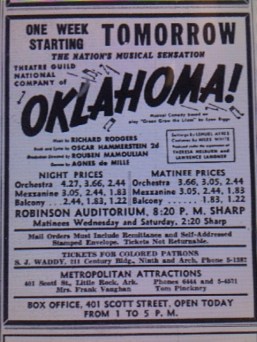
On February 9, 1948, as the original Broadway run was about to mark five years on Broadway, the national tour of Oklahoma! made its way to Little Rock for eight performances. The week-long stay it had in Little Rock at Robinson Center was a record for that building that would last until Wicked came in 2010.  (Hello, Dolly! in 1966 and Beauty and the Beastin 2002 had both equalled the record.)

By the time Richard Rodgers and Oscar Hammerstein II’s first show made it to Little Rock, they were working on their fourth stage show, South Pacific, which had a leading character from Little Rock.

To get Robinson Auditorium ready for Oklahoma!, the Auditorium Commission had to spend $2,000 on upgrades.  That would be the equivalent of just under $21,000 today.

Oklahoma! opened at Robinson on Monday, February 9, 1948.  With eight performances, approximately 24,000 tickets were on sale during the run of the show.  There was a cast of 67 actors and 28 musicians.  The cast was led by Ridge Bond, Carolyn Adair, Alfred Cibelli Jr., Patricia Englund, and David Morris.  Mr. Bond had relatives who lived in Little Rock.  He was a native of Claremore, Oklahoma, which was the town in which the story took place.

OkAdLR

Ad in ARKANSAS GAZETTE on February 8, 1948.

While they were in Little Rock, the stars of the show made an appearance at Reed Music on February 10.  The music store (located at 112 and 114 East 7th Street–across the street from the Donaghey Building) was promoting the sale of the Oklahoma! cast albums, sheet music, and recordings of songs from Oklahoma! by other singers.

Both the Arkansas Gazette and Arkansas Democrat carried reviews of the show.  Another item, which appeared in the paper that week was a syndicated column which noted that the film rights for the show had been sold. It was speculated that the star would be Bing Crosby.  It would actually be 1955 before the film was made, and Mr. Crosby had no connection to that movie.  By the time it was made, the stars were Gordon MacRae and Shirley Jones.  Mr. MacRae would appear in Little Rock for the 1963 opening of the Arkansas Arts Center.  Ms. Jones has made several concert appearances in Little Rock over the years.

Little Rock had seen its fair share of top Broadway shows on tour.  Prior to Robinson’s opening and since then, many well-known actors and popular shows had played Little Rock.  But just as it had been on Broadway, Oklahoma! in Little Rock was more than a show — it was an event!

Over the years, Oklahoma! has been performed by schools, churches, community theatres, dinner theatres, and colleges.  National tours have come through Arkansas again.  People have become jaded or dismissive of it, because they have seen it performed so often — and sometimes badly.  So it is hard to understand the excitement that was felt by Little Rock audiences in 1948 when they first saw it on the stage of Robinson Center.

This weekend, the Arkansas Symphony Orchestra is bringing Oscar “Andy” Hammerstein III, grandson of the beloved librettist and lyricist Oscar Hammerstein II, to host a celebration of some of America’s most cherished music from the stage.