2nd Friday Cinema at Old State House: THE CREATURE FROM THE BLACK LAGOON

Image may contain: one or more people and text

In 2013, the Old State House played host to Little Rock native Julie Adams where she discussed her work in the film The Creature from the Black Lagoon.  Miss Adams died earlier this month. As a tribute to her, the Old State House is screening her seminal film.

This 1954 movie tells the tale of a strange prehistoric beast which lurks in the depths of the Amazonian jungle. A group of scientists try to capture the animal and bring it back to civilization for study. The explorers capture the mysterious creature, but it breaks free. The Gill-Man returns to kidnap the lovely Kay (played by Adams), fiancée of one in the expedition, with whom it has fallen in love.


3 Exhibits open on 2nd Friday Art Night at 1 Historic Arkansas Museum

Join Historic Arkansas Museum for a reception for the openings of “Flourish,” “Olivia Trimble: Ozark Comforts” and “Featured Focus from the Permanent Collection.” Tonya Leeks and Company will be the evening’s live entertainment. New Province Brewing Company will be the evening’s featured brewery.

The reception is sponsored by the Historic Arkansas Museum Foundation, with special thanks to 107 Liquor. Beverages and appetizers will be served in the Stella Boyle Smith Atrium. The exhibits and reception are free and open to the public.

• • •

“Flourish”
Jessica Mongeon and Cara Sullivan
Trinity Gallery, February 8 – April 7, 2019

Mongeon’s inspiration comes from the Ozark-St. Francis National Forest and Petit Jean State Park in Arkansas. She creates her paintings on stone paper, an eco-friendly tree-free material made of calcium carbonate and resin. She says, “I hope that by capturing the unique landscapes of these protected natural areas, I will have encouraged people to support policies which fund their protection and to oppose decisions which may threaten them.”

Sullivan’s recent paintings pay homage to the overgrowth. Her spray painted surfaces reserve attention for the cast-aways: the uncultivated blooms of common weeds. She says, “More than a nod to the lowly weed, these paintings are for me a meditation on the irreverent, persistent nature and joy of rebellion.”

“Olivia Trimble: Ozark Comforts”
Second Floor Gallery, February 8 – May 5, 2019

Olivia Trimble cares about her community, and she understands the power of words and images to lift people up or tear them down. Using the tools of a traditional sign painter, she aims to improve the urban landscape and positively impact the people of Northwest Arkansas. Trimble opened her business, Sleet City Signs, determined to recapture the excitement and individuality common to hand-painted signs of times past. The quilt square paintings she is now known for began as a simple craft project to produce a gift for a friend, but as she made more of them, the meaning of her painted quilts became more significant. Olivia appreciates the long history of quilting in Arkansas, and the many hours of hidden work contained within a completed quilt. She was invited to paint quilt squares at Crystal Bridges Museum of American Art for their American Made exhibit in 2016, and her work has appeared outside the Shiloh Museum of Ozark History, Perrodin Supply Co. in Springdale, and on many hand-painted signs around Northwest Arkansas.

“Featured Focus from the Permanent Collection”
Foyer of Cabe Gallery, Feb. 1 – 28, 2019

In honor of Black History Month, the Cabe Gallery foyer will display a selection of contemporary fine art by influential African American Arkansas artists during the month of February. The focused look includes an iconic delta landscape by Henri Linton, Larry Wade Hampton’s impressionistic scene of daily life, a country church by Glenda McCune and the delicate silverpoint realism of a Marjorie Williams-Smith still life.

This weekend at the Clinton Center – Fusion 2019: Arts+Humanities Arkansas looks at “The Mighty Mississippi: A Mosaic of America’s Growth”

Fusion: Arts + Humanities Arkansas The third edition of FUSION: Arts + Humanities Arkansas takes place on February 10 and 11 at the Clinton Presidential Center.
There is a Fusion public symposium, The Mighty Mississippi: A Mosaic of America’s Growth, on Sunday, February 10, at 5:30 p.m. The program will include a keynote address featuring nationally-recognized photographer, filmmaker, and folklorist Tom Rankin; a Delta Blues musical performance by Grammy Award-winning musician David Evans; and special performances by the Arkansas Symphony Youth Orchestra Jazz Ensemble and North Little Rock High School theater students.

While flowing more than 2,300 miles through ten states and defining eight state borders, the Mighty Mississippi River is an imperative physical aspect that continues to play an integral role in the shaping of our nation’s economics, politics, geography, and culture.

An accompanying exhibit will take you on a journey down the Mississippi River as you view dozens of artifacts and ephemera, including first editions of Mark Twain’s novels, The Prince and the Pauper and The Connecticut Yankee in King Arthur’s Court; original Norman Rockwell lithographs from Twain’s works; the Epiphone guitar and playing knife of Helena native and famed blues guitar player Cedell Davis; and more.

RSVP for the Fusion Public Symposium

Fusion: Arts + Humanities Arkansas
The Mighty Mississippi: A Mosaic of America’s Growth
Sunday, February 10, 2019
Doors Open: 5 p.m. | Program Begins: 5:30 p.m.

Reception and exhibit tours to follow the program
Clinton Presidential Center, Great Hall
Fusion 2019 is made possible because of the generous support of the Quapaw Tribe, Centennial Bank, and the Little Rock Port Authority.

Tonight at the Clinton School – Little Rock Central High 1957-59 and Beyond: A Black and a White Perspective

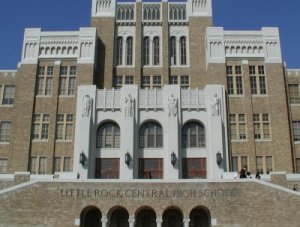
This evening at 6pm, the Clinton School Speaker Series offers another insightful, timely discussion: Little Rock Central High 1957-59 and Beyond: A Black and a White Perspective.
John Bilheimer and Henry Jones bring the civil rights movement to life, offering a first-hand account of what life was like for a black teen and a white teen in the Deep South in the late 1950s.

Bilheimer, who is white, and Jones, who is black, discuss their experiences growing up in Little Rock during the height of the battle over school desegregation from 1957-1959. The two grew up near one another before leaving the state to pursue their education. Billheimer earned undergraduate and law degrees from the University of Arkansas and Harvard University; Jones attended Yale University and the University of Michigan. The pair did not meet until adulthood while working at Arkansas’ first integrated law firm.

All Clinton School Speaker Series events are free and open to the public. Reserve your seats by emailing publicprograms@clintonschool.uasys.edu or by calling (501) 683-5239.

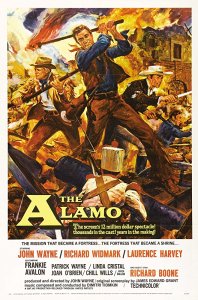
Rock the Oscars 2019: THE ALAMO

One of the early settlers in Little Rock was a man from Tennessee named Davy Crockett.  He did not stay in Little Rock very long. He and several others ventured to the Republic of Texas.  His final days are depicted (with more liberties than the original Texans had under Mexican control), in the film The Alamo.

(While Stephen F. Austin does not appear in the movie, he was actually one of Little Rock’s founding fathers before becoming a founder of Texas.)

The very fictionalized, grandiose, and jingoistic movie starred John Wayne as Crockett, Richard Widmark as Col Jim Bowie (another Arkansas traveler who left his impact on the state), Laurence Harvey as Col. William Travis, along with Frankie Avalon, Patrick Wayne, Chill Wills, Ken Curtis, and Denver Pyle.

Though one of the top grossing films of the year, it was still a financial flop due to its excessive cost.  However, when Oscar time came around, the film received seven nominations. They were Best Picture, Supporting Actor (Wills), Cinematography-Color, Film Editing, Sound, Song, and Scoring of a Dramatic or Comedy Picture.

Wills took out an ad claiming that his fellow Alamo actors were praying for him to win even harder than the original Alamo soldier had prayed for victory.  There was much backlash.  It was felt that this may have affected award chances in all categories.  It only won the Award for Best Sound – which went to Gordon Sawyer and Fred Hynes.

The remake/new version of The Alamo received no Oscar nominations.

Today CALS Butler Center Legacies & Lunch explores “The Son of Little Rock Who Broke Ground for Black Journalists” at noon

Image may contain: 1 person, sunglasses and closeupJoin the Central Arkansas Library System’s Legacies & Lunch, for Benji de la Piedra’s talk on “The Two Herbert Dentons: A Principal and a Journalist, from Black Little Rock to Black DC and Beyond.”

It will take place at 12 noon at the Darragh Center Auditorium inside the main CALS building on Library Sqaure.

Herbert Denton Jr., a native son of Little Rock, was a pioneering African American journalist at the Washington Post from 1966 until his death in 1989. As the first person of color with a position of authority in the Post newsroom, he hired and mentored a generation of influential black journalists and revolutionized coverage of local life in the nation’s capital at a time when the city was more than seventy percent African American.

His father, Herbert Denton Sr., was a lifelong public educator in Little Rock and a pillar of the city’s black community, who so far has gone unacknowledged in the written record of Little Rock history. As Denton Jr.’s biographer, Benji de la Piedra will trace the career arcs of both father and son, with an emphasis on their powerful, if sometimes controversial, approaches to racial uplift, education, and civic responsibility.

Benji de la Piedra is a writer and oral historian from Washington DC, currently living in Little Rock. In addition to his work on Herbert Denton Jr.’s biography, he co-directs the Columbia Life Histories Project and serves on the coordinating committee of the Arkansas People’s History Project. A graduate of Columbia University’s Oral History MA program, and a former fellow of the Alliance for Historical Dialogue and Accountability, he teaches and consults on community-based oral history projects around the United States. He speaks and writes regularly about American history and culture, with an emphasis on black intellectual expression.

Little Rock Look Back: John Herndon Hollis

On February 5, 1870, future Little Rock alderman and acting mayor John Herndon Hollis was born shortly before his family moved to what is now Cleveland County. His parents were originally from Georgia and came from prosperous and longtime families there.

The Hollis family came to Arkansas after the Civil War and settled in Union County. A portion of that county was carved off and became Dorsey County (named after a Republican US Senator from Arkansas) but was renamed Cleveland County after Grover Cleveland was elected President. Cleveland was the first Democrat to be elected President in over 20 years. This name change also reflected the political shift in Arkansas from the Reconstruction-led Republican politics to the Democratic Party politics which would dominate for the next century.

John Herndon Hollis was one of six children, and the only one with a middle name. Herndon had been his mother’s maiden name. As one of his brothers described their childhood in Cleveland County, “they all went to country schools in their home neighborhood, worked hard on the farm in the summertime, and were inside their little Methodist Church every time the doors were open.”

Around 1900, Hollis and his new wife Malinda M. “Linda” Taliaferro Hollis (formerly of Rison) moved to Little Rock.  Together the couple had six children. In Little Rock, Hollis worked in the banking industry. For years he worked for People’s Building and Loan Association.

Hollis was first elected to the Little Rock City Council in April 1904. He would serve as one of the Aldermen from the city’s Fourth Ward until April 1918.  This was on the western border of Little Rock at the time. The family lived at 1510 S. Schiller, which is one block east of Central High, though at the time neither the school nor its predecessor (West End Park) existed.  From 1907 until 1913 he also served on the Little Rock School Board.

In April 1908, at the first City Council meeting in the new City Hall, Mayor W. E. Lenon announced his resignation. Because the resignation was effective immediately, there was a vacancy in the office of mayor.  Hollis was selected by his colleagues to serve as acting mayor until a successor could be elected. So from April 1908 through June 1908, Hollis was the City’s chief political and executive leader.

Though he was never formally mayor (and did not resign his position as alderman), since 1908, Hollis’ name has appeared on the list of mayors of Little Rock. The reason seems to be as a sign of respect since there was a vacancy.

There previously had been acting mayors when the mayor would be absent on business or due to illness. But in those instances, the mayor had not resigned. This is the only instance in Little Rock history when a mayor resigned immediately with no successor in place. So John Herndon Hollis holds a unique role in Little Rock history.

After leaving the City Council, Hollis remained active in civic affairs.  He co-chaired a successful campaign in 1929, to raise a tax for a variety of civic issues.

Hollis’ wife died in 1920.  He later married Ann Jewell of Little Rock (who was a cousin of his first wife). They were married until his death on October 23, 1941.  Ann Hollis lived in Little Rock until her death in 1980.  The Hollis family is entombed in the mausoleum at Mount Holly Cemetery.

Both of John Herndon Hollis’ wives are distant cousins of the Culture Vulture, so he is particularly fond of John Herndon Hollis.
