
18 Cultural Events from 2018 – Arkansas Arts Center unveils plans for expansion

South entrance of new AAC

On February 27, the Arkansas Arts Center unveiled design plans for a renovation that would cost $70 million.

Construction for the museum is scheduled to begin in 2019, and the center is expected to open in 2022. The upgrades, led by architecture firm Studio Gang, include new exhibition areas, a children’s theater space, an expanded educational facility, a glass-enclosed walkway, a garden, and the uncovering of the institution’s original facade from 1937. The $24 million budget increase, which does not include additional costs such as architectural or consultants’ fees, will be taken care of by private funds.

Officials originally explained that $50 million in private donations would complement general obligation bonds approved by Little Rock constituents for the expansion of the museum, whose artworks are owned by the nonprofit Arkansas Arts Center Foundation. “It’s a more expensive project than we originally thought it would be,” Studio Gang owner Jeanne Gang said. “You discover things. There’s a lot to it. There’s a lot of, also, ambition for the project to make it visible, to make it really bring the institution up to the next level.”

The building is currently made up of eight different structures that were added over a period of time to the city’s Museum of Fine Arts, built in 1937. Studio Gang’s aim is to offer a more coherent layout, as well as provide additional space for the AAC’s expansive public arts programming of classes, lectures and film showings.

Among the main features of the project is the introduction of a new axis, which will cut through the center of the building. It will lead from the northern entrance facing Crescent Drive to the 36-acre MacArthur Park on the southern side.

Four glazed volumes featuring curved walls and folded roofs will join up to form the axis – a new entrance will be placed at the front with walls angled to open up to the city, while three others will trail towards the park at the rear, ending with a double-height dining room.

Around 127,000 square feet of space will be added or revamped. The enhanced location will feature an edition of British sculptor Henry Moore’s Large Standing Figure: Knife Edge, 1976, which is currently on view in the city’s Union National Plaza.

Polk Stanley Wilcox is the associate architect and SCAPE is the landscape architect.  More members of the consulting team were added throughout 2018.

18 Cultural Events from 2018 – 2nd FUSION: Arts+Humanities at Clinton Center

3.  In February , the Clinton Presidential Center presented the second annual Fusion: Arts + Humanities Arkansas, a program that promotes heritage and culture and celebrates human achievement by weaving the arts and humanities together to provide a unique and engaging experience. The theme of Fusion 2018 was Exploring the Louisiana Purchase and its Impact on Arkansas.
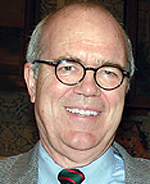
There was a public symposium of Fusion: Arts + Humanities Arkansas which featured interactive conversations with historians and subject matter experts; a Cajun-Creole musical performance by Grammy-nominated fiddler, David Greely; and members of the Early Arkansaw Reenactors Association who participated in-character.

An accompanying exhibit, The Great Expedition: Exploring the Louisiana Purchase and its Impact on Arkansas, included original documents from the Louisiana Purchase, and was on display at the Clinton Center from February 2 to March 4, 2018.

The Great Exhibition: Exploring the Louisiana Purchase and its Impact on Arkansas included the following objects which are on loan from the National Archives and Records Administration, unless otherwise noted.

  • The American original of the treaty between the United States of America and the French Republic ceding the province of Louisiana to the United States, signed for the U.S. by Robert Livingston and James Monroe, and for the French by Finance Minister François de Barbé-Marbois
  • The exchange copy of the convention for payment of sums due to U.S. citizens signed by future French emperor Napoleon Bonaparte
  • The American original of the convention for payment of 60 million francs signed for the U.S. by Robert Livingston and James Monroe, and for the French by Finance Minister François de Barbé-Marbois
  • William Dunbar’s journal, eyeglasses, compass, and other objects from the Dunbar-Hunter expedition of Louisiana and Arkansas (on loan from Ouachita Baptist University)
  • Napoleon Bonaparte death mask (On loan from the Tennessee Historical Society Collection at the Tennessee State Museum)
  • A portrait of Napoleon by John C. Grimes (On loan from the Tennessee Historical Society Collection at the Tennessee State Museum)
  • The “Aux Arc” keelboat, which is a forty-foot-long replica of the boat used during the Dunbar-Hunter expedition, will be displayed in the Clinton Center’s fountain (On loan from the Early Arkansaw Reenactors Association)

Additional objects on display in the exhibit were on loan from the Arkansas State Archives, Butler Center for Arkansas Studies, and Historic Arkansas Museum.

FUSION is spearheaded by Kaki Hockersmith and Stephanie S. Streett.

18 Cultural Events from 2018 – CALS renames Ark. Studies Institute for Bobby Roberts

As the chronological countdown of 18 cultural events from 2018 starts —

In January it was announced that the Central Arkansas Library System (CALS) had renamed the Arkansas Studies Institute (ASI) the Bobby L. Roberts Library of Arkansas History and Art in honor of the former CALS executive director who served in the position for more than twenty years before retiring in 2016.

“Bobby established a new normal at CALS by creating new concepts of what the public library could offer the community and by constructing unique spaces to make the library more appealing and accessible to all sorts of groups with varied interests in learning, enrichment, and entertainment,” said Nate Coulter, CALS executive director. “The library’s primary purpose has always been to provide access to information, but Bobby transformed and expanded what it means to be a library by placing a particular emphasis on Arkansas history and culture.”

Since the early 1990s, CALS has undergone several changes and expansions, now consisting of fourteen library locations in Little Rock, Perryville, and throughout Pulaski County. The Main Library moved from its original location at 7th and Louisiana to its current home in the River Market District, which helped trigger the revitalization of downtown Little Rock. That Main Library is now the centerpiece of a campus that includes the Ron Robinson Theater, the Cox Creative Center, and the Bobby L. Roberts Library of Arkansas History and Art (formerly ASI).
Roberts’s efforts in building striking library structures, in ecologically sustainable construction, and in adaptive reuse have been recognized by local, state, national, and international organizations. That includes the newly named Roberts Library. Opened in 2009, as the Arkansas Studies Institute, the structure houses the Butler Center for Arkansas Studies, CALS’s Arkansas history department, and five galleries that feature art depicting the state or created by artists living in or from Arkansas.

“This complex of buildings certainly wouldn’t be here if it hadn’t been for Bobby Roberts. It is truly fitting for this edifice to be named in his honor,” said David Stricklin, director of the Butler Center.

Roberts’s special interests in Arkansas history and art and CALS’s long-held practice of collecting materials for the benefit of patrons interested in those topics helped inspire the conception of the ASI, which also houses the UA Little Rock Center for Arkansas History and Culture. The university’s Arkansas-related documents and photographs were moved to the facility and are available for public use under an arrangement Roberts developed with former UA Little Rock Chancellor Joel Anderson. The building is also home to the Arkansas Humanities Council’s headquarters and classrooms and offices for the Clinton School of Public Service.

Later in the year, CALS rebranded its downtown campus of buildings as Library Square, unveiled a new website, and started a strategic planning process.

Little Rock Look Back: First Little Rock edition of ARKANSAS GAZETTE

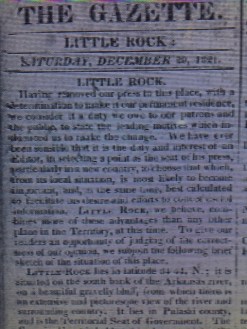
First LR ArkGaz insideAfter months of planning, on Saturday, December 29, 1821, the first edition of ARKANSAS GAZETTE to be published in Little Rock came off the press.  Due to a shortage of paper supplies, it was only a two page edition, instead of the four pages which publisher William Woodruff had been customarily printing.

Because the capitol of the Arkansas Territory had moved from Arkansas Post to Little Rock earlier in 1821, Woodruff wanted to relocate as well.  Not only did it make sense for a newspaperman to be close to the seat of government for purposes of stories, there was a financial reason for the move, too.  Woodruff wanted to continue to be the contracted official publisher of government records.  If he stayed in Arkansas Post, someone else would certainly have opened up an operation in Little Rock to do the printing.

The first Little Rock edition featured the usual mix of national news (often culled from other newspapers once they arrived at Woodruff’s establishment), local stories, and advertisements.  One of the stories was a letter from General Andrew Jackson to the citizens of the Florida Territory.  There was also a dispatch from Pernambuco, Brazil.

Because it was the first issue from Little Rock, Woodruff took time to write about Little Rock.  He noted it was located on the south side of the Arkansas River on a “beautiful gravelly bluff” with picturesque views of the river and surrounding areas.  He noted the territorial and federal government offices which were located in Little Rock.

Though the Gazette ceased publication in 1991, the 1821 publication of that paper in Little Rock set the stage for more than just that one newspaper.  It marks a continual presence of newspaper and journal publication in Little Rock for 197 years.

This afternoon – Arkansas Cinema Society presents free sneak preview of RGB biopic ON THE BASIS OF SEX

Before she was a Supreme Court Justice (and an action figure), Ruth Bader Ginsburg made history as a crusading young attorney.  This chapter of her life is the subject of the new movie ON THE BASIS OF SEX.

This afternoon (Dec 29) at 5pm, the Arkansas Cinema Society presents a free sneak preview of the film.  Doors to the Ron Robinson Theater open at 4:30.

Felicity Jones and Armie Hammer play gender-rights crusader Ruth Bader Ginsburg and her husband Marty in this early-career courtroom drama. Others in the cast include Justin Theroux, Jack Reynor, Cailee Spaeny, Sam Waterston, and Kathy Bates.  The movie was directed by Mimi Leder from a screenplay by Daniel Stiepleman.

Following the screening, there will be a panel discussion. It will feature UA Little Rock Bowen School of Law Dean Theresa Beiner; Professor Beth Levi, JD, of the Bowen School; Justice Annabelle Imber Tuck, retired member of the Arkansas Supreme Court; Judge Ellen Brantley, retired Pulaski County Circuit Court judge; and attorney Tijuana Byrd, who is president of the Women’s Foundation of Arkansas board.  The panel will be moderated by Alison Williams, who serves as Chief of Staff to Governor Asa Hutchinson and is a member of the Arkansas Cinema Society Board.

Little Rock Look Back: Christmas Day birth of actress Fay Templeton

Though largely forgotten today, Little Rock native Fay Templeton was one of the leading stars of vaudeville and Broadway in the late 1800s and early 1900s.
She was born in Little Rock on Christmas Day in 1865.  Her parents were touring here with the Templeton Opera Company. Her father, John Templeton, was a well-known Southern theatre manager, comedian, and author. Her mother, Helen Alice Vane, starred with her husband.  The family of three left Little Rock a few weeks after Fay was born, once her mother was able to travel.

She made her stage debut at age three, and her New York vaudeville debut at eight. At fifteen, she married a co-star but separated after six weeks.  She made her legitimate New York stage debut at nineteen in a revival of Evangeline.

In the late 1880s and early 1890s, she spent most of her time in Europe, appearing on stage and touring shows.  By 1895, she was back on stage in New York.  She then starred in a series of shows first for the vaudeville team of Joe Weber and Lew Fields, later for George M. Cohan. She introduced the songs “So Long Mary” and “Mary Is a Grand Old Name” in the latter’s Forty-Five Minutes from Broadway.  Her work with Cohan is portrayed in the Oscar winning film Yankee Doodle Dandy and in the Tony winning musical George M!

She retired from the stage after marrying Pittsburgh businessman William Patterson. But by 1911, Fay was once again touring with Weber and Fields.  She retired again in 1913, this time staying off stage until 1926. She then played the role of Buttercup in a revival of HMS Pinafore and would be known as the definitive Buttercup for the rest of the 1920s and into the 1930s.  When her husband died in 1932, she returned to the stage.  In 1933, she starred with Bob Hope in the Jerome Kern musical Roberta.

In 1936, she entered the Actors’ Fund Home in New Jersey, but later moved to San Francisco to live with a cousin.  She died there on October 3, 1939, and is buried in Valhalla, New York.

Templeton returned to Little Rock several times throughout her life as she was embarking on tours.

Little Rock Look Back: Birth of Eli Colby, Little Rock’s youngest mayor

On Christmas Day in 1814, future Little Rock Mayor Eli Colby was born in Warner, New Hampshire.

At the age of 23, he moved to Little Rock in 1838.  After arriving, he soon became the editor and publisher of the Times and Advocate newspaper.  As a publisher and printer, Colby also had the contract to print official state notifications and documents in the early 1840s.

Politically, Colby served as a Justice of the Peace for several years.  In September 1843, he was elected Mayor of Little Rock in a special election to fill a vacancy. He was 28 years and nine months old, making him the youngest mayor in Little Rock’s history.  He left office in January 1844.  He died March 15, 1844, at the age of 29 after a long illness and was buried with Masonic honors.

No image of him is known to exist.