Little Rock Look Back: Halloweens Past

A recent romp through an Arkansas Gazette gave insight into Halloween in Little Rock in the middle of the 20th Century.

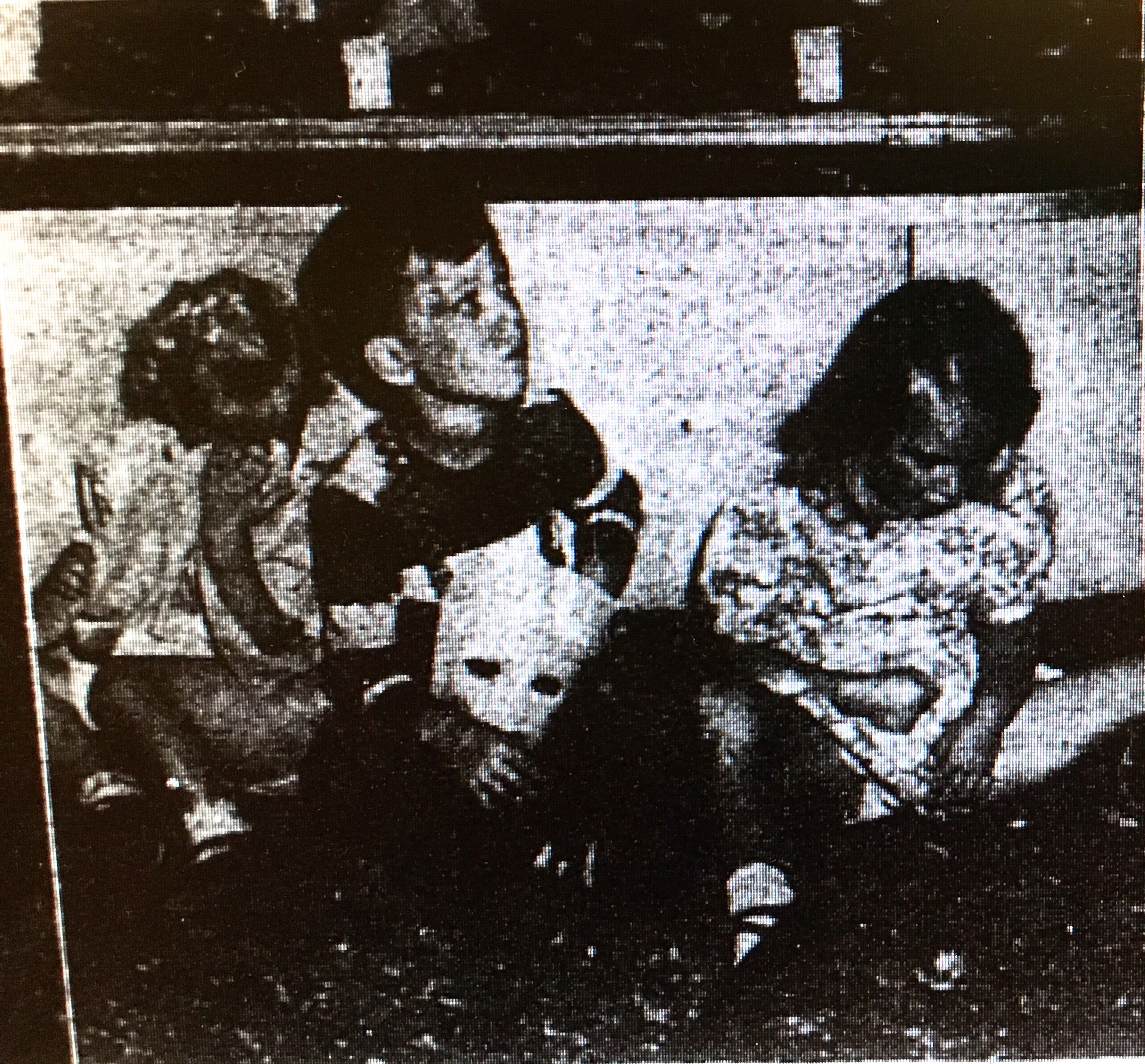
Apparently by late afternoon on Halloween 1950, downtown Little Rock was filled with kids and teens in costumes. Much of the focus seemed to be on tricks as many of these revelers were utilizing water guns to soak people, throwing enough talcum powder to create an aroma downtown, shooting off firecrackers, and soaping store windows. Several industrious store owners had coated there windows with glycerine so that soap would not mark them.

The mayhem was enough to cause even more problems to traffic at rush hour. Police officers were helpless as they were directing traffic.  One city bus filled with passengers was attacked by a phalanx of waterguns, until the windows were all closed.

A Gazette writer noted that two teen boys were dressed rather convincingly as girls. One was described as “rather pretty” until letting out an expletive which the paper reported as “g— d—–” and thus outing the individual as a male.

Not everyone was focused on tricks.  Merchants in the Heights neighborhood created a block party with a carnival. It was deemed to be so successful that it would become an annual event.

Happy Father’s Day with Rabbit Reach

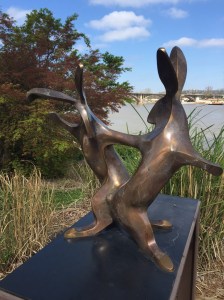
Cherry - Rabbit ReachToday is Father’s Day.  In honor of that, today’s Sculpture Vulture revisits Tim Cherry’s Rabbit Reach.  The sculpture was given in memory of two fathers.

The sculpture is a gift from Whitlow Wyatt and the Carey Cox Wyatt Charitable Foundation. It was given in memory of George Wyatt and Frank Kumpuris.  Those two gentlemen were the fathers of Whitlow Wyatt and Dean & Drew Kumpuris.

The sculpture is located at the corner of Sherman Street and President Clinton Avenue across from the Museum of Discovery.

Cherry’s sculpture was selected for this spot because of its proximity to children at the Museum and in the River Market district.  The design and size of the sculpture encourages children to climb on it and to play around the rabbit.

While some public art is situated so it cannot be touched, this one is situated to be touched as part of the appreciation experience.

Rabbit Reach received national publicity in 2015 when Melissa Joan Hart featured it on her social media while she was in Little Rock filming a movie.

Remembering the Fallen on Memorial Day at Mount Holly Cemetery

MountHolly Memorial DayToday is Memorial Day – a time to pay tribute to the men and women in uniform who died in service to their country.

As a way to give this recognition, today would be a good day to visit a cemetery. One of Little Rock’s most storied cemeteries is Mount Holly Cemetery. There are numerous persons buried there who died while in service to their country.

One of them is 2Lt Carrick W. Heiskell, son of Arkansas Gazette editor J. N. Heiskell.  2Lt Heiskell died while flying for the Air Transport Command in the Himalayas during World War II.  He was posthumously the recipient of the Distinguished Unit Emblem, Purple Heart, and the Air Medal.

Founded in 1843, Mount Holly has been called “The Westminster Abbey of Arkansas.” Thousands of visitors come each year. Those interested in history come to see the resting places of the territorial citizens of the state, including governors, senators, generals, black artisans, and even a Cherokee princess. For others the cemetery is an open air museum of artistic eras: Classical, Victorian, Art Deco, Modern––expressed in gravestone styles from simple to elaborate. Some come to read the epitaphs that range from heartbreaking to humorous to mysterious.

Though a City of Little Rock facility, the cemetery is maintained by the Mount Holly Cemetery Association, a non-profit organization with a volunteer Board of Directors. The cemetery is located at 1200 South Broadway in Little Rock. Gates are open from 8 a.m. until 5 p.m. in the summer and from 8 a.m. until 4 p.m. in the winter.

Interred within the rock walls of Mount Holly are 11 state governors, 15 state Supreme Court justices, four Confederate generals, seven United States senators and 22 Little Rock mayors, two Pulitzer Prize recipients, as well as doctors, attorneys, prominent families and military heroes.

Arkansas Heritage Month – Cinco de Mayo with Diego Rivera

portrait-of-two-womenToday is Cinco de Mayo. This Mexican holiday seems a good day to return again to the art of Diego Rivera.  He is one of the Culture Vulture favorite artists, so any excuse to discuss him and his relationship with the Rockefeller family is greatly appreciated.

One of Rivera’s masterpieces is 1914’s Portrait of Two Women which is part of the permanent collection of the Arkansas Arts Center. The official name is Dos Mujeres.  It is a portrait of Angelina Beloff and Maria Dolores Bastian.  The former was Rivera’s first wife.

This oil on canvas stands six and a half feet tall and five and a half feet wide.

Influenced by cubists such as Picasso, Rivera adopted fracturing of form, use of multiple perspective points, and flattening of the picture plane.  Yet his take on this style of painting is distinctive.  He uses brighter colors and a larger scale than many early cubist pictures. Rivera also features highly textured surfaces executed in a variety of techniques.

The painting was a gift to the Arkansas Arts Center by Abby Rockefeller Mauzé, sister of Arkansas Governor Winthrop Rockefeller.  At the 1963 opening of the Arkansas Arts Center, James Rorimer, the director of the Metropolitan Museum of Art, remarked several times to Arts Center trustee Jeane Hamilton that the Met should have that piece. Jeane politely smiled as she remarked, “But we have it.”

Of all her brothers, Abby was closest to Winthrop. The other brothers, at best ignored, and at worst, antagonized the two.  Given the complicated relationship of Rivera with members of the Rockefeller family, it is not surprising that if Abby were to have purchased this piece, she would donate it to a facility with close ties to Winthrop.  (Though the Rockefeller brothers had Rivera’s mural at Rockefeller Center destroyed, he maintained a cordial relationship with Abby Aldrich Rockefeller — well as cordial as an anti-social Communist could be with the doyenne of capitalist NYC Society.)

The Arkansas Arts Center has several other works of art in their collection with ties to Mexico. Some are by Mexican artists. Others are inspired by Mexico. They have several by Elsie Fruend depicting scenes in Mexico.

Little Rock Look Back: Original STAR WARS Trilogy

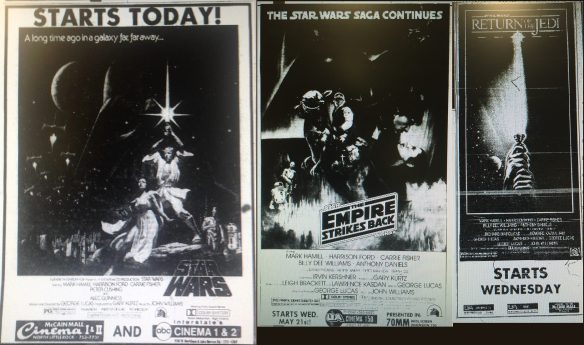
StarWarsTrilogyadsToday, May the 4th, is Star Wars Day.

The classic film first opened in May 1977 (though after May 4).  It did not reach Little Rock until June 24, 1977.

Given its status as a sleeper hit, it is no surprise that it came into Little Rock largely unnoticed.  In that day, major films opening on a Friday would be heralded the previous Sunday with a substantial advertisement.  The first Star Wars ad ran on Thursday, June 23, 1977, the day before it opened.  By contrast, Herbie Goes to Monte Carlo, which would play at the same theatre, had a large ad on Sunday, June 19.

While Star Wars would seem like the perfect movie for the great UA Cinema 150, it did not play there.  The film playing at the 150 was A Bridge Too Far, which was, at least an action movie.  Star Wars did not even open at a UA theatre.  It opened at the ABC Cinema 1 & 2 (located at Markham and John Barrow) and at the McCain Mall Cinema.  (The ABC Cinema location is now home to discount cellphone and discount clothing businesses; a cinema has returned to McCain Mall, but now in the location of the former MM Cohn’s store.)

The day it opened, there was a fairly large ad which incorporated the familiar beefcake Luke, Leia in flowing gowns, and Darth Vader mask.  On the Sunday after it opened, there was a slightly smaller ad with the same artwork.  McCain Mall also ran a small add for both Star Wars and Herbie. It noted that Star Wars was a film that management “does not recommend for children.”

Three years later, The Empire Strikes Back opened nationwide on May 21, 1980. Opening a film on the same date was a newer phenomenon, due in part to the success of Star Wars.  For the opening weeks, The Empire Strikes Back played an exclusive showing at the UA Cinema 150.  It would eventually play at other theatres in Little Rock.   It is interesting to note what was playing at the two theatres which had originally screened the 1977 film.  The McCain Mall Cinema was showing Coal Miner’s Daughter and The Fog. The former ABC Cinema was now the Plitt Southern Theatre and showed the Bill Murray comedy Where the Buffalo Roam and the Get Smart movie The Nude Bomb.  None were likely to attract the same number of audience members as The Empire Strikes Back.

On the day The Empire Strikes Back opened, the Arkansas Gazette had four different stories about the movie in that day’s edition.  While the Arkansas Democrat did not have any stories that day (though they would in subsequent days), they did carry a story on David Letterman preparing to start his (what would turn out to be short-lived) morning TV show.

On May 25, 1983, The Return of the Jedi opened.  Like the first film, though it would have been perfect for the Cinema 150, it did not play there.  Instead it played at the UA Cinema City (Breckenridge Village), the UA Four (at Geyer Springs and I-30 – now the Ron Sherman production studios), and at McCain Mall.  Flashdance was playing at the Cinema 150. In a forerunner of what is now standard practice, The Return of the Jedi played simultaneously on two of the seven screens at UA Cinema City and two of the four screens at UA Four.  While this is now part of the modus operandi, at the time, it was extremely rare to have a movie play on more than one screen in the same complex.  Though each of the theatres was smaller than the Cinema 150, the five combined exceeded the availability if it had played an exclusive run at the Cinema 150.

By the time The Return of the Jedi opened, the former ABC Cinema was now part of the ill-fated locally-based Rand Cinema chain and was known as the Markham 1 & 2.  It was showing the Roy Scheider film Blue Thunder and Dan Aykroyd in Dr. Detroit.

The cost to see The Return of the Jedi in Little Rock in 1983 was $5.00 for adults and $2.50 for children.

 

Happy Easter from the Sculpture Rabbits

Downtown Little Rock has at least three different sculptures of rabbits.  Since today is Easter Sunday and the Easter Bunny is making his rounds, it seems a good day to highlight these sculptures.

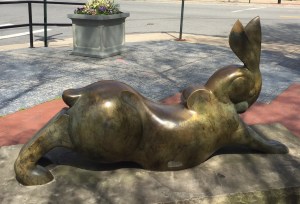
In the Vogel Schwartz Sculpture Garden, Laurel Peterson Greg’s Bunny Bump has been providing whimsy since 2010.

Bunny Bump


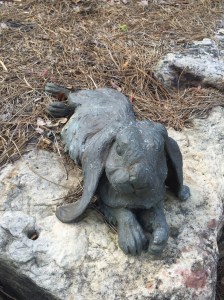
A few yards from the bumping bunnies, James Paulsen’s Lopsided presents a much more laconic rabbit.

Lopsided


And at the corner of President Clinton Avenue and Sherman Street, Tim Cherry’s Rabbit Reach welcomes visitors to the River Market.  It was placed in memory of George Wyatt and Frank Kumpuris by Whitlow Wyatt and the Carey Cox Wyatt Charitable Foundation.

Rabbit Reach

Little Rock Look Back: St. Patrick’s Day with Mayor Pat L. Robinson

IMG_4517On this date in 1900, future Little Rock Mayor Pat L. Robinson was born.  While I cannot verify that he was indeed named after St. Patrick, it would be fairly reasonable to assume there might be a connection.

Robinson was a rising star of Little Rock Democratic politics.  In April 1929, just weeks after his 29th birthday, he was elected Mayor.  He had twice been elected as City Attorney (1926 and 1928) and was one of the youngest to serve in that position.

During Mayor Robinson’s tenure, he announced plans to construct a new airport.  That project led to the creation of what is now the Bill and Hillary Clinton National Airport.  Mayor Robinson was also involved in helping Philander Smith College secure the property where it is now located.  In addition, during his tenure, what is now the Museum of Discovery was folded into the City of Little Rock.  Shortly after taking office, he championed several projects for approval by Little Rock voters. The projects he supported were approved; the ones he did not support did not pass.

Single at the time he was in office and generally considered good looking, Mayor Robinson was sometimes referred to as the “Jimmy Walker of the Southwest.” Walker was the handsome and charming Mayor of New York City at the time.

Mayor Robinson ran afoul of some of the Democratic party leaders. Records don’t seem to indicate exactly what actions he took or did not take.  One thing that is brought up is that the City went into financial distress during his tenure.  Considering the Wall Street crash happened shortly after he took office, that financial state was not unique to Little Rock.

IMG_4532During this era in Little Rock, it was customary for an incumbent mayor to be given a second term. But City Clerk Horace Knowlton challenged Robinson in the primary.  It was a bitter campaign with Robinson linking Knowlton to disreputable denizens and Knowlton charging Robinson with “an orgy of spending.”  Robinson initially came out 17 votes ahead. But after a review and a lawsuit, it was found that Knowlton ended up with 10 more votes and became the nominee.  At the time, being the Democratic nominee was tantamount to election.

After he left office, Robinson practiced law for a few years in Little Rock and then left the city.  Records do not indicate where he went but he no longer appeared in the City of Little Rock directory by the early 1940s.  In the 1940 census he is listed as divorced and a lodger living with a couple.