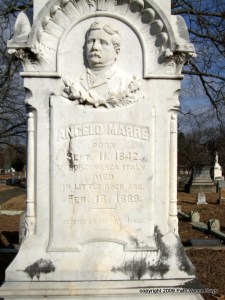
Birth of the man who built the Villa Marre

On September 11, 1842, future Little Rock Alderman Angelo Marre was born in Borzonaca, Italy.  He immigrated to Tennessee with his parents in 1854.
During the Civil War, he served in the Confederate Army. From 1865 to 1868, Angelo Marre worked for the Memphis Police Department but was forced to resign after he was accused of killing a man during an argument.  After his acquittal, he returned to the saloon business.  In 1872 Marre was convicted of stealing money and sentenced to three years in prison.

Tennessee Governor John Brown granted Marre a full pardon two years into his sentence, and he regained his citizenship in 1879.

After getting out of prison, he claimed an inheritance and joined his brothers in Little Rock.  He worked as a bartender at the Metropolitan Hotel.  He later opened a saloon and billiard parlor.

By the mid-1880s, Marre owned two saloons, a liquor import business, an office building in downtown LR, 3,000 sharesof stock in mining companies operating in Garland and Montgomery counties, and he was the first president of Edison Electric Company of LR.

In 1883, he was elected as an alderman on the Little Rock City Council.  He lost is bid for reelection in 1885. In 1888, he was an unsuccessful candidate for Pulaski County Sheriff.

villamarreAngelo Marre died February 18, 1889, as a result of his infection.  He is buried at Calvary Cemetery in LR. His custom designed, marble monument was ordered from Florence, Italy, and cost $5,000.

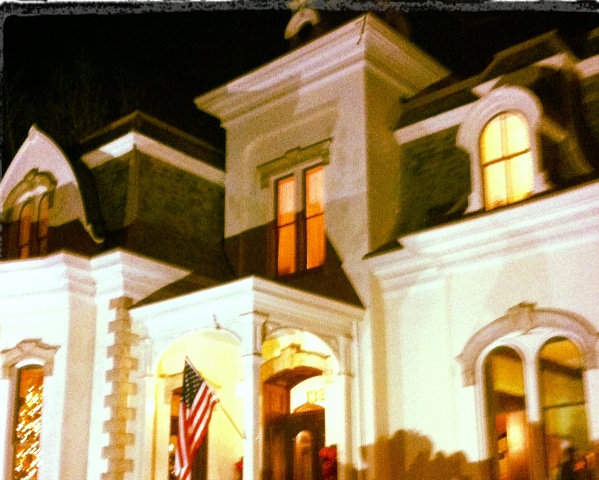
Marre is probably best known today as the builder of the structure now known as the Villa Marre.  Built in 1881, it is designed in the Italianate and Second Empire styles.  It was built in 1881 and 1882 on Block 21, Lots 5 & 6 of the Original City of Little Rock.  The cost was $5,000.

It was originally a red brick structure and has been modified and expanded several times as well as painted white.  It did not bear the name Villa Marre until the 1960s when historic preservation advocate Jimmy Strawn gave it that name.

After serving as the headquarters for the Quapaw Quarter Association for several years, it was returned to a private residence.  It is now available for special events and rentals.

The Villa Marre is probably best known locally and nationally for serving as the facade for the Sugarbaker design firm on the CBS sitcom “Designing Women.”  Though the interior of the house does not match the interior on TV, the building was featured in the opening credits as well as in exterior shots each week.

Final plans approved for “new” (and still current) Little Rock City Hall in 1906

City Hall circa 1908

After a judge ruled in August 1906 that the City of Little Rock could not build a new City Hall and Auditorium complex, it looked like Little Rock would be stuck with its existing inadequate building.

However on September 10 it became obvious that much work had been taking place behind the scenes after that ruling.  On that day, the Board of Public Affairs (a City body charged with overseeing municipal government construction projects and comprised of the mayor and two citizens approved by the City Council) voted to ask the aldermen to cancel plans and rescind legislation for the city hall, jail and auditorium complex.  The Board of Public Affairs then offered up a new plan for a city hall and jail building.  Because no auditorium was involved, these plans would not be in violation of the Chancery Court.

That same evening the City Council followed suit and revoked the plans for the original project.  The aldermen then voted to proceed with building a new city hall and jail without the auditorium.  There was only one dissenting vote; Alderman Jonathan Tuohey voted no.  He explained his negative vote was not a lack of support for the project, but he was not comfortable with the way it was rushed through.

Mayor Warren E. Lenon told the Gazette, “The Chancery Court has enjoined us from erecting an auditorium and the Board of Public Affairs has consequently rescinded all resolutions and orders pertaining to that structure.” He noted that there would “be no appeal from the injunction granted by Chancellor Hart, because there is nothing to appeal.”

The coverage of the actions of the City Council that night was in keeping with the manner in which the two daily newspapers had covered the lawsuit and the trial.  The Gazette headline cried “City Hall Ordinance Railroaded Through” while the staid Democrat merely stated “New $175,000 City Hall Provided by City Council.”  The tone of theGazette’s article matched the headline while the Democrat’s story was more straightforward.

Architect Charles Thompson adjusted his plan for the new City Hall by removing the auditorium wing.  With the revised Th0mpson plan and the approval of the City Council, Little Rock was at last on its way to a new City Hall.  This was over two years after Mayor Lenon had first broached the subject.

Originally slated to open in 1907, the building officially opened in April 1908.

The “Battle” of Little Rock – 156 years ago on Sept. 10, 1863

The Civil War came to an end for Little Rock 156 years ago today (September 10) as Federal troops took control of the city.  Unlike some other Southern capitols, there was no long siege or bloody battle.

On September 10, 1863, Confederate forces under General Sterling Price evacuated Little Rock in advance of Federal forces, thus ending the Little Rock Campaign. By 5:00pm, his forces had left the city and at 7:00pm, civil authorities formally surrendered. Little Rock became the fourth Southern capital to come under Federal control.

The battle was the culmination of a campaign launched by Maj. Gen. Fred Steele, on August 1, 1863 to capture Little Rock. The campaign includes engagements at Westport, on 14 August, Harrison’s Landing, on 16 August, Brownsville on 25 August, the Reed’s Bridge, on 27 August, and Ashley’s Mills on 7 September 1863. After the Union army affected a river crossing east of Little Rock, effectively flanking the Confederate defenses north of the river, the Confederates staged a brief delaying action at Bayou Fourche to allow for evacuation of Little Rock.

As local historian Dr. Bobby Roberts has noted, “It was really more of a ‘skirmish’ than an actual ‘battle.’”

City of Little Rock leaders must have been anticipating the result of the battle.  In August 1861, they took the City’s treasury to an undisclosed location and started scaling back on City government.

The Battle of Little Rock is also known as the Battle of Bayou Fourche.

60 Years since the Labor Day bombings of 1959

ARKANSAS GAZETTE photos showing the exterior and interior of the LRSD building after the bomb blast.

On September 7, 1959, a peaceful Labor Day in Little Rock was shattered by the explosions of three dynamite bombs.

The locations were Fire Chief Gene Nalley’s driveway on Baseline Road at 10:20pm, Baldwin Company offices at Fourth and Gaines at 10:53pm (where Little Rock Mayor Werner Knoop was a partner–the company is now known as Baldwin Shell), and the School District offices at 10:58pm (then located at Eighth and Louisiana streets).

Given the three targets, it was fairly quickly assumed that there was a connection between the bombings and the lingering effects of the 1957 integration crisis. In light of that, police officers were stationed at the homes of all Little Rock City Directors and School Board members.

The investigation into the bombings turned up a purported fourth location for a bomb. That was the office of Letcher Langford. (Culture Vulture Editorializing Note:  This could have been a ploy to throw investigators off the scent. Langford was the only City Director who had been backed by segregationist candidates and had been openly hostile to the Women’s Emergency Committee — to the point of threatening them with legal action for not disclosing their membership rolls.)

Investigators determined that the bombing had been planned in late August by members of the Ku Klux Klan.  Five individuals were arrested.  They were J. D. Sims, Jesse Raymond Perry, John Taylor Coggins, Samuel Graydon Beavers, and E. A. Lauderdale.  The latter had twice been an unsuccessful candidate for the City Board of Directors.

Sims pleaded guilty and started serving a prison term later in September 1959.  Perry, Coggins and Beavers all went to trial in October and November.  Each was found guilty. Their terms ranged from three to five years.  Lauderdale was convicted, but appealed his decision. Though the Arkansas Supreme Court upheld the verdict against him, he did not start serving his sentence until the court decision in February 1961.

Governor Faubus commuted the sentences of Perry, Coggins and Beavers.  All three served less than six months.  Lauderdale’s sentence was reduced by Faubus so that he, too, was eligible for release after six months.  Sims, who was first to plead, served the longest: nearly two years.

Sadly, this would not be the last bombing in Little Rock tied to 1957. In February 1960, Carlotta Walls’ house was bombed.

The Arkansas Arts Center was formally established on Sept 6, 1960

Architectural model of the original Arkansas Arts Center which would open in 1963.

On Tuesday, September 6, 1960, the City of Little Rock Board of Directors adopted ordinance 11,111 which formally established the Arkansas Arts Center.

In July 1957, the City Council of Little Rock granted the Museum of Fine Arts the authority to solicit and receive funds for expanding that museum’s physical plant.  During that process, it had been decided that the museum needed an expanded mission and a new name.  By the summer of 1960, the museum supporters had raised sufficient funds to proceed with constructing the new facility.  Therefor the new ordinance was prepared and submitted to the City Board.  (In November 1957, the City Council had been replaced by a City Board.)

Ordinance 11,111 set forth that the Museum of Fine Arts would be known as the Arkansas Arts Center and that the previous museum’s board would serve as the board for the new museum.  The Board of the Arkansas Arts Center was given the authority to have the new building constructed in MacArthur Park and the existing building modified.  As a part of the planning for the new museum, the City committed $75,000 for the capital campaign.

The groundbreaking for the new museum would take place in August 1961.  Mayor Werner Knoop, who signed Ordinance 11,111, took part in the groundbreaking.

Media attending the September 6, 1960, City Board meeting were more interested in discussion about a potential leash law for dogs within the City limits.