
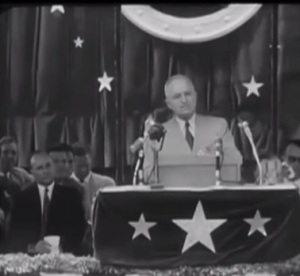
 Though President Truman was in Little Rock for a military reunion, he did conduct some official business while here. In his Presidential role, he spoke at the dedication of War Memorial Park on June 11, 1949.
(It is sometimes erroneously reported that he dedicated the stadium. That took place in September 1948, at a Razorback game with former Razorback player and future Lt. Governor Maurice “Footsie” Britt delivering the keynote.)
President Truman’s address took place inside War Memorial Stadium at 2:30 p.m.. It was not a brief dedicatory speech, but instead was a lengthy treatise on foreign affairs. The address was carried live on nationwide radio (though some radio networks opted to broadcast it later). The text of his address can be found here.
The stadium was by no means full. A major reason for that was that many thousand individuals had turned out to witness a parade downtown in which President Truman marched along side Governor Sid McMath. The parade was in conjunction with the military reunion. Given the June heat in Arkansas (in which parade spectators had been standing for several hours) and the difficulty of getting from the parade route to the stadium, most (if not all) parade spectators opted for skipping the presidential address.
Before the parade, President Truman (who was still riding high from his upset victory in the 1948 election) was asked by a local reporter if he would run in 1952. He refused to answer stating that the national media would think he had planted the question with a local member of the press.
Prior to the name War Memorial Park, the land had been known as Fair Park. It was a former location of the State Fair. In the 1930s, it had briefly been known as Overman Park in honor of then-Mayor R. E. Overman. The City Council had named it for him as a tribute to his work on a variety of projects. When he displeased them, they reversed their decision and renamed it to Fair Park.
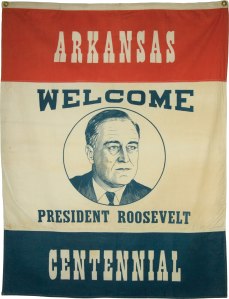 On June 10, 1936, President Franklin D. Roosevelt visited Little Rock as part of a day-long series of appearances in conjunction with the Arkansas Centennial celebration. (The actual statehood dates is June 15.)
 Outside of his capacity as President of the United States, Harry S. Truman visited Little Rock on June 10, 1949, for the annual reunion of the 35th Division, his World War I unit. He was joined on this trip by members of Arkansas’ congressional delegation and his sister.
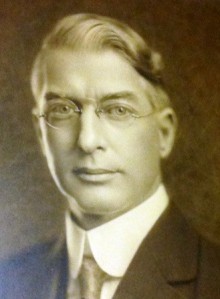 On June 8, 1873, future Little Rock Mayor Ben D. Brickhouse was born in Virginia. He moved to Texas as a child before his family settled in Arkansas.
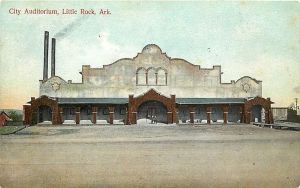 On June 7, 1920, the Little Rock City Council finally authorized the demolition of Little Rock’s 1906 temporary auditorium. The structure had originally been built as a skating rink which, when chairs were added, could be used for public meetings. Since the mid 1910’s, the City Council had discussed tearing it down over safety concerns. But since Little Rock had no other structure as a substitute, the Council kept delaying the decision.


 Little Rock Culture Vulture