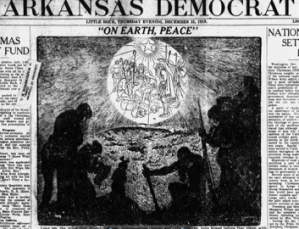
An early Christmas present in 1937, Robinson Auditorium groundbreaking on Christmas Eve

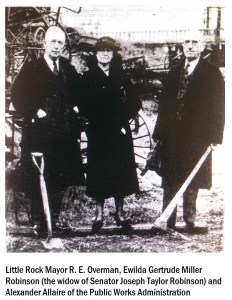
On December 24, 1937, at 11:30 a.m., Little Rock Mayor R. E. Overman, Ewilda Gertrude Miller Robinson (the widow of Senator Joseph Taylor Robinson) and  Alexander Allaire of the PWA turned dirt to participate in the brief groundbreaking ceremony for Little Rock’s municipal auditorium.
That morning, the Arkansas Gazette ran a brief story on the upcoming groundbreaking.  The story mentioned that the building would be named in memory of the late beloved Arkansas politician.  This appears to be the first public pronouncement of the Robinson name for this civic structure.

Among others in attendance at the groundbreaking were Mrs. Charles Miller (sister-in-law of Mrs. Robinson), Mr. and Mrs. Grady Miller (brother and sister-in-law of Mrs. Robinson), the mayor’s wife, the three architects (George Wittenberg, Lawson Delony and Eugene John Stern), and D. H. Daugherty and Will Terry of the City’s Board of Public Affairs.

Construction had to start by January 1, 1938, in order to receive PWA funds.  By breaking ground on December 24, there was over a week to spare.  The site had been selected in late October 1937, and the purchase had not been finalized.  But the PWA did give permission for the City to let a contract for excavation, demolition and filling on the site.

The groundbreaking took place at the corner of Garland and Spring Streets which was on the northeast corner of the block set aside for the auditorium.  Today, Spring Street does not extend north of Markham; the street was closed to make way for the parking structure and what is now the Doubletree Hotel.  That section of Garland Street is basically an alley that runs parallel to Markham north of City Hall, Robinson Auditorium and the Doubletree Hotel.

Birth of Little Rock’s 16th Mayor – Roswell Beebe

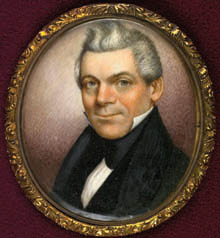
On December 22, 1795, future Little Rock Mayor Roswell Beebe was born in Hinsdale, New York.  His family were wealthy English immigrants.  At seventeen, Beebe went to New Orleans and fought with Andrew Jackson in the 1815 Battle of New Orleans.  He stayed in the Crescent City for the next two decades building successful lumber and brick businesses.

Due to health concerns, he moved north to a drier climate in 1834.  After first stopping in Fulton, Arkansas, he settled in Little Rock in 1835 at the age of forty.  He stayed at the home of Chester Ashley and married Ashley’s sister-in-law, Clarissa Elliott.  He and Clarissa had two children, Roswell and Cora.

For nearly 30 years, Little Rock had a complicated history of deeds, titles and land ownership.  In 1839, Beebe went to Washington DC and received the original patent from President Martin Van Buren.  He then set about clearing up the land and title issues, as well as drawing up a plan for the city and laying off blocks and streets.  Beebe deeded the streets and alleys to the City for a dollar.  He also donated the land on Markham Street for a new State Capitol building (now home of the Old State House Museum).  Along with his brother-in-law Chester Ashley, he donated the land for the establishment of Mount Holly Cemetery.

In 1848, Beebe was elected to the Little Rock City Council.  The following year, he was elected Mayor.  He served as Mayor of Little Rock from April 1849 to February 1850.

While his primary business focus in the 1840s had been real estate, in the 1850s he focused on railroads.  Beebe was named president of the Cairo and Fulton Railroad Company in 1853.

While on a visit to New York, Beebe died on September 27, 1856.  His body was returned to Little Rock, and Roswell Beebe was buried at Mount Holly Cemetery.  The town of Beebe, Arkansas, is named in his honor.

Original bonds sold for construction of Robinson Auditorium on Dec. 20, 1937

On December 20, 1937, the Little Rock City Council adopted Resolution 1,418 which authorized the sale of municipal bonds to fund the municipal auditorium.
Earlier that year, Little Rock voters had authorized the sale of $468,000 of Municipal Auditorium Bonds.  Since that January election, city leaders had been undertaking various steps to plan for the project.  Finally, they were ready to sell the bonds.  On December 20, a public sale was held.  The US federal government made a bid for the purchase of $418,000 of the bonds. It was the only bid received.

The sale was accompanied by an Emergency Clause so that it would go into effect immediately.  The clause noted: “It is ascertained and declared that by reason of the present economic conditions many citizens of the City are out of work, and the improvements herein provided would furnish work for a large number of persons and thereby add to the peace and happiness of the City; further, that the City has no Municipal Auditorium or facilities for large conventions or gatherings…”

The offer by the US Government to purchase the bonds was in addition to an outright grant of $342,000 to help fund the auditorium.

While there would be other issues in financing and funding the project, the sale of the bonds on December 20, 1937, set things in motion which led to the February 16, 1940, opening.

As Skywalker rises, a look back to STAR WARS opening in LR in 1977

As a third grade boy, I remember devouring the novelized version of Star Wars in 1977. I read everything I could about the movie. I owned (and still have) the two disc London Symphony Orchestra soundtrack on LP.
I was a few months late to Star Wars figures, but Christmas of 1977 and birthday of 1978 did feature them as gifts. (I promptly lost my Sandcrawler weapon at my grandparents’ house on Christmas day.)

In those early days, I was excited by the idea of NINE Star Wars movies. Then, I gave up hope when George Lucas abandoned them after Return of the Jedi. When the prequels were announced during my adulthood, I was excited. Only to be disappointed by the actual movies (though admittedly they did get better by episode 3).

Then in 2015, the day my eighth grade self dreamed of, was here: what happens AFTER Return of the Jedi?  I saw The Force Awakens and flashed back to those early days. (Cynics might say it was because so much of Episode 7 was a retread of Episode 4.)  While 2017’s The Last Jedi may have disappointed or confused some fans, it offered many memorable moments.

And today: 42 years after it all began, (after sneak peeks last night), The Rise of Skywalker, the long promised ninth installment opens.

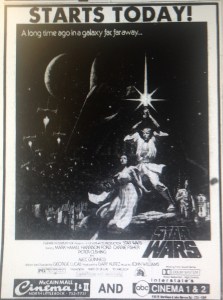
First ad in Arkansas Gazette (June 23, 1977)

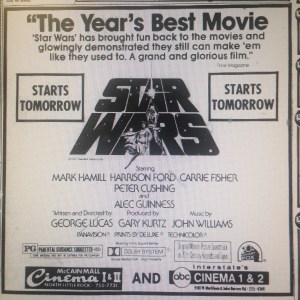
In honor of Star Wars: The Rise of Skywalker‘s opening day, here is a flash back to the Arkansas Gazette ad in June 1977 when the first film hit Little Rock (a full month after it first opened in New York).

It did not reach Little Rock until June 24, 1977. Given its status as a sleeper hit, it is no surprise that it came into Little Rock largely unnoticed.

In that day, major films opening on a Friday would be heralded the previous Sunday with a substantial advertisement. The first Star Wars ad ran on Thursday, June 23, 1977, the day before it opened. By contrast, Herbie Goes to Monte Carlo, which would play at the same theater, had a large ad on Sunday, June 19.

While Star Wars would seem like the perfect movie for the great UA Cinema 150, it did not play there. The film playing at the 150 was A Bridge Too Far, which was, at least an action movie. Star Wars did not even open at a UA theatre. It opened at the ABC Cinema 1 & 2 (located at Markham and John Barrow) and at the McCain Mall Cinema. (The ABC Cinema location is now home to discount cellphone and discount clothing businesses; a cinema has returned to McCain Mall but in a different location.)

The day it opened, there was a fairly large ad which incorporated the familiar beefcake Luke, Leia in flowing gowns, and Darth Vader mask. On the Sunday after it opened, there was a slightly smaller ad with the same artwork. McCain Mall also ran a small add for both Star Wars and Herbie. It noted that Star Wars was a film that management “does not recommend for children.”

51 years since first full-length, locally produced THE NUTCRACKER was presented in Little Rock at Robinson Auditorium

In December 1968:

  • the final stretch of Interstate 40 between Little Rock and Memphis was completed. (Little did anyone know that milestone merely meant work would change from construction to non-stop reconstruction.)
  • Talks were underway about merging private Little Rock University with the University of Arkansas system (which would be finalized in the summer of 1969).
  • On the TV on December 19, “The Little Drummer Boy” TV special was being shown for the first time.  Also, Arkansan Glen Campbell was one of the guest stars on Bob Hope’s Christmas TV special.

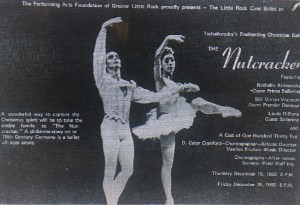
For those who did not sit at home watching TV, at Robinson Auditorium on December 19 and 20, 1968, the nascent Little Rock Civic Ballet (a forerunner to today’s Ballet Arkansas) presented its first production of THE NUTCRACKER.

Under the direction and choreography of D. Cater Cranford, this production featured 135 performers, a fifty piece orchestra under the direction of Vasilios Priakos, and the largest number of stagehands in Robinson Auditorium’s history.  The production cost $25,000 to mount.  That would be the equivalent of just over $184,775 in 2019.

A large portion of the money went to renting sets from Dallas for the production. The costumes were designed and sewn by Cranford.  He also appeared as Drosselmeyer in the production.  His wife Lorraine, assisted with the choreography and also appeared on stage.

Though most of the dancers were local, the leading roles were danced by Bill Martin-Viscont, Nathalie Krassovak, Linda DiBona, Margo Dean and Carl Tressler.  Some of the dancers who had rehearsed for the production were unable to participate due to several cast members coming down with flu in the days immediately prior to the production.

The production sold out both public performances as well as the daytime matinee for school children.  The dress rehearsal on December 18 was opened up for children with disabilities to attend.

Though The Nutcracker has not been presented in Little Rock every year since 1968, it has certainly been on stage most of the years since then.  The overwhelming response to this production set the stage for it to become a much-loved holiday tradition in the city.