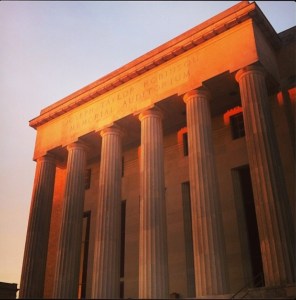
Little Rock Look Back: Robinson Auditorium opens in 1940

auditoriumduskOn February 16, 1940, after three years of planning and construction including several delays due to lack of funding, the Joseph Taylor Robinson Memorial Auditorium officially opened. It was a cold, rainy night, but those in attendance did not care.

Searchlights painting arcs in the sky greeted attendees. They were borrowed from the Arkansas National Guard. Newspaper accounts noted that only a few of the men who attended were in tuxedos, most were simply in suits. The work to get the building opened had been so harried, that it was discovered there was not an Arkansas Flag to fly in front of the building. Mayor Satterfield found one at the last minute courtesy of the Arkansas Department of the Spanish War Veterans.

The weather delayed arrivals, so the program started fifteen minutes late. Following a performance of Sibelius’ Finlandia by the fledgling Arkansas State Symphony Orchestra, Mayor J. V. Satterfield, Mrs. Joseph T. Robinson, Mrs. Grady Miller (the Senator’s sister-in-law and a member of the Auditorium Commission) and D. Hodson Lewis of the Chamber of Commerce participated in a brief ribbon cutting ceremony. Mrs Robinson cut the ribbon on her second attempt (once again proving that nothing connected with getting the building open was easy).

The ceremony was originally set to be outside of the building but was moved indoors due to the inclement weather. The ribbon cutting took place on the stage with the ribbon stretched out in front of the curtain. The opening remarks were broadcast on radio station KGHI.

Mr. Lewis, Mrs. Miller and Mayor Satterfield look on as Mrs. Robinson cuts the ribbon

Mr. Lewis, Mrs. Miller and Mayor Satterfield look on as Mrs. Robinson cuts the ribbon

Though he had previously discussed how he had voted against the auditorium in 1937 before entering public life, the mayor’s remarks that evening were appropriately gracious, statesmanlike and a testament to the effort he had invested to get it open upon becoming mayor. “We hope you have a very pleasant evening and hope further that it will be the first in a long series which you will enjoy in this, your auditorium.”

Tickets for the event, advertised as being tax exempt, were at four different pricing levels: $2.50, $2.00, $1.50 and $1.00.

The estimated attendance was 1700. Following the ribbon cutting, the main performance took place. The headliner for the grand opening was the San Francisco Opera Ballet accompanied by the new Arkansas State Symphony Orchestra (not related to the current Arkansas Symphony Orchestra). The featured soloist with the ballet was Zoe Dell Lantis who was billed as “The Most Photographed Miss at the San Francisco World’s Fair.”

At the same time that the gala was going on upstairs in the music hall, a high school basketball double-header was taking place in the downstairs convention hall. North Little Rock lost to Beebe in the first game, while the Little Rock High School Tigers upset Pine Bluff in the marquee game.
Little Rock Look Back: Mayor John Wassell

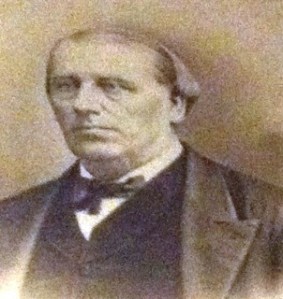
JWassellFuture Little Rock Mayor John Wassell was born on February 15, 1813 in Kidderminster, England.

In 1829, he came to the United States.  He learned carpentry and construction in Ohio and ended up in Little Rock.  One of his jobs was as the finishing contractor on the State Capitol building, now known as the Old State House.

He later gave up carpentry and became an attorney.  (It is said that he did so after becoming embroiled in a legal dispute arising from one of his construction jobs.) Wassell also served as a judge.

In 1868, he was appointed Mayor of Little Rock by President Andrew Johnson.  He is Little Rock’s only Mayor to have served through a military appointment.  Mayor Wassell died in January 1881 and is buried at Mount Holly Cemetery along with his wife and other family members.  One of his grandsons, Samuel M. Wassell also served as Mayor of Little Rock.

A Lincoln Viaduct Portrait

Photo courtesy of the Arkansas Historic Preservation Program

Photo courtesy of the Arkansas Historic Preservation Program

Since today is Abraham Lincoln’s birthday, it is a good day to pay tribute to the Lincoln Avenue Viaduct.  This arched bridge is traversed by thousands of cars each day, with most having no idea the name of the structure.  The Lincoln Avenue Viaduct is the arched bridge connecting LaHarpe with Cantrell Road which (literally) bridges downtown with the west along Highway 10.

The Lincoln Avenue Viaduct is a reinforced concrete rainbow arch bridge. It was opened at 2:05 p.m. on Friday, December 28, 1928, and, despite later alterations, it remains particularly well-preserved. The Missouri Pacific Railroad Company, considered the most important railroad company in the state, constructed the bridge amid a series of improvements in Little Rock made necessary by the damage wrought by the infamous spring floods of 1927.

Though the bride was constructed by the railroad, the City had to give authorization to do so, this was accomplished by the passing of Ordinance 4,335, at the May 28, 1928, City Council meeting.

Lincoln Avenue was one of several names for stretches of Highway 10 in Little Rock. By the 1960s, the areas west of the Lincoln Avenue viaduct were all renamed Cantrell in honor of the man who had developed much of the area west of the Heights. The longest stretch of the road already carried that name. There had been an effort to rename Highway 10 (including sections named Lincoln, Q, and Cantrell) in Little Rock for Senator Joseph Taylor Robinson in 1930. He declined the offer because he did not want to diminish the contributions of Mr. Cantrell.  Over time the entire stretch bore the name Cantrell.

The stretches east of the viaduct which involved a couple of names were renamed La Harpe Boulevard in honor of the French explorer who first saw the Little Rock.

Though the street has been renamed, the bridge still carries the name of the 16th President of the United States.

Little Rock Look Back – Abraham Lincoln

Abraham_Lincoln_November_1863On February 12, 1809, Abraham Lincoln was born in Kentucky.

Lincoln never visited Arkansas. In the 1860 election, he barely registered on the Arkansas election map. Arkansas counties went strongly for Southern Democratic candidate John Breckinridge.  John Bell, the Constitutional Union/Whig candidate ran strongly in Pulaski County and a scattering of other counties.  Neither Lincoln nor Northern Democratic candidate Stephen Douglas carried a county in Arkansas.  In 1864, though Arkansas was officially under control of the Union forces, the state had not been readmitted. Therefore no Arkansans voted for Lincoln that year.

As President, Lincoln did correspond with several Arkansans.  It is said that the polite written exchanges he had with former Mayors C. P. Bertrand and Gordon Peay were helpful in maintaining a fairly peaceful occupation of Little Rock by federal forces.

In the listing of Presidential Streets of Little Rock, Lincoln is omitted.  On first blush, this might seem to be intentional to skip the name of the President who oversaw the “occupation.”  However, if that were the case, then surely Johnson would have been left out as well since he was President during the final years of the federal military occupation.  In fact, there once was a Lincoln Street. A portion of what is now Cantrell/Highway 10 was named for Lincoln. It predated the other Presidential streets.  At the time the other streets were laid out, Lincoln was skipped because a street already bore the name.

Over time, Highway 10 had been given multiple names for various sections: Lincoln, Q, and Cantrell. In the 1930s, these names were consolidated into Cantrell which was the longest section. The name Lincoln was dropped. There were very few addresses on Lincoln, most of it was railroad property.  The viaduct connecting Highway 10 with LaHarpe still bears the name of Lincoln Avenue.

In 2008, Sam Waterston appeared at the Clinton School of Public Service to kick off the Abraham Lincoln Sesquicentennial celebration activities. The official launch was supposed to be elsewhere but was cancelled due to inclement weather. So it happened in Little Rock as Waterston appeared in a program reading letters and writings from throughout Lincoln’s lifetime.  In 1994, Waterstson had received a Tony Award nomination for starring in the Lincoln Center revival of Abe Lincoln in Illinois.

Super Bowl Sunday Little Rock Look Back: Copper Bowl

Copper Bowl

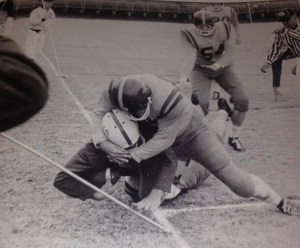
A Little Rock police officer tackles a NLR player in one of the Copper Bowls.

Today is Super Bowl Sunday, so it seems to be a good time to remember the five year series of football games in Little Rock known as the Copper Bowl.

From December 1959 through December 1963, the Little Rock Police Department played the North Little Rock Police Department in a series of football games.  The Copper Bowl games were fundraisers to help the LRPD provide food and presents for needy families during the Christmas season.

The agreement was that the teams would play for five years. The team with the most wins would permanently receive the Copper Bowl trophy.  The LRPD was outfitted with uniforms from Little Rock University and Louisiana State University (thanks to the efforts of Sgt. Harold Zook).  The games were played at Quigley Stadium.

Before the final game on December 1, 1963, the series was tied at 2-2.  The LRPD team won the game and permanently captured the trophy.  Over the five year period several thousand dollars were raised.

Little Rock Look Back: Acting Mayor John Herndon Hollis

John Herndon HollisOn February 5, 1870, future Little Rock alderman and acting mayor John Herndon Hollis was born shortly before his family moved to what is now Cleveland County. His parents were originally from Georgia and came from prosperous and longtime families there.

The Hollis family came to Arkansas after the Civil War and settled in Union County. A portion of that county was carved off and became Dorsey County (named after a Republican US Senator from Arkansas) but was renamed Cleveland County after Grover Cleveland was elected President. Cleveland was the first Democrat to be elected President in over 20 years. This name change also reflected the political shift in Arkansas from the Reconstruction-led Republican politics to the Democratic Party politics which would dominate for the next century.

John Herndon Hollis was one of six children, and the only one with a middle name. Herndon had been his mother’s maiden name. As one of his brothers described their childhood in Cleveland County, “they all went to country schools in their home neighborhood, worked hard on the farm in the summertime, and were inside their little Methodist Church every time the doors were open.”

Around 1900, Hollis and his new wife Malinda M. “Linda” Taliaferro Hollis (formerly of Rison) moved to Little Rock.  Together the couple had six children. In Little Rock, Hollis worked in the banking industry. For years he worked for People’s Building and Loan Association.

Hollis was first elected to the Little Rock City Council in April 1904. He would serve as one of the Aldermen from the city’s Fourth Ward until April 1918.  This was on the western border of Little Rock at the time. The family lived at 1510 S. Schiller, which is one block east of Central High, though at the time neither the school nor its predecessor (West End Park) existed.  From 1907 until 1913 he also served on the Little Rock School Board.

In April 1908, at the first City Council meeting in the new City Hall, Mayor W. E. Lenon announced his resignation. Because the resignation was effective immediately, there was a vacancy in the office of mayor.  Hollis was selected by his colleagues to serve as acting mayor until a successor could be elected. So from April 1908 through June 1908, Hollis was the City’s chief political and executive leader.

Though he was never formally mayor (and did not resign his position as alderman), since 1908, Hollis’ name has appeared on the list of mayors of Little Rock. The reason seems to be as a sign of respect since there was a vacancy.

There previously had been acting mayors when the mayor would be absent on business or due to illness. But in those instances, the mayor had not resigned. This is the only instance in Little Rock history when a mayor resigned immediately with no successor in place. So John Herndon Hollis holds a unique role in Little Rock history.

Hollis’ wife died in 1920.  He later married Ann Jewell of Little Rock (who was a distant cousin of his first wife). They were married until his death on October 23, 1941.  Ann Hollis lived in Little Rock until her death in 1980.  The Hollis family is entombed in the mausoleum at Mount Holly Cemetery.

Both of John Herndon Hollis’ wives are distant cousins of the Culture Vulture, so he is particularly fond of John Herndon Hollis.

Little Rock Look Back: LR Mayor George Wimberly

https://www.meaningfulfunerals.net/fh_live/10300/10306/images/obituaries/1388392.jpgOn February 3, 1920, future Little Rock Mayor George Wimberly was born in Star City. He served his country first in the Civilian Conservation Corps and later aboard a U.S. Naval Department hospital ship in the Pacific during World War II.

Wimberly was first elected to the Little Rock City Board in November 1968.  He was re-elected in November 1972 and served until December 1976.  In January 1971, he was selected to serve as Little Rock Mayor through December 1972.  In a rare move, he was again selected to serve as Mayor from January 1975 through December 1976.  During the era of the City Board selecting one of their own members to serve as Mayor, George Wimberly was the only one selected to two non-sequential terms.

In 1978, he was elected to the State House of Representatives and served until December 1988.  While in the House he led the effort for smoking to be banned in the House chambers (a move that predated many public smoking bans of the 1990s and onward).

For over fifty years he was an employee and later owner of Buice Drugstore located on Markham in the Stifft Station neighborhood. In 1986 he received the Arkansas Pharmacist of the Year Award and the Lifetime Achievement Award in 2009.

Mayor Wimberly died on February 5, 2012, two days after his 92nd birthday.  He was survived by his wife, two sons, a grandson and several other relatives.