COWS typing T H E E N D today at 2 and 4

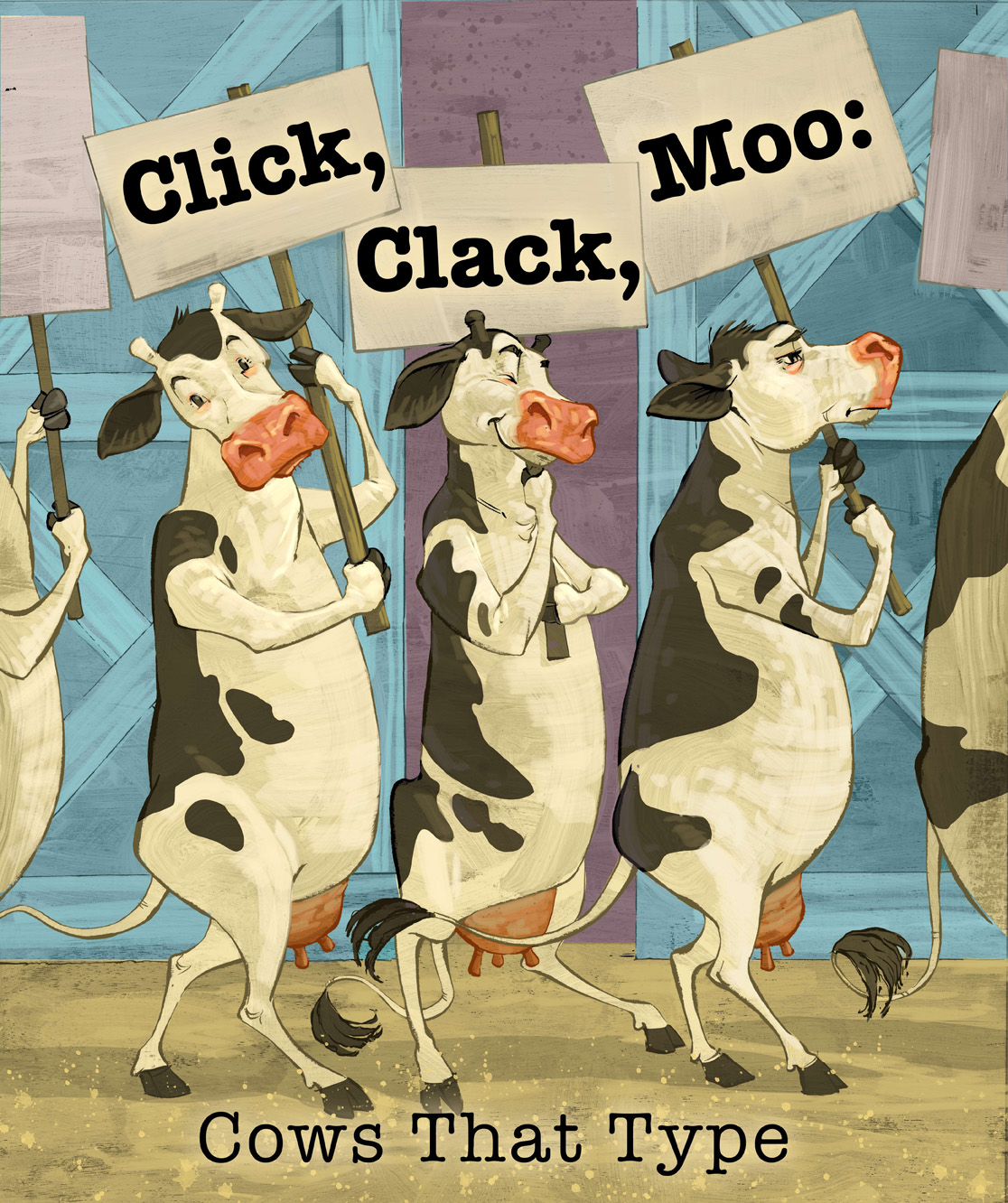
aacctcowsToday at 2pm and 4pm, the typing cows will be preparing to remove the paper from the typewriter one final time at the Arkansas Arts Center Children’s Theatre production of Click, Clack, Moo: Cows That Type.

“This classically hilarious children’s story about some rebelliously clever farm animals will come to life on stage at the Arkansas Arts Center Children’s Theatre as they engage in peaceful protests to improve their working conditions,” said Arkansas Arts Center Children’s Theatre artistic director Bradley Anderson. “This delightful tale about negotiation and compromise is enjoyable for any age.”

Farmer Brown thinks it’s odd when he hears typing sounds coming from the barn but his troubles really begin when his cows start leaving him notes demanding better working conditions before staging a strike. Join the Arkansas Art Center Children’s Theatre as a bunch of literate cows turn Farmer Brown’s farm upside down. Click, Clack, Moo: Cows That Type is adapted by George Howe and James E. Grote from Doreen Cronin’s original book with illustrator Betsey Lewin.

The cast for Click, Clack, Moo: Cows That Type includes: John Isner, of Little Rock, as Farmer Brown Jeremy Matthey, of Little Rock, as Duck Moriah Patterson, of Sheridan, as Cow 1 Aleigha Garstka, of Little Rock, as Cow 2 Veronica Lowry, of Charlottesville, VA, as Hen

Bradley D. Anderson is the artistic director and the director for the production. Choreography by Moriah Patterson, musical direction by Lori Isner, costumes are designed by Erin Larkin, technical direction by Drew Posey, lighting design by Penelope Poppers, scenic design and properties by Miranda Young and Sarah Gasser is the stage manager.

Presenting sponsors are Landers FIAT in Benton, Arkansas Blue Cross and Blue Shield, and in honor of Dorothy and Fallon Davis by Dr. Scott and Shannon Davis. Also sponsored by All Aboard Restaurant and Martha Logue.

Recognized by The Drama League as one of the best regional theatre companies in America, the Arkansas Arts Center Children’s Theatre is the only professional company in Arkansas that produces children’s literary works for the stage. Since 1979, Children’s Theatre has been creating unique experiences for family audiences.

For more information, visit arkansasartscenter.org or call (501)372-4000.

General Admission Tickets are $12.50 for children and adults & $10 for AAC members.

CLYBOURNE PARK at Ark Rep closing this weekend

ClybourneIn real estate, “closing” is a good thing. In theatre, “closing” means a production is ending. Bruce Norris’ Pulitzer and Tony winning Clybourne Park closes its run this Sunday.

A few seasons ago, the Arkansas Rep produced Lorraine Hansberry’s seminal work A Raisin in the Sun. Clybourne Park explores events which happened before and after Hansberry’s play.

Clybourne Park is a bitingly funny and fiercely provocative play about the volatile combination of race and real estate. Written by Bruce Norris and directed by Rep founder Cliff Baker, its searing wit, intriguing plot twists and hard hitting social commentary make Clybourne Park a theatrical tour de force not to be missed.

In 1959, a white couple sells their home to a black family (the fictional Younger family from A Raisin in the Sun), causing an uproar in their middle-class neighborhood. Fifty years later in 2009, the same house is changing hands again, but the stakes have changed.

As neighbors wage a hilarious and pitched battle over territory and legacy, Clybourne Park reveals just how far our ideas about race and identity have evolved.

The cast includes Shaleah Adkisson, Ryan Barry, Katie Cunningham, Lawrence Evans, LeeAnne Hutchison, Robert Ierardi, Jason O’Connell, and David Tennal.

The creative team includes scenic designer Mike Nichols, costume designer Yslan Hicks, lighting designer Yael Lubetzky, sound designer Allan Branson and properties designer Lynda J. Kwallek.

The play was first performed in 2010 at Playwright’s Horizons. Following that production Norris received the 2011 Pulitzer Prize for Drama. A subsequent production was mounted on Broadway in 2012. The Broadway production was nominated for four Tony Awards and won the Tony for Best Play.

Clybourne Park is made possible in part by a grant from the Arkansas Black Hall of Fame Foundation, a component fund of the Arkansas Community Foundation.

For a review of Clybourne Park, read this.

Little Rock’s 9th Street and Ark Rep’s CLYBOURNE PARK focus of Mosaic Templar FRIDAY Lunch Program

ClybourneRescheduled from earlier in the week, as part of the Mosaic Templars Cultural Center lunchtime “It’s in the Bag” lecture program, members of the Ninth Street Community and Clybourne Park cast members will discuss how Arkansas Rep’s production of Clybourne Park relates to issues of race, property, history and legacy in our own communities.

The “It’s in the Bag” Lunch ‘n Learn Series offers a chance to learn about a host of topics designed to educate, inspire and entertain. Mosaic Templars Cultural Center provides soda and water, and attendees bring their own lunch. “It’s in the Bag” Lunch ‘n Learn Series is free and open to the public.

For decades, Little Rock’s Ninth Street with the hub of African American business and social life in Little Rock.  This can be traced back to 1854 when the family of Chester Ashley gave land to a group of black Methodists so that they could erect a church at 8th and Broadway.

Through urban renewal efforts and changing migration patterns as well as the integration of previously all-white businesses, Ninth Street lost its identity as an important hub for Little Rock’s African American community.  With the opening of the Mosaic Templar’s Cultural Center and efforts to restore the Dreamland Ballroom on the top floor of Arkansas Flag and Banner, efforts are underway to remind others of the important role this area played in Little Rock’s history.

The program begins at 12 noon.  Mosaic Templar’s Cultural Center is located at 9th and Broadway in downtown Little Rock.

The Mosaic Templar’s Cultural Center is an agency of the Department of Arkansas Heritage.

Weather prompting changes; Good day to stay in and try CALS new Hoopla download service

Due to inclement weather, many area museums and performances may be postponed or cancelled. Please call ahead before venturing out.

The Central Arkansas Library System now offers Hoopla, a movie, tv, audiobook, and music downloading system. Today would be a great day to try out this new service.

To learn more, visit the CALS website at www.cals.org.

20140204-070013.jpg

Typing Cows Continue on stage at Ark Arts Center

aacctcowsTyping cows and a talking duck are just a few of the wonders which await audiences as the Arkansas Arts Center Children’s Theatre production of Click, Clack, Moo: Cows That Type continues through February 9.

“This classically hilarious children’s story about some rebelliously clever farm animals will come to life on stage at the Arkansas Arts Center Children’s Theatre as they engage in peaceful protests to improve their working conditions,” said Arkansas Arts Center Children’s Theatre artistic director Bradley Anderson. “This delightful tale about negotiation and compromise is enjoyable for any age.”

Farmer Brown thinks it’s odd when he hears typing sounds coming from the barn but his troubles really begin when his cows start leaving him notes demanding better working conditions before staging a strike. Join the Arkansas Art Center Children’s Theatre as a bunch of literate cows turn Farmer Brown’s farm upside down. Click, Clack, Moo: Cows That Type is adapted by George Howe and James E. Grote from Doreen Cronin’s original book with illustrator Betsey Lewin.

The cast for Click, Clack, Moo: Cows That Type includes:
John Isner, of Little Rock, as Farmer Brown
Jeremy Matthey, of Little Rock, as Duck
Moriah Patterson, of Sheridan,  as Cow 1
Aleigha Garstka, of Little Rock, as Cow 2
Veronica Lowry, of Charlottesville, VA, as Hen

Bradley D. Anderson is the artistic director and the director for the production. Choreography by Moriah Patterson, musical direction by Lori Isner, costumes are designed by Erin Larkin, technical direction by Drew Posey, lighting design by Penelope Poppers, scenic design and properties by Miranda Young and Sarah Gasser is the stage manager.

Presenting sponsors are Landers FIAT in Benton, Arkansas Blue Cross and Blue Shield, and in honor of Dorothy and Fallon Davis by Dr. Scott and Shannon Davis. Also sponsored by All Aboard Restaurant and Martha Logue.

Recognized by The Drama League as one of the best regional theatre companies in America, the Arkansas Arts Center Children’s Theatre is the only professional company in Arkansas that produces children’s literary works for the stage. Since 1979, Children’s Theatre has been creating unique experiences for family audiences. During the 2012-13 season, nearly 43,000 children and families enjoyed Arkansas Arts Center Children’s Theatre productions which included more than 200 schools across Arkansas.

For more information, visit arkansasartscenter.org or call (501)372-4000.

General Admission Tickets are $12.50 for children and adults & $10 for AAC members.
Friday at 7 p.m.
Saturday at 2 p.m.
Sunday at 2 p.m.

Sold on CLYBOURNE PARK – expanded

ClybourneClybourne Park, Bruce Norris’ Pulitzer and Tony winning play, is about race and place. But it is not a pedantic treatise meant to induce guilt. Through its humor and honesty it examines prejudice, property value, and protection of principles. The prejudice on display is not just racial, but also extends to gender, class, disability and sexual identity. The characters are alternately clinging to a past as well as trying to bury it. If this sounds like heavy stuff, it is. But it is presented in such a way, that it does not seem weighty or oppressive.

The action of Clybourne Park takes place in the unseen house that was the crux of Lorraine Hansberry’s A Raisin in the Sun. The conceit of Norris’ play is that fifty years separate the first act from the second one. Though played by the same actors, the characters are different in the two acts. Neither the playwright nor Cliff Fannin Baker, the director, hit the audience over the head with the connections the second act characters have to the first act or to the Hansberry play. They let things emerge organically. The people in this play are rarely who they seem to be. Allegiances shift throughout each act as layers are peeled back on the characters and their motivations.

It is cliché to say, but this play is truly an ensemble piece. As such, Norris (an erstwhile actor himself who once was directed by Baker) has provided each actor with moments to shine in both acts. When given these moments, the actors seized them. In quieter moments, the members of the ensemble exhibited wonderful performances as well without stealing focus from their fellow actors.

Shaleah Adkisson is marvelous both as a long-suffering maid and wife in the first act and a neighborhood activist in the second act. Her voice can drip honey and cut like a knife at the same time. Katie Cunningham plays an expectant mother in both acts. In the first act her character is deaf, while in the second act her character can hear perfectly (but may wish there things she didn’t hear). Shifting from prim to relaxed in the two acts, Cunningham creates two distinct characterizations on stage.

LeeAnne Hutchison’s first act housewife is appropriately daffy and warm. In the second act, she transforms herself into a self-absorbed, calculating professional by use of a different voice, demeanor and posture. As Hutchinson’s husband in the first act Robert Ierardi portrays a man wrestling with emotions and changing times while trying his best to continue to provide for and protect his wife. His interaction with Hutchison during the opening of the first act captured the dichotomy of comfort and confrontation found in long-married couples.

Ryan Barry’s harried priest in the first act is doing his best to be helpful and remain calm in the midst of a sea of turmoil. In the second act he is a bemused, detached attorney trying to facilitate conversation between opposing parties. Though the reactions are different, in both acts his character is pushed to a brink long after other characters have been. In many ways, he is a barometer for the audience. Lawrence Evans has little stage time in the first act but creates a memorable character as a husband just trying to be helpful. In the second act Evans has more opportunity to shine as a neighborhood resident working to preserve his community, and perhaps understand his wife as much as he is trying to understand some strangers.

In the first act, Jason O’Connell plays Karl, a character who appeared in A Raisin in the Sun. While not trying to justify his racist actions, this play fleshes out Karl. O’Connell’s characterization is not a broad villain, but it does not try to make excuses for his beliefs. He also handles some physical comedy in a manner that is both humorous but also completely in character. In the second act, O’Connell’s character is more naïve on some levels as he is confronting aspects of himself and his wife (played by Cunningham) that had never been considered.

Rounding out the cast is David Tennal, an alum of the Rep’s Summer Musical Theatre Intensive, in a small but pivotal role at the end of the play. It is always nice to see students who came up through the Rep’s SMTI program hold their own on mainstage productions. It was nice to see Rep veterans Adkisson (Avenue Q), Evans (Fences) and O’Connell (All My Sons, Sherlock Holmes, Frost/Nixon) return and create memorable characters. Based on their performances in this play, hopefully Cunningham, Ierardi, Hutchison and Barry will be back in the future.

The seamless direction provided by Baker well-serves the actors and Norris’ masterful script. It is obvious that in rehearsal Baker created an atmosphere of trust and collaboration among the acting company. Together he and the actors have mined the play for its much needed humor. But they did not settle for cheap laughs. The play uses laughter to relieve tension. But it does not shy away from making the audience or the characters onstage uncomfortable. Baker and his cast know when to let the feelings of unease simmer. In Baker’s hands, the play never seems pious but it does show the challenges of building and maintaining a community when often well-meaning people have competing perspectives.

While the acting ensemble could have undoubtedly sold the play performing in street clothes in a bare stage, luckily they did not have to. The physical design supported the play. Mike Nichols’ set is in many ways another character in the play. He has created a pre-war two story house. While the play is set in a fictional Chicago neighborhood, the actions in the play could easily take place in any mid- to large-sized American city over the past half century. In the first act, Nichols’ house is the epitome of the emerging middle class. The second act shows the same house after years of neglect. With only a few physical changes, the difference is stark.

Yslan Hicks’ costumes ably showcase not only the different time periods but also the different stations in life of the characters. Through exacting details, her costumes enable the characters to look like they have stepped out of magazine photos from the two eras. Yael Lubetzky’s subtle lighting adds atmosphere to the play. The early morning shadows cast in the final moments of the play were particularly memorable. As sound designer, Allan Branson not only set the mood with music but had the unenviable task of ensuring that numerous actors talking over each other throughout the play could still be heard. Lynda J. Kwallek has a knack for finding props which tell the audience about the characters and their stations in life more than spoken words can do.

Whether we know it or not (or are willing to admit it) Clybourne Park is all our story. There are times we each feel like an outsider, a protector, a denier, a fighter, a detached observer, a victim or a peacemaker. The play offers no easy answers or pat conclusions. In fact it’s one message seems to be that unless we continue to have these messy conversations we will never move forward.

We must respect each other and see value in each other. But we must not be afraid to engage each other in meaningful and often complicated dialogue. If that doesn’t happen, sectors of the community will continue to move back and forth sliding past each other like some sort of societal amoebas without respecting differences.

A final note, some of the language in Clybourne Park is harsh. There are words said on the stage that could definitely offend theatregoers. But the use is not gratuitous. It is to highlight how words do matter, but also ideas. Audience members should not let their distaste for those words detract from their play-going experience. Kudos to Rep Producing Artistic Director Bob Hupp for choosing this play for Little Rock audiences.

Little Rock audiences need to pay a visit to Clybourne Park. It runs only through February 9. For those who want to laugh and think, this is one property not to be missed.

Due to a cut and paste error, an earlier version of this review inadvertently omitted a section on Robert Ierardi’s performance. This review has also been edited because the author of it is constantly tweaking his writing.

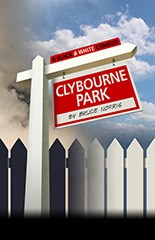
Prize winning CLYBOURNE PARK at Ark Rep opens tonight

ClybourneA few seasons ago, the Arkansas Rep produced Lorraine Hansberry’s seminal work A Raisin in the Sun.  Tonight the Rep opens a production of Bruce Norris’ prize winning play Clybourne Park which explores events which happened before and after Hansberry’s play.

Clybourne Park is a bitingly funny and fiercely provocative play about the volatile combination of race and real estate. Written by Bruce Norris and directed by Rep founder Cliff Baker, its searing wit, intriguing plot twists and hard hitting social commentary make Clybourne Park a theatrical tour de force not to be missed.

In 1959, a white couple sells their home to a black family (the fictional Younger family from A Raisin in the Sun), causing an uproar in their middle-class neighborhood. Fifty years later in 2009, the same house is changing hands again, but the stakes have changed.

As neighbors wage a hilarious and pitched battle over territory and legacy, Clybourne Park reveals just how far our ideas about race and identity have evolved.

The cast includes Shaleah Adkisson, Ryan Barry, Katie Cunningham, Lawrence Evans, LeeAnne Hutchison, Robert Ierardi, Jason O’Connell, and David Tennal.

The creative team includes scenic designer Mike Nichols, costume designer Yslan Hicks, lighting designer Yael Lubetzky, sound designer Allan Branson and properties designer Lynda J. Kwallek.

The play was first performed in 2010 at Playwright’s Horizons. Following that production Norris received the 2011 Pulitzer Prize for Drama.  A subsequent production was mounted on Broadway in 2012.  The Broadway production was nominated for four Tony Awards and won the Tony for Best Play.

Clybourne Park is made possible in part by a grant from the Arkansas Black Hall of Fame Foundation, a component fund of the Arkansas Community Foundation.