Robin Hood Steals in to Ark Arts Center Children’s Theatre

aacctrobinThe Arkansas Arts Center Children’s Theatre presents The Legend of Robin Hood April 24 through May 10.
“The Legend of Robin Hood takes the audience on an action-packed journey that’s familiar to so many generations,” said Todd Herman, executive director of the Arkansas Arts Center. “The audience will be entertained as Robin Hood and his gang take them on adventure after adventure through Nottingham.”

Swords will clash. Arrows will fly. Truth and justice will be championed. From the treetops of Sherwood, the call rings out: “Come to the forest, all ye of stout heart and true. Rally to Robin Hood and his Merry Band as they outwit and outclass the nasty Sheriff of Nottingham. Now is the time to find your heart and your courage. Now is the time to liberate England’s honest poor from the strangling grasp of tyranny.

The cast for The Legend of Robin Hood includes:

  • Noah Kaplan of Virginia Beach VA, as Robin Hood
  • Katie Campbell of Little Rock as Marian of Lea
  • Jordan Taylor of Little Rock as the Old Woman
  • Drew Posey of Jonesboro as the Sheriff of Nottingham
  • Paige Carpenter of Lonsdale as The Prioress of Kirklees
  • Richard Nelson of Little Rock as Forrester Willie
  • Margaret Lowry of Little Rock as Much
  • John Isner of Little Rock as Little John
  • Mark Hansen of Little Rock as Will Scarlet and Sir Guy of Gisbourne
  • Jeremy Matthey of Little Rock as Alan-a-Dale
  • Genevieve West Fulks of Jonesboro as Ellen of Lea
  • Keara Billings of Little Rock as an ensemble member
  • Kate Kelly of Little Rock as an ensemble member
  • Gabriel Moleta of Brazil as an ensemble member

Bradley Anderson is the artistic director. Keith Smith is the playwright for the production. Sets are designed by MA Hare; costumes are designed by Erin Larkin; technical direction by Drew Posey; lighting design by Penelope Poppers; properties design by Miranda Young; fight choreography by Brett Ihler and Sarah Gasser is the stage manager.

The Arkansas Arts Center Children’s Theatre presenting sponsor is Arkansas Blue Cross and Blue Shield and the season sponsor is Dr. Loren Bartole, ‘Family Footcare’; Pay What You Can Night is sponsored by Dorothy Morris.

Arkansas Arts Center Children’s Theatre is supported in part by: The Shubert Foundation, the City of Little Rock; the Little Rock Convention and Visitors Bureau; Arkansas Arts Center Board of Trustees; and the Arkansas Arts Council, an agency of the Department of Arkansas Heritage and the National Endowment for the Arts.

Performances for the public Fridays at 7pm and Saturdays & Sundays at 2pm.

Shake a spear, it’s Will’s 451st Birthday

william-shakespeareToday is the traditionally observed birthday of William Shakespeare. It is known he was born in 1564, which makes this the 451st birthday.

The Arkansas Shakespeare Theatre earlier announced the lineup for the 2014 season.   The dates have now been announced.

The Merry Wives of Windsor – Love and deception are the name of the game in the small town of Windsor when Shakespeare’s famous larger-than-life anti-hero Falstaff comes for a visit. Falstaff sets out to woo the Housewives of Windsor for some quick cash, but finds himself outfoxed by the wise Windsor Wives, becoming the buffoon instead of the leading man in his own ambitious tale of romance.  The entire family will laugh their way through this energetic and charming farce.

Presented outdoors at the Village at Hendrix and on the ground of the Argenta Farmers’ Market.  All performances are “pay what you can,” with a suggested donation of $15. Performances are June 4, 5, 6, 11, 13, 25, 26 & 28


 The Merchant of Venice – Comedy and tragedy collide in this story of lovers united and families torn apart.  At the center is Shylock, the Jewish moneylender. When the Venetian merchant Antonio is forced to seek a loan from Shylock, a man he despises for his religion and profession, he is asked to enter into an impossible contract: he must give a pound of flesh if unable to pay back the borrowed sum. What follows is a complex and challenging exploration of love, mercy, integrity, and justice that reminds us that, “all that glisters is not gold.”

Presented on-stage at Reynolds Performance Hall, Conway. Performances are June 19, 20, 23, 27 & 28.


As You Like It – For All Ages! This one-hour Family Shakespeare adaptation takes you on a comedic romp through the Forest of Arden, an enchanting world in which nothing is quite what it seems.  Rosalind is our bold and witty heroine who discovers her true nature and the nature of love when forced into disguise as a boy. This play reveals the potential of poetry to make things happen—to transform and reform, to turn longing into love, and to reveal wisdom through silliness.


Presented on-stage at Reynolds Performance Hall, Conway. Performances are June 23, 25, 26 & 27.


Also available to tour to communities across the state through July 5. All you need is a space—we’ll provide the rest.  For more information about how to bring As You Like It to your town, e-mail Mary Ruth Marotte at mrmarotte@arkshakes.com.


Fiddler on the Roof – This classic beloved musical tells the story of Tevye the dairyman who takes ultimate joy in his family and traditions. He works to raise his five daughters and see them married well, but must struggle against modern ideas and the rising tide of anti-Semitism in 1900s Russia that threaten to destroy his family and their way of life.


Presented on-stage at Reynolds Performance Hall, Conway. Performances are June 10, 12, 14, 21, 24 & 27.


The Arkansas Repertory Theatre will kick off their 2015-2016 season with the Scottish Play running from September 11 – 27.

Murder, madness and magic haunt every shadowy corner in the most powerful of William Shakespeare’s great tragedies.

After receiving an ominous prophecy on a blood-soaked battlefield, Macbeth and his ambitious wife claw their way to the Scottish throne, and damned be all who stand in their way! Each step closer to fulfilling his royal Fate leads Macbeth deeper and deeper into a fiendish quagmire of carnage and corruption, from which none can survive; not even him.

“The original House of Cards. It’s fitting to start off a milestone season with the English language’s greatest author,” said Bob Hupp, Producing Artistic Director at Arkansas Repertory Theatre. “Shakespeare keeps us honest, and tests our mettle when we seek to tell great stories that demand to live on a stage. I’ve been reading and seeing productions of The Scottish Play for more than 30 years, now I’m ready to direct it for you this fall.”

Little Rock Look Back: SOUTH PACIFIC wins Pulitzer Prize for Drama

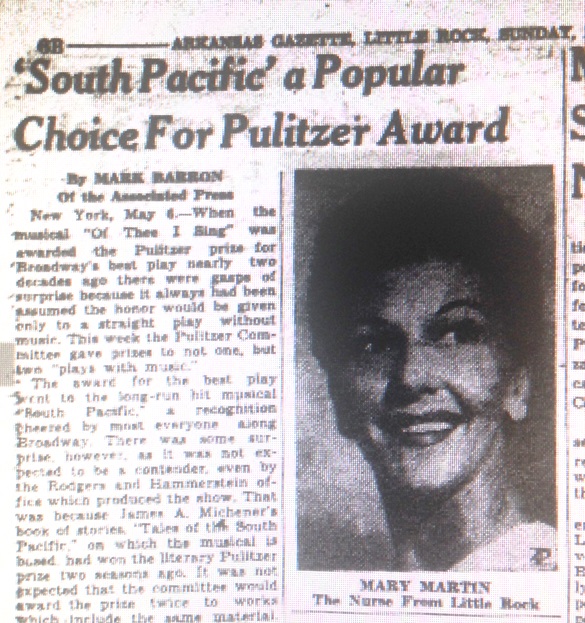
SoPa Pul GazThe Pulitzer Prizes will be announced today.  In 1950, one of the recipients in the “Letters, Drama and Music” categories featured a character from Little Rock.

The 1950 Pulitzer for Drama went to a musical, for only the second time in the history of the awards.  The recipient was South Pacific by Richard Rodgers, Oscar Hammerstein II and Joshua Logan.  The character was the leading lady of Nellie Forbush. She was an Navy ensign and a nurse stationed on an exotic island during World War II.  The musical was based on a Pulitzer Prize winning novel, James Michener’s Tales of the South Pacific.

In the Michener novel, Miss Forbush is not from Little Rock.  She is actually from a small town in Alabama.  The part was written for Mary Martin from Weatherford, Texas.  Rodgers, Hammerstein & Logan did not discuss why they relocated Nellie’s birthplace.

In the musical, Nellie struggles with her own prejudices. This issue of prejudice became an instance of fact meeting fiction. In 1957, a few weeks after Eisenhower sent troops into Little Rock to ensure that Central High would be desegregated, a production of South Pacific on Long Island was temporarily halted when the audience booed and yelled after Nellie mentioned she was from Little Rock.


World premiere of Phillip McMath’s play KARSKI’S MESSAGE next at Weekend Theater

Karaskis-Message-Poster_LgThe latest offering of the Weekend Theater is a world premiere of Phillip McMath’s new play, Karski’s Message.

A local playwright, lawyer and historian, McMath based the play on the true story of Jan Karski, a Polish World War II resistance fighter and later professor at Georgetown University. In 1942 and 1943, Karski escaped capture and near death to report to the Western Allies — Britain and the United States — on the situation in German-occupied Poland, especially the destruction of the Warsaw Ghetto and the secretive German-Nazi extermination camps. Karski personally met with world leaders, telling them about the situation in Poland, becoming the first eyewitness to try to convince the world that the Jewish Holocaust was a reality.

The cast includes Ryan Whitfield, Jeff Lewellen, Terry White, Brice Ward, Madison Wolfe, Barry Clifton, Tommie Tinker, Ann Norris, Deb Lewis, Bill Jones, Alexander White, Elijah White, Lauren Lasseigne and Justin Wolfe.  It is directed by Matthew Mentgen.

The play opened last night and continues its run tonight, April 17 & 18 and April 24 & 25. Curtain times are 7:30.


Little Rock Look Back: Ben Piazza’s Broadway Debut

kataki-playbill-cover1Though he had been an understudy in the short-lived Too Late the Phalarope, Little Rock native Ben Piazza never went on in the production.  He made his Broadway debut in Kataki, which opened 56 years ago today at the Ambassador Theatre on April 9, 1959.

Piazza was the valedictorian of the Little Rock High School class of 1951. While there, he was recognized for his acting and writing abilities.  After being a Little Rock High School Tiger, he became a Princeton Tiger and graduated in 1955 before moving to New York City.

Written by Shimon Wincelberg, Kataki concerned an older Japanese pilot and a young American soldier stranded on an island at the end of World War II.  As was the case of many plays in the late 1950s, it had originally been a television play.  The title is the Japanese word for “enemy.”

Kataki starred Sessue Hayakawa and Piazza. Most of Hayakawa’s dialogue was in Japanese, so in some ways, Piazza acted in a two-character, one-person play – since he was the only one talking for most of the play.  The play was produced by Jay Garon and Bob Sokoler, with Richard Randall serving as associate producer.  David Amram provided the incidental music.  Peter Dohanos designed the island scenery.  Anne Graham provided the costume design, and Paul Morrison was the lighting designer.

The actors received high praise for their performances, but the play’s dramatic structure was criticized as being plodding and trite.  The play was directed by Alan Schneider, who would reunite with Piazza in the original production of Who’s Afraid of Virginia Woolf?  a few years later.  The play would run only 20 performances, but Piazza was recognized with a Theatre World Award for his portrayal of Alvin, the young soldier.

The play was revived in Los Angeles in 2010 to good reviews.

Little Rock Look Back: SOUTH PACIFIC opens on Broadway 66 years ago today

southpacific_obcSixty-six years ago today, a fictional Little Rock heroine took the stage of a Broadway megahit when South Pacific opened at the Majestic Theatre on April 7, 1949. It settled in for a run of 1925 performances. Based on the James Michener Pulitzer Prize winning novel Tales of the South Pacific, it featured a book by Oscar Hammerstein II and Joshua Logan, songs by Richard Rodgers and Hammerstein and direction by Logan. It was produced by Rodgers, Hammerstein, Logan and Leland Hayward. Set in the titular islands, it concerned the relationships of sailors, nurses, island natives and other island inhabitants.

The musical starred recent Tony winner Mary Martin as Little Rock native Nellie Forbush, opera star Ezio Pinza, stage veterans Myron McCormick and Juanita Hall, and stage newcomers William Tabbert and Betta St. John. Cloris Leachman was Martin’s understudy and would later succeed her in the part of Little Rock native Nellie Forbush.

Like other Rodgers and Hammerstein musicals, this show tackled tough themes – this one being prejudice. That did not set well with some theatergoers. Indeed, some potential investors did not put money into the show because of its stance. But Rodgers, Hammerstein, Logan and Hayward persisted. Their diligence paid off when the musical received the 1950 Pulitzer Prize in Drama, only the second musical to receive this designation. It is also the only Pulitzer Prize for Drama winner to be based on Pulitzer Prize winning source material. This was the first Rodgers & Hammerstein musical to not feature big dance numbers. In fact, there was no choreographer. The dance steps which existed were created by Martin, who had taught dance in her native Texas as a young mother.

Opening late in the season, South Pacific was named the 1949 New York Drama Critics Circle Best Musical, but was not part of the Tony Awards until 1950. (Though Jo Mielziner, who designed the set for South Pacific received a Tony for his set designs of shows during the 1948-49 season and South Pacific was one of the titles listed.) At the 1950 Tonys, it received six Tony Awards (sometimes listed as eight because Book and Score were not broken separate from Best Musical that year—but some sources incorrectly separate them.) It was named Best Musical, Actor in a Musical (Pinza), Actress in a Musical (Martin), Featured Actor in a Musical (McCormick), Featured Actress in a Musical (Hall), and Director (Logan). This is the only time that all four acting awards in the musical category went to performers in the same production. In fact, the other two acting trophies that year were incorrectly engraved as being from South Pacific out of habit.

Logan’s win was also the first time that the Director Tony went for a musical, since at the time that award was not separated out among plays and musicals. Hall was the first African American to win a Tony Award for Acting. Martin would reunite with Hayward, Rodgers & Hammerstein ten years later for The Sound of Music. Pinza and Tabbert reunited in 1954 for Fanny which would be the final Broadway credit for each gentleman. McCormick stayed with the show the entire run, except for vacations.

In 1999 for the 50th anniversary and in 2008 for the opening of the first Broadway revival remaining cast members from the original production had reunions in New York City. At the 50th anniversary ceremony, a proclamation from Little Rock Mayor Jim Dailey was read declaring it South Pacific day in Little Rock and honoring the show. It is interesting to note that in 1949, there were two heroines on the Broadway stage from Little Rock: Nellie Forbush from South Pacificand Lorelei Lee from Gentlemen Prefer Blondes.

In 2008, Lincoln Center Theatre produced the first revival of South Pacific on Broadway. It opened on April 3, just four days shy of the musical’s 59th anniversary.  The cast was led by Paulo Szot, Kelli O’Hara (as Little Rock girl Nellie Forbush), Matthew Morrison (before “Glee”), Danny Burstein and Loretta Ables Sayre.  The production restored a song which had been written for the original Broadway production that had been dropped. “My Girl Back Home” was featured in the movie version and in this Broadway revival. In it O’Hara and Morrison sang of their hometowns of Little Rock and Philadelphia.  The production was nominated for 11 Tony Awards and won 7: Best Musical Revival, Actor in a Musical (Szot), Director of a Musical (Bartlett Sher), Scenic Design (Michael Yeargan), Costume Design (Catherine Zuber), Lighting Design (Donald Holder) and Sound Design (Scott Lehrer).

Bartlett and O’Hara are reunited with Lincoln Center right now for a revival of The King and I. The song “Getting to Know You” from that show was originally written for South Pacific as a song called “Suddenly Lucky.”  It was replaced in South Pacific by “(I’m in Love with a) Wonderful Guy.”

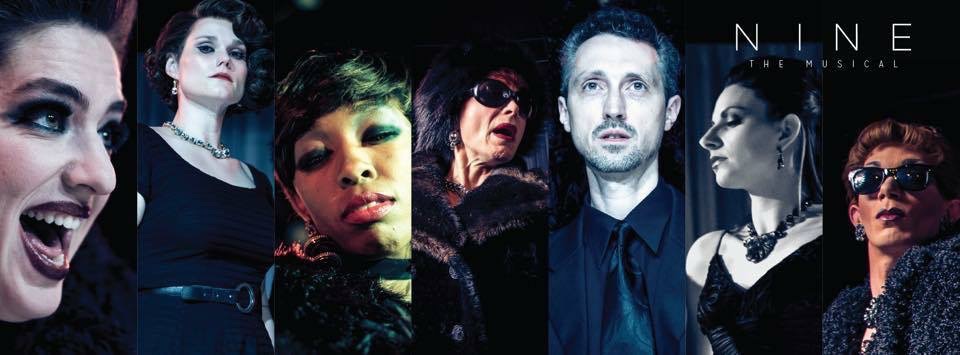
NINE a 10

imageOne would be hard pressed to find a stronger volunteer theatre production than the Studio Theatre’s current offering of Maury Yeston and Arthur Kopjt’s Tony Award winning musical NINE. (The term “volunteer” theatre is used because “amateur,” “community,” or “non-professional” belie the quality of the production.)

Rafael Colon Castanera’s production is both visually stunning and full of surprises. The cohesive ensemble is up to the task of telling this compelling, complex tale in an entertaining and enchanting manner. They find the humor and humanity in these sometimes thinly sketched characters and scenarios.

The anchor of the production is James Norris as auteur Guido Contini. He deftly morphs from reality to fantasy while juggling numerous romantic conquests and searching for fulfillment. It is a challenging role because Guido is, at the same time, supposed to be worthy of the audience’s sympathy while also behaving in a unsympathetic manner.  Norris had many touching moments as the man-child desperately seeking something. A fearless actor, he threw himself into the role whether the moment called for romance, humor or desperation. These different moods are also reflected in the wide range of singing styles required of the role–all of which he handled skillfully.

As the younger version of Guido, Price Clark showed maturity beyond his years. His performance of “Getting Tall” at the end wrapped up the show as a lesson to the audience about the challenges and opportunities of getting older. Clark also had a wonderful rapport with both Norris (acting as a mentor to his older self) and Beth Ross as his mother (showing love, respect and embarrassment).

Ross was one of many in the cast who had the chance to showcase a wider range of their talents. Often cast in wisecracking roles, she here displayed a maternal warmth and daffiness as well as weariness and frustration. Likewise Julie Atkins often plays long-suffering, noble women. In this show she had the chance to show her comic skills and her bawdiness as an all-knowing spa proprietor. Often playing heartbreaking heroines, Erin Martinez zealously attacked her role as a tambourine-wielding unapologetically, earthy strumpet.

Antisha Anderson-Scruggs was audacious and bodacious as one of Guido’s mistresses. She was bawdy but never crass as she flaunted her sexuality. Anderson-Scruggs also displayed depth as her character faced disappointment with resolve and a new-found strength.

As another mistress, Rachel Warnick elegantly captured the persona of a classic European beauty who is no longer content with being a trophy. She was grateful and forgiving toward Guido, but resolute nonetheless to pursue her new life.

Mary Ann Hansen put the gal in Gallic as a gamine French film producer. She relished her moments in the spotlight and evoked a bygone era as she celebrated a past career (and joyously took the audience along on this reflective journey). Amy Young and K. L. Martin played her entourage; the pair enjoyably insulted, threatened and otherwise antagonized Guido each in her own way.

Elena McKinnis, Bailey Lamb and Moriah Patterson were a protean trio who functioned as a sort of Greek chorus (or was it Italian chorus?) playing various parts and keeping action moving.  Together with Martin, these performers showcased their dancing talents as showgirls during the musical within a musical numbers.

Heather Smith was Guido’s long-suffering wife. While clearly in love with him, she was also weary of her stagnant life.  A high point of her performance was her sung defense of him to the press in which she is convincing them of his sincerity, while also trying to convince herself.

As director, Castanera elicited layered performances from each of the actors and kept the action moving seamlessly.  As designer, he used a deceptively simple, classically elegant scenic design as a framework for the action. Tyler Herron’s transformative lighting and Greg Wirges’ evocative sound design reflected the many different moods and settings.

The orchestra led by music director Bob Bidewell played almost nonstop through this cinematic, nearly operatic production. This lush score has many moods which were ably performed without overpowering the actors.

The costumes by Castanera are almost worth the cost of admission by themselves. Each character was uniquely clad in black attire that reflected their character down to minute details. It is safe to say this show has the most intricate and lavish costumes of any volunteer theatre production in Little Rock history. For the “film” sequence, Castanera mixed some white in with the black and created fantastic, over the top ensembles (again often with unique and humorous touches). The wigs by Robert Pickens were the same quality as the costumes. Together, wigs and costumes helped define the characters without distracting from the actors’ performances.

As a musical, NINE has challenges. In the wrong hands the characters can be vapid and unlikeable.  It is also vocally demanding. Much like the source material (a semi-autobiographical Italian film), it has moments of absurdity and a plot which wavers between linear and concept. But NINE also has enormous warmth, heart and joy. The Studio Theatre’s production captures these merits without betraying the complexities of the characters. NiINE is another step forward in the development of both The Studio Theatre as well as volunteer theatre in Central Arkansas.

NINE continues April 4, 9-12 and 16-19. Performances are at 7pm except for Sundays, which are at 2pm.