African Americans and Sports in Arkansas focus of Black History Commission of Arkansas program today (2/2)

Image may contain: one or more people and textThe Black History Commission of Arkansas presents “African Americans and Sports in Arkansas.”  The program runs from 9:45 am to 3 pm today at the Mosaic Templars Cultural Center.

Speakers: Evin Demirel, Jimmy Cunningham Jr., Dr. Wilbert Gaines, and Kenneth (Muskie) Harris. Lunch will be provided. Teachers can earn up to four professional development hours. Registration is required.

10 a.m.
Evin Demirel, author of “African-American Athletes in Arkansas: Muhammad Ali’s Tour, Black Razorbacks and Other Forgotten Stories”
• The legacy of African American sports in Jim Crow era with an emphasis on the now-defunct, all-black high school’s athletic association and stories from his book.

11 a.m.
Jimmy Cunningham, Jr., author of “African Americans of Pine Bluff and Jefferson County”
• Highlights and stories about three African American athletes from Jefferson County, including Boid “One Arm” Buie, Willie Roaf and Ivie Moore.

12:45 p.m.
Dr. Wilbert Gaines, former Arkansas State University professor
• Personal experiences and surmounting challenges and obstacles as a pioneer and trailblazer in sports, sports-related activities and academia.

1:45 p.m.
Kenneth “Muskie” Harris, community activist and former Razorback
• The history of the Razorbacks and integration of athletes, including facts about all 17 sports at the University of Arkansas and some of the first African Americans to receive sports scholarships.

For those unable to attend, footage from the programs will be on the Arkansas State Archives Facebook page in the coming days.

The Black History commission of Arkansas is an advisory board of the Arkansas State Archives, a division of the Department of Arkansas Heritage.

Little Rock Look Back: Movie Ball sends LR Film Fans into Frenzy

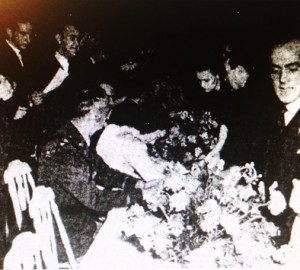
Autograph seekers crowd around the actors at the Movie Ball (photo from Arkansas Gazette)

As final preparations were being made for the opening of the Joseph Taylor Robinson Municipal Auditorium in early 1940, a glamorous evening took place in Robinson’s lower level convention hall on February 1.

In conjunction with a meeting of film executives and movie theatre owners sponsored by Robb and Rowley Theaters (which later became the United Artists theatre chain), several Hollywood actors were in Little Rock and headlined a Movie Ball. While in Little Rock, Maureen O’Hara, Phyllis Brooks, Arleen Whelan, Tim Holt and Gene Autry had also made a variety of public appearances.

Mr. Autrey had to miss the ball because he had to return to Hollywood early to attend to business matters. Actress Ilona Massey had also been scheduled to attend the events but was unable due to illness.

The quartet who did appear at the Movie Ball caused quite a scene. Upon their entrance, so many of the attendees crowded around for autographs that the evening’s grand march could not take place (a newspaper headline in the Democrat innocently used the word “orgy” to describe the crowd). After two attempts, Little Rock Mayor J. V. Satterfield (who was escorting Miss O’Hara) and the other members of the Little Rock host delegation led the Hollywood foursome to their reserved table. For quite a while that evening, the table was besieged by autograph seekers.

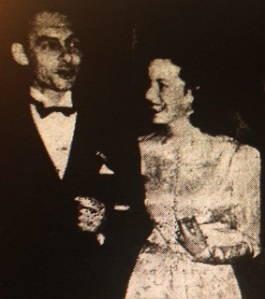
Though it is unknown as to whether he sought an autograph, photos from the evening showed a very satisfied Mayor Satterfield with Miss O’Hara on his arm. Satterfield family lore joked that Mrs. Satterfield (who had stayed home that night to tend to a sick son) was not a fan of Miss O’Hara’s films after that evening.

The Movie Ball showed Little Rock citizens the value of Robinson Auditorium even before it had been officially dedicated. The film industry meetings had taken place at the Albert Pike Hotel which did not feature a ballroom large enough to host the ball. Without the auditorium’s availability for the gala, organizers might not have chosen Little Rock for the meeting.

With the auditorium’s convention hall not attached to any hotel, it opened up the chance for Little Rock to host more events. This had been one of the key arguments for an auditorium since Mayor W. E. Lenon’s first proposal back in 1904. Having a glamorous event this early in the auditorium’s life validated that contention. After having endured the challenges to open the building, it was a nice lagniappe for the auditorium’s proponents who were present.

The actor Tim Holt would again be connected to Little Rock. In September 1951, he tried to obtain a divorce in Arkansas and stated that he had been a resident of the state for at least six weeks. He also had someone else testify to that fact. In October 1951, the divorce was granted. Later Mr. Holt was charged with perjury and fined $200 for falsely representing his length of residence in Arkansas. Judicial sanctions for his legal team, which included a State Senator, were eventually reviewed by the Arkansas Supreme Court.

Photographing Frida: Portraits of Frida Kahlo/Fotografiando Frida: Retratos de Frida Kahlo exhibit at Arkansas Arts Center from Feb 1 to April 14

Nickolas Muray, American (Szeged, Hungary, 1892 – 1965, New York, New York), Frida Kahlo on White Bench, New York (2nd Edition), 1939, color carbon print, 19 x 14 ½ inches. Courtesy of Throckmorton Fine Art, New York, New York.

The Arkansas Arts Center presents a rare opportunity to see one of Mexico’s greatest painters captured by some of the 20th century’s most important photographers. 

Photographing Frida: Portraits of Frida Kahlo/ Fotografiando Frida: Retratos de Frida Kahlo will be on view at the Arkansas Arts Center through April 14, 2019.

Photographing Frida: Portraits of Frida Kahlo features 65 images of Kahlo as art and artist. The photographs document Kahlo’s life as seen by the greatest photographers of the time – Lola and Manuel Álvarez Bravo, Imogen Cunningham, Emmy Lou Packard, Graciela Iturbide, Nickolas Muray, and Edward Weston, among others. From casual snapshots to intimate family photographs to artfully posed studio portraits, viewers will see the full spectrum of Kahlo’s life, from self-assured adolescent, to influential artist, fashion icon and passionate lover, as she takes on a mythic presence in our collective imagination.

In the hands of photojournalists, friends and artists, the camera allowed Kahlo to explore her own image and identity, document her marriage to the great muralist Diego Rivera, express her strong political views, and artfully reveal her life-long struggle to overcome her physical challenges. In the process, she ultimately defined the principal subject of her own art – herself.

Photographing Frida is an opportunity to see Frida Kahlo as you’ve never seen her before,” Chief Curator Brian J. Lang said. “These images defined not only the way the world saw her – and continues to see her – but how she saw and depicted herself through her own work.”

Frida Kahlo was born in Coyoacán, Mexico City, Mexico in 1907. Her father, Guillermo Kahlo, was a photographer, and often photographed the young Frida. Through her father’s portraits, she became acquainted with the power of her own image.

In 1929, Kahlo married muralist Diego Rivera. Throughout their tumultuous marriage, the couple was often photographed together, both in Mexico and in the United States. Rivera was a major presence, both in Kahlo’s life and in the photographs that document their life. As they traveled through Mexico and the United States, “Frida and Diego” – as they were affectionately known – became a source of fascination and intrigue for the paparazzi: Kahlo, stunning in her Tehuana dresses, beribboned hair and beaded jewelry, accompanied her famous muralist husband. Photos of their second wedding (the couple divorced in 1939, only to remarry a year later) in California were captured by American press photographers.

The exhibition reveals Kahlo’s fascination with fashion – as self-expression, political expression, and a means for concealing her physical disabilities. She was often photographed wearing traditional Mexican clothing – Tehuana dresses, huipils and rebozos, and beaded jewelry. Under the voluminous skirts and flowing dresses, she was able to hide the injuries that had affected her since youth. The pre-Hispanic clothing she was so fond of allowed her to express her belief in mexicanidad – the nationalist movement that found its inspiration in pre-Columbian Mexico after the end of the Mexican Revolution.

Kahlo continued to be photographed until her death in 1954. To each photographer she encountered, she became something new – ever present and continually beguiling – but made different through their lens. In the process, she herself became a work of art.

Photographing Frida features images by Lola Álvarez Bravo, Manuel Álvarez Bravo, Florence Arquin, Lucienne Bloch, Imogen Cunningham, Gisèle Freund, Hector Garcia, Juan Guzman, Graciela Iturbide, Peter Juley, Guillermo Kahlo, Bernice Kolko, Leo Matiz, Nickolas Muray, Emmy Lou Packard, Victor Reyes, Bernard Silberstein, Edward Weston and Guillermo Zamora. A fully-illustrated catalogue, Mirror, Mirror: Portraits of Frida Kahlo, featuring an essay by Salomon Grimberg, a noted authority on Latin American art, accompanies the exhibition.

Photographing Frida: Portraits of Frida Kahlo/Fotografiando Frida: Retratos de Frida Kahlo is organized by the Arkansas Arts Center in collaboration with Throckmorton Fine Art, New York, New York. The exhibition is sponsored by Bank of America; JC Thompson Trust; Judy Fletcher, In Memory of John R. Fletcher; Belinda Shults; Laura Sandage Harden and Lon Clark; Holleman & Associates, P.A.; Barbara House; and Rhonda and Tim Jordan. Additional support by Consulate of Mexico in Little Rock.

THIS LITTLE PIGGY WENT TO MARKET comes to Arkansas Arts Center Children’s Theatre stage

This Little Piggy Went to MarketThe 2018–2019 Arkansas Arts Center Children’s Theatre continues this winter with This Little Piggy Went to Market. The show runs February 1– 17, 2019. Performances of This Little Piggy Went to Market are Fridays at 7 p.m. and Saturdays and Sundays at 2 p.m.
Hooray! Hooray! It’s Cajun market day! Little Piggy loves Cajun market day. So many good things to eat! So many good games to play! When Mama Piggy sends her precious piglet off to Boudreaux’s Bayou Market for flour and sugar and eggs – wearing the pretty little dress her grandma made – she reminds her of three things: Be kind to others; obey all the rules; and never stray from the market road.

Fairly squealing with excitement, Little Piggy trots off to town, promising to be good. But can such a fun-loving little pig keep her promise? Especially when her two best friends, Skinny Piggy and Curly Piggy, join the adventure? They are the two “rowdiest boys in the bayou,” after all.

This Little Piggy Went to Market was written by Keith Smith. The Arkansas Arts Center Children’s Theatre’s production of This Little Piggy Went to Market is directed by John Isner. Bradley D. Anderson is the Artistic Director. Original music was composed by Lori Isner, set design and technical direction by Frank Mott, costume design by Nikki Gray, properties design by Cathleen Brignac, and lighting design by Mike Stacks. Liz McMath is the stage manager.

The cast includes: Mark Hansen (Boudreaux), Anthony McBride (Thibodeaux and Curly Piggy); Stephen Jones (Fontenot and Skinny Piggy); Morgan Jones (Charmaine); Samantha Harrington (Little Piggy); Georgeann Burbank (Momma Piggy); and Hazel Ragsdell (Market Girl).

The Arkansas Arts Center Children’s Theatre will offer several events in conjunction with This Little Piggy Went to Market including a Pay-What-You-Can preview, opening night celebration and a pajama party. Full programming details can be found below.

Friday, February 1, 2019
Opening Night Dinner at Watercolor in the Park – 5 p.m.
Join us for dinner at Watercolor in the Park before the 7 p.m. opening night performance of This Little Piggy Went to Market! Make memories while enjoying a Cajun Buffet Dinner, with favorites like Cajun Spiced Pork Loin, Veggie Gumbo, PK Mac and Cheese, Hand Breaded Chicken Tenders, Strawberry Shortcake and more. Creative coloring placemats featuring activities and artwork from the show will be available for children to enjoy. Seatings at 5 p.m., 5:15 p.m., 5:30 p.m., 5:45 p.m., and 6 p.m.

Reservations recommended. Call 501-396-0390 for reservations

Friday, February 1, 2019
Opening Night Celebration: This Little Piggy Went to Market – 7 p.m.
After the show, enjoy a meet and greet with the cast, snacks and punch to celebrate the opening night of This Little Piggy Went to Market.

Friday, February 8, 2019
Pajama Night at This Little Piggy Went to Market – 7 p.m.
Toss on those cute pajamas and join us at the Children’s Theatre for the 7 p.m. performance of This Little Piggy Went to Market. Stickers are available at the Box Office before the show for children (and parents!) wearing pajamas.

Saturday, February 9, 2019
ASL Interpreted Performance – 2 p.m.
There will be American Sign Language interpreters at the 2 p.m. performance of This Little Piggy Went to Market. Visit the Box Office before the performance for seating assistance.

For more information, visit ArkansasArtsCenter.org/theatre or call 501-372-4000.

Rock the Oscars 2019: Maureen O’Hara

Mayor J V Satterfield escorting actress Maureen O’Hara at the Movie Ball (photo from Arkansas Democrat)

Oscar winner Maureen O’Hara lived until she was 95.  In February 1940, a nineteen year old Miss O’Hara turned many heads and set off a frenzy of autograph seekers when she came to Little Rock to attend a series of events.

In conjunction with a meeting of film executives and movie theatre owners sponsored by Robb and Rowley Theaters (which later became the United Artists theatre chain), several Hollywood actors were in Little Rock and headlined a Movie Ball. While in Little Rock, Maureen O’Hara, Phyllis Brooks, Arleen Whelan, Tim Holt and Gene Autry had also made a variety of public appearances.

At the time of the event, Miss O’Hara had recently completed her starring turn as Esmerald opposite Charles Laughton in The Hunchback of Notre Dame.  She had already filmed A Bill of Divorcement (which was the first movie for which she received star billing) but it was not released until May 1940.

On the evening of February 1, 1940, Robb and Rowley hosted the Movie Ball in the lower level of Robinson Auditorium. So many of the attendees crowded around for autographs that the evening’s grand march could not take place (a newspaper headline in the Democrat innocently used the word “orgy” to describe the crowd). After two attempts, Little Rock Mayor J. V. Satterfield (who was escorting Miss O’Hara) and the other members of the Little Rock host delegation led the Hollywood stars to their reserved table. For quite a while that evening, the table was besieged by autograph seekers.

February is National Pie Month

February is National Pie Month!

As it has for the past several years, the Capital Bar & Grill is celebrating with a specialty pie a day.

Here is the schedule:

Friday, 1st – Derby Pie
Saturday, 2nd – Banana Cream Pie
Sunday, 3rd – Chocolate Chess Pie
Monday, 4th – Ice Box Lemon Pie
Tuesday, 5th – Steak & Ale Pie
Wednesday, 6th – Lemon Brulee Pie
Thursday, 7th – Chocolate Cherry Pie
Friday, 8th – Key Lime Pie
Saturday, 9th – Sweet Potato Pie
Sunday, 10th – Apple Pie
Monday, 11th – White Chocolate Velvet Pie
Tuesday, 12th – Pecan Pie
Wednesday, 13th – Apple & Rhubarb Pie
Thursday, 14th – Chocolate Raspberry Pie
Friday, 15th – Snickerdoodle Pie
Saturday, 16th – Banoffee Pie
Sunday, 17th – S’More Pie
Monday, 18th – Blueberry Pie
Tuesday, 19th – Chicken Pot Pie
Wednesday, 20th – Strawberry Jello Pie
Thursday, 21st – Black Forest Pie
Friday, 22nd – Traditional Chess Pie
Saturday, 23rd – Peach Pie
Sunday, 24th – Lemon Meringue Pie
Monday, 25th – Sugar Cream Pie
Tuesday, 26th – Butterscotch Pie
Wednesday, 27th – Coconut Cream Pie
Thursday, 28th – Peanut Butter Banana Pie

Sandwich in History at Mosaic Templars today (2/1) at noon

Image may contain: sky, cloud, tree and outdoorThe Arkansas Historic Preservation Program each month sponsors a Sandwiching in History tour which familiarize people who live and work in central Arkansas with the historic structures and sites around us.

The tours take place on Fridays at noon, last less than an hour, and participants are encouraged to bring their lunches so that they can eat while listening to a brief lecture about the property and its history before proceeding on a short tour.

Today (February 1) at 12 noon, this month’s tour is at Mosaic Templars State Temple (906 S. Broadway).  Built in 1921, the Mosaic Templars State Temple was designed by African American architect Walter Thomas Bailey. The building was built by the Mosaic Templars of America, an important late 19th- and early 20th-century African American fraternal organization, as part of its headquarters and originally contained offices, a lodge hall and a hospital space.

For February, the schedule for the tour will be a little different than normal. At noon, the MLK Commission will hold a ribbon cutting for their offices in the building, which will be followed by the lecture on the building. The lecture will be held in the Auditorium of the Mosaic Templars Cultural Center and will likely start about 12:15-12:30. After the lecture, feel free to tour the building.

The Arkansas Historic Preservation Program is an agency of the Department of Arkansas Heritage.