Birth of William E. Ashley in 1823 – first LR Mayor to have been born in LR

On August 6, 1823, future Little Rock Mayor William Eliot Ashley was born in Little Rock.  He would go on to become the first Little Rock Mayor to be born in Little Rock.  Ashley was the son of Mary and Chester Ashley; his father would later serve as a U. S. Senator from Arkansas.  He was the second of the couple’s seven children.

Though he was raised in Little Rock, he did receive some schooling out of state. The State History Commission has correspondence between eleven year old William, studying in New York, and his father. Part of the letter is a request for money.

On October 26, 1846, he married Frances Eliza Grafton at Christ Episcopal Church.  They were the first Little Rock residents to be married in that church.  The couple had five children, including triplets.  Only one of the children, Frances (who was one of the triplets) survived to adulthood.

Ashley was first elected Mayor of Little Rock in 1857. After completing a two year term, he was succeeded by Gordon N. Peay (another scion of a prominent Little Rock family).  In 1861, Ashley returned to the office of Mayor.  He was reelected to a third term in 1863.  In September 1863, following the defeat of Confederate troops by the Union forces at the Battle of Little Rock, the City of Little Rock ceased operations.  On September 21, 1863, Little Rock municipal government closed its doors, stopped collection of taxes and disbanded.  Thus Ashley’s third term ended.

In addition to his interest in local government, Ashley was a member of St. John’s College Board and a director of the newly-formed Little Rock Gas Company.

William Eliot Ashley died on August 16, 1868, at the age of 45.  He was buried in Mount Holly Cemetery (which sat partially on land that had once belonged to his family). His parents, wife and children are all buried in Mt. Holly as well.

Interestingly, for someone who grew up in a prominent family, there does not appear to be a surviving likeness of Mayor Ashley – either in painting or photograph.  Several exist of his parents, but none of him.

1906 verdict scuttles plans for new LR City Hall with Auditorium

The 1906 plans for City Hall with the Municipal Auditorium on the left portion.

Little Rock Mayor Warren E. Lenon had been advocating for a new City Hall a municipal auditorium since shortly after taking office in April 1903. After plans were approved in July 1906, a group of citizens, led by Arkansas Gazette publisher J. N. Heiskell, filed suit to stop the City.

The closing arguments in the trial against plans for a new City Hall and auditorium complex had been heard on Monday, July 30.  The case was heard by Chancery Judge J. C. Hart.  Serving as an advisor to Chancellor Hart throughout the trial (though with no official legal standing) was Pulaski County Circuit Court Judge Robert J. Lea.  To accommodate the expected large attendance, the trial had been moved into his courtroom which was larger than Chancellor Hart’s.

On Friday, August 3, Pulaski County Chancery Judge J. C. Hart issued an injunction to keep the City from signing a contract for the construction of a city hall, jail and auditorium.  Chancellor Hart concurred with the plaintiffs that Arkansas’ constitution and laws dictated all taxation must be for public purposes.  He found there was nothing in Arkansas case law which defined an auditorium to be used for conventions as a public purpose.

As had been the case throughout the trial, the tone of the coverage of the decision differed greatly in the city’s two daily papers.  The subheading in the Democrat noted that the plaintiffs would be liable for any losses to the municipal government’s coffers due to a delay in commencing the construction if Little Rock eventually prevailed.  That fact is not mentioned by the Gazette.  Both papers did make note that Judge Lea agreed with the Chancellor’s decision.

For now, it looked as if the City of Little Rock would be stuck in the 1867 City Hall on Markham between Main and Louisiana.  Mr. Heiskell and his compatriots waited to see if the City would appeal the decision.

While August would be a quiet month publicly, work would go on behind the scenes.  More on that, in the future.

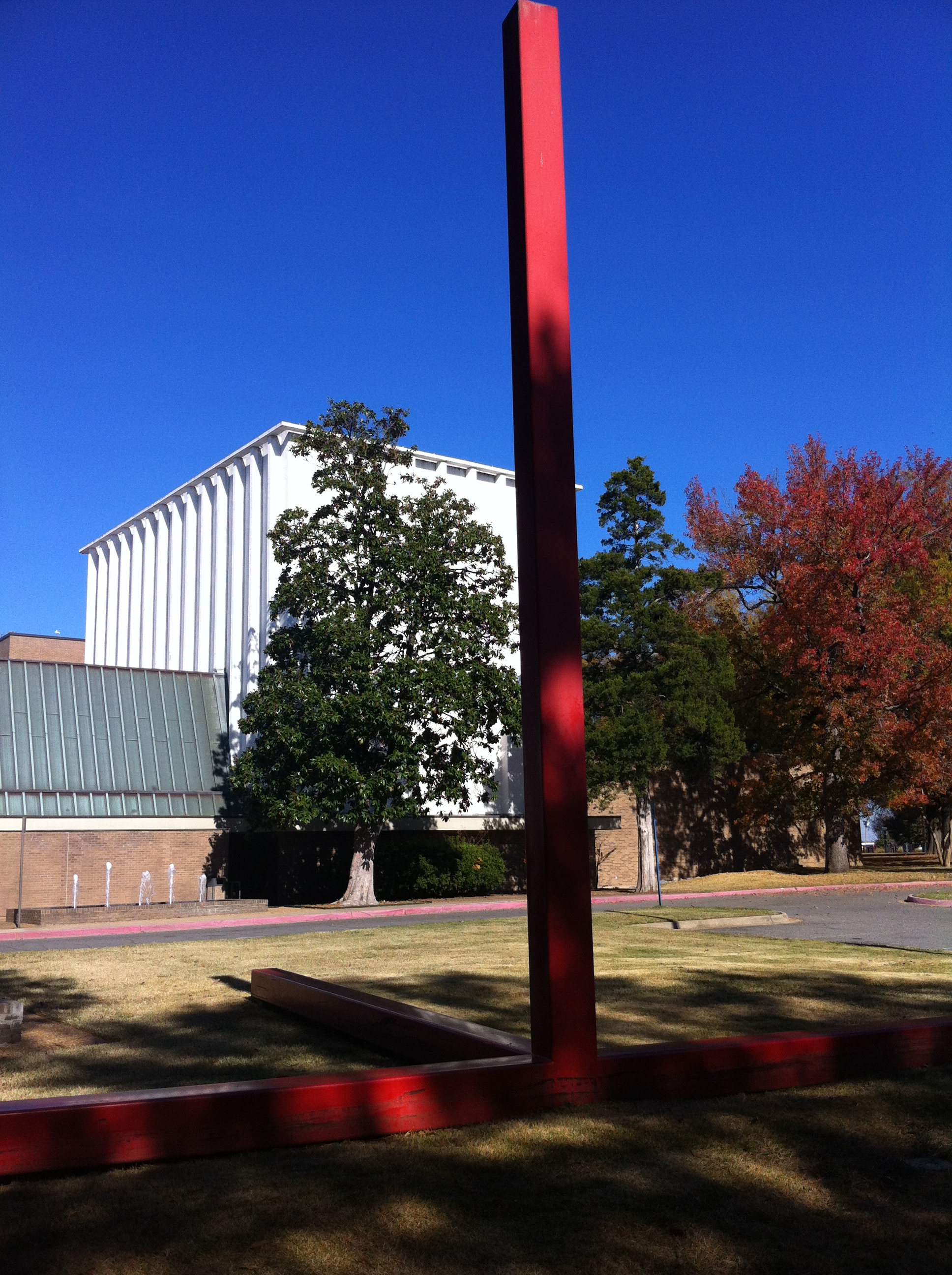
Birth of sculptor Tal Streeter who has a piece in MacArthur Park as part of Arkansas Arts Center collection

On August 1, 1934, Tal Streeter was born in Oklahoma City.  After graduating from the University of Kansas, he worked as a sculptor and artist.  He died in 2014.

In 1970, Streeter and the Arkansas Arts Center Board of Trustees donated Streeter’s sculpture Standing Red in honor of Jeannette Edris Rockefeller.  Mrs. Rockefeller had been a champion of the Arkansas Arts Center and had served as longtime chair of the Board.  She had also been instrumental in the recruitment and hiring of Townsend Wolfe who would be the longtime director of the Arkansas Arts Center.

Streeter’s sculpture stands 27 feet tall and is 54 feet from one end to another.  It consists of a T-shaped base and a perpendicular pedestal.  It is in the Minimalist style of art.  In creating it, Streeter focused on the placement of a thin red line into a setting.  It was placed near the then-entrance of the Arkansas Arts Center (which still serves as the entrance for the Museum School and Children’s Theatre).

This was one of the earliest pieces of abstract art in Little Rock.  A silkscreen by Streeter is also in the Arkansas Arts Center collection.

Happy Birthday to Jim Dailey! Little Rock’s 71st Mayor and current Director of Tourism for Arkansas

On July 31, 1942, Dalton James “Jim” Dailey, Jr. was born to Dalton and Ellen Dailey.   He would serve fourteen years as Little Rock’s 71st mayor and is now continuing his public service as the Director of Tourism for the Arkansas Department of Parks and Tourism.

After graduating from Little Rock Catholic High School, he attended the University of Arkansas at Fayetteville.  He graduated with a Bachelor of Science degree in Business Administration. He joined his father in the family business, Dailey’s Office Furniture.

In 1974, Dailey was elected to the City of Little Rock Board of Directors.  He served one four-year term. The last two years of that term, he was the Vice Mayor of Little Rock.

Following that term, he remained engaged in civic activities including serving in leadership capacities in community campaigns.  He also served as president of the National Office Products Association – the first Arkansan to do so.  Dailey also served as the founding chair of Leadership Greater Little Rock.

In 1988, Dailey was elected to return to the City Board.  He was reelected in 1992.  Dailey served as Vice Mayor in 1991 and 1992.  In January 1993, he was chosen by his fellow City Directors to serve a two year term as Mayor.  Under his leadership, the Future-Little Rock goal-setting process took place.

Following a voter-approved change to the City structure, the position of Mayor was changed to be elected by the people while maintaining the City Manager form of government.  On January 1, 1995, Jim Dailey was sworn in as the first popularly-elected Mayor of the City of Little Rock in over 38 years.

As Mayor, he served as Chair of the Intergovernmental Advisory Committee of the Federal Communications Commission. He was also a member of the United States Conference of Mayor’s Communications Task Force.  He also served as president of the Arkansas Municipal League in 2002 and 2003.

While he was Mayor of Little Rock, he was a strong proponent of the development of the River Market and worked to locate the Clinton Presidential Library in Little Rock.  He also worked to increase public safety support.  He also oversaw the establishment of Central Arkansas Water, the development of downtown headquarters for Acxiom Corporation and Heifer International, and the creation of Prevention, Intervention and Treatment programs.  In addition, he was instrumental in leading the efforts for the 40th anniversary of the integration of Little Rock Central High in 1997.

Mayor Dailey was re-elected in 1998 and 2002.  His fourteen years as Mayor of Little Rock set a longevity record.  Upon his retirement the City’s fitness center was renamed the Jim Dailey Fitness and Aquatic Center.  This was in recognition of his lifelong interest in wellness activities.

Since 1965, he has been married to the former Patti Murphy.  They have four children and six grandchildren.

Ben Piazza – born in LR 85 years ago

Actor-director-playwright-author Ben Piazza was born on July 30, 1933, in Little Rock.  Piazza graduated from Little Rock High School in 1951 as valedictorian. He also had starred in the senior play that year (The Man Who Came to Dinner) and edited the literary magazine.

Piazza attended college at Princeton University and graduated in 1955.  While there he continued acting, including an appearance in a Theatre Intime production of Othello.

In February 1958, he starred in Winesburg, Ohio sharing the National (now Nederlander) Theatre stage with James Whitmore, Dorothy McGuire, and Leon Ames. In April 1959, Piazza starred in Kataki at the Ambassador Theatre.  For his performance, Piazza received one of the 1959 Theatre World Awards.

Piazza started the 1960s on Broadway starring at the Eugene O’Neill Theatre in A Second String with Shirley Booth, Jean-Pierre Aumont, Nina Foch, Cathleen Nesbitt, and Carrie Nye.   Following that, he started his association with Edward Albee by appearing as the title character in The American Dream.  That play opened at the York Playhouse in January 1961.  Later that year, he appeared in Albee’s The Zoo Story opposite original cast member William Daniels at the East End Theatre.

In February 1963, he took over the role of Nick in the original run of Who’s Afraid of Virginia Woolf? when original actor George Grizzard left to play Hamlet at the Guthrie Theatre.  (He had participated in earlier readings of the play prior to it being mounted on Broadway.)

Piazza played Nick for the remainder of the run and acted with Uta Hagen, Arthur Hill, fellow Arkansan Melinda Dillon, Eileen Fulton, Nancy Kelly, Mercedes McCambridge, Rochelle Oliver and Sheppard Strudwick.

During the run of this show, Piazza’s novel The Exact and Very Strange Truth was published.  It is a fictionalized account of his growing up in Little Rock during the 1930s and 1940s.  The book is filled with references to Centennial Elementary, West Side Junior High, Central High School, Immanuel Baptist Church and various stores and shops in Little Rock during that era.  The Piazza Shoe Store, located on Main Street, was called Gallanti’s.

He appeared with Alfred Drake in The Song of the Grasshopper in September 1967.  In 1968, he returned to Albee and starred in The Death of Bessie Smith and The Zoo Story in repertory on Broadway at the Billy Rose Theatre.

Later that season, in March 1969, his one-acts: Lime Green/Khaki Blue opened at the Provincetown Playhouse.  Throughout the 1960s and early 1970s, Piazza toured in many plays nationally and internationally. As the 1970s progressed, he turned his focus to television and movies.

Piazza’s film debut was in a 1959 Canadian film called The Dangerous Age. That same year, his Hollywood film debut came opposite Gary Cooper, Karl Malden, Maria Schell and George C. Scott in The Hanging Tree.

Throughout the 1950s and 1960s, he appeared in a number of TV shows.  He had a recurring role during one season of Ben Casey and appeared on the soap opera Love of Life. In the 1970s, he starred in the films Tell Me That You Love Me, Junie Moon; The Candy Snatchers and I Never Promised You a Rose Garden.  He also starred as the City Councilman who recruits Walter Matthau to coach a baseball team inThe Bad News Bears.

Among his numerous TV appearances in the 1970s were The Waltons, Mannix, Switch, Barnaby Jones, Gunsmoke, Mod Squad and Lou Grant . In the 1980s, he appeared in The Blues Brothers, The Rockford Files, Barney Miller, Hart to Hart, Family Ties, The Winds of War, Dallas, Dynasty, Too Close for Comfort, The A Team, Saint Elsewhere, Santa Barbara, The Facts of Life, Mr. Belvedere, Moonlighting and Matlock.

Piazza’s final big screen appearance was in the 1991 film Guilty by Suspicion.  He played studio head Darryl Zanuck in this Robert DeNiro-Annette Bening tale of Hollywood during the Red scare.

Ben Piazza died on September 7, 1991.

In November 2016, a room at the Robinson Conference Center was dedicated to his memory.

Gretchen Hall of LRCVB appointed to International Tourism Board

Little Rock Convention & Visitors Bureau (LRCVB) President & CEO Gretchen Hall has been appointed to the Destinations International 2018-2019 Board of Directors representing Little Rock’s and Arkansas’s tourism and hospitality industry on a national and global stage.

Destinations International (formerly Destination Marketing Association International) is the world’s largest resource for official destination organizations, convention and visitors bureaus (CVBs) and tourism boards.

“I’m proud to join the DI Board representing more than 6,000 professional members and 575 destination organizations. My appointment means that Little Rock will be well represented in driving economic impact, job creation, community sustainability and quality of life through travel. Having recently returned from DI’s Annual Convention, I can tell you that the organization is THE leading source for education, research, advocacy and community in the tourism space.”

Hall has spent the majority of her career in the hospitality industry, having served the LRCVB in multiple roles for nearly 17 years. She has been the LRCVB’s President and CEO since May 2011. Hall is the President of the Heart of Arkansas Regional Tourism Association, President of the Arkansas Travel Council, Chair of the Arkansas Association of CVBs, an executive committee member of the Downtown Little Rock Partnership, and serves on the board of directors for the Little Rock Regional Chamber of Commerce and on the finance committee of Destinations International. She is also a member of the US Travel Association, Destinations International, Skål International, and Little Rock Rotary – Club 99.

Together with representatives from Tourism Toronto, Visit Baltimore, Visit Vacaville, Visit Phoenix and Houston First Corporation, Hall will serve a three-year term dedicated to serving Destinations International’s 6,000 members.

Destinations International serves destination marketing professionals first and foremost. Together with partners from nearly 600 destinations in approximately 15 countries, Destinations International represents a powerful forward-thinking, collaborative association; exchanging bold ideas, connecting innovative people and elevating tourism to its highest potential. For more information, visit www.destinationsinternational.org

The Little Rock Convention & Visitors Bureau (LRCVB) is the official destination marketing organization for the City of Little Rock, charged with marketing and selling the city as a meeting, sports and leisure travel destination. The LRCVB also manages the Statehouse Convention Center, Robinson Center, River Market and multiple parking facilities.

Shark Week remembrance of Roy Schneider

Actor Roy Scheider’s connection to Little Rock is a sad one.  He visited the City quite frequently during the last years of his life as he was getting treated at the University of Arkansas for Medical Sciences.  Despite UAMS’s best efforts, Scheider died in Little Rock on February 10, 2008.

Though he starred in several iconic films in the 1970s and 1980s, he is probably best remembered for his role in the Jaws series of films.

In the 1970s, Scheider received two Oscar nominations. His first, for Best Supporting Actor, was in The French Connection.  While Scheider did not pick up the Oscar, the film itself was named Best Picture.  It won four other Oscars that night. (As a side note: it was the first R-rated movie to win Best Picture.  Though Midnight Cowboy was re-released as an R-Rated movie after winning the Best Picture Oscar, it was initially released as an X-rated movie.)

Scheider’s second Oscar nomination came for playing Bob Fosse’s stand-in in the movie All That Jazz.  It, too, won four Oscars, though Scheider’s nomination would not result in a win.