Arkansas Heritage Month – SOUTH PACIFIC wins the Pulitzer Prize

SoPa Pul GazOn May 6, 1950, the Associated Press ran a story which would later be carried in the Arkansas Gazette about the Rodgers and Hammerstein musical South Pacific capturing the Pulitzer Prize in Drama.  The reason this carried such weight in Arkansas was that the musical had a connection to Little Rock.

The 1950 Pulitzer for Drama went to a musical, for only the second time in the history of the awards.  The recipient was South Pacific by Richard Rodgers, Oscar Hammerstein II and Joshua Logan.  The character was the leading lady of Nellie Forbush. She was an Navy ensign and a nurse stationed on an exotic island during World War II.  The musical was based on a Pulitzer Prize winning novel, James Michener’s Tales of the South Pacific.

In the Michener novel, Miss Forbush is not from Little Rock.  She is actually from a small town in Alabama.  The part was written for Mary Martin from Weatherford, Texas.  Rodgers, Hammerstein & Logan did not discuss why they relocated Nellie’s birthplace.

Originally the musical contained a song entitled “My Girl Back Home” in which Nellie sang of being from “Little Rock, A-R-K” while another character sang of being from “Philadelphia, P-A” and “Princeton, N-J.”  It is possible the change to Little Rock was made because it offered more lyrical possibilities, but that is only a supposition on the part of the Culture Vulture. That song did appear in the movie version in which Mitzi Gaynor played Nellie Forbush.  It was also featured in the 2008 Broadway revival, this time with Kelli O’Hara playing Nellie.

In the musical, Nellie struggles with her own prejudices. This issue of prejudice became an instance of fact meeting fiction. In 1957, a few weeks after Eisenhower sent troops into Little Rock to ensure that Central High would be desegregated, a production of South Pacific on Long Island was temporarily halted when the audience booed and yelled after Nellie mentioned she was from Little Rock.  Interestingly, the movie was released in 1958, but retained references to Little Rock. That was either a testament to the expense of re-editing it, or the fact that audience reaction had lessened.

Little Rock Look Back: Jesse Brown

Map showing boundaries of original City of Little Rock

Map showing boundaries of original City of Little Rock

This is Teacher Appreciation Week.  In keeping with that, today highlights one of Little Rock’s first mayors, who was also a teacher.

Jesse Brown was Little Rock’s sixth mayor. He was also Little Rock’s first teacher. In the 1820s and 1830s he operated Little Rock’s first school.

On March 10, 1823, he founded the coeducational Little Rock Academy. One of his early pupils was C. P. Bertrand, stepson of Little Rock’s first physician, Dr. Matthew Cunningham.  Cunningham, Brown and Bertrand would each serve as Little Rock mayor prior to the Civil War.

By 1826, Brown had added a second employee.  In his advertisement in the Arkansas Gazette for March 7, 1826, he says: “Jesse Brown, principal of the Little Rock Academy, returns thanks for patronage during the past year and solicits its continuance.” His terms for spelling, reading, writing, and arithmetic were $24 per annum. (This is the equivalent of $556 in 2016–a bargain for private school!)  These branches, with geography, grammar, elocution, history, chronology, bookkeeping, and ”Italian method,” were taught for $36. Subscriptions less than a year were $1 per month extra. French was also offered.

In 1829, Brown started offering night classes. He continued to expand his offerings throughout the 1830s.  However, by 1837, he was forced to remind customers who were in arrears to pay up because he “could not live upon the wind.”

Brown served as mayor from January 1838 until January 1841.  He was out of Little Rock recovering from illness from April to November of 1839, but was subsequently elected to a third one-year term commencing in January 1840.

Arkansas Heritage Month – Cinco de Mayo with Diego Rivera

portrait-of-two-womenToday is Cinco de Mayo. This Mexican holiday seems a good day to return again to the art of Diego Rivera.  He is one of the Culture Vulture favorite artists, so any excuse to discuss him and his relationship with the Rockefeller family is greatly appreciated.

One of Rivera’s masterpieces is 1914’s Portrait of Two Women which is part of the permanent collection of the Arkansas Arts Center. The official name is Dos Mujeres.  It is a portrait of Angelina Beloff and Maria Dolores Bastian.  The former was Rivera’s first wife.

This oil on canvas stands six and a half feet tall and five and a half feet wide.

Influenced by cubists such as Picasso, Rivera adopted fracturing of form, use of multiple perspective points, and flattening of the picture plane.  Yet his take on this style of painting is distinctive.  He uses brighter colors and a larger scale than many early cubist pictures. Rivera also features highly textured surfaces executed in a variety of techniques.

The painting was a gift to the Arkansas Arts Center by Abby Rockefeller Mauzé, sister of Arkansas Governor Winthrop Rockefeller.  At the 1963 opening of the Arkansas Arts Center, James Rorimer, the director of the Metropolitan Museum of Art, remarked several times to Arts Center trustee Jeane Hamilton that the Met should have that piece. Jeane politely smiled as she remarked, “But we have it.”

Of all her brothers, Abby was closest to Winthrop. The other brothers, at best ignored, and at worst, antagonized the two.  Given the complicated relationship of Rivera with members of the Rockefeller family, it is not surprising that if Abby were to have purchased this piece, she would donate it to a facility with close ties to Winthrop.  (Though the Rockefeller brothers had Rivera’s mural at Rockefeller Center destroyed, he maintained a cordial relationship with Abby Aldrich Rockefeller — well as cordial as an anti-social Communist could be with the doyenne of capitalist NYC Society.)

The Arkansas Arts Center has several other works of art in their collection with ties to Mexico. Some are by Mexican artists. Others are inspired by Mexico. They have several by Elsie Fruend depicting scenes in Mexico.

Arkansas Heritage Month – Sibelius’ FINLANDIA rings out at Robinson Auditorium

finlandia_kansi_300This fall, when the newly renovated Robinson Center Music Hall reopens, the Arkansas Symphony Orchestra will play the first notes in the new space.

The first notes in the original space were Jean Sibelius’ Finlandia.  The piece was commissioned in 1899 as part of a three day arts festival to celebrate the Finnish press.  At the time, Tsarist Russia was cracking down on the press in Finland, so this festival was planned as a way to show solidarity. The selection was one of seven composed to be played against tableaus of scenes of Finnish history.  The pieces were played in a new music hall.

Given the political nature of the music, subsequent performances of it were often given fake names to avoid Russian censorship in the ensuing years.

Because of the fact it had been played at the opening of a new facility, Finlandia was chosen to be played at the opening of the Joseph Taylor Robinson Memorial Auditorium in February 1940.  It would be played by the Arkansas State Symphony Orchestra (a forerunner, though not directly connected, to the current Arkansas Symphony Orchestra).

In the weeks leading up to the opening of Robinson, the Russians invaded Finland sparking the “Winter War.” Against overwhelming odds the Finnish people fought back though the Russians had far more soldiers and military weaponry.  However, by February 1, the Russians started breaking through lines on several fronts, and it became apparent that they would likely best the Finns.

With Finland dominating the front pages of newspapers, the performance of Finlandia took on additional significance for the audience at Robinson’s first performance on February 16, 1940. Press accounts indicate that the selection was very warmly received by the audience.

Though not noticed at the time, there was another reason that Finlandia was an apt selection to open the building.  The location of Robinson Auditorium had been chosen by Arkansas Gazette editor J.N. Heiskell. It was no one else’s first choice as the site for the building. As other options fell away, Heiskell kept trumpeting the northeast corner of Markham and Broadway.  So it was appropriate that the first piece of music be a selection that celebrated newspapers and the people who published them.

Little Rock Look Back: Original STAR WARS Trilogy

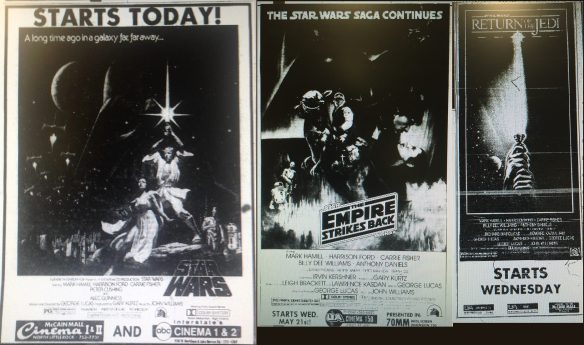
StarWarsTrilogyadsToday, May the 4th, is Star Wars Day.

The classic film first opened in May 1977 (though after May 4).  It did not reach Little Rock until June 24, 1977.

Given its status as a sleeper hit, it is no surprise that it came into Little Rock largely unnoticed.  In that day, major films opening on a Friday would be heralded the previous Sunday with a substantial advertisement.  The first Star Wars ad ran on Thursday, June 23, 1977, the day before it opened.  By contrast, Herbie Goes to Monte Carlo, which would play at the same theatre, had a large ad on Sunday, June 19.

While Star Wars would seem like the perfect movie for the great UA Cinema 150, it did not play there.  The film playing at the 150 was A Bridge Too Far, which was, at least an action movie.  Star Wars did not even open at a UA theatre.  It opened at the ABC Cinema 1 & 2 (located at Markham and John Barrow) and at the McCain Mall Cinema.  (The ABC Cinema location is now home to discount cellphone and discount clothing businesses; a cinema has returned to McCain Mall, but now in the location of the former MM Cohn’s store.)

The day it opened, there was a fairly large ad which incorporated the familiar beefcake Luke, Leia in flowing gowns, and Darth Vader mask.  On the Sunday after it opened, there was a slightly smaller ad with the same artwork.  McCain Mall also ran a small add for both Star Wars and Herbie. It noted that Star Wars was a film that management “does not recommend for children.”

Three years later, The Empire Strikes Back opened nationwide on May 21, 1980. Opening a film on the same date was a newer phenomenon, due in part to the success of Star Wars.  For the opening weeks, The Empire Strikes Back played an exclusive showing at the UA Cinema 150.  It would eventually play at other theatres in Little Rock.   It is interesting to note what was playing at the two theatres which had originally screened the 1977 film.  The McCain Mall Cinema was showing Coal Miner’s Daughter and The Fog. The former ABC Cinema was now the Plitt Southern Theatre and showed the Bill Murray comedy Where the Buffalo Roam and the Get Smart movie The Nude Bomb.  None were likely to attract the same number of audience members as The Empire Strikes Back.

On the day The Empire Strikes Back opened, the Arkansas Gazette had four different stories about the movie in that day’s edition.  While the Arkansas Democrat did not have any stories that day (though they would in subsequent days), they did carry a story on David Letterman preparing to start his (what would turn out to be short-lived) morning TV show.

On May 25, 1983, The Return of the Jedi opened.  Like the first film, though it would have been perfect for the Cinema 150, it did not play there.  Instead it played at the UA Cinema City (Breckenridge Village), the UA Four (at Geyer Springs and I-30 – now the Ron Sherman production studios), and at McCain Mall.  Flashdance was playing at the Cinema 150. In a forerunner of what is now standard practice, The Return of the Jedi played simultaneously on two of the seven screens at UA Cinema City and two of the four screens at UA Four.  While this is now part of the modus operandi, at the time, it was extremely rare to have a movie play on more than one screen in the same complex.  Though each of the theatres was smaller than the Cinema 150, the five combined exceeded the availability if it had played an exclusive run at the Cinema 150.

By the time The Return of the Jedi opened, the former ABC Cinema was now part of the ill-fated locally-based Rand Cinema chain and was known as the Markham 1 & 2.  It was showing the Roy Scheider film Blue Thunder and Dan Aykroyd in Dr. Detroit.

The cost to see The Return of the Jedi in Little Rock in 1983 was $5.00 for adults and $2.50 for children.


Arkansas Heritage Month – Tony Awards nominations with Will Trice

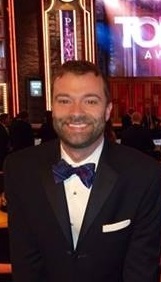
Trice at the 2014 Tony Awards

Trice at the 2014 Tony Awards

Trice at last year's Tony Awards (photo by Lisa Pacino)

Trice at 2013 Tony Awards (photo by Lisa Pacino)

The Tony Awards nominations were announced today.  Little Rock native Will Trice picked up his eighth nomination as a Broadway producer with year’s nod for the revival of Fiddler on the Roof.

Trice has earned previous Tony nominations for producing the plays All The Way* and Wolf Hall; play revivals The Best Man, The Glass Menagerie, Who’s Afraid of Virginia Woolf?*, and You Can’t Take It With You; and the musical revival Porgy and Bess*.  (An * indicates a Tony win.)

This season, Trice was a producer of four different shows: Sylvia with Matthew Broderick and Annaleigh Ashford; China Doll with Al Pacino; Fiddler on the Roof with Danny Burstein, Jessica Hecht and Ben Rappaport; and American Psycho with Benjamin Walker and Alice Ripley.

Arkansas Heritage Month – Public Art comes to Little Rock with Henry Moore’s LARGE STANDING FIGURE: KNIFE EDGE

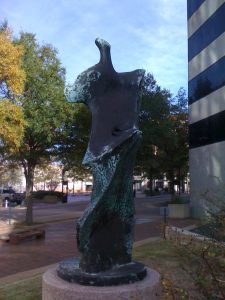
HenryMooreIt was 1978, Bill Clinton was making his first run for Governor, Dallas and Robin Williams both made their TV debuts, disco was dominating the music scene, and Little Rock received its first major piece of public art.

Arguably Little Rock’s most famous piece of public art is Henry Moore’s 1961 creation Large Standing Figure: Knife Edge, which is known locally as “The Henry Moore Sculpture.”

The original model was created in 1961; this sculpture was cast in 1976 and purchased in June 1978 by the Little Rock Metrocentre Improvement District.

The purchase price was $185,000 — a princely sum at the time but now a bargain for a Henry Moore sculpture. (Adjusted for inflation, that amount would be the equivalent of $705,000 today.)

A committee consisting of Townsend Wolfe (then the director and chief curator of the Arkansas Arts Center), James Dyke and Dr. Virginia Rembert traveled to England to meet with Moore about the sculpture.

It was originally placed on Main Street when the street had been bricked over as part of the Metrocentre Mall pedestrian mall plan. As portions of the street became unbricked and reopened to vehicular traffic, it was moved to the intersection of Capitol and Main. Finally, when the last segment was reopened to vehicular traffic, it was put at its current location of the southeast corner of Capitol and Louisiana. Because it was purchased by the Improvement District, it must stay within the boundaries of the district.

There is currently discussion about the Metrocentre Improvement District disbanding and the sculpture being relocated elsewhere in the City.

A replica of the sculpture is featured in the 1980s classic The Breakfast Club.