National Park Service Director, Local Leaders to Speak at Black History Month Town Hall Meeting

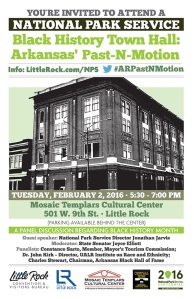
Feb 2 NPS eventLittle Rock Central High School National Historic Site in partnership with Little Rock Convention & Visitors Bureau, Mosaic Templars Cultural Center and the City of Little Rock, invite the public to join them for a Black History Month Town Hall Meeting entitled Arkansas’s Past-N-Motion to be held at Mosaic Templars Cultural Center at 5:30pm on February 2, 2016.

National Park Service Agency Director Jonathan Jarvis will serve as the guest speaker, and will discuss the National Parks Centennial Celebration, his tour to several of our nation’s civil rights-related historic sites and parks, and the importance of the National Park Service’s role in preserving and sharing our country’s history for future generations.  After his remarks, a panel discussion with local individuals will discuss several local institutions, and their roles and recent initiatives in preserving and sharing our city’s African American history, and its unique place in our nation’s civil rights movement.  This discussion will feature State Senator Joyce Elliott as moderator, and feature local panelists: Constance Sarto, Member, Mayor’s Tourism Commission; Dr. John Kirk – Director, UALR Institute on Race and Ethnicity; and Charles Stewart, Chairman, Arkansas Black Hall of Fame.

This Town Hall Meeting will highlight the resources of Civil Right institutions both from a national and local perspective, and the role of the National Park Service as the nation’s storyteller as it prepares to embark upon its Centennial 100th Birthday celebration on August 25, 2016.

During Director Jarvis’ time in Arkansas, he plans to visit Little Rock Central High School National Historic Site, engage Youth Leadership Academy members from Central High School as well as elementary students around the new White House youth initiative to get all 4th graders and their families to experience the places that are home to our country’s natural treasures, rich history, and vibrant culture FREE OF CHARGE! His visit to Arkansas will mark the start of Director Jarvis’ month-long endeavor to promote Civil Rights Sites during Black History Month.

They have also created the hashtag #ARPastNMotion to encourage local community groups to share information regarding any upcoming events relating to Black History Month.

For more information, please contact Enimini Ekong at (501) 396-3006 or Enimini_Ekong@nps.gov, or visit www.LittleRock.com/NPS.

Little Rock Central High School National Historic Site is located at 2120 Daisy L. Gatson Bates Drive, diagonally across the street from Central High School. The visitor center is open from 9:00 a.m. – 4:30 p.m. Monday through Sunday.  Admission is free. For more information call (501) 374-1957 or email chsc_visitor_center@nps.gov.
African Americans in the arts is topic of Mosaic Templars lunchtime program

mosaictemplarsThe Mosaic Templars Cultural Center “It’s In the Bag” quarterly lunch series offers a variety of topics meant to educate, entertain and inspire.

Today (2/2) at noon, the topic is African Americans in the arts.  It will feature guest panelists: poet Chris James, founder and executive director, House of Art; filmmaker Brian Lee; and Theresa Timmons-Shamberger, executive director, Timmons Arts Foundation.

Bring your lunch and MTCC will provide the drinks!

The Mosaic Templars Cultural Center is an agency of the Department of Arkansas Heritage.

Black History Month Spotlight – West Ninth Street

BHM16 W9thThe new Arkansas Civil Rights History Audio Tour was launched in November 2015. Produced by the City of Little Rock and the University of Arkansas at Little Rock allows the many places and stories of the City’s Civil Rights history to come to life an interactive tour.  This month, during Black History Month, the Culture Vulture looks at some of the stops on this tour which focus on African American history.

As early as the 1840s and reaching 1880, the businesses of both black and white races existed in what is now known as Downtown Little Rock. In the last years of the 1800s, a prolific business broker and social center for African Americans dominated West Ninth Street.

In 1898, D. B. Gaines, a local black doctor who also served as pastor of the Mt. Pleasant Baptist Church, wrote a book called Racial Possibilities as Indicated by the Negroes of Arkansas. The last chapter, “Colored Business Directory of Little Rock,” documents the existence of a vibrant commercial center with almost twenty churches and hundreds of dealers of black people.

The black district was home to doctors, dentists, lawyers and entrepreneurs such as restaurant owners, newspaper editors, pharmacists, barbers, tailors, and merchants.

This city within a city, met the needs of the black community since the early 1880 to the 1950s. West Ninth Street saw its peak between 1870 and 1950. Since the 1960s, a number of factors including desegregation, urbanization, urban renewal and the construction of I-630 caused its decline.

The app, funded by a generous grant from the Arkansas Humanities Council, was a collaboration among UALR’s Institute on Race and Ethnicity, the City of Little Rock, the Mayor’s Tourism Commission, and KUAR, UALR’s public radio station, with assistance from the Little Rock Convention and Visitors Bureau.

Little Rock Look Back: Movie Stars send LR fans in frenzy at Robinson Auditorium

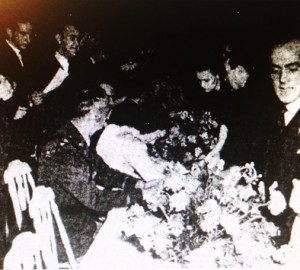
Autograph seekers crowd around the actors at the Movie Ball (photo from Arkansas Gazette)

Autograph seekers crowd around the actors at the Movie Ball (photo from Arkansas Gazette)

As final preparations were being made for the opening of the Joseph Taylor Robinson Municipal Auditorium in early 1940, a glamorous evening took place in Robinson’s lower level convention hall on February 1.

In conjunction with a meeting of film executives and movie theatre owners sponsored by Robb and Rowley Theaters (which later became the United Artists theatre chain), several Hollywood actors were in Little Rock and headlined a Movie Ball. While in Little Rock, Maureen O’Hara, Phyllis Brooks, Arleen Whelan, Tim Holt and Gene Autry had also made a variety of public appearances.

Mr. Autrey had to miss the ball because he had to return to Hollywood early to attend to business matters. Actress Ilona Massey had also been scheduled to attend the events but was unable due to illness.

The quartet who did appear at the Movie Ball caused quite a scene. Upon their entrance, so many of the attendees crowded around for autographs that the evening’s grand march could not take place (a newspaper headline in the Democrat innocently used the word “orgy” to describe the crowd). After two attempts, Little Rock Mayor J. V. Satterfield (who was escorting Miss O’Hara) and the other members of the Little Rock host delegation led the Hollywood foursome to their reserved table. For quite a while that evening, the table was besieged by autograph seekers.

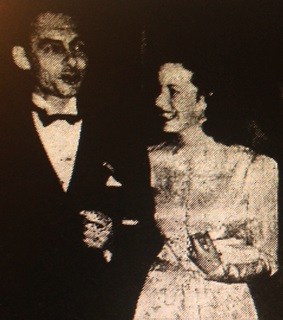
Mayor J V Satterfield escorting actress Maureen O'Hara at the Movie Ball (photo from Arkansas Democrat)

Mayor J V Satterfield escorting actress Maureen O’Hara at the Movie Ball (photo from Arkansas Democrat)

Though it is unknown as to whether he sought an autograph, photos from the evening showed a very satisfied Mayor Satterfield with Miss O’Hara on his arm. Satterfield family lore joked that Mrs. Satterfield (who had stayed home that night to tend to a sick son) was not a fan of Miss O’Hara’s films after that evening.

The Movie Ball showed Little Rock citizens the value of Robinson Auditorium even before it had been officially dedicated. The film industry meetings had taken place at the Albert Pike Hotel which did not feature a ballroom large enough to host the ball. Without the auditorium’s availability for the gala, organizers might not have chosen Little Rock for the meeting.

With the auditorium’s convention hall not attached to any hotel, it opened up the chance for Little Rock to host more events. This had been one of the key arguments for an auditorium since Mayor W. E. Lenon’s first proposal back in 1904. Having a glamorous event this early in the auditorium’s life validated that contention. After having endured the challenges to open the building, it was a nice lagniappe for the auditorium’s proponents who were present.

The actor Tim Holt would again be connected to Little Rock. In September 1951, he tried to obtain a divorce in Arkansas and stated that he had been a resident of the state for at least six weeks. He also had someone else testify to that fact. In October 1951, the divorce was granted. Later Mr. Holt was charged with perjury and fined $200 for falsely representing his length of residence in Arkansas. Judicial sanctions for his legal team, which included a State Senator, were eventually reviewed by the Arkansas Supreme Court.

Little Rock Look Back: Carol Channing

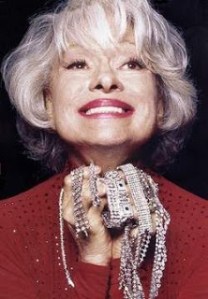
Carol C2On January 31, 1921, future “Little Girl from Little Rock” Carol Channing was born. Alas it was in Seattle.

After gaining the notice of New York critics and audiences in the musical revue, Lend an Ear, Channing achieved Broadway stardom playing fictional Little Rock native Lorelei Lee (the creation of Anita Loos) in Gentlemen Prefer Blondes.  In this show, which opened in December 1949, she introduced the Leo Robin-Jule Styne songs “Little Girl from Little Rock” and “Diamonds Are a Girl’s Best Friend.”  Her work in this show predated Tony Award nominations being announced.  (The Tony that year went to Mary Martin for playing another Little Rock native – Nellie Forbush in South Pacific).

Her first Tony nomination came for the The Vamp in 1956. Five years later, she earned a second nomination for Show Girl.  In 1964, she won the Actress in a Musical Tony for her second signature role playing the title character in Hello, Dolly!  Channing also earned a special Tony in 1968 for Dolly when it became the longest-running Broadway musical.

She returned to Lorelei Lee in the reworked update entitled Lorelei and earned a Tony nomination.  In 1995 she earned a Lifetime Achievement Tony.

In the 1960s, she visited Little Rock on a tour of Hello, Dolly! which played at Robinson Auditorium. It was arguably the biggest Broadway show to have played Robinson at that time.  While she was in Little Rock she spent time at the Governor’s Mansion and was made an honorary citizen of Little Rock.  (Nearly 30 years later, she recounted very glowingly her Little Rock visit to the Culture Vulture.)

In 1993, she spent her birthday in Washington DC at a White House dinner for the National Governors’ Association.  This was the Clintons’ first offiical White House dinner after moving in to the residence eleven days prior.  President Bill Clinton led the crowd in singing “Happy Birthday” to her.  She remarked to the President that she was Christian Scientist and didn’t celebrate birthdays, which meant she didn’t get any older.  He replied that it meant the night was her first birthday (it was her 72nd in actuality).

Little Rock Look Back: Congressman David D. Terry

david_terry_fOn January 31, 1881, future U.S. Congressman David Dickson Terry was born in Little Rock.  He was the son of William Leake Terry, who would serve in Congress from 1891 until 1901.  At the time David was born, his father was Little Rock City Attorney.  His mother was Mollie C. Dickson Terry. His parents also had two other sons, and after his mother’s death and his father’s remarriage, David had a half-sister.  He attended school in Virginia, and studied law in Little Rock and Chicago.

In 1910, he married Adolphine Fletcher, daughter of a former Little Rock mayor.  They had four children: David, Sarah, William and Mary. They later adopted a fifth child, Joseph.  The family lived in the Albert Pike Mansion, now known today as the Pike-Fletcher-Terry House.

In 1918, at the age of 37, David enlisted for service in World War I.  During the war, he would remain stateside.  Due to some family health issues, after the war he split his time between Little Rock and Massachusetts.  By the late 1920s, he had returned to Little Rock pretty much full time.

Continuing with his family’s commitment to public service, he served as president of the Little Rock Boys Club beginning in 1928. He oversaw a fundraising drive which raised $150,000 to replace a building destroyed by fire in 1930.  From 1929 until 1933, he served on the Little Rock School Board.

In 1933, David began service in the Arkansas House of Representatives.  The next year, he was elected to Congress to fill a vacancy in a hotly-contested election.  After the primary, he had barely made it into a runoff with Brooks Hays. But he ended up defeating Hays by 625 votes. Hays and his supporters protested due to election irregularities in Yell County, but David Terry was declared the winner.

Though he often was fiscally very conservative, he was also a strong advocate for the New Deal. His first bill in congress was to provide relief for financially strapped Arkansas schools.  In 1942, he decided to run for the Senate, but lost to John L. McClellan.  He ran unsuccessfully for Governor in 1944.  The winner that year, Ben Laney, appointed David Terry to lead the Flood Control, Water and Soil Conservation office. He held this position until 1953.

In later years, he kept a lower profile, even as his wife continued to raise her profile.  Arguably more people in Little Rock today are familiar with Adolphine Fletcher Terry and her efforts to reopen the Little Rock public schools than with the Congressman.

He died on October 6, 1963 and is buried at Mount Holly Cemetery.

The Terry Lock and Dam and the Little Rock School District’s Terry Elementary are both named for the former Congressman.

Enjoy the Winter Fair today at the Old State House Museum

osh_img_OSH_Winter_Fair_logo_copyThe Old State House Museum invites people to break out of the winter doldrums and join them for their Winter Fair!

They will have crafts, games, music, and refreshments for the whole family to enjoy. Learn how to make a snow globe, play games on the Old State House lawn, visit with living history interpreters, and watch a puppet show and make your own puppets.

You can also watch a master ice carver create a magical sculpture from a block of ice. Refreshments, including hot cocoa and kettle corn, will be served, as well as festive music throughout the afternoon.

The event runs from 1pm to 4pm today (January 30).  Drop in any time, admission and refreshments are free!

The Old State House Museum is an agency of the Department of Arkansas Heritage.