
Arkansas and the Southern Manifesto explored at Butler Center’s Legacies & Lunch today

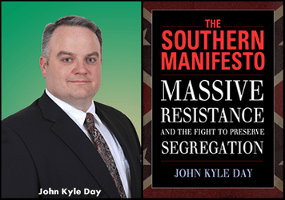
southern_manifestoAt Legacies & Lunch, John Kyle Day, associate professor of history at University of Arkansas at Monticello, will discuss the efforts of the United States Congress to delay desegregation in the 1950s and onward.  The program will take place today (February 3) at 12 noon at the Darragh Center on the CALS campus.

On March 13, 1956, ninety-nine members of the United States Congress promulgated the Declaration of Constitutional Principles, popularly known as the Southern Manifesto. This document formally stated opposition to the landmark United State Supreme Court decision Brown v. Board of Education, and the emergent civil rights movement. This allowed the white South to prevent Brown‘s immediate full-scale implementation and, for nearly two decades, set the slothful timetable and glacial pace of public school desegregation. The Southern Manifesto also provided the Southern Congressional Delegation with the means to stymie federal voting rights legislation, so that the dismantling of Jim Crow could be managed largely on white southern terms.

Day’s book, The Southern Manifesto: Massive Resistance and the Fight to Preserve Segregation, narrates this single worst episode of racial demagoguery in modern American political history and considers the statement’s impact upon both the struggle for black freedom and the larger racial dynamics of postwar America.

Legacies & Lunch is free, open to the public, and supported in part by the Arkansas Humanities Council. Programs are held from noon-1 p.m. on the first Wednesday of each month. Attendees are invited to bring a sack lunch; drinks and dessert are provided. For more information, contact 918-3033.

Little Rock Look Back: LR Mayor George Wimberly

https://www.meaningfulfunerals.net/fh_live/10300/10306/images/obituaries/1388392.jpgOn February 3, 1920, future Little Rock Mayor George Wimberly was born in Star City. He served his country first in the Civilian Conservation Corps and later aboard a U.S. Naval Department hospital ship in the Pacific during World War II.

Wimberly was first elected to the Little Rock City Board in November 1968.  He was re-elected in November 1972 and served until December 1976.  In January 1971, he was selected to serve as Little Rock Mayor through December 1972.  In a rare move, he was again selected to serve as Mayor from January 1975 through December 1976.  During the era of the City Board selecting one of their own members to serve as Mayor, George Wimberly was the only one selected to two non-sequential terms.

In 1978, he was elected to the State House of Representatives and served until December 1988.  While in the House he led the effort for smoking to be banned in the House chambers (a move that predated many public smoking bans of the 1990s and onward).

For over fifty years he was an employee and later owner of Buice Drugstore located on Markham in the Stifft Station neighborhood. In 1986 he received the Arkansas Pharmacist of the Year Award and the Lifetime Achievement Award in 2009.

Mayor Wimberly died on February 5, 2012, two days after his 92nd birthday.  He was survived by his wife, two sons, a grandson and several other relatives.

“Disagree to Agree” is topic of February Architecture and Design Network

According to architect  Neil Denari, it’s not unusual for parties to disagree when it comes to making decisions about  matters architectural. Stands taken in response to deeply seated concerns about money or commitment to “a specific direction and outcome” sometimes lead to stalemates. In his lecture, Denari will talk about ways in which NMDA deploys  “potentially disagreeable ideas into a welcoming context of agreement”. Equal amounts of “logic and enthusiasm” are key to resolving  differences between architect and client.

Tonight (February 2) Denari will discuss this at the Arkansas Arts Center at 6pm as part of the Architecture and Design Network series.  A reception at 5:30 will precede the address.
 
A native of Fort Worth, Texas, Denari, who earned a BArch at the University of Houston and a MArch from Harvard, founded the firm that bears his name in 1988, the same year he began a five year teaching stint at Southern California Institute of Architecture (SCI-Arc). Currently, he serves as Professor of Architecture and Vice Chair of Architecture and Urban Development (AUD) at UCLA. Living in New York City during the 1980s,  he worked for James Stewart Polshek Partners as a senior designer. Denari has held visiting professorships at UC Berkeley, Columbia, Princeton, University of Pennsylvania and the University of Texas at Arlington. Author, artist and filmmaker as well as architect, Denari has won a number of prestigious awards, including two from the National Academy of Design. 
 
Architecture and Design Network lectures are free and open to the public. Denari’s participation in ADN’s Little Rock lecture series is made possible by the UA Fay Jones School of Architecture and Design. For additional information contact ardenetwork@icloud.com.
 
Supporters of Architecture and Design Network include the Arkansas Arts Center, the Central Section of the Arkansas Chapter of the American Institute of Architecture, the UA Fay Jones School of Architecture and Design and friends in the community. 

Music of Mozart and Mendelssohn tonight at ASO River Rhapsodies concert

ASO NewStart this February off right by getting your tickets to the third installment of the River Rhapsodies Chamber Series. This concert will include the works of Mozart and Mendelssohn. It starts at 7pm on Tuesday, February 2, in the beautiful Great Hall of the Clinton Presidential Center.

Tickets are $23.

PROGRAM

Dohnányi – Sextet in C Major, Op. 37
Mozart – String Quartet in A Major, K. 169
Mendelssohn – Piano Trio No. 2 in C minor, Op. 66

Little Rock Look Back: Little Rock Public Library opens in 1910

On February 2, 1910, the Little Rock Public Library officially opened its doors.  There had been an open house the night before, but this was the first day of acquiring a library card and checking out books.

Various private libraries had existed sporadically in Little Rock throughout the 19th Century.  In November 1900, a Little Rock School District committee made the first inquiry into the the creation of a Carnegie Library in Little Rock.  Over the next several years, numerous entreaties were made, but funding for the City’s portion was an obstacle.  On December 17, 1906, the Little Rock City Council passed an ordinance to move forward with building, furnishing and equipping a library.  Finally, in February 1908, the City approved acceptance of $88,100 from Andrew Carnegie.  The building would be designed by Edward Tilton, who designed Carnegie libraries, working with local architect Charles Thompson.

Mary Maud Pugsley was hired as the first librarian for Little Rock in May 1909. She began her duties on September 15, 1909, in order to get ready for the opening of the library at the southwest corner of 7th and Louisiana Streets.

On February 2, 1910, formal circulation of books began.  J. N. Heiskell was issued library card number 1.  He was secretary of the Library’s Board of Trustees and had long been an advocate for a public library in Little Rock.  He had often used his bully pulpit as editor of the Arkansas Gazette to advocate for a public library since arriving in Little Rock in 1902.  (Years later — he lived until 1972 — he received a replica of the library card made out of gold.)

That first day of operation, 500 people had applied for library cards. The application process required one to be a Little Rock property owner or to have a property owner sign the application.

Within the first year of operation, 2.5% of Little Rock’s population of 45,951 had applied for a library card.

For more on the history of the transformation of the Little Rock Public Library into the Central Arkansas Library System, read Shirley Schuette and Nathania Sawyer’s From Carnegie to Cyberspace — 100 Years at the Central Arkansas Library System, published by Butler Center Books.

And the 2016 Ellie for General Excellence in Literature, Science and Politics goes to THE OXFORD AMERICAN!

2e6b4_1320267846-oxa_logoOn February 1, at a ceremony in New York City, the Oxford American received some very good news: They won the 2016 Ellie – National Magazine Award in General Excellence! 

The OA was recognized in the Literature, Science and Politics category.  The other nominees were Aperture; Foreign Affairs; Nautilus; Poetery; and Virginia Quarterly Review.
Honors smaller-circulation general-interest magazines as well as publications covering the arts.


This is the Oxford American’s thirteenth National Magazine Award nomination since the magazine’s founding in 1992, and their first for General Excellence since 1999.  The award recognized both the efforts of former editor Roger Hodge and current editor Eliza Borné and the OA staff.
The American Society of Magazine Editors (ASME) celebrated the 50th anniversary of the awards.
Other winners of the evening were:

General Excellence

  • News, Sports and Entertainment – New York
  • Service and Lifestyle – Lucky Peach
  • Special Interest – The Hollywood Reporter

Design – Wired
Photography – The California Sunday Magazine
Single-Topic Issue – Bloomberg Businessweek for “Code: An Essay,” June 15-28
Website – New York
Multimedia – New York for “This Is the Story of One Block in Bed-Stuy, Brooklyn,”
Video – Vice News for “Selfie Soldiers: Russia’s Army Checks In to Ukraine
Public Interest – BuzzFeed News for “The New American Slavery,” and “All You Americans Are Fired,” by Jessica Garrison, Ken Bensinger and Jeremy Singer-Vine,
Personal Service – FamilyFun for “The Happy Family Playbook,” by Jennifer King Lindley
Leisure Interests – Eater for “The Eater Guide to Surviving Disney World
Magazine Section – New York for “The Culture Pages”
Reporting – Matter for “My Nurses Are Dead and I Don’t Know If I’m Already Infected,” by Joshua Hammer
Feature Writing – The New Yorker for “The Really Big One,” by Kathryn Schulz
Feature Photography – Politico for “Front Row at the Political Theater,” photographs by Mark Peterson
Essays and Criticism – Esquire for “The Friend,” by Matthew Teague
Columns and Commentary – The Intercept for three “The Barrett Brown Review of Arts and Letters and Prison” columns by Barrett Brown: “Stop Sending Me Jonathan Franzen Novels,” “A Visit to the Sweat Lodge,” and “Santa Muerte, Full of Grace.”
Fiction – Zoetrope: All-Story for “The Grozny Tourist Bureau,” by Anthony Marra
Magazine of the Year – The Atlantic

The American Society of Magazine Editors is the principal organization for magazine journalists in the United States. The members of ASME include the editorial leaders of most major consumer and business magazines published in print and on digital platforms. Founded in 1963, ASME works to defend the First Amendment, protect editorial independence and support the development of journalism. ASME sponsors the National Magazine Awards in association with the Columbia Journalism School and publishes the ASME Guidelines for Editors and Publishers.

Black History Month Spotlight – Mosaic Templars of America

The new Arkansas Civil Rights History Audio Tour was launched in November 2015. Produced by the City of Little Rock and the University of Arkansas at Little Rock allows the many places and stories of the City’s Civil Rights history to come to life an interactive tour.  This month, during Black History Month, the Culture Vulture looks at some of the stops on this tour which focus on African American history.

The Mosaic Templars of America was formed as a business in the late 1870s by Arkansas freedmen John E. Bush and Chester W. Keatts to provide insurance and other services to black people, and was incorporated as a fraternal organization in 1882. The Mosaic Templars name was derived from the biblical Moses who led his people out of bondage and relates to black America’s journey out of slavery.

By the 1920s the Templars’ organization extended to 26 states and six Caribbean nations. At the time, as one of the largest black-owned business enterprises in the world, Templars’ holdings included the original insurance company, a building and loan association, a publishing company, a business college, a nursing school and a hospital. For more than 40 years, the Templars Headquarters Building and the adjoining Annex and State Temple buildings on Broadway anchored the city’s black business district on West Ninth Street. Like many businesses, black and white, the Templars did not survive the era of the Great Depression.

Though the original Headquarters building burned in 2005, the Mosaic Templars Cultural Center is modeled on the original design. Exhibits highlight black business and self-achievement from Reconstruction to the 1950s in Arkansas and the nation.

The app, funded by a generous grant from the Arkansas Humanities Council, was a collaboration among UALR’s Institute on Race and Ethnicity, the City of Little Rock, the Mayor’s Tourism Commission, and KUAR, UALR’s public radio station, with assistance from the Little Rock Convention and Visitors Bureau.