Marcie Cohen Ferris will discuss THE EDIBLE SOUTH at special Legacies & Lunch at noon today

Marcie Ferris at her home in Chapel Hill, NC. Photo by Kate Medley

Marcie Ferris at her home in Chapel Hill, NC. Photo by Kate Medley

Marcie Cohen Ferris, author of The Edible South, is a professor of American studies at the University of North Carolina at Chapel Hill. Ferris’ research and teaching interests include the history of the Jewish South and the foodways and material culture of the American South. The Edible South: The Power of Food and the Making of an American Regionexamines the visceral connection between Southern food and the politics of power from the colonial period to the present.

At this special Legacies & Lunch, co-hosted by the Butler Center for Arkansas Studies and the Clinton School of Public Service, Ferris will talk about the power of food to nourish cultures as well as people’s bodies and the way it helps people understand the South – from scholars and chefs to casual consumers and hardcore foodies. Books will be available for purchase, and Ferris will sign copies after her talk.

The Butler Center’s Legacies & Lunch program is free and open to the public and supported in part by the Arkansas Humanities Council. Attendees are invited to bring a sack lunch; drinks and dessert will be provided.

The Butler Center for Arkansas Studies is a department of the Central Arkansas Library System (CALS). It was founded in 1997 to promote the study and appreciation of Arkansas history and culture. The Butler Center’s research collections, art galleries, and offices are located in the Arkansas Studies Institute building at 401 President Clinton Ave. on the campus of the CALS Main Library.
Little Rock Look Back: Louis Armstrong

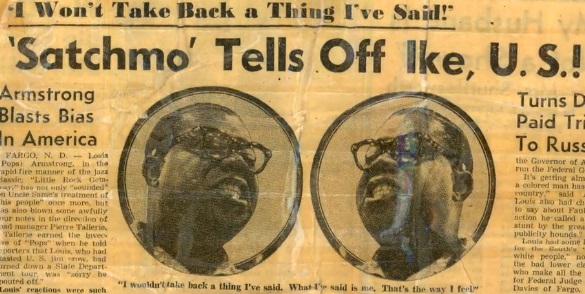
SatchmoLouis Armstrong was born on August 4, 1901 in New Orleans.  As he rose to fame, he would play Little Rock numerous times in a variety of venues.

As the Civil Rights movement started taking hold in the mid-1950s, many African American entertainers were vocal in their support.  Armstrong stayed silent.  Until, that is, September 17, 1957.  That night, in Grand Forks, North Dakota, he blasted President Dwight Eisenhower for his lack of action to make Governor Orval Faubus obey the law.  This was in an interview conducted by a 21 year old University of North Dakota journalism student named Larry Lubenow.

Journalist David Margolick wrote about the incident in The New York Times in September 2007 in conjunction with the 50th anniversary of the integration of Little Rock Central High School.  He recounted how the story, written for the Grand Forks Herald, was picked up all over the country.  The entire Margolick piece can be read here.  Margolick tells that when Armstrong was given the chance to back off the comments, he asserted that he meant all of it.

On September 24, 1957, the night that the 101st Airborne was being mobilized to come into Little Rock, Armstrong sent Eisenhower a telegram again criticizing him for lack of action.  He used colorful language which sarcastically spoofed the “Uncle Tom” moniker which some of his critics had bestowed when they felt he was not doing enough for Civil Rights.  The Eisenhower Presidential Library has a copy of that telegram.  The incident between Satchmo and Ike was the basis for two different plays: Terry Teachout’s Satchmo at the Waldorf and Ishmael Reed’s The C Above C Above High C.

Armstrong would again play a part in Little Rock’s Civil Rights history.  In September 1966, he played the first major concert in Robinson Auditorium that was before a fully integrated audience.  Since the early 1960s, there had been a few sporadic concerts which had been before integrated audiences. But the policy of the Auditorium Commission remained that the building was to be segregated.  Following the approval of the 1964 Civil Rights Act, public facilities had to be integrated. Louis Armstrong played before a full house at Robinson Auditorium that night.

Little Rock Look Back: Mayor William Whipple

whippleOn August 4, 1834, future Little Rock Mayor William G. Whipple was born in Connecticut.  He attended school in Massachusetts and graduated from Wesleyan University. After studying law at Albany Law School, he moved to Milwaukee, Wisconsin.

In 1868, Whipple moved to Little Rock following the 1866 death of his first wife in Wisconsin. Long active in Republican politics, he quickly became involved in Little Rock’s political and social life.  Shortly after his arrival he was appointed United States Attorney and served three years.

In 1870, he married Mary S. Dodge, daughter of former mayor Roderick Lathrop Dodge MD.  They had one son Durand, who followed his father into the legal profession. The Whipples were active members of Trinity Episcopal Cathedral.

In 1887, Whipple was elected Mayor of Little Rock and was re-elected two years later.  Whipple’s mayoral administration introduced electric lighting to the city beginning on September 1, 1887, paved many streets with granite and macadam, created sixty miles of new brick and concrete sidewalks, and introduced a steam dummy railway.

In 1892, he ran for Governor of Arkansas as the Republican nominee but was unsuccessful.  In 1895, he sought a third term for Mayor but was defeated by James A. Woodson.

From 1897 to 1900, he served as register of the US Land Office in Arkansas.  Whipple, who had long practiced law, was appointed United States Attorney for the Eastern District of Arkansas in 1900.  He served in that capacity until 1913.

In July 1914, Mayor Whipple died.  He is buried at Oakland Cemetery in Little Rock.

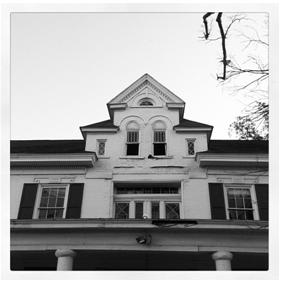
Cleanup day at William E. Woodruff House announced for Saturday, Aug 8

The historic Woodruff house.

The historic Woodruff house.

The QQA acquired the William E. Woodruff Housein December 2014 with the help of the City of Little Rock and the Arkansas Historic Preservation Program.   The QQA has donated interior and façade easements to protect the house in perpetuity, and we continue to work with the City and AHPP to stabilize the house and make repairs before selling it for development.

On Saturday, August 8 from 8am to 12 noon, join other volunteers at the Woodruff House (1017 East 8th Street) for a cleanup day.

The main task is basic landscape cleanup surrounding the house.  Before the house can be treated for termite damage and repaired, weeds and shrubs surrounding the foundation must be removed.  There is also trash on the property that needs to be picked up.

Volunteers must sign a waiver before working, they will be available on site.  Volunteers should wear old clothes, sturdy closed-toe shoes, and bring work gloves. If you would like to be involved but can’t join us on the 8th, you can help by donating cold drinks, snacks, or lunch to our volunteers. Contact the QQA office at qqa@quapaw.com or 501-371-0075 to make arrangements. If you have supplies you would be willing to let us borrow, drop them by QQA office, clearly labeled with your name and phone number, or just bring them with you when you volunteer.

If you’re interested in sponsoring this or future work days at the Woodruff House, please contact the QQA office at qqa@quapaw.com or 501-371-0075. 

The Quapaw Quarter Association’s mission is to promote the preservation of Little Rock’s architectural heritage through advocacy, marketing and education. Incorporated in 1968, the QQA grew out of an effort to identify and protect significant historic structures in Little Rock during the urban renewal projects of the early 1960s. Throughout its existence, the QQA has been a driving force behind historic preservation in Greater Little Rock.

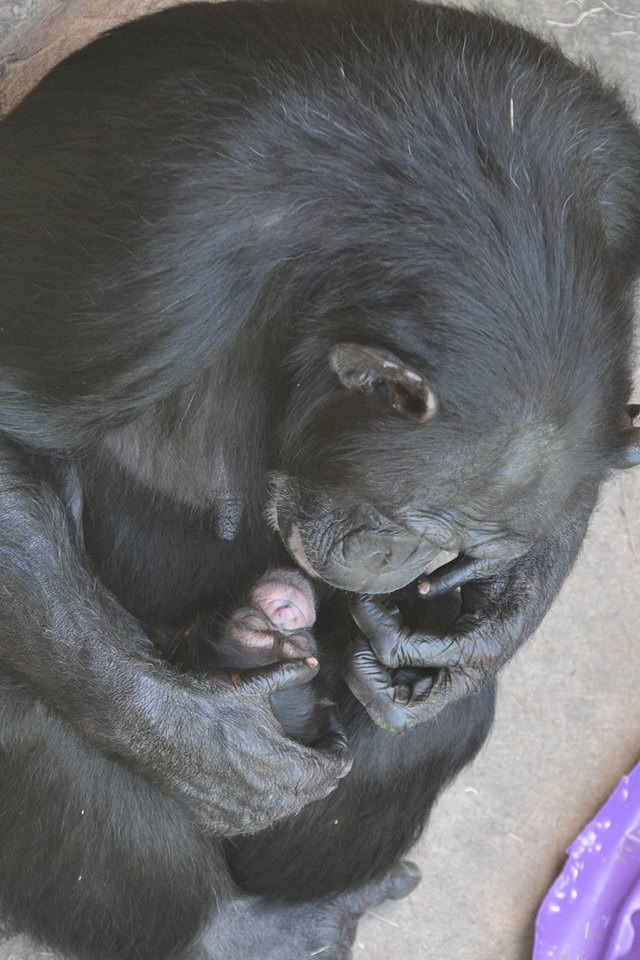
And the Baby Chimp’s Name Is….

Mahale and JumokeThe votes are in, the results have been tabulated and the Little Rock Zoo is proud to announce that the name of its new baby chimpanzee is JUMOKE (pronounced joo MOH keh).

A total of 1,401 votes were cast in an online poll collected at the Little Rock Zoo’s website. Jumoke received 42 percent of the vote with 584 votes. Kibale received 36 percent of the vote with 504 percent and Kgosi received 22 percent with 313 votes.

The public was asked to participate in an online poll posted after the July 18, 2015, birth of its new baby chimpanzee to chimp Mahale (pronounced ma HAH lay). Keepers selected three possible choices from which the public would be asked to choose:

Jumoke – Swahili for “everyone loves the child”

Kibale – (pronounced kih BAH lay) named after Kibale National Park in Uganda. The baby’s mother, Mahale, was named for Mahale Mountains National Park in Tanzania.

Kgosi –   (pronounced koh see) a Setswana term for “king” or “chief”. The baby’s grandfather was named “King Richard”

This marks the second birth for Mahale who gave birth to Kendi (pronounced ken dee) on August 29, 2009. While paternity tests have not been conducted, keepers suspect the likely father of the baby is Kijana (pronounced key JHON ah) the alpha male chimpanzee of the group.

The new baby and the chimp family are most likely to be visible to the public during the 1:30 p.m. scatter feed at the Great Ape exhibit every day. However, keepers note that mom and baby have access to an indoor air conditioned area and have the choice to venture outside or stay inside.

The birth of this chimp comes as the result of the Little Rock Zoo’s participation in the chimpanzee Species Survival Plan (SSP) of the Association of Zoos and Aquariums (AZA). The SSP is an organization with members from other AZA accredited zoos that makes breeding and companionship recommendations for endangered animals.  The Little Rock Zoo is accredited by the Association of Zoos and Aquariums.

Explore the Mindbender Mansion at the Museum of Discovery

Mindbender_logo_CMYKIt’s hot outside, but there are plenty of cool things to do inside.  The Museum of Discovery has the exhibit “Mindbender Mansion” now through September 7.

Mister E. and the Mindbender Society invite you to enter the wonderfully puzzling world of Mindbender Mansion, an eclectic place full of puzzles, brainteasers, and interactive challenges guaranteed to test the brain power and problem solving skills of even the most experienced puzzlers. Adults and children alike will enjoy exercising their minds as they try to master each of the 11 individual brain teasers and the three group activities in this fun and unconventional new exhibit.

Visitors to Mindbender Mansion will be greeted by the wacky Mr. E., master brainteaser and puzzler extraordinaire, and current curator of the Mindbender Society. He will explain the mysteries of Mindbender Mansion and how to become a member of the eccentric Mindbender Society by gathering hidden clues and secret passwords. The clues can only be found by solving key puzzles found in select themed areas.

Throughout the exhibit visitors will find a combination of tabletop brainteasers they can solve on their own and larger group challenges that require assistance from their fellow mansion guests.

The group challenges include:

  • Feeding Frenzy-Kitchen mayhem is guaranteed in a race to beat the clock by filling T.V. dinner trays (with five kinds of food) on a fast moving conveyer belt.
  • Spelling Fever-Hopscotch meets Scrabble® in this race to spell correct words within a limited amount of time by hopping on letter squares that light up.
  • Amazing Maze-In this version of the classic steel ball labyrinth game visitors must work together to tilt a table in different directions, guiding a ball into six holes as quickly as possible.

Upon completing each of the select brainteasers and group challenges, visitors will have gathered the necessary clues and secret passwords to become a member of the Mindbender Society and add their portrait to the “Wall of Fame.”

Final day for Kaleidoscope Film Festival first year

FSLR Kaleidoscope 2015This is the final day of Kaleidoscope, but there is still plenty to see.

At 12:15 at The Studio Theatre, the film Androids Dream (Suenan los Andoides) will be presented by Fantastic Cinema.  A lo-fi spin on Philip K. Dick’s “Do Androids Dream of Electric Sheep,” famously adapted by Ridley Scott in Blade Runner.  It is the year 2052, on Earth, in Spain, and the final days of almost everything. The city is a string of abandoned construction sites. Everyday there are fewer people and not all of them are human. A sheep costs four and a half million pesetas and you have to spend a lot of bullets to pay for one.

At 1:30 in The Lobby Bar, the “Time Change: Narrative Shorts” block will be shown.  Included are “Lady of the Night,” “My Personal Art History,” “Nothing,” “You.Me.Bathroom.Sex.Now,” “The Last Girl,” “Intrinsic Moral Evil,” “Life in Colors,” and “Devin.”

The film Driving Not Knowing will be shown at The Studio Theatre at 1:30.  Lee, a drug-addled yet sensitive musician, is in love with Will, an ambitious poet. Volatile and intense, Will is hesitant to make himself vulnerable to Lee’s affection. After a year apart, the two reunite for a weekend at Lee’s home in the country. Not knowing how to be free and connected at the same time, the men struggle to find what they are driving towards.

At 3:45pm at The Studio Theatre, the Center for Artistic Revolution/ Final Draft Student Short Film Prize block will be presented. Included in this are “Some Rainbows Never Gery,” “Water,” “Border Woods,” “Plunge,” “Falling Angels,” “A Kiss From Your Lips,” and “Southern Pride.”

The final film is S&M Sally which will be preceded by the short “Bad at Dancing.” These will be shown at the Studio Theatre at 6pm.  When Jamie finds out her girlfriend Jill has spent time exploring BDSM, her insecurities about falling behind in the bedroom push her to propose that they start going to underground clubs. Identifying as the butch one in a traditional butch/femme couple, Jamie assumes she will take the dominant role in their escapades, with Jill as her submissive, but Jill has ideas of her own. A provocative and hilarious ride, S&M Sally details the unexpected journey that happens when your insecurities push you outside of your comfort zone.

At 8pm, there will be a final party with a champagne toast in the Lobby Bar.