Little Rock Look Back: Plans for new City Hall finally proceed

City Hall circa 1908

City Hall circa 1908

After a judge ruled in August 1906 that the City of Little Rock could not build a new City Hall and Auditorium complex, it looked like Little Rock would be stuck with its existing inadequate building.

However on September 10 it became obvious that much work had been taking place behind the scenes after that ruling.  On that day, the Board of Public Affairs (a City body charged with overseeing municipal government construction projects and comprised of the mayor and two citizens approved by the City Council) voted to ask the aldermen to cancel plans and rescind legislation for the city hall, jail and auditorium complex.  The Board of Public Affairs then offered up a new plan for a city hall and jail building.  Because no auditorium was involved, these plans would not be in violation of the Chancery Court.

That same evening the City Council followed suit and revoked the plans for the original project.  The aldermen then voted to proceed with building a new city hall and jail without the auditorium.  There was only one dissenting vote; Alderman Jonathan Tuohey voted no.  He explained his negative vote was not a lack of support for the project, but he was not comfortable with the way it was rushed through.

Mayor Warren E. Lenon told the Gazette, “The Chancery Court has enjoined us from erecting an auditorium and the Board of Public Affairs has consequently rescinded all resolutions and orders pertaining to that structure.” He noted that there would “be no appeal from the injunction granted by Chancellor Hart, because there is nothing to appeal.”

The coverage of the actions of the City Council that night was in keeping with the manner in which the two daily newspapers had covered the lawsuit and the trial.  The Gazette headline cried “City Hall Ordinance Railroaded Through” while the staid Democrat merely stated “New $175,000 City Hall Provided by City Council.”  The tone of the Gazette’s article matched the headline while the Democrat’s story was more straightforward.

Architect Charles Thompson adjusted his plan for the new City Hall by removing the auditorium wing.  With the revised Th0mpson plan and the approval of the City Council, Little Rock was at last on its way to a new City Hall.  This was over two years after Mayor Lenon had first broached the subject.

Originally slated to open in 1907, the building officially opened in April 1908.
Little Rock Look Back: Would Little Rock get a new City Hall and Auditorium in 1906?

The 1906 plans for City Hall with the Municipal Auditorium on the left portion.

The 1906 plans for City Hall with the Municipal Auditorium on the left portion.

Last week: Little Rock Mayor Warren E. Lenon had been advocating for a new City Hall a municipal auditorium since shortly after taking office in April 1903. After plans were approved in July 1906, a group of citizens, led by Arkansas Gazette publisher J. N. Heiskell, filed suit to stop the City.

The closing arguments in the trial against plans for a new City Hall and auditorium complex had been heard on Monday, July 30.  The case was heard by Chancery Judge J. C. Hart.  Serving as an advisor to Chancellor Hart throughout the trial (though with no official legal standing) was Pulaski County Circuit Court Judge Robert J. Lea.  To accommodate the expected large attendance, the trial had been moved into his courtroom which was larger than Chancellor Hart’s.

On Friday, August 3, Pulaski County Chancery Judge J. C. Hart issued an injunction to keep the City from signing a contract for the construction of a city hall, jail and auditorium.  Chancellor Hart concurred with the plaintiffs that Arkansas’ constitution and laws dictated all taxation must be for public purposes.  He found there was nothing in Arkansas case law which defined an auditorium to be used for conventions as a public purpose.

As had been the case throughout the trial, the tone of the coverage of the decision differed greatly in the city’s two daily papers.  The subheading in the Democrat noted that the plaintiffs would be liable for any losses to the municipal government’s coffers due to a delay in commencing the construction if Little Rock eventually prevailed.  That fact is not mentioned by the Gazette.  Both papers did make note that Judge Lea agreed with the Chancellor’s decision.

For now, it looked as if the City of Little Rock would be stuck in the 1867 City Hall on Markham between Main and Louisiana.  Mr. Heiskell and his compatriots waited to see if the City would appeal the decision.

While August would be a quiet month publicly, work would go on behind the scenes.  More on that, in the future.

Little Rock Look Back: Plans for new City Hall go on trial

The 1906 plans for City Hall with the Municipal Auditorium on the left portion.

The 1906 plans for City Hall with the Municipal Auditorium on the left portion.

The Little Rock City Council approved Charles Thompson’s plans for a new city hall, auditorium and jail on July 9, 1906, by the adoption of Resolution 281 and Ordinance 1,295.  This did not set well with the powers that be at the Arkansas Gazette.  A lawsuit was filed against the City. The lead plaintiff was J. N. Heiskell, the owner and editor of the Gazette.  From July 24 through July 27, the Arkansas Gazette featured stories and editorials on its front page decrying the action.  (It most likely stems from the fact that the editor was trying to get the City Council to construct a public library.  He ostensibly felt that money spent on a new city hall and auditorium would divert funds from construction of a library.)

In response to the lawsuit, a temporary restraining order was issued on July 24 stopping the City from any further action on the new building plans until the trial had taken place.  The plaintiffs’ four main points were that state law did not authorize a city government to construct an auditorium, that the contract exceeded the amount authorized by the City Council, that the City did not own the land on which the city hall and auditorium would be built, and that “the city of Little Rock now has a city hall sufficient for all necessary purposes.”

The trial started on Friday, July 27, 1906.  Among the legal team for the plaintiffs were J. H. Harrod and former Arkansas Governor Daniel Webster Jones.  The City’s legal team included City Attorney W. Burt Brooks joined by three attorneys from prominent Little Rock families: former City Attorney Ashley Cockrill, John Fletcher and Thomas Mehaffy.

The trial began on a Friday, continued on Saturday (!) and concluded on a Monday.

Architect Frank W. Gibb (who had applied for but not been selected to design the new city hall and auditorium) was called as a witness by the prosecution.  He stated that, based on his review, the capacity for the auditorium would be between 1,700 and 2,000.  This was used to bolster claims by the plaintiffs that the auditorium, if built, would be insufficient to the meet the needs offered by proponents.  Mr. Gibb also estimated that the auditorium wing was about forty-two percent of the cost for the entire project.  He was asked by the defense about the adequacy of the existing City Hall.  The architect replied that the current seat of municipal government was not large enough to meet all the present needs.

Mayor Lenon was the only defense witness; in his testimony he addressed the inadequacies of the current City Hall which echoed the points raised by Mr. Gibb. The mayor also detailed the purchase of the land for the new project.  While the plaintiffs charged the city had not purchased the land, Mayor Lenon pointed out the land was under contract.  He further stated that the work was done through a third party for fear that if the land owners had known the city was the interested buyer, the price might have been inflated by the potential sellers.

Next up were the closing arguments.  More on those and the verdict next week.

Little Rock Look Back: New City Hall approved

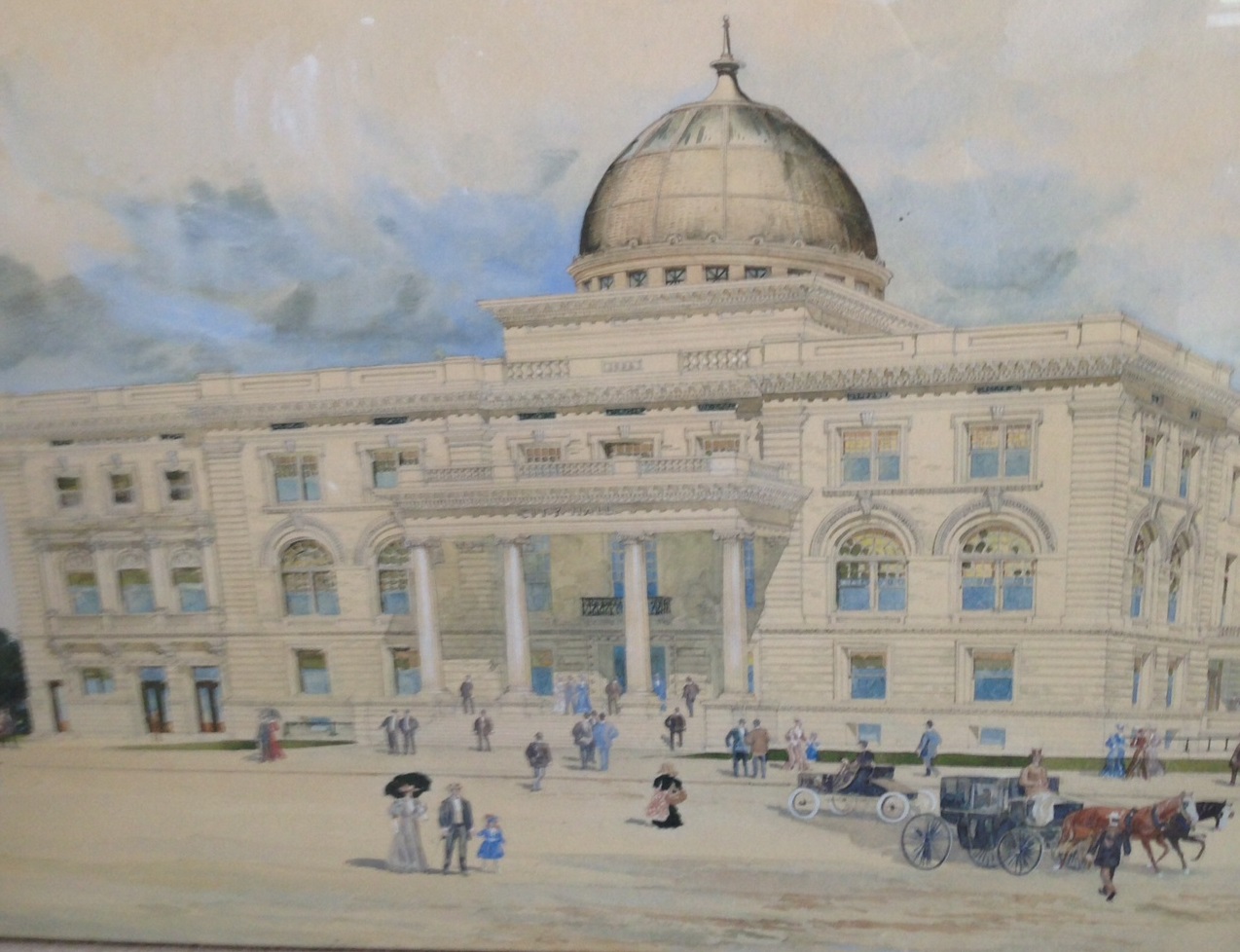
1906 City Hall watercolor

Watercolor of Charles Thompson’s original plan for a Little Rock City Hall complex

On July 9, 1906, the Little Rock City Council approved Resolution 281 and Ordinance 1,295. These actions approved the plans for a new City Hall complex to be constructed on land at the northwest corner of Markham and Broadway Streets.  A few days later, the contract was awarded for the construction of the new building.

Mayor Warren E. Lenon had first called for a new city hall complex in his annual address in April 1904. He repeated his request in April 1905.   The City Council took up Mayor Lenon’s quest for a new city hall in December of 1905.  The Council appropriated money for the purchase of land for a city hall, jail and auditorium.

In response to this, the Arkansas Gazette daily newspaper ran a story featuring the viewpoints of a few civic leaders weighing in on the need for a new city hall complex which would also include a new jail and a city auditorium.  Two of the respondents, L. B. Leigh and P. Raleigh, stressed the need for paved streets and better sewers instead of a new city hall and auditorium.

The other three businessmen interviewed were more favorable to Mayor Lenon’s proposal.  Morris M. Cohn, a former Little Rock City Attorney, stated “I do not think we can make a better investment than in a fine city hall and auditorium.”  (Mr. Cohn, though an M. M. Cohn, was not related the M. M. Cohn who was the namesake for the longtime Little Rock department store.) County Judge William Marmaduke Kavanaugh offered his satisfaction with the action of the City Council on that matter.  R. E. Walt, a banker, opined that he thought $150,000 was not enough; he suggested $200,000 should be spent.

Later that month the Gazette reported that a site had been selected for the city hall and auditorium complex.  The proposed location was most of a city block located at the corner of Markham and Broadway Streets.  Mayor Lenon was vague as to the details of the deal because negotiations were still underway with the property owners

As 1906 dawned, Mayor Lenon and other city leaders continued to take steps to build the new city hall and auditorium.  They invited three local architects to make presentations for the chance to design the new complex.  The three were Charles L. Thompson, Frank W. Gibb and George R. Mann.  Mr. Thompson was chosen to receive the assignment.

On February 5, 1906, Mayor Lenon announced the creation of a special committee to work on the planning for a future city hall complex.  This committee consisted of Aldermen Louis Walther, A. B. Poe, L. N. Whitcomb, Christopher Ledwidge, and John A. Adams.

Mayor Lenon further stated that the new city hall complex and several private developments would “put us in that march of progress with which nothing can prevent us from having a 100,000 population in a few years.”

The saga to get the building built was just starting.

Little Rock Look Back: Dan Sprick, LR’s 50th Mayor

SprickFuture Little Rock Mayor Dan T. Sprick was born on May 19, 1902.  He served three terms on the Little Rock City Council (from 1935 to 1941).  In 1945, he was elected Mayor of Little Rock and served one term. During his tenure on the City Council, he was the sole vote against locating Robinson Auditorium at Markham and Broadway.  He had favored another location.

He was not alone, however, in being held in contempt of court and spending part of the day in jail.  On Monday, December 4, a dozen of Little Rock’s aldermen (which included Sprick) reported to the county jail to serve sentences for contempt of court. The previous Monday, the twelve council members had voted against an ordinance which had been ordered by the judge in an improvement district matter. The other aldermen had either voted in the affirmative or had been absent. Because the twelve had refused to change their votes since that meeting, the judge ordered them jailed.

Mrs. C. C. Conner, the only female, was not jailed but was fined $50. The eleven men were held at the jail, though not in cells. In order to get out of jail, the judge gave the aldermen the chance to change their votes. The mayor asked the judge to let them leave the jail to attend the meeting at City Hall, which was nearby. He requested that the city be allowed to maintain “what little dignity remained” by not having the meeting at the jail. The judge relented, and the aldermen were escorted by deputies to the council chambers. After the aldermen changed their votes, the judge suspended the remainder of their sentences.

His tenure as Mayor was relatively quiet. He took office the same month that World War II ended. While in office, the Sprick administration was marked by growth in the city budget and in city positions. As a part of that growth, there were many more new purchases taking place which had prompted extra scrutiny of the City’s purchasing procedures. A thorough investigation toward the end of his tenure found no malfeasance or misfeasance, it did note that the city needed to do a better job of anticipating cash flow. Much of the City’s focus during the Sprick tenure was on growth and keeping up infrastructure needs.

Sprick later served for ten years in the Arkansas State Senate (from 1961 to 1970).  During his tenure in the Senate, Sprick was closely aligned with Gov. Orval Faubus.  When the Little Rock high schools had been closed a year to ensure segregation, Sprick had served on the board of a private school set up by some of the leaders of the segregation movement.

His time in the Senate was also marked by controversy.  He was one of three Senators to opposed Muhammad Ali’s speaking at the University of Arkansas at Fayetteville.  After an Arkansas Gazette editorial lambasted him, Sprick sued the paper for libel. The Gazette settled with him out of court because his health was poor.

Sprick died in January 1972.

A Prized Cemetery – Mount Holly on Pulitzer Day

The Pulitzer Prizes are to be announced today.  Mount Holly Cemetery not only touts that it is the site of a whole host of elected officials, it is also the only place in Arkansas where two Pulitzer Prize recipients are buried.

In 1939, John Gould Fletcher became the first Southern poet to win the Pulitzer Prize for Poetry.  He was born into a prominent Little Rock family in 1886.  Fletcher was awarded the prize for his collection Selected Poems which was published by Farrar in 1938.  Two years earlier, he had been commissioned by the Arkansas Gazette to compose an epic poem about the history of Arkansas in conjunction with the state’s centennial.

Fletcher is buried next to his wife, author Charlie May Simon and his parents (his father was former Little Rock Mayor John Gould Fletcher).  Other relatives are buried nearby in the cemetery.

The other Pulitzer Prize winner buried in Mount Holly is J. N. Heiskell, the longtime editor of the Arkansas Gazette.  It was Heiskell, in fact, who asked Fletcher to compose the poem about Arkansas.  Heiskell served as editor of the Gazette from 1902 through 1972.  He died at the age of 100 in 1972.

Under his leadership, the Gazette earned two Pulitzer Prizes for its coverage of the 1957 desegregation of Little Rock Central High.  One was for Harry Ashmore’s editorial writing and the other was for Public Service.

Heiskell remained in charge of the Gazette until his death in 1972.  He is buried alongside his wife with other relatives nearby.  Also not too far from Mr. Heiskell are two of his nemeses, proving that death and cemeteries can be the great equalizer. In the early days of his Gazette stewardship, he often locked horns with Senator (and former Governor) Jeff Davis. Later in Mr. Heiskell’s career, he vehemently disagreed with Dr. Dale Alford, who had been elected to Congress on a segregationist platform.

Little Rock Look Back: General MacArthur Returns to Little Rock

MacArthur and Mayor Remmel

General MacArthur and Mayor Remmel

On Sunday, March 23, 1952, General Douglas MacArthur made his only post-infancy visit to Little Rock. He had previously been scheduled to visit Mississippi, and Little Rock Mayor Pratt Remmel had persuaded him to add a visit to Little Rock to the agenda. The fact that Little Rock now had a Republican mayor had apparently piqued the General’s interest.

General MacArthur, accompanied by his wife and son as well as several journalists and members of his military retinue, arrived at Little Rock Airport at 10:40 am. He was met by a delegation of civic leaders including Mayor Remmel. Alderman James Griffey made welcoming remarks on behalf of the city. Then the General and Mayor boarded an open car and led a motorcade from the airport to downtown.

The motorcade’s destination was Christ Episcopal Church at Capitol and Scott streets. It was at this church that MacArthur had been baptized as an infant. The delegation was greeted by the Episcopal Bishop R. Bland Mitchell, Rector J. Hodge Alves, and Rector Emeritus W. P. Witsell. (While he had been Rector, Dr. Witsell had garnered national attention by issuing an Easter blessing to Gen. MacArthur as he had been evacuating the Philippines at the height of World War II.) In order to gain admittance to the church that morning, church members and guests had to have tickets.

Following the worship service, the General and his party went to three events in the park named in his honor. The first was a tour of the Museum of Natural History (now the Museum of Discovery and located in the River Market; the current tenant of the building is the MacArthur Museum of Arkansas Military History), which was located in the building in which the General had been born. After the tour, he spoke at a dedication of a small rose garden adjacent to the museum. It was sponsored by the Little Rock City Beautiful Commission and the Garden Clubs of Greater Little Rock.

General MacArthur addressing several thousand in MacArthur Park.

General MacArthur addressing several thousand in MacArthur Park.

Though every stop of the General’s visit had featured crowds, the largest was at the third location in MacArthur Park. A crowd of several thousand greeted the General as he spoke from the Foster Bandshell in the park’s southwest corner. Chamber of Commerce president Richard C. Butler (brother-in-law of Mayor Remmel) was the master of ceremonies. Following an invocation by Methodist Bishop Paul Martin, the only other speaker was the General. In his remarks he spoke of his Southern heritage and of his appreciation for the support of the citizens of Little Rock over the years.

Several gifts were bestowed upon the MacArthurs at the ceremony. The City of Little Rock presented Mrs. MacArthur with an engraved silver serving tray.

Following the events in MacArthur Park, the family retired for a brief respite to the Hotel Marion. They then attended a luncheon buffet in their honor at the home of Howard and Elsie Stebbins on Edgehill Road. The General and Mrs. MacArthur circulated through the house greeting guests and then eschewed a special table in favor of balancing their plates on their laps and sitting in wingback chairs. Meanwhile Arthur MacArthur stayed upstairs and discussed stamp collecting and other hobbies with the Stebbins’ two teenage sons.

Following the luncheon, the MacArthur party went back to the airport and by 4:00pm, the plane was in the air.

Though this visit was coming at the end of a whirlwind of activities, by all accounts, the General and Mrs. MacArthur were very gracious and accommodating. The General was being mentioned as a potential GOP candidate for President, but purposefully steered clear of any political comments in his remarks. He and Mrs. MacArthur dutifully posed for photos not only for the media but also for amateur photographers. At lunch, the General even asked a Gazette photographer to take a photo of him with his Little Rock Police motorcycle escorts so that they could have a souvenir of the visit.