
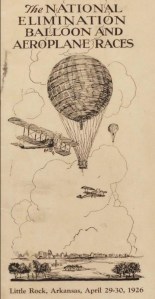
National Balloon Race starts in Little Rock on April 29, 1926

On April 29, 1926, nine hot air balloons took off from Little Rock’s airport (which was actually just an airfield at the time) in a national race to win the Litchfield Trophy.  In addition to the trophy, the winner would be on the American team in an international balloon race in Belgium.

The New York Times coverage noted that the weather conditions were ideal as the balloons took off in five minute intervals between 5:00pm and 5:30pm.  The test balloon (akin to a pace car in a car race) was the Arkansas Gazette‘s Skylark.  It took off at 4:25 and headed in the direction of the northeast, which was the desired direction.

The nine balloons, in order of liftoff were: the US Army from Phillips Field in Maryland; the US Army from McCook Field in Ohio; the Goodyear Southern California; the Detroit; the Goodyear IV (whose pilot Ward T. Van Orman had won the 1924 and 1925 contests); US Army from Scott Field; a balloon piloted by a Danish pilot Svend A. U. Rasmussen; US Army balloon from Langley Field in Virginia; and the Akron National Aeronautic Association balloon.

The pilots carried provisions for 48 hours and were equipped for sea flying.  Each had a radio and loud speaker.  KTHS radio of Hot Springs (a forerunner to today’s KTHV TV station) was broadcasting the location of each balloon.  As they left the Arkansas radio station’s range, there was a network of other stations which would do the same.

It was expected that the race would last between eighteen and thirty-six hours.  The last balloon aloft was Van Orman for the third year.  He lasted approximately 31 hours and landed near Chesapeake Bay.

Though no headcount was given, the New York Times called the viewing audience “the largest crowd ever assembled in Little Rock.”

Many thanks to Brian Lang of the Arkansas Arts Center for giving me the tip on this.

You cannot spell Pulitzer without LIT

The 2019 Pulitzer Prizes are announced later today.  Over the years, there have been several Pulitzer winners with connections to Little Rock.
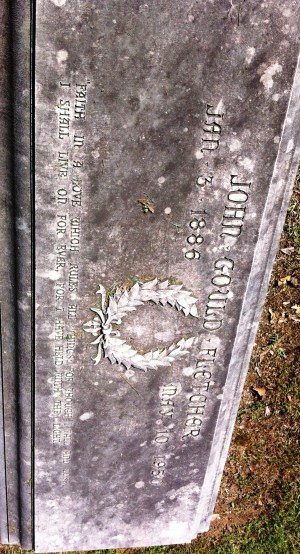
In 1939,  Little Rock native John Gould Fletcher, a scion of a politically prominent family, won the Pulitzer Prize in Poetry for his work Selected Poems.  He appears to be the first Pulitzer Prize winner with Little Rock connections.

The 1950 Pulitzer Prize for Drama went to South Pacific. With a leading lady who is from Little Rock, this Richard Rodgers, Oscar Hammerstein II, and Joshua Logan musical explores race against the backdrop of World War II.  It is based on James Michener’s Tales of the South Pacific, which won the 1948 Pulitzer for Fiction. (Because it was a collection of interrelated short stories, the category was changed from Novel to Fiction from that year onward.)  But in the Michener book, Forbush is not from Little Rock.

The Arkansas Gazette made Pulitzer history in 1958 by winning both the Public Service and Editorial prizes in the same year. This was the first time that one organization had received both awards in the same year.  These were for the coverage of and response to the 1957 integration of Central High School by the Little Rock Nine.  J. N. Heiskell was the paper’s owner and editor, while Harry Ashmore led the editorial page.  Relman Morin of the Associated Press received the Pulitzer for National Reporting for his coverage of the events at Central.  Apparently Will Counts of the Arkansas Democrat was the jurors’ choice to receive the Pulitzer for Photography. But the Board opted to give the prize to another photographer.  Some speculate that the Pulitzer Board did not want to give four prizes in the same year for the same story.

Current Little Rock resident Paul Greenberg won the 1969 Pulitzer for Editorial Writing.  at the time, he worked for the Pine Bluff Commercial.   In 1986, he was a finalist in the same category.  Greenberg moved to Little Rock to join the staff of the Arkansas Democrat-Gazette in 1992.  While no longer the Editorial Page Editor, Greenberg continues to write columns for the newspaper.

Former Little Rock resident Richard Ford received the 1996 Pulitzer for Fiction for his novel Independence Day.  As a young boy of eight, and for several years after, Ford spent much time at Little Rock’s Marion Hotel with his grandparents.  In making the presentation, the Pulitzer Board noted it was, “A visionary account of American life, Independence Day reveals a man and country with unflinching comedy and the specter of hope and even permanence…”

The Pulitzer Prize for Drama in 2001 went to David Auburn.  A 1987 graduate of Hall High School, Auburn was recognized for his play Proof.  The Pulitzer Board described Proof thus: “This poignant drama about love and reconciliation unfolds on the back porch of a house settled in a suburban university town, that is, like David Auburn’s writing, both simple and elegant.”  Auburn also served as a 2014 juror for the Pulitzer Prize for Drama.  While a student in Little Rock, Auburn participated in theatre at the Arkansas Arts Center.

A Pulitzer Preview – Prizing Mount Holly Cemetery

The Pulitzer Prizes are to be announced tomorrow (Monday, April 15).  This year marks the 102nd anniversary of the prizes, though not all of the current categories have been around since 1917.

Mount Holly Cemetery not only touts that it is the site of a whole host of elected officials, it is also the only place in Arkansas where two Pulitzer Prize recipients are buried.

The cemetery is open every day, but a special visit to these two prize winner gravesites can be made on Sunday, April 28, during the Mount Holly Cemetery Association’s annual “Restore in Perpetuity” fundraiser picnic.

In 1939, John Gould Fletcher became the first Southern poet to win the Pulitzer Prize for Poetry.  He was born into a prominent Little Rock family in 1886.  Fletcher was awarded the prize for his collection Selected Poems which was published by Farrar in 1938.  Two years earlier, he had been commissioned by the Arkansas Gazette to compose an epic poem about the history of Arkansas in conjunction with the state’s centennial.

Fletcher is buried next to his wife, author Charlie May Simon and his parents (his father was former Little Rock Mayor John Gould Fletcher).  Other relatives are buried nearby in the cemetery.

The other Pulitzer Prize winner buried in Mount Holly is J. N. Heiskell, the longtime editor of the Arkansas Gazette.  It was Heiskell, in fact, who asked Fletcher to compose the poem about Arkansas.  Heiskell served as editor of the Gazette from 1902 through 1972.  He died at the age of 100 in 1972.

Under his leadership, the Gazette earned two Pulitzer Prizes for its coverage of the 1957 desegregation of Little Rock Central High.  One was for Harry Ashmore’s editorial writing and the other was for Public Service.

Heiskell remained in charge of the Gazette until his death in 1972.  He is buried alongside his wife with other relatives nearby.  Also not too far from Mr. Heiskell are two of his nemeses, proving that death and cemeteries can be the great equalizer. In the early days of his Gazette stewardship, he often locked horns with Senator (and former Governor) Jeff Davis. Later in Mr. Heiskell’s career, he vehemently disagreed with Dr. Dale Alford, who had been elected to Congress on a segregationist platform.

Women Making History: Rev. Dr. Peggy S. Bosmyer

In 1977, Peggy S. Bosmyer was ordained an Episcopal priest at Little Rock’s Trinity Cathedral.  Not only was she the first woman in Arkansas to be ordained to a full priesthood in the Episcopal Church, she was the first woman south of the Mason-Dixon line.

Born in Helena, she was a graduate of the University of Arkansas and Virginia Theological Seminary.  She served as a deacon at Grace Episcopal in Pine Bluff before serving as a curate at Little Rock’s St. Mark’s Episcopal.  In 1976, the Episcopal Church approved the ordination of women to the priesthood. It was after that she was able to be ordained in 1977.  Her ordination was front page news in the Arkansas Gazette.

Following ordination, she was appointed Vicar of Little Rock’s St. Michael’s Episcopal Church, then a part-time position. She also served as a program director for the Diocese of Arkansas, which included oversight of Camp Mitchell.  In 1985, Rev. Bosmyer was appointed full-time Vicar of St. Michael’s.  Nine years later, she left Little Rock to be a professor on the faculty of the School of Theology at the University of the South.  While there she served as Co-Vicar of St. James at Sewanee. She also received her Doctor of Divinity from the University of the South in 1999.

Rev. Dr. Bosmyer returned to Little Rock in 2001 to be Vicar of St. Margaret’s Episcopal Church.  She held that position until her death in December 2008 from pancreatic cancer.  She is interred at the columbarium of St. Margaret’s.  She was survived by her husband of 24 years, Reverend Dr. Dennis Campbell, and four children.

She was not only one of the first female Episcopal priests in the U.S, she was on the forefront of women serving as ordained priests and preachers in mainline denominations.  Certainly her ordination was not without controversy. There are still those who disagree with women serving as priests (though likely few remain within the Episcopal church).

The legacy of Rev. Dr. Bosmyer continues today with the women serving as rectors, vicars, priests in charge, and associate rectors throughout the state of Arkansas.  While Arkansas has not had a woman serve as Bishop, Rev. Dr. Katherine Jefferts Schori served as Presiding Bishop of the Episcopal Church from 2006 to 2015.

Little Rock Look Back: Airplane explosion shatters Hillcrest calm

An LRPD officer talks to bystanders next to a piece of debris

An LRPD officer talks to bystanders next to a piece of debris

An LRPD officer talks to bystanders next to a piece of debrisThe peaceful morning of March 31, 1960, was interrupted by a horrendous noise over Hillcrest around 6:00am.  A six-engine B47 from the Little Rock Air Force Base exploded mid-air.

Flaming debris fell from Allsopp Park all the way to the State Capitol grounds and stretched from Cantrell to 12th Street.  Other debris was found as far away as the Country Club of Little Rock.  The next day the Arkansas Gazette ran a map which showed the extent of the damage.

Three airmen died in the explosion.  The only survivor from the crew, 1st Lieutenant Thomas Smoak, was found dangling from a tree in his parachute at Kavanaugh and Martin.  He was treated by a nurse, Jimmye Lee Holeman, in whose yard he had landed.

Two civilians on the ground were killed by falling debris.  Many vehicles and homes were damaged, some were destroyed by debris.  The damage estimate was put around $4 million.

Police and fire crews were quickly on the scene to secure impacted areas, fight fires and rescue injured persons.

Those who perished were Captain Herbert Aldridge, Lieutenant Colonel Reynolds Watson, Staff-Sergeant Kenneth Brose, and civilians Alta Lois Clark and James Hollabaugh.

Today, a portion of the crash site is part of the Arkansas Children’s Hospital campus.  Other sites were removed by the I-630 construction.  Other houses were rebuilt or removed.

While there may not be visible reminders of that fateful morning, to those who lost loved ones, there is still a sense of grief over their loss.  It is a reminder that History is not just places, names, and dates: but events that happened to actual people.

B47 Wreck Map

Arkansas Gazette map of debris and damage

Little Rock Look Back: MacArthur Returns

MacArthur and Mayor Remmel

General MacArthur and Mayor Remmel

On Sunday, March 23, 1952, General Douglas MacArthur made his only post-infancy visit to Little Rock. He had previously been scheduled to visit Mississippi, and Little Rock Mayor Pratt Remmel had persuaded him to add a visit to Little Rock to the agenda. The fact that Little Rock now had a Republican mayor had apparently piqued the General’s interest.

General MacArthur, accompanied by his wife and son as well as several journalists and members of his military retinue, arrived at Little Rock Airport at 10:40 am. He was met by a delegation of civic leaders including Mayor Remmel. Alderman James Griffey made welcoming remarks on behalf of the city. Then the General and Mayor boarded an open car and led a motorcade from the airport to downtown.

The motorcade’s destination was Christ Episcopal Church at Capitol and Scott streets. It was at this church that MacArthur had been baptized as an infant. The delegation was greeted by the Episcopal Bishop R. Bland Mitchell, Rector J. Hodge Alves, and Rector Emeritus W. P. Witsell. (While he had been Rector, Dr. Witsell had garnered national attention by issuing an Easter blessing to Gen. MacArthur as he had been evacuating the Philippines at the height of World War II.) In order to gain admittance to the church that morning, church members and guests had to have tickets.

Following the worship service, the General and his party went to three events in the park named in his honor. The first was a tour of the Museum of Natural History (now the Museum of Discovery and located in the River Market; the current tenant of the building is the MacArthur Museum of Arkansas Military History), which was located in the building in which the General had been born. After the tour, he spoke at a dedication of a small rose garden adjacent to the museum. It was sponsored by the Little Rock City Beautiful Commission and the Garden Clubs of Greater Little Rock.

Though every stop of the General’s visit had featured crowds, the largest was at the third location in MacArthur Park. A crowd of several thousand greeted the General as he spoke from the Foster Bandshell in the park’s southwest corner. Chamber of Commerce president Richard C. Butler (brother-in-law of Mayor Remmel) was the master of ceremonies. Following an invocation by Methodist Bishop Paul Martin, the only other speaker was the General. In his remarks he spoke of his Southern heritage and of his appreciation for the support of the citizens of Little Rock over the years.

Several gifts were bestowed upon the MacArthurs at the ceremony. The City of Little Rock presented Mrs. MacArthur with an engraved silver serving tray.

Following the events in MacArthur Park, the family retired for a brief respite to the Hotel Marion. They then attended a luncheon buffet in their honor at the home of Howard and Elsie Stebbins on Edgehill Road. The General and Mrs. MacArthur circulated through the house greeting guests and then eschewed a special table in favor of balancing their plates on their laps and sitting in wingback chairs. Meanwhile Arthur MacArthur stayed upstairs and discussed stamp collecting and other hobbies with the Stebbins’ two teenage sons.

Following the luncheon, the MacArthur party went back to the airport and by 4:00pm, the plane was in the air.

Though this visit was coming at the end of a whirlwind of activities, by all accounts, the General and Mrs. MacArthur were very gracious and accommodating. The General was being mentioned as a potential GOP candidate for President, but purposefully steered clear of any political comments in his remarks. He and Mrs. MacArthur dutifully posed for photos not only for the media but also for amateur photographers. At lunch, the General even asked a Gazette photographer to take a photo of him with his Little Rock Police motorcycle escorts so that they could have a souvenir of the visit.

Women Making History – Adolphine Fletcher Terry

Photos from the collection of the Butler Center

Adolphine Fletcher Terry was born on November 3, 1882 to former Little Rock Mayor John Gould Fletcher and his wife Adolphine Krause Fletcher.

Raised in Little Rock, in 1889 she moved into the Albert Pike House on East 7th Street, when her aunt transferred the title to her father. That house would be her primary residence the rest of her life.  Her sister Mary Fletcher Drennan never lived in Arkansas as an adult after marriage. Her brother John Gould Fletcher spent much of his adulthood in Europe before returning to Little Rock and establishing his own house, Johnswood.

At age 15, Adolphine attended Vassar. She later credited that experience as broadening her views on many issues.  After graduating at age 19, she returned to Little Rock.  Her parents both died prior to her 1910 wedding to David D. Terry, which took place at what was then known as the Pike-Fletcher House (and today is known as the Pike-Fletcher-Terry House).

She is perhaps best known today for establishing the Women’s Emergency Committee in 1958 and for her subsequent deeding of the family house to the City for use by the Arkansas Arts Center.  But her entire life was based on civic engagement.

She was instrumental in establishing the first juvenile court system in Arkansas and helped form the first school improvement association in the state. She was long an advocate for libraries, serving 40 years on the Little Rock public library board.  Through her leadership, the library opened its doors to African Americans in the early 1950s. Today a branch of the Central Arkansas Library System (the successor the Little Rock public library) is named after her.  Another branch is named after her Pulitzer Prize winning brother.

Adolphine formed the Little Rock chapter of the American Association of University Women, the Pulaski County tuberculosis association and the Community Chest.

In 1958, when the Little Rock public high schools were closed instead of allowing them to be desegregated again, she called Harry Ashmore the editor of the Gazette and exclaimed, “the men have failed us…it’s time to call out the women.”  With this, she formed the Women’s Emergency Committee to Open Our Schools. This group played a major role in getting the four high schools open the following year.

From 1933 to 1942, David Terry served in the U.S. Congress. During that time, Adolphine alternated her time between Washington DC and Little Rock. But she spent much time in Little Rock raising her five children.

After her husband’s death in 1963, she continued to remain active in civic affairs. In the 1960’s, she and her sister deeded the Pike-Fletcher-Terry House to the City of Little Rock for use by the Arkansas Arts Center upon both their deaths.  Following Adolphine Fletcher Terry’s death in 1976, Mary turned over the title to the City.

Adolphine Fletcher Terry is buried in Mount Holly Cemetery alongside her husband. Three of her children are also buried in that plot.  Her parents and brother are buried in a nearby plot.

Her granddaughters and their families carry on Adolphine Fletcher Terry’s commitment to making Little Rock better.