Tonight at Arkansas Rep – UALR History Professor Carl Moneyhon will discuss the South at the end of the Civil War

Carl_Moneyhon_smIn conjunction with the current production of The Whipping Man, UALR History Professor Dr. Carl Moneyhon will be speaking at the Arkansas Repertory Theatre this evening. His remarks are entitled “The World Turned Upside Down: The South at The End.

Dr. Moneyhon is a specialist in the history of the American Civil War and the South and is widely published in his field. He is faculty liaison with the University History Institute, an organization that develops closer ties between the department and the community. He serves on editorial boards of the Arkansas Historical Quarterly & the Encyclopedia of Arkansas History and Culture. He has won the UALR Faculty Excellence Award for Research and the UALR Faculty Excellence Award for Teaching.

The program is at 6:00 tonight in Foster’s at the Arkansas Rep.  The doors open at 5:30; a cash bar will be available.  Admission is free for members of the Rep and $10 for non-members.  Registration is required and can be made by calling the Rep Box Office at 501-378-0405.

LR Cultural Touchstone: Margaret Deane Smith Ross

Ross bookMargaret Deane Smith Ross was born August 24, 1922 in Central Arkansas.  She attended both what is now Arkansas Tech University and the University of Arkansas. A journalism major at the latter, she left the university before graduating to marry Captain Edwin L. Ross in September 1942; he was killed in combat in Normandy on July 4, 1944.

Following the death of her husband, she lived in Little Rock and worked as a freelance writer for the Arkansas Democrat. In 1953 she became an associate editor of the Arkansas Historical Quarterly, a position she retained until 1993. She was a charter member of the Pulaski County Historical Society, and from 1953 to 1957 served as its journal’s first editor. From 1954 to 1957 she was a research assistant at Arkansas History Commission.

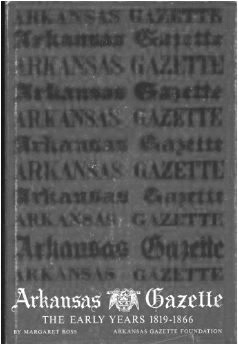
In 1957 she became the Arkansas Gazette historian and curator of the J.N. Heiskell Collection of Arkansiana; she remained with the Gazette for twenty-seven years. From 1958 to 1968 she wrote a historical column for the Gazette, the “Chronicles of Arkansas.” She was a charter member of the Arkansas Genealogical Society, founded by Walter Lemke in 1962. In 1968 she became a member of the Arkansas Historical Association’s board of directors, a position she occupied until 1980. In 1969 she published a book, Arkansas Gazette: The Early Years, 1819-1866: A History; it received the Award of Merit from the American Association for State and Local History. From 1979 to 1984 she wrote “Grass Roots,” a genealogical column for the Gazette. Also in 1979 she became the first fellow of the Arkansas Museum of Science and History. In April 2000 she received a lifetime achievement award from the Arkansas Historical Association.

As a historian for the Gazette, she became the de facto historian for the State of Arkansas.  Her knowledge of Arkansas history was unsurpassed during her lifetime.  She also served as an unofficial teacher to generations who were interested in learning more about the history of their state, and how to do that research.


She died in Little Rock in December 2002.

Legacies & Lunch Looks at Slavery in Arkansas

legaciesSlave resistance in Arkansas is the topic of Legacies & Lunch in January. Kelly Houston Jones, a Ph.D. candidate at the University of Arkansas, will present “A Rough, Saucy Set of Hands to Manage,” a discussion of her research on slavery in Arkansas.

This work was the lead essay in the Spring 2012 issue of Arkansas Historical Quarterly. Making extensive use of legal documents and carefully reading oral histories, Jones sought “to recover the slave point of view in examining explicit resistance.” She concludes that “slaves’ resistance in Arkansas seems to have had more to do with making their lives a little easier than with a continuing, self conscious effort to undermine the slave regime.”

Legacies & Lunch is free, open to the public, and supported in part by the Arkansas Humanities Council. The program is held from noon-1 p.m. on the first Wednesday of each month in the Main Library’s Darragh Center. Attendees are invited to bring a sack lunch; drinks and dessert will be provided.

The Butler Center for Arkansas Studies is a department of the Central Arkansas Library System (CALS). It was founded in 1997 to promote the study and appreciation of Arkansas history and culture. The Butler Center’s research collections, art galleries, and offices are located in the Arkansas Studies Institute building at 401 President Clinton Ave. on the campus of the CALS Main Library.

For more information, call 918-3086.

Historic Preservation Alliance seeking Endangered Places nominations

The Historic Preservation Alliance of Arkansas is now accepting nominations for the 2012 Most Endangered Places List.  The deadline for nominations is Monday, April 2, 2012.

Every year, many historic properties across the state of Arkansas are threatened by demolition, neglect, lack of resources or knowledge of their importance. Each of the endangered resources holds a special place in our collective memory and helps to define who we are as a people, a culture, and a State. Once these unique places are gone, they are gone forever

The Historic Preservation Alliance of Arkansas has maintained a Most Endangered Places List in our state since 1999. By bringing attention to these threatened buildings, sites and places in Arkansas, we seek to raise awareness in communities statewide and to create many success stories from places in peril. This nomination form is your chance to initiate your own story of success.

Properties selected for the Most Endangered Places List will be announced in May during Arkansas Heritage Month and National Preservation Month.

The list of Arkansas’s Most Endangered Historic Places is publicized each year through the announcement of the list in mid-May, which is also Arkansas Heritage Month and National Preservation Month. Press packets are issued to the media in conjunction with the announcement, encouraging TV and radio coverage as well as articles in both statewide and local newspapers. In addition, the Alliance newsletter annually publishes an article about the properties in the list, and information about the list is provided to the Arkansas Historical Quarterly and to the newsletters of local preservation groups and historical societies.

Each year, the Board of Directors of the Alliance appoints a special five-member “Most Endangered List Committee” to oversee the selection of properties for the list and to work with Alliance staff on organizing the announcement of that year’s list.

The composition of this special committee is as follows:

  • A representative of the Alliance Board of Directors
  • A representative of the Arkansas Historic Preservation Program
  • An architect
  • A historian familiar with Arkansas history
  • An at-large member chosen from the Alliance membership

The representative of the Alliance Board of Directors chairs the committee.