Little Rock Look Back: First Class status granted City of Little Rock

On March 9, 1875, the City of Little Rock became a City of the First Class in Arkansas. It was the first city in the state to receive this designation.

This was in conjunction with the adoption of the Arkansas Constitution of 1874 which created this status.  The Constitution defines them as: “All cities, which at the last federal census had, or now have, a population exceeding two thousand five hundred (2,500) inhabitants shall be deemed cities of the first class.”

March 9 is just one of several dates Little Rock could celebrate as a birthday.

  • January 6, 1866 – Little Rock government resumes operations following the Civil War
  • November 2, 1835 – Little Rock is incorporated as a City
  • November 7, 1831 – Little Rock is incorporated as a Town
  • October 27, 1825 – Little Rock given the right to elect a governing board of trustees
  • June 1, 1821 – Little Rock officially becomes capital of Arkansas
  • April 9, 1722 – Jean Batiste Benard de La Harpe sees Le Petite Roche

There could also be the dates in 1812 when William Lewis built the first home in Little Rock (a shack) or in February 1820 when the first permanent settlement was established.  But neither of those have exact dates that are remembered.
Ark @ CLXXXI

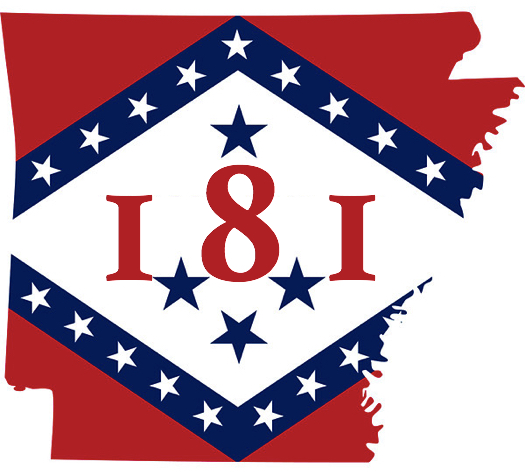
Arkansas181One hundred and eighty-one years ago today, Arkansas was admitted to the Union.  Happy Birthday Arkansas!
Pulitzer Day – a good time to “Prize” Mount Holly Cemetery

The Pulitzer Prizes are to be announced today.  This year marks the 100th anniversary of the prizes, though not all of the current categories have been around since 1917.

Mount Holly Cemetery not only touts that it is the site of a whole host of elected officials, it is also the only place in Arkansas where two Pulitzer Prize recipients are buried. The cemetery is open every day, but a special visit to these two prize winner gravesites can be made on Sunday, April 30, during the Mount Holly Cemetery Association’s annual “Rest in Perpetuity” fundraiser picnic.

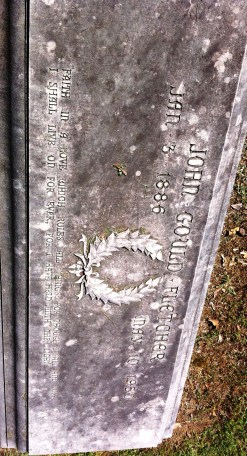
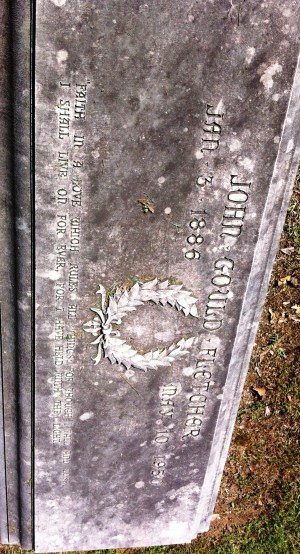
In 1939, John Gould Fletcher became the first Southern poet to win the Pulitzer Prize for Poetry.  He was born into a prominent Little Rock family in 1886.  Fletcher was awarded the prize for his collection Selected Poems which was published by Farrar in 1938.  Two years earlier, he had been commissioned by the Arkansas Gazette to compose an epic poem about the history of Arkansas in conjunction with the state’s centennial.

Fletcher is buried next to his wife, author Charlie May Simon and his parents (his father was former Little Rock Mayor John Gould Fletcher).  Other relatives are buried nearby in the cemetery.

The other Pulitzer Prize winner buried in Mount Holly is J. N. Heiskell, the longtime editor of the Arkansas Gazette.  It was Heiskell, in fact, who asked Fletcher to compose the poem about Arkansas.  Heiskell served as editor of the Gazette from 1902 through 1972.  He died at the age of 100 in 1972.

Under his leadership, the Gazette earned two Pulitzer Prizes for its coverage of the 1957 desegregation of Little Rock Central High.  One was for Harry Ashmore’s editorial writing and the other was for Public Service.

Heiskell remained in charge of the Gazette until his death in 1972.  He is buried alongside his wife with other relatives nearby.  Also not too far from Mr. Heiskell are two of his nemeses, proving that death and cemeteries can be the great equalizer. In the early days of his Gazette stewardship, he often locked horns with Senator (and former Governor) Jeff Davis. Later in Mr. Heiskell’s career, he vehemently disagreed with Dr. Dale Alford, who had been elected to Congress on a segregationist platform.

Prizing Mount Holly Cemetery on Pulitzer Day

The Pulitzer Prizes are to be announced today.  This year marks the 100th announcement of the prizes, though not all of the current categories have been around since 1917.

Mount Holly Cemetery not only touts that it is the site of a whole host of elected officials, it is also the only place in Arkansas where two Pulitzer Prize recipients are buried. The cemetery is open every day, but a special visit to these two prize winner gravesites can be made next Sunday during the Mount Holly Cemetery Association’s annual “Rest in Perpetuity” fundraiser picnic.

In 1939, John Gould Fletcher became the first Southern poet to win the Pulitzer Prize for Poetry.  He was born into a prominent Little Rock family in 1886.  Fletcher was awarded the prize for his collection Selected Poems which was published by Farrar in 1938.  Two years earlier, he had been commissioned by the Arkansas Gazette to compose an epic poem about the history of Arkansas in conjunction with the state’s centennial.

Fletcher is buried next to his wife, author Charlie May Simon and his parents (his father was former Little Rock Mayor John Gould Fletcher).  Other relatives are buried nearby in the cemetery.

The other Pulitzer Prize winner buried in Mount Holly is J. N. Heiskell, the longtime editor of the Arkansas Gazette.  It was Heiskell, in fact, who asked Fletcher to compose the poem about Arkansas.  Heiskell served as editor of the Gazette from 1902 through 1972.  He died at the age of 100 in 1972.
Under his leadership, the Gazette earned two Pulitzer Prizes for its coverage of the 1957 desegregation of Little Rock Central High.  One was for Harry Ashmore’s editorial writing and the other was for Public Service.

Heiskell remained in charge of the Gazette until his death in 1972.  He is buried alongside his wife with other relatives nearby.  Also not too far from Mr. Heiskell are two of his nemeses, proving that death and cemeteries can be the great equalizer. In the early days of his Gazette stewardship, he often locked horns with Senator (and former Governor) Jeff Davis. Later in Mr. Heiskell’s career, he vehemently disagreed with Dr. Dale Alford, who had been elected to Congress on a segregationist platform.

Creative Class of 2015: Katie Campbell

Katie CampbellKatie Campbell is a director, performer, and teaching artist. She is originally from North Carolina but for six years has found an artistic home in Little Rock as a company member with the Arkansas Art Center Childrenʼs Theater (AACCT), director and performer with the Arkansas Shakespeare Theatre, and improvisor with ImprovLittleRock and The Joint Venture.  She is also the co-founder and co-director of the youth improv comedy company, Armadillo Rodeo.

Campbell is a 2015 Jim Henson Family Grant recipient for her devised and directed shadow puppet play for young people, The Ugly Duckling.  That production recently played to sold out houses at the AACCT Studio Series enrapturing children and adults alike.

She has an MFA in directing Theatre for Young Audiences from The University of North Carolina at Greensboro and a BA in Theatre Arts from the University of North Carolina at Charlotte. She is also an alumna of the North Carolina School of the Arts where she studied acting with Tanya Belov, voice with Mary Irwin, circus arts with Dikki Ellis, and movement/mask work with Robert Francesconni and Mollie Murry.

Some of her favorite roles include Adriana in The Comedy of Errors with the Arkansas Shakespeare Theatre (2010); Roxanne in Cyrano de Bergerac and Barbara in Night of the Living Dead AACCT Studio Series (2008);  Mouse in If You Give A Mouse A Cookie, If You Take a Mouse to School, and Merry Christmas Mouse! (AACCT Mainstage 2007-12).

Arkansas at 179

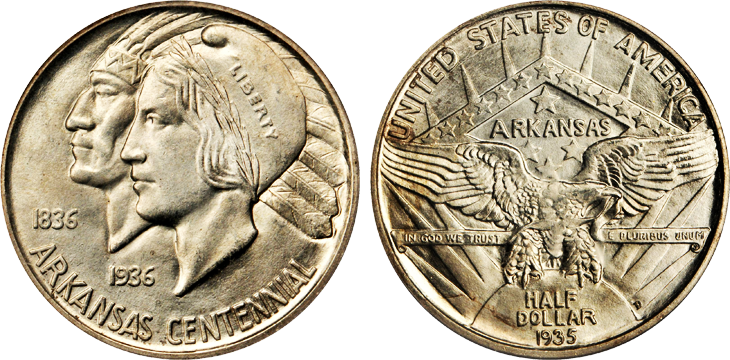
1935_arkansas_centennial_silver_half_dollar-dOn June 15, 1836, Arkansas was admitted as the twenty-fifth state of the Union.  The flag did not get an additional star until July 4, 1836.

Today, she turns 179.

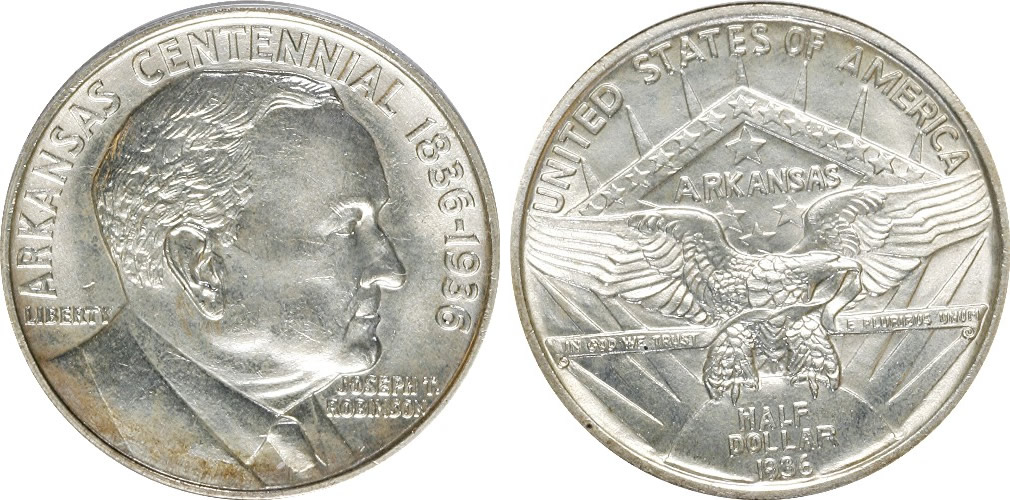
In advance of the 1936 Centennial, the U.S. Mint struck a Centennial Coin with the value of fifty cents.  The original 1935 design depicted a Native American male chief and a female with a Liberty cap.  The reverse side featured an eagle in front of the insignia from the Arkansas flag.

arkansas-robinson_half_dollar_commemorativeIn 1936, a second version was also authorized.  This was the only time that a design change was ever authorized for a commemorative coin.  The second version was a bust of Senator Joseph T. Robinson.  He was the Senate Majority Leader at the time and had been the 1928 Vice Presidential nominee for the Democratic Party.

The Centennial coins were actually issued up through 1940.  Today these coins can be valued well over $150 depending on their condition, the year of their issue and the location where they were struck.

Celebrate Arkansas’ Statehood today at Historic Arkansas Museum and Old State House Museum

Statehood Day

Statehood Day

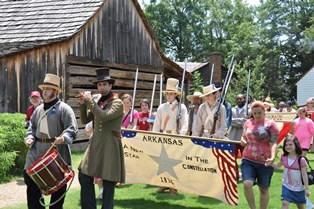
The Old State House Museum and Historic Arkansas Museum will celebrate Arkansas’ Statehood today. A joint living history event, “The Quest for Statehood: From The Delta To The Hills,” will mark 179 years of statehood at both locations.

Costumed interpreters will transform The Old State House and Historic Arkansas Museum into the daily life and work of people representing all sections of 1836 Arkansas with games, talks and activities from 10 to 4 on June 13th.

Pick up a packet of clues about which historical figure you are, where you’re traveling from and why you are in Little Rock on this special day; use these clues to complete a task specific to your character and win a prize! You can participate as an individual, a couple or as a family! All activities are free and open to the public.

The museums are both agencies of the Department of Arkansas Heritage.