Little Rock Look Back: A Dozen Years of the Clinton Library

SkipIt has been twelve years.  Have you warmed up yet?

Many remember November 18, 2004, for the rain and cold wind which greeted visitors to the opening of the William Jefferson Clinton Presidential Center and Park.  In the years which lead up to that day, November 18, 2004, was known simply as “Game Day” for a group of people.  The chief one was Skip Rutherford.

Overseeing the planning for the Clinton Presidential Center and the events surrounding it had been the focus of James L. “Skip” Rutherford for many years. A FOB for decades, he had stayed in Little Rock when so many went to Washington DC in 1993.

He oversaw the planning for the Clinton Library and led the Clinton Foundation.  No detail was too small or insignificant for him to consider. For months leading to the opening he led meetings to help restaurants, hotels, and attractions understand the scope of the opening.

Together with Dean Kumpuris and Bruce Moore on behalf of the City of Little Rock and Stephanie Streett of the Clinton Foundation, he reviewed plans for the Clinton Presidential Park and the streets and neighborhoods around the Clinton Presidential Center.

Skip used his connections with the business community in Little Rock and throughout the state to discuss the importance of a Presidential Library regardless of one’s personal political affiliations.  He withstood critics who second-guessed everything from the cost, the design, the location, the purpose, and even the anticipated tourism and economic impacts.

Finally the big day had come.  If the weather was not ideal, that was almost inconsequential. It was still the culmination of more than seven years hard work.  As he remarked later that evening when discussing the weather “Many who attended today go to events like this all the time.  This is one they won’t forget!”

However, the opening of the Clinton Presidential Center was not the end of the task. It merely was the move from one phase to another. A few years later, Skip’s role would change as he would leave the Foundation and become the second Dean of the Clinton School of Public Service.

RobinsoNovember: Dr. William Grant Still

bhm StillLast night, the Arkansas Symphony Orchestra’s Opus Ball was the first public event in the William Grant Still Ballroom of Robinson Center.  This afternoon at 3pm, the Arkansas Symphony Youth Orchestra is playing a Still composition in a performance with Ballet Arkansas at the Albert Pike Memorial Temple on Scott Street.

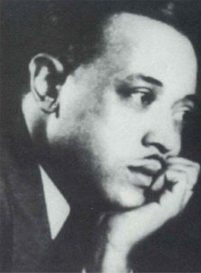
Dr. William Grant Still was a legend in his own lifetime.  Dr. Still, who wrote more than 150 compositions ranging from operas to arrangements of folk themes, is best known as a pioneer. He was the first African-American in the United States to have a symphonic composition performed by a major orchestra. He was the first to conduct a major symphony orchestra in the US; the first to conduct a major symphony in the south; first to conduct a white radio orchestra in New York City; first to have an opera produced by a major company. Dr. Still was also the first African-American to have an opera televised over a national network

Dr. Still was born May 11, 1895 in Woodville, Mississippi to parents who were teachers and musicians. When Dr. Still was only a few months old, his father died and his mother took him to Little Rock. Inspired by RCA Red Seal operatic recordings, his musical education began with violin lessons.

After his studies at Wilberforce University and the Oberlin Conservatory of Music, he played in orchestras and orchestrated for various employers including the great W. C. Handy. For several years he arranged and conducted the “Deep River Hour” over CBS and WOR.

In the 1920’s, Still made his first appearances as a serious composer in New York. Several fellowships and commissions followed. In 1994, his “Festive Overture” captured the Jubilee prize of the Cincinnati Symphony orchestra. In 1953, he won a Freedoms Foundation Award for “To You, America!” which honored West Point’s Sesquicentennial Celebration. In 1961, he received honors for this orchestral work, “The Peaceful Land”. Dr. Still also received numerous honorary degrees from various colleges and universities, as well as various awards and a citation from Arkansas Governor Dale Bumpers in 1972.

In 1939, Dr. Still married journalist and concert pianist Verna Avery, who became his principal collaborator. They remained together until Dr. Still’s death in 1978.  In a proclamation marking the centennial of Dr. Still’s birth, President Bill Clinton praised the composer for creating “works of such beauty and passion that they pierced the artificial barriers of race, nationality and time.”

In 1995, Dr. Still was posthumously inducted into the Arkansas Black Hall of Fame.

Little Rock Look Back: Clinton selects Little Rock as library site

ClintonCenterConstruction-48

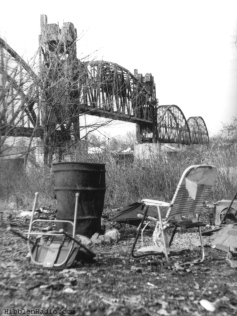
Refuse littered the future site of the Clinton Presidential Center

On November 7, 1997, President Bill Clinton announced his intentions to locate his presidential library in Little Rock at the end of a warehouse district.

The Little Rock City Board met in a special meeting that day to rename part of Markham Street, which would lead to the site, as President Clinton Avenue.

While the announcement was met with excitement in many quarters, there were still some skeptics who had a hard time envisioning a presidential library and park in the middle of a wasteland worthy of a T. S. Eliot poem.

There would be many hurdles between the November 1997 announcement to the December 2001 groundbreaking. But for the moment, City of Little Rock leaders, celebrated the achievement.  Then Mayor Jim Dailey had appointed City Director Dean Kumpuris and City employee Bruce T. Moore to lead the City’s efforts.  Moore and Kumpuris worked with Skip Rutherford and others to narrow the potential sites.

In September 1997, the Clintons were in town for the 40th anniversary of the integration of Central High School.  They surprised Kumpuris and Moore with a decision for a Sunday afternoon visit to the warehouse district proposed site. Secret Service would not let the limousine drive in part of the property, so the Clintons, Moore, Kumpuris, and Rutherford walked up a path to the roof of the abandoned Arkansas Book Depository.  It was there that the Clintons could see the Little Rock skyline which would be visible from the library.

Of course by the time the library had opened in November 2004, the Little Rock skyline was different. Spurred on by the library, several new highrises had been constructed in downtown.

Little Rock Look Back: Central & Hall Football at 2-0

lrchs-lrhhsAfter two weeks of prep gridiron (that is high school football to those who don’t write like a 1950s inky wretch), Little Rock Central and Little Rock Hall are both posting records of 2 wins and 0 losses.  This feat has not been achieved in quite a while.

How long?  37 seasons!  It was 1979, the last time that the Tigers and Warriors were both out of the gate at 2-0.

1979

Jimmy Carter was in the White House. Bill Clinton was in his first term as Governor. First Lady Hillary Rodham was several months pregnant with Chelsea. Hall High and Razorback standout Webb Hubbell was Mayor of Little Rock.  The City’s population was in the 150,000s (it would be 159,151 after the 1980 census).  Little Rock had an area of approximately 80 square miles.  (Today it is approximately 200,000 citizens over 122 square miles.)

Lou Holtz was coaching the Arkansas Razorbacks in the Southwest Conference.  Harry Hall was in his first season as Commissioner of the Arkansas Intercollegiate Conference.  Rex Nelson was a student at Ouachita.  Paul Eells was in his second year with KATV, while Dave Woodman was finishing his first decade at KARK.  Gary Hogan was anchoring sports for KTHV.  Hogs football games were broadcast on KAAY radio.  While Bob Buice and Jim Elder were ruling the airwaves at KARN, Craig O’Neill was dominating mornings at KLAZ.

Orville Henry, Jim Bailey, and Wadie Moore covered college and high school sports for the Arkansas Gazette.  The Arkansas Democrat had switched to morning delivery and hired John Robert Starr as editor.  Both papers carried ads for Kempners, Golds, M.M. Cohn, Skaggs Albertsons, Minute Man, Union National Bank, Commercial National Bank, Worthen National Bank, and First National Bank.

Metrocentre Mall existed with bricked over streets on Main and Capitol. The Grady Manning Hotel and Hotel Marion still stood (though in their twilight days before their February 1980 date with demolition.)

So a lot has changed since Central and Hall previously achieved this.  In the interval, Central has been 2-0 a dozen times and Hall has achieved that a brace. But the schools never managed it during the same season.  Three times the schools both managed 1-1 seasons and seven times they each started at 0-2.

The 1979 Warriors were helmed by C. W. Keopple, who would lead the team from the 1960s into the 1980s winning four conference/state titles. (When your conference is statewide, winning one got you the other.)  Bernie Cox was in his fifth season as the Tigers’ mentor, with two state championships already under his belt, five more would be in his future.

The teams stayed tied through the fourth week. But in the fifth week, while Central won, Hall lost to Parkview by a score of 7-0.  The following week, the Warriors rebounded, while the Tigers settled for a 0 to 0 tie with Ole Main.  Weeks seven through ten saw both teams notching another win each week.  This set up a Thanksgiving Day classic with the state’s top two teams facing off.  Central was slightly favored, but season records seldom carried any weight when the two cross-town rivals played on Thanksgiving afternoon.  In an upset, Hall bested Central by a score of 17 to 0.

From 1987 to 1990, the second game of the season was the Hall-Central matchup, which meant that it would have been impossible to both start with a 2-0 record.  This second week matchup was made necessary by the fact that not only could the two teams no longer face off on Thanksgiving after 1982, but the two schools were not in the same conference from 1983 through 2000. So the faceoff was early in the season, during the non-conference portion.

Due to subsequent restructurings by the Arkansas Activities Association, the two schools have not played a football game since 2005.  The bell from the “Battle of the Bell” which was supposed to replace the pageantry and intense rivalry of the Thanksgiving Day matchups, sat forlornly and largely forgotten in the trophy case at Central following the 2005 edition which Central won by a score of 24 to 7.  (That season Central started at 0-2 on the way to a 5-5 record and Hall started at 1-1 on the way to a 3-7 record.)  UPDATE: As noted in a comment on this piece, the Bell has now been refurbished and sits proudly at Quigley Stadium.  Thank you Belinda Stilwell for the information!

Who knows how the 2016 season will turn out for these two teams?  In the past 2-0 has led both to State Championships and to a 6-4 record.  But for two schools that have struggled in the past few seasons, to start with a 2-0 record is quite an accomplishment. For both to start with that record is remarkable.


While the blog hiatus and a restructuring continue, this was a bit of history that needed mentioning.

Arkansas Heritage Month – The architecture of AIA/ALA award winning CALS libraries by Polk Stanley Wilcox

To encourage excellence in the architectural design and planning of libraries, the AIA and the American Library Association/Library Administration and Management Association created this award to distinguish accomplishments in library architecture.  In 2011 and again in 2015, Polk Stanley Wilcox won the award for projects designed for the Central Arkansas Library System.

AIA ALA PSW ASIThe 2011 award went to for work on the Arkansas Studies Institute.  This actually combines three buildings of three different centuries and construction types into one architectural timeline, evoking imagery of pages of an opening book.

The Arkansas Studies Institute is a repository for 10 million historic documents and the papers of seven Arkansas Governors, including President Bill Clinton. Located in a thriving entertainment district comprised of rejuvenated warehouses near the Arkansas River, the design combines significant, but neglected buildings from the 1880’s and 1910’s with a new technologically expressive archive addition. This creates a pedestrian focused, iconic gateway to the public library campus – and the public face of Arkansas history.

The design philosophy is based literally on the book – a physical container of information, with pages flowing into a site-sensitive narrative of the building’s function. Taking cues from the medium for which the Institute was created, the entrance acts as an abstract book cover, pulled away from the building as a double wall, defusing western sunlight and heat in the atrium beyond.

Public Spaces – galleries, a café, museum, and meeting rooms – enliven streetscape storefronts, while the great library research hall encompasses the entire second floor of the 1914 warehouse building. A thin atrium pulls the new structure away to protect the old, stretching the building’s length and flooding all levels with light – a key sustainable strategy. 100 historic images in glass handrails signify that architecture can and should actively engage in storytelling. Suspended bridges span the gap between new and old, open and secure, today and yesterday.

The Arkansas Studies Institute weaves history, research, pedestrians, and a restored streetscape together, healing a gaping wound in the urban fabric, while expanding environmental stewardship into the public realm and serving as a beacon of knowledge.

AIA ALA PSW HRCCLCIn 2015, the award went to PSW for their work on the Hillary Rodham Clinton Children’s Library and Learning Center.

Based on experiential learning where hands-on education teaches life skills needed to become responsible adults, a new Children’s Library and Learning Center boosts hopes for a neglected neighborhood, serves as an exemplary tale of urban renewal, and acts as a beacon of hope for an entire city.

This “community embedded, supportive learning center” offers not only books, but also a performance space, teaching kitchen, greenhouse, vegetable garden, and an arboretum. It is the state’s first library holistically imagined as a children’s education destination. The Library Director’s challenge was to create a “playground without equipment” where nature and imagination create grand adventures on an abandoned six acre site in the heart of the capital city. A charrette with youth uncovered a surprising and heartbreaking result: their top desire wasn’t for the latest video game technologies… it was food security. They wanted to learn how to feed themselves. Children also desired a place that was uplifting, inspirational and full of natural light, while in contrast feeling safe, secure, and sheltered. They wanted a place that “lifted expectations”.

An interstate highway—the railroad tracks of our generation—split Little Rock 40 years ago and destroyed a unified city grid, contributing to racial and socioeconomic divisions that separated citizens physically and emotionally. The site’s border condition became a national symbol for gang violence when featured in a 1990’s HBO documentary. Its opposite side, however, continued to be the city’s version of New York City’s Central Park—the place to live, work, and play. The design team’s overarching idea was centered on three moves: bridge the gap by stretching the park across the highway, create a library that is “the place to be” for all children, and develop civic pride in an underserved neighborhood, helping to mend partitions that have plagued the city for so long.

Landscape ecology and urban connectivity themes provide experiential education. Children see natural vegetation representing the state’s varied ecological regions from the Ozark Highlands to the Mississippi Delta. Two bus lines within a quarter mile assure access from distances, while the hundreds of children living within a half mile can walk or bike. An instructional greenhouse, gardens, and teaching kitchen allow children to cultivate, harvest, prepare meals, and sell produce in a planned farmer’s market. A full time ‘Environmental Educator’ oversees programs, teaching proper use of water, energy, and resources, and how we keep healthy through decisions made within the built environment. The lobby’s smart monitors can display real time water and energy consumption. Mechanical and structural systems are purposefully exposed so operations and construction methods can be discussed.

While this Library exceeded expectations by achieving LEED Gold, the true measure of success beyond points is the neighborhood’s feel, which shifted from dangerous to full of life and pride. The library is a safe zone and home to a sustainable-minded community.

Arkansas Heritage Month – The Architecture of Little Rock Central High School

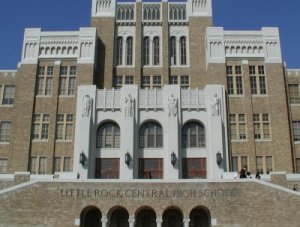
centralentranceArchitecture is often overlooked when considering the arts, but it is definitely an art form.

Built in 1927 as Little Rock Senior High School, Central was named “America’s Most Beautiful High School” by the American Institute of Architects. The New York Times called it the most expensive high school built at the time.

Designed as a mix of Art Deco and Collegiate Gothic architectural styles, the building is two city blocks long and includes 150,000 square feet of floor space. The project involved most of Little Rock’s leading architects who were still practicing at the time: John Parks Almand, George H. Wittenberg and Lawson L. Delony, Eugene John Stern, and George R. Mann.  Over the years, different architects would take credit for various facets of the building.  Given the size of the project, there was plenty of work for each architect to do.

More than 36 million pounds of concrete and 370 tons of steel went into the building’s construction. The building contained 150,000 square feet of floor space, upon its completion. It cost $1.5 million to construct in 1927. The school received extensive publicity upon its opening. An article in the Arkansas Gazette said, “we have hundreds of journalists in our fair city for the dedication” of the new high school.

At its construction, the auditorium seated 2,000 people between a main level and a balcony.  The stage was sixty feet deep and 160 feet long so that it could be used gymnasium. From 1927 until the opening of Robinson Auditorium in 1940, the auditorium would be Little Rock’s main site for hosting performances by musical and theatrical groups.

Subsequent additions would include a separate gymnasium, a library, and a football stadium. In 1953 the school’s name was changed to Little Rock Central High School, in anticipation of construction of a new high school for students, Hall High School.

In 1977, the school was listed on the National Register of Historic Places, and it was designated a National Historic Landmark in 1982. These were in recognition of desegregation events which took place in the school in 1957.

In 1998, President William Jefferson Clinton signed legislation designating the school and visitor center across the street as a National Historic Site to “preserve, protect, and interpret for the benefit, education, and inspiration of present and future generations…its role in the integration of public schools and the development of the Civil Rights movement in the United States.”

Little Rock Look Back: William Grant Still

bhm StillLong known as the Dean of African American composers, Dr. William Grant Still was a legend in his own lifetime.

Dr. Still, who wrote more than 150 compositions ranging from operas to arrangements of folk themes, is best known as a pioneer. He was the first African-American in the United States to have a symphonic composition performed by a major orchestra. He was the first to conduct a major symphony orchestra in the US; the first to conduct a major symphony in the south; first to conduct a white radio orchestra in New York City; first to have an opera produced by a major company. Dr. Still was also the first African-American to have an opera televised over a national network

Dr. Still was born May 11, 1895 in Woodville, Mississippi to parents who were teachers and musicians. When Dr. Still was only a few months old, his father died and his mother took him to Little Rock. Inspired by RCA Red Seal operatic recordings, his musical education began with violin lessons.  He graduated from Gibbs High School in Little Rock.

After his studies at Wilberforce University and the Oberlin Conservatory of Music, he played in orchestras and orchestrated for various employers including the great W. C. Handy. For several years he arranged and conducted the “Deep River Hour” over CBS and WOR.  He also played in the orchestra for the 1921 musical Shuffle Along, which was the first Broadway musical to feature an all African-American cast and writing team.  A musical is currently on Broadway about the creation of that musical, but Still is not a character in it.

In the 1920’s, Still made his first appearances as a serious composer in New York. Several fellowships and commissions followed. In 1994, his “Festive Overture” captured the Jubilee prize of the Cincinnati Symphony orchestra. In 1953, he won a Freedoms Foundation Award for “To You, America!” which honored West Point’s Sesquicentennial Celebration. In 1961, he received honors for this orchestral work, “The Peaceful Land”. Dr. Still also received numerous honorary degrees from various colleges and universities, as well as various awards and a citation from Arkansas Governor Dale Bumpers in 1972.

In 1939, Dr. Still married journalist and concert pianist Verna Avery, who became his principal collaborator. They remained together until Dr. Still’s death in 1978.  In a proclamation marking the centennial of Dr. Still’s birth, President Bill Clinton praised the composer for creating “works of such beauty and passion that they pierced the artificial barriers of race, nationality and time.”

In 1995, Dr. Still was posthumously inducted into the Arkansas Black Hall of Fame.