Little Rock Look Back: Public facilities in Little Rock ordered to be integrated

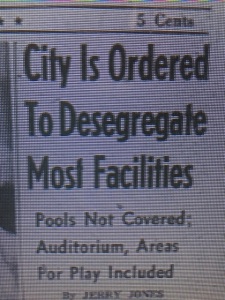
Following the March 1962 lawsuit by twenty-two (22) African Americans seeking the integration of public facilities in Little Rock, Federal Judge J. Smith Henley issued a order on February 15, 1963.  Judge Henley ordered the end to segregation in City parks, playgrounds, golf courses, tennis facilities, community centers, and Robinson Auditorium.

Regarding the auditorium, the order allowed for single event, short-term leasing of wholly private meetings for membership and immediate friends of members.  But it did stress that there could be no racial discrimination in the selection of or terms of leases.

The judge’s order did not cover “other facilities not identified in the record.”  Which meant, the order did not apply to swimming pools.  At the time, War Memorial pool was operated for whites and Gillam Park pool was operated for African Americans.   The judge wrote that he saw no reason to extend it to facilities not mentioned, but did not rule out the ability for future lawsuits.  In asking for a summary judgement in January 1963, the defendants had listed many types of facilities but not swimming pools.

Judge Henley’s decision did not mean that a municipality was required to integrate.  It just could not enforce segregation.  As with many other court decisions at the time, it was narrow in scope.

The end result was that Little Rock facilities were now integrated.  Except for the swimming pools.  Those would have their own story.  It would take the 1964 Civil Rights act and more legal actions for that to happen.

Little Rock Look Back: First night of first TABRIZ

After over a decade of the Beaux Arts Bal (it was spelled the French way with only one “L”), a change was afoot in 1971. Because of the need to raise more money for the Arkansas Arts Center, the Fine Arts Club decided to replace their evening of dining and dancing with an auction event.

While there had undoubtedly been thrift sales and small-scale bidding on items to raise money in Little Rock, this effort would be the first large-scale endeavor to use an auction as part of a fundraiser.   In order to maximize the fundraising potential, it was decided this would be a two-night event. The first night (Friday, February 12) would be casual with a silent auction while the second (Saturday, February 13) would be formal.

There were two major reasons the Fine Arts Club needed to raise more money.  The National Endowment for the Arts had issued the Arts Center a challenge grant which required a $10,000 match. In addition, the Arkansas Arts Center was trying to build up an endowment for future purchases.  (This was less than three years after the facility had been faced with closing its doors.)

The name Tabriz was chosen because it was the name of a cultural city in the Mideast known for its marketplace.  The first edition had the tagline of “A Persian Market of All Things.”

The logo was designed by Jim Johnson of the firm then-known as Cranford/Johnson Associates. The decorations echoed the exotic theme employing palm trees, ferns, ceramic elephants, paisley fabric swaths, and turbans.

Among those working on the first Tabriz were Jane McGehee Wilson, Betty Mitchell, Betty Terry, Frances Cranford, Feetie Hurst, Tina Poe, Annette Connaway, Willie Oates, Phyllis Brandon, Jane Wolfe, and Mary Worthen.

Over 650 people attended the Friday night event. Admission of $5 provided sandwiches (conflicting newspaper accounts indicate either coldcut sandwiches or hot dogs) and beer.  Mixed drinks were an additional $1.

Newspaper coverage indicated that men wore “sports outfits,” suits without ties, or colorful parkas. It attracted men with “longhair and beards” and “conventional haircuts.” (Depending on who the writer was, “longhair” could have meant anything over one inch.)  The women that Friday favored maxi or midi skirts. There were no mini skirts on hand, but a Gazette reporter noted that some women were wearing hot pants which might make a mini skirt look long.

Music was provided by the trio of Tom, Jerry, and Barbara.

Because a Silent Auction was such a new thing, newspaper coverage pointed out that the rooms were actually quite full of sound as people chatted with each other both about bidding on the items and socializing in general.

To give people a preview of the auction items, the Arts Center galleries had been opened for viewing on the Sunday and Monday prior to the Friday and Saturday events.  An auction catalog was also available for pickup in advance of Friday.

Among the items up for bid were tennis and golf lessons, visits to beauty salons, credit at a pharmacy, a tour of the Municipal Courts building and lunch with city prisoners, a tour of the Little Rock Zoo, jewelry, artwork, tickets to Razorback games, a football jersey worn by Lance Alworth, a week in Las Vegas (one of only three items with a minimum bid), and a subscription to an answering service.

When all was said and done, the evening raised $9,500 for the Arkansas Arts Center.

On Lincoln’s Birthday – A Lincoln Viaduct Portrait

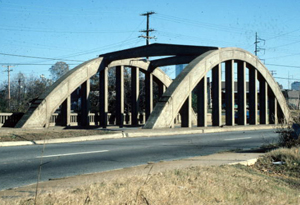
Photo courtesy of the Arkansas Historic Preservation Program

Since today is Abraham Lincoln’s birthday, it is a good day to pay tribute to the Lincoln Avenue Viaduct.  This arched bridge is traversed by thousands of cars each day, with most having no idea the name of the structure.  The Lincoln Avenue Viaduct is the arched bridge connecting LaHarpe with Cantrell Road which (literally) bridges downtown with the west along Highway 10.

The Lincoln Avenue Viaduct is a reinforced concrete rainbow arch bridge. It was opened at 2:05 p.m. on Friday, December 28, 1928, and, despite later alterations, it remains particularly well-preserved. The Missouri Pacific Railroad Company, considered the most important railroad company in the state, constructed the bridge amid a series of improvements in Little Rock made necessary by the damage wrought by the infamous spring floods of 1927.

Though the bridge was constructed by the railroad, the City had to give authorization to do so, this was accomplished by the passing of Ordinance 4,335, at the May 28, 1928, City Council meeting.

Lincoln Avenue was one of several names for stretches of Highway 10 in Little Rock. By the 1960s, the areas west of the Lincoln Avenue viaduct were all renamed Cantrell in honor of the man who had developed much of the area west of the Heights. The longest stretch of the road already carried that name. There had been an effort to rename Highway 10 (including sections named Lincoln, Q, and Cantrell) in Little Rock for Senator Joseph Taylor Robinson in 1930. He declined the offer because he did not want to diminish the contributions of Mr. Cantrell.  Over time the entire stretch bore the name Cantrell.

The stretches east of the viaduct which involved a couple of names were renamed La Harpe Boulevard in honor of the French explorer who first saw the Little Rock. (La Harpe was originally an extension of Riverfront Drive. But with changes to development along the Arkansas River and the coming of I-30, the streets were reconfigured significantly in the 1950s and early 1960s.)

Though the street has been renamed, the bridge still carries the name of the 16th President of the United States.

Little Rock Look Back: LR Voters Overwhelmingly Support Arts+History

On Tuesday, February 9, 2016, Little Rock overwhelmingly approved the Arts+History initiative which funded expansion and enhancements to the Arkansas Arts Center, MacArthur Museum of Arkansas Military History, and MacArthur Park.
There were 7,989 votes cast in the special election.  This was 6.61% of the electorate.  Of those, 6,733 or 84.28% voted for the proposal.

In 2018, the MacArthur Museum of Arkansas Military History was closed for several months for a renovation, which was financed by these bonds.  It reopened in September.  The Arkansas Arts Center unveiled plans in February 2018 for its expansion.  It is preparing to start construction later in 2019. As part of that, Arts Center programming will continue in a variety of locations including Central Arkansas Library System branches.

Super Bowl Sunday look at the Copper Bowl

Today is Super Bowl Sunday, so it seems to be a good time to remember the five year series of football games in Little Rock known as the Copper Bowl.

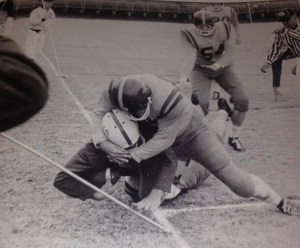
A Little Rock police officer tackles a NLR player in one of the Copper Bowls.

A Little Rock police officer tackles a NLR player in one of the Copper Bowls.

From December 1959 through December 1963, the Little Rock Police Department played the North Little Rock Police Department in a series of football games.  The Copper Bowl games were fundraisers to help the LRPD provide food and presents for needy families during the Christmas season.

The agreement was that the teams would play for five years. The team with the most wins would permanently receive the Copper Bowl trophy.  The LRPD was outfitted with uniforms from Little Rock University and Louisiana State University (thanks to the efforts of Sgt. Harold Zook).  The games were played at Quigley Stadium.

Before the final game on December 1, 1963, the series was tied at 2-2.  The LRPD team won the game and permanently captured the trophy.  Over the five year period several thousand dollars were raised.

Little Rock Look Back: Mayor George Wimberly

On February 3, 1920, future Little Rock Mayor George Wimberly was born in Star City. He served his country first in the Civilian Conservation Corps and later aboard a U.S. Naval Department hospital ship in the Pacific during World War II.

Wimberly was first elected to the Little Rock City Board in November 1968.  He was re-elected in November 1972 and served until December 1976.  In January 1971, he was selected to serve as Little Rock Mayor through December 1972.

In a rare move, he was again selected to serve as Mayor from January 1975 through December 1976.  During the era of the City Board selecting one of their own members to serve as Mayor, George Wimberly was the only one selected to two non-sequential terms.

In 1978, he was elected to the State House of Representatives and served until December 1988.  While in the House he led the effort for smoking to be banned in the House chambers (a move that predated many public smoking bans of the 1990s and onward).

For over fifty years he was an employee and later owner of Buice Drugstore located on Markham in the Stifft Station neighborhood. In 1986 he received the Arkansas Pharmacist of the Year Award and the Lifetime Achievement Award in 2009.

Mayor Wimberly died on February 5, 2012, two days after his 92nd birthday.

Little Rock Look Back: Opening of Little Rock Public Library

On February 2, 1910, the Little Rock Public Library officially opened its doors.  There had been an open house the night before, but this was the first day of acquiring a library card and checking out books.

Various private libraries had existed sporadically in Little Rock throughout the 19th Century.  In November 1900, a Little Rock School District committee made the first inquiry into the the creation of a Carnegie Library in Little Rock.  Over the next several years, numerous entreaties were made, but funding for the City’s portion was an obstacle.  On December 17, 1906, the Little Rock City Council passed an ordinance to move forward with building, furnishing and equipping a library.  Finally, in February 1908, the City approved acceptance of $88,100 from Andrew Carnegie.  The building would be designed by Edward Tilton, who designed Carnegie libraries, working with local architect Charles Thompson.

Mary Maud Pugsley was hired as the first librarian for Little Rock in May 1909. She began her duties on September 15, 1909, in order to get ready for the opening of the library at the southwest corner of 7th and Louisiana Streets.

On February 2, 1910, formal circulation of books began.  J. N. Heiskell was issued library card number 1.  He was secretary of the Library’s Board of Trustees and had long been an advocate for a public library in Little Rock.  He had often used his bully pulpit as editor of the Arkansas Gazette to advocate for a public library since arriving in Little Rock in 1902.  (Years later — he lived until 1972 — he received a replica of the library card made out of gold.)

That first day of operation, 500 people had applied for library cards. The application process required one to be a Little Rock property owner or to have a property owner sign the application.

Within the first year of operation, 2.5% of Little Rock’s population of 45,951 had applied for a library card.

For more on the history of the transformation of the Little Rock Public Library into the Central Arkansas Library System, read Shirley Schuette and Nathania Sawyer’s From Carnegie to Cyberspace — 100 Years at the Central Arkansas Library System, published by Butler Center Books.