Little Rock Look Back: Roswell Beebe receives Little Rock land title

Map showing boundaries of original City of Little Rock

Map showing boundaries of original City of Little Rock

On September 25, 1839, businessman Roswell Beebe received title to all of the land in Little Rock.

Starting in the 1810s, there had been much dissension as to who had title to land in what would become Little Rock.  As the settlement developed into a town and city, these disagreements became greater. Often land speculators would sell land to settlers without having the right to do so.

Coming to Little Rock in 1835, Beebe was a witness to the continued uncertainty over land ownership.  In early 1839, he acquired 240 acres which had the only incontestable title in town. This acreage comprised most of Little Rock. He went to Washington DC in 1839 and, on September 25, received the original patent for the town of Little Rock, signed by President Martin Van Buren. It is recorded in the Pulaski county recorder’s office Book L, page 312.

Upon his return, Beebe gave all the people who had bought lots from a certain real estate developer, whom he considered to be fair and honest, title to their land for a dollar. In December 1839, he drew up a plan for Little Rock, laying off blocks and streets. He deeded the streets and alleys to the city for a dollar. He gave the state the title for the land on Markham Street, where the new capitol building (now the Old State House Museum) was located.  He also donated part of the land for Mount Holly Cemetery, the other portion came from his brother-in-law Chester Ashley.
Little Rock Look Back: LR City Hall Ceases Operation in 1863

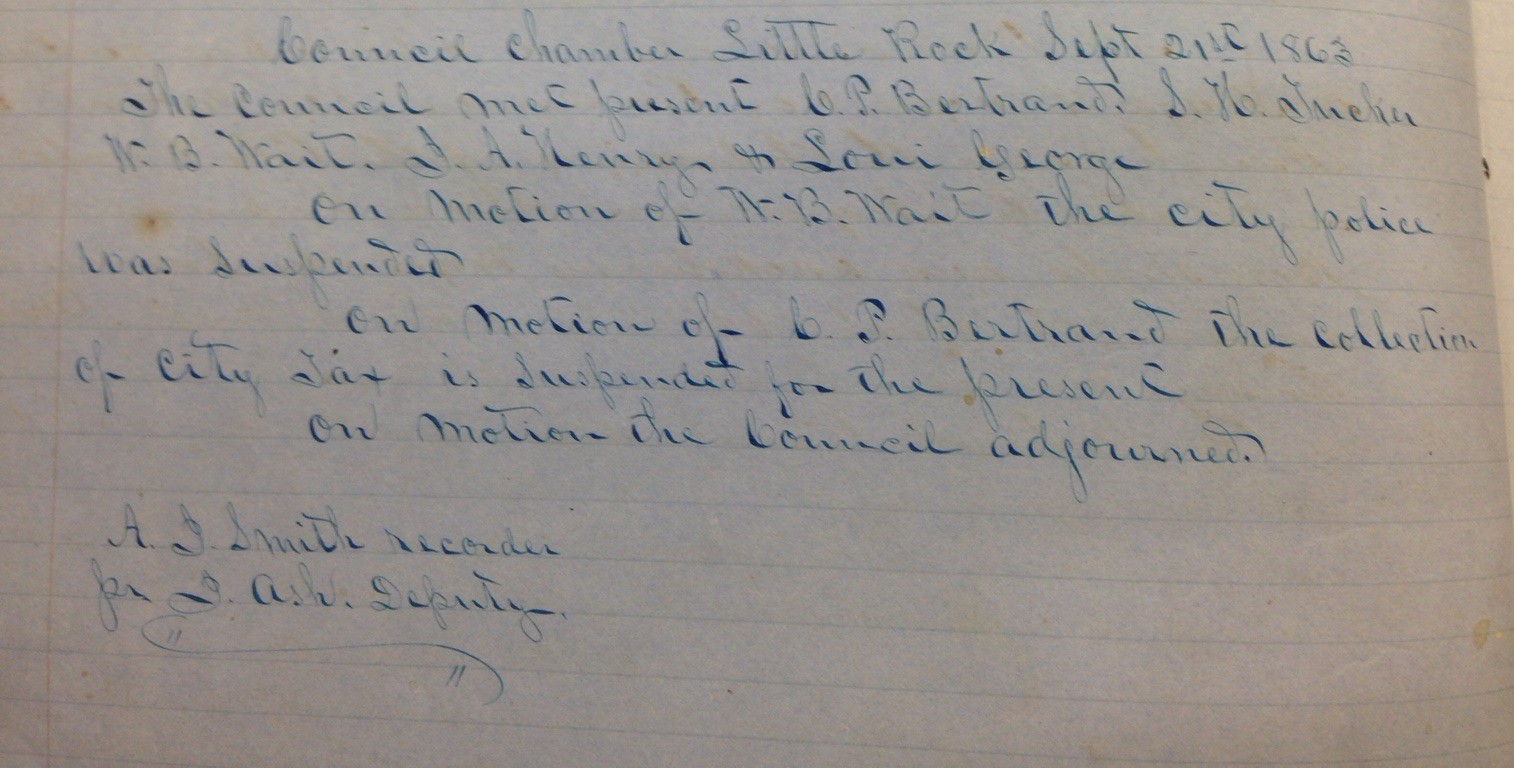
LR1863 minutes of closureFollowing the Battle of Little Rock, the City of Little Rock ceased operations on September 21, 1863.

Planning for this had started in August, which would suggest that civic leaders were none too confident in the ability of Confederate forces to hold on to the city.  At the August 24, 1863, City Council meeting it was reported that the City’s funds (presumably Confederate) had been “placed in the hands of a reliable party who is well known to the Council.”  The identity of this “reliable party” has never been disclosed.

On September 21, the Council met and took three votes.  The first was to suspend the operation of City police (which at the time was not an official police force, it was a constable and some volunteers). The second was to suspend the collection of City taxes.  The final vote was to adjourn.

There is no record of Mayor William Ashley being present at this meeting.  Recorder A. J. Smith (the equivalent of City Clerk today) was not present.  The minutes were signed by “J. Ash, Deputy.” Records do not indicate if that gentleman was officially Deputy Recorder or if he had simply been deputized to take minutes at the meeting.  The five City Council members present were C. P. Bertrand (a former mayor and step-son of Little Rock’s first Mayor, Matthew Cunningham), S. H. Tucker, W. B. Walt, I. A. Henry (would would also serve on the first City Council after the war in 1866), and Lou George.

Little Rock Look Back: Mayor John E. Knight

Jno E Knight sigOn September 20, 1816, future Little Rock Mayor John Elliott Knight was born in Newburyport, Massachusetts. In 1843 he married Hannah Donnell in New York, and came to Little Rock that same year.

Knight was editor of the Arkansas Democrat from 1846 to 1850. He was also associated with the Arkansas Gazette and published the short-lived Chronicle. In 1851, Knight served as Mayor of Little Rock. In 1855, he served as a member of the City Council.

In 1858 a song was published entitled “I Am Near to Thee” which featured music by Arkansan Benjamin Scull and lyrics by Knight.  The song was dedicated to Mary Woodruff.

During the Civil War, he served as a Colonel.  During the 1850, 1860 and 1880 census, he was listed as an attorney.

He had one daughter, Elizabeth Knight, who married James S. Pollock, a banker in Little Rock. Knight died in Little Rock, Arkansas, on October 28, 1901, and was buried in Mount Holly Cemetery. Elizabeth Knight Pollock died in 1910.

As an attorney and newspaper editor, John E. Knight collected documents about the settlement of Little Rock. Those papers are now part of a collection at the Arkansas History Commission.  The majority of these papers are from William Russell to Chester Ashley, pertaining to pre-emption claims in and around Little Rock. Other material concerns the 1819-1822 dispute related to the the New Madrid Certificate and pre-emption claims of James Bryant, Stephen F. Austin, and William M. O’Hara.

Sculpture Vulture: Lorri Acott’s Who Rescued Who

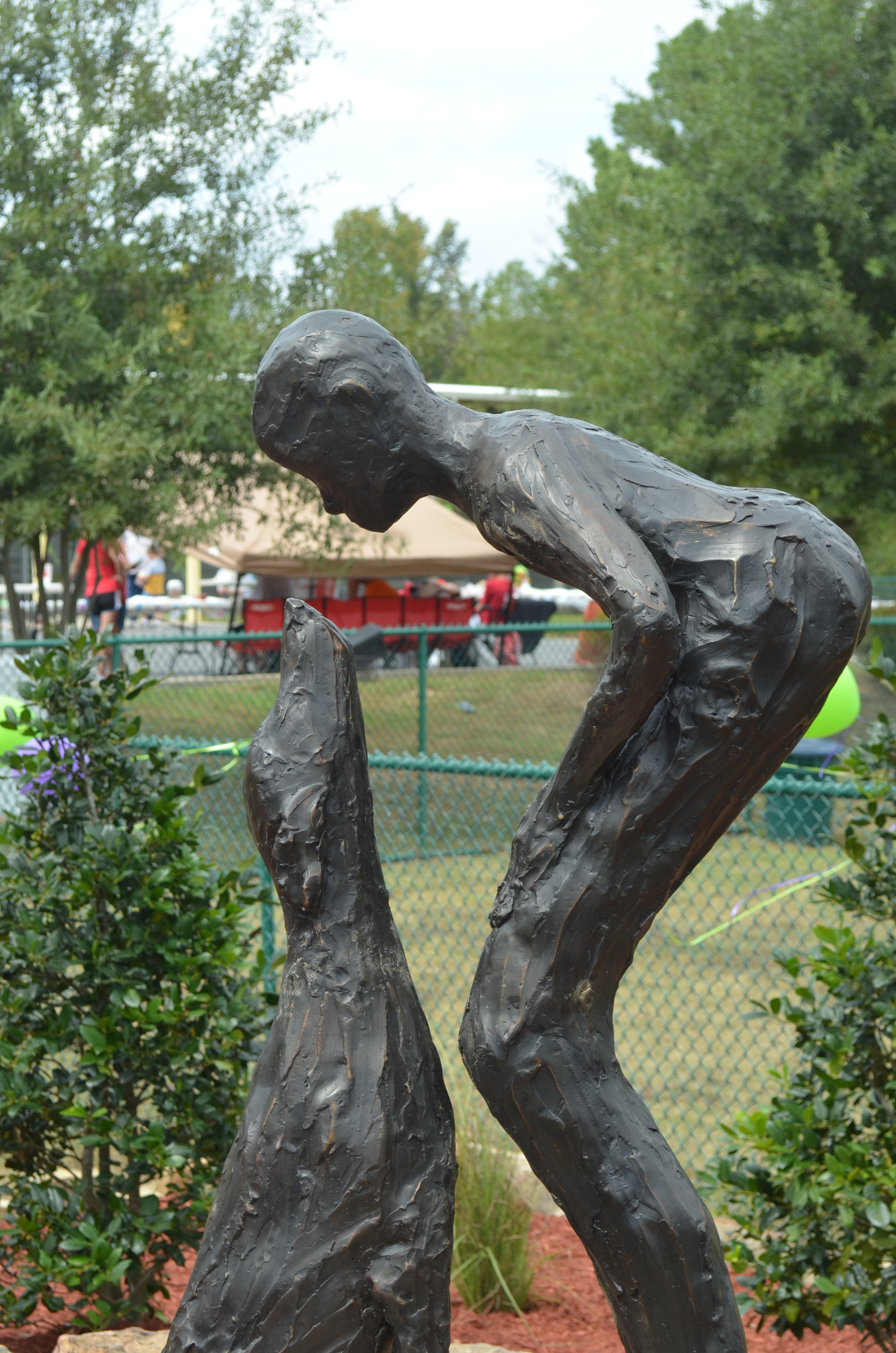
DSC_1091Little Rock’s newest sculpture was unveiled on Saturday.  Located at the entrance to the Little Rock Animal Village, Lorri Acott’s Who Rescued Who depicts a person and dog looking at each other. They are sharing a bond of respect, admiration and love.

The human figure has Acott’s trademark extended length legs. These represent the ability to overcome obstacles and rise above adversity.  This is even more apt when considering the role that pets can play in our lives, as well as the role humans play in “adopting” rescued pets.

The sculpture is dedicated to the memory of Jack Adcock. It is given by his family, which includes longtime City Director Joan Adcock, their two children, eleven grandchildren, two great-grandchildren (with two more on the way).

Sculptor Lorri Acott & City Director Joan Adcock with "Who Rescued Who"

Sculptor Lorri Acott & City Director Joan Adcock with “Who Rescued Who”

The unveiling took place at the annual Animal Village “Paw”ty which is a combination birthday party celebration and opportunity for more interaction with animals.

The landscaping for the sculpture was designed and implemented by the Little Rock Parks and Recreation Department.  The project was also made possible by the support of Little Rock Animal Services staff, City of Little Rock leadership and Sculpture at the River Market.

Acott is also the creator of “Conversation with Myself” which is located in Riverfront Park’s Vogel Schwartz Sculpture Garden and “Peace” at the corner of Second and Main in downtown.

Little Rock Look Back: Charles Taylor, LR’s 42nd Mayor

Mayor TaylorOn September 15, 1868, future Little Rock Mayor Charles E. Taylor was born in Austin, Mississippi.  After locating to eastern Arkansas, his family moved to Little Rock around 1880.

Taylor graduated from Scott Street High School in Little Rock and proceeded to work for various hardware stores and other businesses.  In 1895 he married Belle Blackwood, with whom he would have four children.

In 1910, Taylor announced his intention to run for Mayor of Little Rock.  Though he had never held elective office, he had been involved in several civic organizations.  Taylor was the main challenger to Alderman John Tuohey.  Seen as a reformer, Taylor initially lost to Tuohey.  But after an investigation of voter fraud and a subsequent runoff, Taylor was elected Mayor.

Upon taking office in August 1911, Mayor Taylor focused on improving health conditions in the city, upgrading the fire department and enhancing the overall moral tone of the city.

As a progressive of the era, he fought against gambling, drinking and prostitution.  He created a Health Department and enhanced the City Hospital.  His efforts led to a decrease in the death rate in Little Rock.  As Mayor, Taylor introduced motorized vehicles to the Fire Department.  He also led the City Council to establish building and electrical codes.  Mayor Taylor also oversaw the construction of the 1913 Beaux Arts Central Fire Stations (which today serves as the City Hall West Wing).

Under his leadership, the City of Little Rock annexed Pulaski Heights. One of the selling points to Pulaski Heights residents was Mayor Taylor’s ability to provide modern services such as paved streets, water mains, fire hydrants and street lights.

Though neither his 1911 Parks Master Plan nor his dreams for a civic auditorium came to fruition, they paved the way for future successes in both of those areas.

Funding for projects continued to be a problem throughout Mayor Taylor’s four terms in office.  He believed that one obstacle to city funding was the prohibition by the state constitution against cities issuing bonds.  Though that ban has since been lifted, Taylor tried three times unsuccessfully to get it changed while he was Mayor.

In April 1919, Taylor left office after having served eight years.  He was the longest serving Mayor of Little Rock until Jim Dailey served in the 1990s and 2000s.  Following several business ventures, Taylor moved to Pine Bluff and led their chamber of commerce from 1923 through 1930.

Mayor Charles E. Taylor died in Pine Bluff in 1932. He was buried at Oakland Cemetery in Little Rock.

During his time in office, Mayor Taylor was presented with an unofficial flag of Little Rock by a group of citizens.  During Mayor Dailey’s tenure, that flag was restored by some private citizens and presented to the City.  It is framed on the 2nd Floor of Little Rock City Hall.

Creative Corridor Celebrated This Afternoon

A grand opening to highlight the new features and completed sections of the Creative Corridor’s Low Impact Development (LID) streetscape will be held 3 p.m. Monday, Sept. 14, as the revitalization of Little Rock’s Main Street continues to take shape, block by block.

Little Rock Mayor Mark Stodola will join Ron Curry, Region 6 administrator for the U.S. Environmental Protection Agency, and Randy Young, executive director of the Arkansas Natural Resources Commission, for the kickoff event, which will begin with a project update at the Arkansas Repertory Theatre (601 Main Street). Professor Stephen Luoni of the University of Arkansas School of Architecture and director of the UA Community Design Center will give an informative presentation on the theories of Low Impact Development and creative place-making that underpin the project.

The most recently completed improvements in the 500 block of Main Street will be open to the public for strolling along the tree-lined boardwalk on the west side.  All of the pedestrian and environmentally friendly streetscapes in the 100, 200, 300 and 500 blocks of Main Street contain LID features such as bioswales, porous pavers, rain gardens, and other biodiverse vegetation.

The grand opening will also celebrate the elements of creative place-making that have occurred. Recent public art installations and the clustering of artistic and creative organizations on Main Street are transforming the Creative Corridor into a downtown hub that supports a great level of pedestrian activity, sociability, recreation and aesthetics.

An arts open house and reception will follow the tour, with the Arkansas Repertory Theatre, Arkansas Symphony Orchestra, Ballet Arkansas, Matt McLeod Fine Art, and Cranford Co. opening the doors to their new, connected spaces.

“The progress on Main Street is a harbinger of the exciting development yet to come for this area,” says Stodola. “The Creative Corridor, once just a vision, has become a vibrant reality that has earned national accolades, brought together many of our City’s cultural institutions, and created these beautiful spaces that will continue to grow.”

The Creative Corridor is a mixed-use development project aimed at restoring the vitality of Main Street by creating an arts district and retrofitting a four-block segment of the street between President Clinton Avenue and 7th streets. The City of Little Rock estimates that more than $100 million in private and public investment has occurred to date to help make this vision a reality.


Little Rock Look Back: Mayor Sharon Priest

13632023960On September 12, 1947, future Little Rock Mayor Sharon Priest was born in Montreal, Canada. After marrying Bill Priest, she came to Little Rock. She began her public service at the grassroots level when she led the effort to bring flood relief to Southwest Little Rock and Pulaski County following the devastating flood of 1978 that killed 13 people in central Arkansas.

She was appointed to the Little Rock City Beautiful Commission.  Following that, she challenged an incumbent City Director and won her first elective office in 1986. In January 1989, she was named Vice Mayor of Little Rock by her colleagues on the City Board.  Two years later, she was selected Mayor becoming only the second female to serve as Mayor of Little Rock.  During her service to the City of Little Rock, she spearheaded the effort to create a Little Rock flag.  At the conclusion of her second four year term on the City Board, she decided to run for Secretary of State.

In November 1994, she elected Secretary of State, becoming the first woman to be elected to that position in Arkansas.  She was reelected in 1998.   In the summer of 2000, she became President of the National Association of Secretaries of State. After the 2000 presidential election, she was thrust into the forefront of the movement toward election reform. Ms. Priest testified before U.S. House and Senate Committees on election reform. As Secretary of State, restoring the Governor’s Reception Room and the Old Supreme Court Chamber of the State Capitol to their original splendor and restoring the rotunda marble are a few of her proudest achievements.

In January 2003, Priest was selected to serve as Executive Director of the Downtown Little Rock Partnership. She served in that capacity until early 2015.  She has also been a leading champion for the redevelopment of MacArthur Park, the City’s oldest park.

Prior to her work as an elected official, she worked as Director of Membership for Little Rock Chamber of Commerce and was founder and owner of the Delvin Company, a property management firm.

She was a Toll Fellow in 1995, and has won numerous distinctions including the Excellence in Leadership Fellowship, Women Executives in State Government, 1997 and TIME/NASBE Award for Outstanding Leadership in Voter Education, 1996.  In 2013, she was the featured honoree at the Big Brothers/Big Sisters Roast and Toast, becoming the first (and to date only) female to be so honored.