
Little Rock Look Back: Alderman Angelo Marre

angelomarre

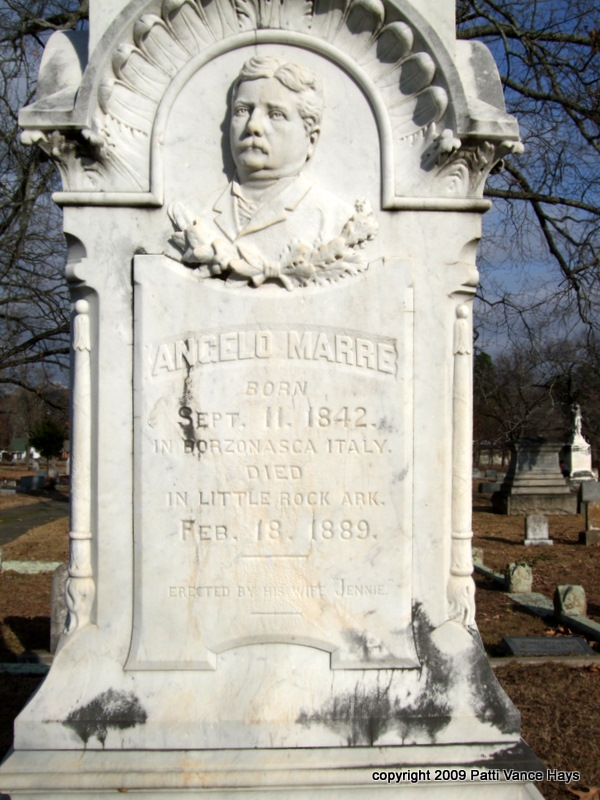
On September 11, 1842, future Little Rock Alderman Angelo Marre was born in Borzonaca, Italy.  He immigrated to Tennessee with his parents in 1854.

During the Civil War, he served in the Confederate Army. From 1865 to 1868, Angelo Marre worked for the Memphis Police Department but was forced to resign after he was accused of killing a man during an argument.  After his acquittal, he returned to the saloon business.  In 1872 Marre was convicted of stealing money and sentenced to three years in prison.

Tennessee Governor John Brown granted Marre a full pardon two years into his sentence, and he regained his citizenship in 1879.

After getting out of prison, he claimed an inheritance and joined his brothers in Little Rock.  He worked as a bartender at the Metropolitan Hotel.  He later opened a saloon and billiard parlor.

By the mid-1880s, Marre owned two saloons, a liquor import business, an office building in downtown LR, 3,000 sharesof stock in mining companies operating in Garland and Montgomery counties, and he was the first president of Edison Electric Company of LR.

In 1883, he was elected as an alderman on the Little Rock City Council.  He lost is bid for reelection in 1885. In 1888, he was an unsuccessful candidate for Pulaski County Sheriff.
villamarreAngelo Marre died February 18, 1889, as a result of his infection.  He is buried at Calvary Cemetery in LR. His custom designed, marble monument was ordered from Florence, Italy, and cost $5,000.

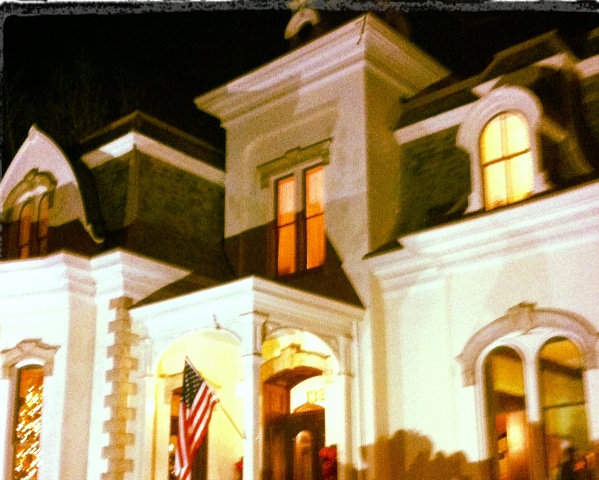
Marre is probably best known today as the builder of the structure now known as the Villa Marre.  Built in 1881, it is designed in the Italianate and Second Empire styles.  It was built in 1881 and 1882 on Block 21, Lots 5 & 6 of the Original City of Little Rock.  The cost was $5,000.

It was originally a red brick structure and has been modified and expanded several times as well as painted white.  It did not bear the name Villa Marre until the 1960s when historic preservation advocate Jimmy Strawn gave it that name.

After serving as the headquarters for the Quapaw Quarter Association for several years, it was returned to a private residence.  It is now available for special events and rentals.

The Villa Marre is probably best known locally and nationally for serving as the facade for the Sugarbaker design firm on the CBS sitcom “Designing Women.”  Though the interior of the house does not match the interior on TV, the building was featured in the opening credits as well as in exterior shots each week.

Little Rock Look Back: The City welcomes Katrina evacuees

Hurricane KatrinaIn light of the landfall of Hurricane Katrina in August 2005, Little Rock Mayor Jim Dailey and City Manager Bruce Moore sprung into action to marshal resources to welcome visitors who found themselves in Little Rock. From greeting buses and aircraft that arrived with evacuees, to coordinating with churches and non-profits to distribute supplies, to working with area businesses to identify resources, Mayor Dailey, the City Manager and other City leaders worked diligently to offer assistance.

Mayor Dailey noted, “While we welcome these visitors to our City, obviously the timeframe for this stay was not of their own choosing. As they wait out the hurricane and its aftereffects, I wanted to extend this hospitality to them on behalf of all our citizens.”

One of the things the City did was distribute a list of the cultural institutions which had free admission. These museums offered a respite for people who were spending time in hotel rooms or temporary shelters. With economic futures uncertain, spending money on entertainment was not an option for many.  The chance to see exhibits for free was a break from the monotony of television coverage and endless waiting.

In addition to providing information on free and low-cost Little Rock attractions, the Convention & Visitors Bureau worked around the clock to identify available hotel rooms and other places where evacuees could stay.  Little Rock’s Animal Services division worked to find places to keep animals since some could not stay in hotel rooms.

With the breaking of the levee and the subsequent flooding, it became obvious that what many had expected to be a three-day absence from New Orleans and the Gulf Coast, was going to be much longer.  The days turned into weeks; subsequently, the City shifted its focus into helping people find housing and jobs.

“I am proud of how Little Rock has responded,” said Mayor Dailey at the time. “From volunteers to utility workers, a number of our citizens are poised to go down there and help restore those basic necessities to the areas hit by Hurricane Katrina. I am also proud to know that our hospitality and attraction industries in Little Rock are working to offer comfort and relief here. Perhaps most importantly, the compassionate smiles and words of encouragement extended by everyday men and women in Little Rock to our newest visitors are so significant.”

“I think we can never underestimate the value of helping our neighbors. When Little Rock has been beset by disaster, it has been the knowledge that other people cared about us that has helped as we worked to return to daily routines. While I am sorry that this situation has occurred, I am grateful that we can repay in some small way, all that others have done for us,” said the Mayor.

Ten years on, much has changed in Little Rock because of Katrina.  Some people who came here “temporarily” have stayed.  Others who returned have maintained ties with Central Arkansas friends.  Little Rock’s culinary and hospitality industry have benefitted from several of the newcomers who were brought here by Katrina.  There is perhaps a bit more diversity of beliefs, tastes, and accents because of this storm.

As they did with people stranded in Little Rock after September 11, the City’s cultural institutions opened their doors, their arms and their hearts to the Katrina visitors.  It proved again the healing power of not only the arts but also of hospitality.

Little Rock Look Back: City Council approves 1935 auditorium plan

An August 25, 1935, rendering in the ARKANSAS GAZETTE of the proposed Little Rock auditorium at Capitol and Scott Streets.

An August 25, 1935, rendering in the ARKANSAS GAZETTE of the proposed Little Rock auditorium at Capitol and Scott Streets.

On August 26, 1935, the City of Little Rock took its first significant step in a decade for the creation of a City auditorium..  Under the leadership of Mayor R. E. Overman, the City Council approved authorization for the City to apply for $1,000,000 from the Federal Emergency Administration of Public Works (PWA) for the construction of an auditorium.  The PWA had issued a September 16, 1935, deadline for applications to be received as it sought to spend $4.8 billion in construction projects.

The auditorium plan was announced on Saturday, August 24, 1935.  Much preparation had already been undertaken before the project was publicly unveiled.  Private presentations hhad taken place, a team of architects had been chosen (Eugene Stern and the firm of Wittenberg & Delony), and a location had been selected.

The auditorium complex was slated for a block bounded by Capitol, Scott, Fourth and Cumberland Streets.  The Women’s City Club building on that block would remain with the new structure being built to wrap around two sides of the existing structure. The site was chosen because it was one block east of the Main Street business corridor and near existing meeting locations such as the Boys Club, Albert Pike Hotel, Albert Pike Masonic Lodge and several churches.

As planned by the architects, this structure’s front façade would have run the length of the Capitol Avenue side of the block.  The building was proposed to be constructed of concrete, stone and steel.  It would have a large hall with a proscenium stage and seating capacity of 4,000 with overflow of an additional 500.  The adjoining exhibition hall could seat 3,500 people.  The plan called for 150 cars to be parked in the building, and an additional 100 cars to be parked on a surface lot on the site.

Following an August 26 closed door meeting to discuss the project from which members of the public and press were excluded, in open session the City Council voted to pursue the funding for the million dollar auditorium.  If approved by the PWA, the funds would be provided in grants and loans, to be paid by over a 35 year period.

The auditorium proposal was filed with the PWA in Washington in September 1935.  Throughout the next several months, Mayor Overman and the city were engaged in a series of conversations and negotiations with the PWA for the expansion of both the water system and the sewer system. This diverted attention from pursuing the auditorium immediately.  This specific auditorium project stalled.  But because the plan had been filed by the September 16 deadline, it allowed the City to make use of PWA funds a few years later which would lead to the construction of Robinson Auditorium.


Remember end of WWII with a visit to MacArthur Museum of Arkansas Military History

With this month marking the 70th anniversary of the end of World War II, it is a good time to remember the museum in Little Rock dedicated to preserving Arkansas’ rich military history.

Located in the historic Arsenal Tower in MacArthur Park, the MacArthur Museum of Arkansas Military History honors the Arkansans who have served in the armed forces.  Exhibits feature artifacts, photographs, weapons, documents, uniforms and other military items that vividly portray Arkansas’s military history at home and abroad.

Undaunted Courage, Proven Loyalty:
Japanese American Soldiers in World War II
This exhibit focuses on the military experience of Japanese Americans during World War II including stories from veterans of the 100th Infantry Battalion and the 442nd Regimental Combat Team, and the Military Intelligence Service. To prove their loyalty to the United States government, many Japanese American men joined the army as part of the 442nd Regimental Combat Team or as part of the Military Intelligence Service.

Other exhibits include:

  • From Turbulence to Tranquility: The Little Rock Arsenal
  • Capital In Crisis and Celebration: Little Rock and the Civil War
  • Alger Cadet Gun
  • Camden Expedition
  • David Owen Dodd
  • Through the Camera’s Eye: The Allison Collection of World War II Photographs
  • By the President in the Name of Congress: Arkansas’ Medal of Honor Recipients
  • Conflict and Crisis: The MacArthur- Truman Controversy
  • Duty, Honor and Country: General Douglas MacArthur
  • The Sun Never Sets on the Mighty Jeep: The Jeep During World War II
  • War and Remembrance: The 1911 United Confederate Veterans Reunion
  • First Call – American Posters of World War I

The MacArthur Museum of Arkansas Military History is a museum of the City of Little Rock.  It is led by executive director Stephan McAteer who works with the MacArthur Military History Museum Commission.

Hours of Operation
Monday – Saturday; 9:00 a.m. – 4:00 p.m.
Sunday; 1:00 p.m. – 4:00 p.m.

Little Rock Look Back: Judge Eisele rules HAIR must flow at Robinson Auditorium

Ad for the original production of HAIR in Little Rock. Note the ticket prices. And that they could be purchased at Moses Music Shops.

Ad for the original production of HAIR in Little Rock. 

Forty-four years ago today, on August 11, 1971, Nixon appointee Federal Judge G. Thomas Eisele ruled that the musical Hair must be allowed to play in Little Rock in 1972 at Robinson Auditorium.

In February 1971, a young Little Rock attorney named Phil Kaplan petitioned the Little Rock Board of Censors to see if it would allow a production of Hair to play in the city. He was asking on behalf of a client who was interested in bringing a national tour to Arkansas’ capital city. The show, which had opened on Broadway to great acclaim in April 1968 after an Off Broadway run in 1967, was known for containing a nude scene as well for a script which was fairly liberally sprinkled with four-letter words. The Censors stated they could not offer an opinion without having seen a production.

By July 1971, Kaplan and his client (who by then had been identified as local promoter Jim Porter and his company Southwest Productions) were seeking permission for a January 1972 booking of Hair from the City’s Auditorium Commission which was charged with overseeing operations at Robinson Auditorium. At its July meeting, the Commissioners voted against allowing Hair because of its “brief nude scene” and “bawdy language.”

Kaplan decried the decision. He stated that the body couldn’t “sit in censorship of legitimate theatrical productions.” He noted courts had held that Hair could be produced and that the Auditorium Commission, as an agent for the State, “clearly can’t exercise prior censorship.” He proffered that if the production was obscene it would be a matter for law enforcement not the Auditorium Commission.

The Commission countered that they had an opinion from City Attorney Joseph Kemp stating they had the authority. One of the Commissioners, Mrs. Grady Miller (sister-in-law of the building’s eponym, the late Senator Robinson, she had served on the Commission since 1940), expressed her concern that allowing Hair would open the door to other productions such as Oh! Calcutta!

On July 26, 1971, Southwest Productions filed suit against the Auditorium Commission. Four days later there was a hearing before federal Judge G. Thomas Eisele. At that hearing, Auditorium Commission member Lee Rogers read aloud excerpts from the script he found objectionable. Under questioning from Kaplan, a recent touring production of Neil Simon’s Plaza Suite was discussed. That play has adultery as a central theme of one of its acts. Rogers admitted he found the play funny, and that since the adultery did not take place on stage, he did not object to it. Among those testifying in favor of it was Robert Reddington, who was director of performing arts at the Arkansas Arts Center.

Judge Eisele offered a ruling on August 11 which compelled the Auditorium Commission to allow Hair to be performed. Prior to the ruling, some of the Auditorium Commissioners had publicly stated that if they had to allow Hair, they would close it after the first performance on the grounds of obscenity. To combat this, Judge Eisele stated that the Commission had to allow Hair to perform the entire six day engagement it sought.

Upon hearing of the Judge’s ruling, Commissioner Miller offered a succinct, two word response. “Oh, Dear!”

On January 18, 1972, Hair played the first of its 8 performances over 6 days at Robinson Auditorium.  In his review the next day, the Arkansas Gazette’s Bill Lewis noted that Hair “threw out all it had to offer” and that Little Rock had survived.

Little Rock was by no means unique in trying to stop productions of Hair.  St. Louis, Birmingham, Los Angeles, Tallahassee, Boston, Atlanta, Charlotte NC, West Palm Beach, Oklahoma City, Mobile and Chattanooga all tried unsuccessfully to stop performances in their public auditoriums.  Despite Judge Eisele’s ruling against the City of Little Rock, members of the Fort Smith City Council also tried to stop a production later in 1972 in that city. This was despite warnings from City staff that there was not legal standing.

Little Rock Look Back: Mayor William Ashley

W E Ashley signature

On August 6, 1823, future Little Rock Mayor William Eliot Ashley was born in Little Rock.  He would go on to become the first Little Rock Mayor to be born in Little Rock.  Ashley was the son of Mary and Chester Ashley; his father would later serve as a U. S. Senator from Arkansas.  He was the second of the couple’s seven children.

Though he was raised in Little Rock, he did receive some schooling out of state. The State History Commission has correspondence between eleven year old William, studying in New York, and his father. Part of the letter is a request for money.

On October 26, 1846, he married Frances Eliza Grafton at Christ Episcopal Church.  They were the first Little Rock residents to be married in that church.  The couple had five children, including triplets.  Only one of the children, Frances (who was one of the triplets) survived to adulthood.

Ashley was first elected Mayor of Little Rock in 1857. After completing a two year term, he was succeeded by Gordon N. Peay (another scion of a prominent Little Rock family).  In 1861, Ashley returned to the office of Mayor.  He was reelected to a third term in 1863.  In September 1863, following the defeat of Confederate troops by the Union forces at the Battle of Little Rock, the City of Little Rock ceased operations.  On September 21, 1863, Little Rock municipal government closed its doors, stopped collection of taxes and disbanded.  Thus Ashley’s third term ended.

In addition to his interest in local government, Ashley was a member of St. John’s College Board and a director of the newly-formed Little Rock Gas Company.

William Eliot Ashley died on August 16, 1868, at the age of 45.  He was buried in Mt. Holly Cemetery (which sat partially on land that had once belonged to his family). His parents, wife and children are all buried in Mt. Holly as well.

Interestingly, for someone who grew up in a prominent family, there does not appear to be a surviving likeness of Mayor Ashley – either in painting or photograph.  Several exist of his parents, but none of him.

Little Rock Look Back: Mayor William Whipple

whippleOn August 4, 1834, future Little Rock Mayor William G. Whipple was born in Connecticut.  He attended school in Massachusetts and graduated from Wesleyan University. After studying law at Albany Law School, he moved to Milwaukee, Wisconsin.

In 1868, Whipple moved to Little Rock following the 1866 death of his first wife in Wisconsin. Long active in Republican politics, he quickly became involved in Little Rock’s political and social life.  Shortly after his arrival he was appointed United States Attorney and served three years.

In 1870, he married Mary S. Dodge, daughter of former mayor Roderick Lathrop Dodge MD.  They had one son Durand, who followed his father into the legal profession. The Whipples were active members of Trinity Episcopal Cathedral.

In 1887, Whipple was elected Mayor of Little Rock and was re-elected two years later.  Whipple’s mayoral administration introduced electric lighting to the city beginning on September 1, 1887, paved many streets with granite and macadam, created sixty miles of new brick and concrete sidewalks, and introduced a steam dummy railway.

In 1892, he ran for Governor of Arkansas as the Republican nominee but was unsuccessful.  In 1895, he sought a third term for Mayor but was defeated by James A. Woodson.

From 1897 to 1900, he served as register of the US Land Office in Arkansas.  Whipple, who had long practiced law, was appointed United States Attorney for the Eastern District of Arkansas in 1900.  He served in that capacity until 1913.

In July 1914, Mayor Whipple died.  He is buried at Oakland Cemetery in Little Rock.
