
Mark Christ to receive Booker Worthen Literary Prize

christ_markAs one of the most fertile regions in the South, the Arkansas River Valley was highly contested territory during the Civil War. While the Siege on Vicksburg raged, equally important battles were fought here in Arkansas. This struggle is the topic of Mark Christ’s nonfiction work, Civil War Arkansas 1863, which has been selected to receive the 2013 Booker Worthen Literary Prize, awarded by the Central Arkansas Library System (CALS).
Christ, community outreach director for the Arkansas Historic Preservation Program, has edited a number of books and articles about Civil War events in Arkansas. He is a member of the Arkansas Civil War Sesquicentennial Commission, serves as chairman of the board of directors of the Arkansas Humanities Council, and is a member of the board of trustees of the Arkansas Historical Association. Christ recently received the 2013 State Preservation Leadership Award from the Civil War Trust, the largest nonprofit battlefield preservation organization in the United States.
The Worthen Prize is awarded each year to an author living in the CALS’s service area whose work is highly regarded. It is named for Booker Worthen, who served twenty-two years on CALS’s board of trustees. The Worthen Prize will be presented to Christ at CALS’s annual event, “A Prized Evening,” which also features presentation of the Porter Prize. “A Prized Evening” will be held in October 2013; an exact date will be announced later this year.

Little Rock Look Back: Mayor Robert Francis Catterson

R_F_Catterson_BGen_ACWOn this date in 1835, future Little Rock Mayor Robert Francis Catterson was born in Indiana, the son of Irish immigrants.  He studied medicine in Ohio and established a medical practice in Indiana upon completion of his studies.

With the outbreak of the Civil War, he enlisted as a private in the Union Army.  Throughout the war, he was promoted and was eventually mustered out as a brigadier general in 1866.  During his service, he participated in the siege of Vicksburg, the Battle of Chattanooga, the Atlanta Campaign and Sherman’s March to the Sea.

Following his departure from the military, Catterson decided not to return to medical practice.  He moved to Arkansas and worked for a brief time in the cotton commodities field.  He later returned to military service commanding a militia fighting the Ku Klux Klan.  Catterson was appointed US Marshal and would also command the Brooks troops during the Brooks-Baxter War in Little Rock.

In November 1871, he was elected Mayor of Little Rock. His election ended a tumultuous two-year period where the Little Rock City Council tried unsuccessfully to remove Mayor A. K. Hartman.  Mayor Catterson served a relatively quiet two year term in office until November 1873.

Following the completion of his term, Mayor Catterson moved to Minnesota. He later moved to Texas where he died on March 30, 1914 at the age of 79.  He is buried in the San Antonio National Cemetery.

Legacies & Lunch today: Women During the Civil War

howardArkansas women faced monumental challenges during the Civil War. To commemorate Women’s History Month, Rebecca Howard will speak about women during the Civil War era for the Butler Center for Arkansas Studies’ Legacies and Lunch program on Wednesday, March 6, at noon in the Main Library’s Darragh Center, 100 Rock Street.

Howard’s presentation will focus on the stories of northwest Arkansas women who faced hardships including starvation, displacement, and harassment. She uses diaries, newspaper articles, government claims, and service and pension records to illustrate the experience of a variety of northwest Arkansas women, from the perspectives of Union and Confederate, rich and poor, black and white.

Howard is currently a PhD candidate in History at the University of Arkansas at Fayetteville. She completed her undergraduate work at Texas A&M. A northwest Arkansas native, Howard is focusing her dissertation work on that region during and after the Civil War.

The Butler Center’s Legacies & Lunch program is free and open to the public and supported in part by the Arkansas Humanities Council. Attendees are invited to bring a sack lunch; drinks and dessert will be provided.

The Butler Center for Arkansas Studies is a department of the Central Arkansas Library System (CALS). It was founded in 1997 to promote the study and appreciation of Arkansas history and culture. The Butler Center’s research collections, art galleries, and offices are located in the Arkansas Studies Institute building at 401 President Clinton Ave. on the campus of the CALS Main Library. For more information, call 918-3086.

Little Rock Look Back: Charles P. Bertrand

On November 23, 1808, future Mayor Charles P. Bertrand was born in New York.  He was the son of Pierre and Eliza Wilson Bertrand; his father died in 1809 in an uprising in Haiti and his mother eventually remarried.  With her new husband, Dr. Matthew Cunningham, she and the family moved to Little Rock in 1820.

After apprenticing with family friend William Woodruff at the Arkansas Gazette, Bertrand opened the Arkansas Advocate newspaper.  He later studied law under Robert Crittenden and entered the legal profession.

In 1835-1836, he served as State Treasurer for the Arkansas Territory, and in 1836 as secretary for the first constitutional convention. He was a member of the Arkansas House of Representatives from 1840-1841 and 1844-1849.

Bertrand followed in his stepfather’s footsteps and became Mayor of Little Rock.  (Dr. Cunningham had been the first Little Rock Mayor in 1831.)  He was in office from January 1855 through January 1857, serving two one-year terms.  He later served on the City Council and filled in as acting mayor. (Another influence on his upbringing was studying under future Mayor Jesse Brown who taught at the first school in Little Rock.)

Bertrand, as acting mayor, was involved in the negotiations of the surrender of Little Rock to federal troops in 1863.  He also later corresponded with President Lincoln on behalf of Little Rock citizens.  Though a staunch Confederate, his good will toward the Union soldiers and federal officials is credited with helping to save Little Rock from the destruction which befell many other Southern cities.

He had put his considerable fortune into Confederate money during the war. At the Civil War’s conclusion, the family was financially ruined. Though they had vast land holdings, those would be sold off in parcels to pay for taxes.

Bertrand died August 27, 1865, shortly after the conclusion of the Civil War.  He, like his mother, step-father, and several other relatives is buried in Mt. Holly Cemetery.

Legacies and Lunch tomorrow

The Butler Center’s monthly “Legacies and Lunch” series continues tomorrow.

Wednesday, August 1, 2012, noon to 1 p.m.
Darragh Center, Main Library
100 Rock St.
The Civil War in Arkansas

In conjunction with the Butler Center exhibition Invasion or Liberation? The Civil War in Arkansas, Dr. Carl Moneyhon will discuss opposition to the Civil War in Arkansas. Moneyhon, a faculty member in the University of Arkansas at Little Rock history department, is a specialist in the history of the American Civil War and the South and is widely published in the field.

Invasion or Liberation? will be on view on Concordia Hall (401 President Clinton Ave.) through October 27, 2012. Legacies & Lunch is sponsored in part by the Arkansas Humanities Council. Bring a sack lunch; drinks and dessert are provided.
Dr. Moneyhon joined the faculty in 1973 and holds a Ph.D. from the University of Chicago. He is faculty liaison with the University History Institute, an organization that develops closer ties between the department and the community. He also serves on the editorial boards of the Arkansas Historical Quarterly and the Encyclopedia of Arkansas History and Culture. He was won the UALR Faculty Excellent Award for Research and the UALR Faculty Excellence Award for Teaching.

Dr. Moneyhon is a specialist in the history of the American Civil War and the South and is widely published in the field. His work has been supported by the National Endowment for the Humanities, and he recently received one of the first College of Arts, Humanities, and Social Sciences Summer Fellowships for Research. He is a Fellow of the Texas Historical Association. He is working on a book on the connection of war-time experience and developed identity among Confederate soldiers.

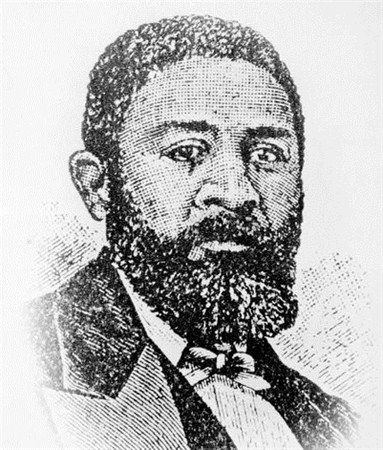
Arkansas’ African-American legislators during Reconstruction

On display at the Arkansas State Capitol is a temporary exhibit – Arkansas’s African American Legislators, 1868-1893.  It was created by the Black History Commission of Arkansas and the Arkansas History Commission. It honors the African Americans who made up a significant part of Arkansas’s legislature during the 1860s and early 1870s, and who continued to serve until 1893.

State Rep. William H. Grey, one of first two African Americans to serve in Arkansas legislature

On Tuesday, February 14, 2012, State Representative Fred Allen and Black History Commission chair, Carla Coleman, spoke at the official opening of the exhibit in the lower-level foyer at the Arkansas State Capitol. African Americans participated in Arkansas politics for the first time following the Civil War. After the end of that conflict, the state adopted a new constitution in 1868. Its provisions included the right to vote and hold public office for black males.

Between 1868 and 1893, eighty-five African Americans are known to have served in the Arkansas General Assembly. These legislators included lawyers, merchants, ministers, educators, farmers, and other professionals. The majority served in the House, with nine being chosen for the Senate. Election laws passed by the General Assembly in 1891 and new poll tax regulations in 1893 effectively ended the election of African Americans to the legislature. Blacks did not serve again in the General Assembly until 1973.
Photographs survive for forty-five of the African Americans who served in the Arkansas General Assembly during the nineteenth century and are featured in this exhibit. Forty-three of these are from the holdings of the Arkansas History Commission.