Heritage Month – Ten Mile House

Ten_Mile_fDeriving its common name from its distance from Little Rock at the time, the Federal-style Ten Mile House,  is a rare example of a largely intact rural home of the early nineteenth century.  In addition to the house, there are four nineteenth-century outbuildings surrounded by a large parcel of wooded property.

It was built by Archibald McHenry, and is sometimes known as the McHenry House or Stagecoach House (due to its presence on the Southwest Trail stagecoach line).  During the Civil War it served as a military outpost for Union troops.  David O. Dodd was held a prisoner in the smokehouse prior to his trial and execution.

Ten Mile House exhibits Early Georgian or Federal influence through the use of bridging between paired chimneys situated at each end of the house. Traits of the Federal style include simple, symmetrical proportions and large multi-paned windows. Ornamentation is minimal and is usually found around entries, windows, and cornice lines. A brick smokehouse, dairy house, well house, and kitchen house—all dating from the nineteenth century—remain on the property.

The Ten Mile House was listed on the National Register in June of 1970. Several families have owned the home since its early nineteenth century construction. It has served as a combination tea room/antiques store, a venue for public dinner parties and weddings, and a residence.

Heritage Month – U.S. Arsenal Tower Building

MacPark ArsenalToday is Armed Forces Day.  It is an appropriate day to look at the U. S. Arsenal Tower Building.  Construction on the Little Rock Arsenal began in 1838 and was completed in 1840.  The complex grew to include more than thirty buildings. The arsenal building itself was a two story brick building with an unusual central octagonal tower between two wings. The tower was actually used to move munitions between floors of the building. Other buildings included office buildings, a storehouse, a magazine, a guardhouse, a hospital and other service structures. The hospital and service structures were built of wood.

On 25 Jul 1873 the Little Rock Arsenal became the Little Rock Barracks and remained that until the facility was abandoned 25 Sep 1890. The tower building was converted into married officer quarters. Douglas MacArthur was born 26 Jan 1880, in the tower building at the Little Rock Barracks to then Captain Arthur MacArthur, Jr. and his wife.

The site was turned over to the city 23 Apr 1892, stipulated for use as a city park. In return, the City of Little Rock gave the U.S. Government 1,000 acres  on which Fort Logan H. Roots was established by the U.S. Congress on the same date, 23 Apr 1892. All of the remaining buildings on the original site were sold or destroyed except the Arsenal Tower building.

The land became known as City Park and later MacArthur Park.  The Tower Building remained empty and in deteriorating condition until the late 1930s, when the City of Little Rock renovated the building.  For many years, the Aesthetic Club met in the building as the only tenant.  When others refused to pay the utilities, the Aesthetic Club members did.  The organization continues to meet in the building.

In 1942, the Museum of Natural History and Antiquities opened in the building; it had previously been located in Little Rock’s City Hall. The name of the museum changed in 1964 to the Museum of Science and Natural History, and again in 1983 to the Arkansas Museum of Science and History. In 1997, the museum moved to a new location in the River Market, where it now is known as the Museum of Discovery.

In May 2001, the MacArthur Museum of Arkansas Military History opened in the building.

The structure was listed in National Register of Historic Places on July 28, 1970.  It was designated a National Historic Landmark on April 19, 1994.

On Armed Forces Day – Visit the MacArthur Museum of Arkansas Military History

Today is Armed Forces Day.  It is a good day to visit Little Rock’s museum devoted to Arkansas’ military heritage.  Located in the historic Arsenal Tower in MacArthur Park, the MacArthur Museum of Arkansas Military History honors the Arkansans who have served in the armed forces.  Exhibits feature artifacts, photographs, weapons, documents, uniforms and other military items that vividly portray Arkansas’s military history at home and abroad.

The exhibits include:

  • From Turbulence to Tranquility: The Little Rock Arsenal
  • Capital In Crisis and Celebration: Little Rock and the Civil War
  • Alger Cadet Gun
  • Camden Expedition
  • David Owen Dodd
  • Through the Camera’s Eye: The Allison Collection of World War II Photographs
  • By the President in the Name of Congress: Arkansas’ Medal of Honor Recipients
  • Conflict and Crisis: The MacArthur- Truman Controversy
  • Duty, Honor and Country: General Douglas MacArthur
  • The Sun Never Sets on the Mighty Jeep: The Jeep During World War II
  • War and Remembrance: The 1911 United Confederate Veterans Reunion
  • First Call – American Posters of World War I
  • Undaunted Courage, Proven Loyalty: Japanese American Soldiers in World War II
  • Vietnam, America’s Conflict

The MacArthur Museum of Arkansas Military History is a museum of the City of Little Rock.  It is led by executive director Stephan McAteer who works with the MacArthur Military History Museum Commission.  The museum is open Tuesday through Friday from 9am to 4pm, Saturday from 10am to 4pm and Sunday from 1pm to 4pm.

Emancipation & Reconstruction focus of Civil War 150 Seminar today at Old State House Museum

oldstatehouseAs part of its celebration of the passage of the 13th Amendment in Arkansas, the Old State House Museum and the Arkansas Civil War Sesquicentennial Commission will hold a mini-seminar this afternoon from 1pm to 5pm.  The seminar’s topic will be “Emancipation and Reconstruction.”

1:00 pm Introduction
1:15 pm Speaker – Tom DeBlack, End of the war
2:00 pm Speaker – Angela Walton-Raji, Emancipation
2:4 5pm Break
3:00 pm Speaker – Carl Moneyhon, Reconstruction
3:45 pm Q & A/Wrap-up
4:15 pm Program Ends

The Old State House Museum and the Arkansas Civil War Sesquicentennial Commission are programs of the Department of Arkansas Heritage.

Bio Information:

Tom DeBlack: End of the war
Thomas DeBlack is a professor of history at Arkansas Tech University in Russellville, Arkansas. He is a 1969 graduate of Nashville (Arkansas) High School and holds a B. A. from Southern Methodist University in Dallas, Texas (1973), an M.S.E. from Ouachita Baptist University (1979), and a PhD from the University of Arkansas (1995). Tom taught in the public schools in Arkansas for twelve years. He is a past president of the Arkansas Historical Association and the Arkansas Association of College History Teachers and currently serves on the board of the Arkansas Humanities Council.He is co-author Arkansas: A Narrative History (University of Arkansas Press, 2002; 2nd edition, 2013 ), and author of With Fire and Sword: Arkansas 1861-1874 (University of Arkansas Press, 2003). In 2003 Arkansas: A Narrative History was named the winner of the Arkansas Library Association’s Arkansiana Prize, and With Fire and Sword was named the first winner of the Butler-Remmel Arkansas History Literary Prize. Tom is currently working on a book on Lakeport Plantation in Chicot County and on a centennial history of Arkansas Tech University. He lives in Conway with his wife Susan, an optometrist, and their eleven-year-old daughter, Susannah.

Angela Walton-Raji: Emancipation
Angela Walton-Raji is a genealogist and researcher specializing in the Freedmen of Indian Territory. She is the author of Black Indian Genealogy Research, African Ancestors Among the Five Civilized Tribes and the co-publisher of VOICES of Indian Territory a scholarly journal with focus on the historical documents pertaining to the Freedmen of the Five Tribes. She has spoken at a number of national conferences and institutes throughout the nation. A native of western Arkansas, Ms. Walton-Raji earned a bachelor’s degree in Romance Languages from St. Louis University and a master’s degree from Antioch University. She works at the University of Maryland Baltimore County as Director of Graduate Recruitment, and continues to study, research and lecture on the history of Indian Territory Freedmen.

Carl Moneyhon: Reconstruction
Dr. Moneyhon joined University of Arkansas-Little Rock faculty in 1973 and holds a Ph.D. from the University of Chicago. He is faculty liaison with the University History Institute, an organization that develops closer ties between the department and the community. He also serves on the editorial boards of the Arkansas Historical Quarterly and the Encyclopedia of Arkansas History and Culture. He was won the UALR Faculty Excellent Award for Research and the UALR Faculty Excellence Award for Teaching. Dr. Moneyhon is a specialist in the history of the American Civil War and the South and is widely published in the field. His work has been supported by the National Endowment for the Humanities, and he recently received one of the first College of Arts, Humanities, and Social Sciences Summer Fellowships for Research. He is a Fellow of the Texas Historical Association.

Little Rock Look Back: President Benjamin Harrison becomes first sitting president to visit LR

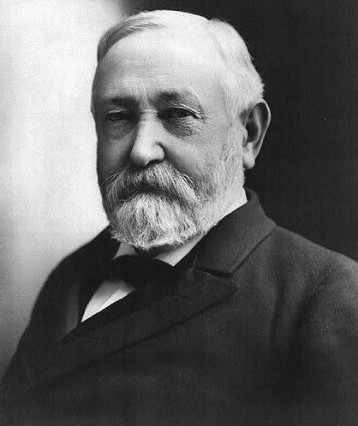
Benjamin-Harrison-by-Joseph-Gray-Kitchell-1897-358x426On April 17, 1891, Benjamin Harrison became the first sitting president to visit Arkansas.  He was on a cross-country railroad trip having left DC on April 13.

The morning of the 17th he spoke in Memphis and then took the train to Little Rock.  Accompanying him from Memphis to Little Rock were a delegation which included Governor and Mrs. James P. Eagle, Mayor H. L. Fletcher and Col. Logan H. Roots.  Also in the party was Mrs. W. G. Whipple, a former first lady of Little Rock.

They arrived in Little Rock in the afternoon.  A parade took them from the train station to the State House (now the Old State House Museum) where the Governor formally welcomed the President and his party.

In his brief remarks, President Harrison spoke of the hospitality and the natural resources available in Arkansas.  He also touched on the Civil War, which at the time was less than 30 years in the past. He noted “The commonwealth rests upon the free suffrage of its citizens and their devotion to the Constitution and the flag is the bulwark of its life.  We have agreed, I am sure, that we will do no more fighting among ourselves.” These remarks were met enthusiastically by the crowd assembled.

The President concluded is brief remarks thanking the State officials and the citizenry.  He then took the train to Texarkana where he made his third remarks of the day.

Benjamin Harrison was on the Presidential ticket two times. The first time he lost the popular vote but won the Electoral College defeating incumbent Grover Cleveland. The second time he lost both the popular and electoral votes to Cleveland.  He did not carry Arkansas in either election. Though he was the first sitting president to visit Little Rock, there is nothing here named for him.  Since there was already a Harrison Street named after his grandfather, he is skipped between Cleveland and McKinley in the presidential streets.

Marking 150th anniversary of 13th Amendment – CALS will “Let Freedom Ring”

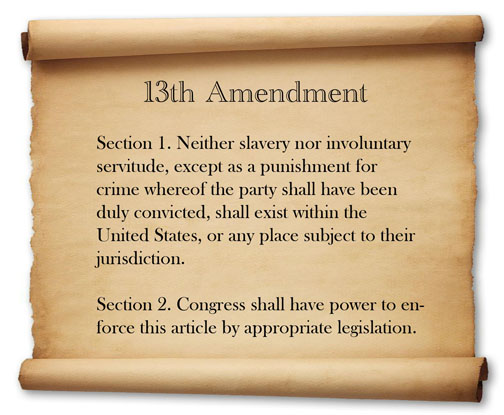
2014-06-21-13thAmendmentIn honor of the 150th anniversary of the 13th Amendment, which abolished slavery, the Central Arkansas Library System (CALS) will join the Arkansas Civil War Commission in “Let Freedom Ring,” a ringing of bells 13 times at 13:00 (1 p.m.) on Tuesday, April 14. Staff and volunteers will ring bells and read the 13th Amendment.

Locations

  • Main Library, 100 Rock Street
  • Butler Center for Arkansas Studies, 401 President Clinton Avenue
  • McMath Library, 2100 John Barrow Road
  • Dee Brown Library, 6325 Baseline Drive

“Let Freedom Ring” honors the 150th anniversary of the amendment, and is a statewide initiative sponsored by the Arkansas Civil War Sesquicentennial Commission’s commemoration of the 150th anniversary of the Civil War.

The 13th Amendment reads as follows:

“Neither slavery nor involuntary servitude, except as a punishment for crime whereof the party shall have been duly convicted, shall exist within the United States, or any place subject to their jurisdiction. Congress shall have power to enforce this article by appropriate legislation.”

The Arkansas Civil War Sesquicentennial Commission is part of the Arkansas Historic Preservation Program, an agency of the Department of Arkansas Heritage. The Arkansas Historic Preservation Program is responsible for identifying, evaluating, registering and preserving the state’s cultural resources.

Little Rock Look Back: Robert Catterson–Doctor, Soldier, LR Mayor

R_F_Catterson_BGen_ACWOn this date in 1835, future Little Rock Mayor Robert Francis Catterson was born in Indiana, the son of Irish immigrants.  He studied medicine in Ohio and established a medical practice in Indiana upon completion of his studies.

With the outbreak of the Civil War, he enlisted as a private in the Union Army.  Throughout the war, he was promoted and was eventually mustered out as a brigadier general in 1866.  During his service, he participated in the siege of Vicksburg, the Battle of Chattanooga, the Atlanta Campaign and Sherman’s March to the Sea.

Following his departure from the military, Catterson decided not to return to medical practice.  He moved to Arkansas and worked for a brief time in the cotton commodities field.  He later returned to military service commanding a militia fighting the Ku Klux Klan.  Catterson was appointed US Marshal and would also command the Brooks troops during the Brooks-Baxter War in Little Rock.

In November 1871, he was elected Mayor of Little Rock. His election ended a tumultuous two-year period where the Little Rock City Council tried unsuccessfully to remove Mayor A. K. Hartman.  Mayor Catterson served a relatively quiet two year term in office until November 1873.

Following the completion of his term, Mayor Catterson moved to Minnesota. He later moved to Texas where he died on March 30, 1914 at the age of 79.  He is buried in the San Antonio National Cemetery.