Arts+History Throwback Thursday: Arsenal Building in 1942

Associated Press photo

Associated Press photo

On February 9, Little Rock voters will have the chance to say Yes to improving the MacArthur Museum of Arkansas Military History, Arkansas Arts Center, and MacArthur Park.

Leading up to that election is a good time to look back at the development of these two MacArthur Park sited museums.

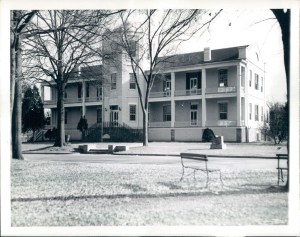
This is a 1942 Associated Press photo of the Arsenal Building.  Completed in 1840, it was decommissioned in 1890 after fifty years as a military arsenal and later officer barracks.  In 1893, the land on which it sits was transferred from the Federal Government to the City of Little Rock. The land became Little Rock’s first public park.  Briefly known as Arsenal Park, it was known as City Park until 1942, when it was renamed MacArthur Park after the five star general who was born there in 1880.

From 1942 until 1996, it was home to the Museum of Science and History (under several different names). The building was restored in preparation for the museum moving in.  After the building was vacated again in 1997 (when the museum moved to the River Market to become the Museum of Discovery), it stood vacant in preparation for a proposed military history museum. In 1999, the building was hit by a tornado which severely damaged part of the roof and caused some interior flooding.  The building was repaired and restored while plans for the new museum were underway.  In May 2001, the MacArthur Museum of Arkansas Military History opened.

6th Annual “Holiday Music at the Arsenal” today at the MacArthur Museum of Arkansas Military History

macmusThis afternoon from 2pm to 4pm, visitors to the MacArthur Museum of Arkansas Military History can enjoy a seasonal concert given by pupils of the Margaret Wyatt Vocal and Piano Studios.

Wyatt enjoyed a career in both opera and musical theater, working throughout the United States and locally with the Arkansas Repertory Theater and Arkansas Symphony Orchestra.  She has taught piano and voice in Little Rock for over 25 years.  Included in the concert will be holiday favorites from around the world.  The concert is free and open to the public.

Located in the historic Arsenal Tower in MacArthur Park, the MacArthur Museum of Arkansas Military History honors the Arkansans who have served in the armed forces.  Exhibits feature artifacts, photographs, weapons, documents, uniforms and other military items that vividly portray Arkansas’s military history at home and abroad.

Other exhibits include:

  • Undaunted Courage, Proven Loyalty: Japanese American Soldiers in World War II
  • From Turbulence to Tranquility: The Little Rock Arsenal
  • Capital In Crisis and Celebration: Little Rock and the Civil War
  • Alger Cadet Gun
  • Camden Expedition
  • David Owen Dodd
  • Through the Camera’s Eye: The Allison Collection of World War II Photographs
  • By the President in the Name of Congress: Arkansas’ Medal of Honor Recipients
  • Conflict and Crisis: The MacArthur- Truman Controversy
  • Duty, Honor and Country: General Douglas MacArthur
  • The Sun Never Sets on the Mighty Jeep: The Jeep During World War II
  • War and Remembrance: The 1911 United Confederate Veterans Reunion
  • First Call – American Posters of World War I

On Veterans Day, visit the Little Rock museum which pays tribute to Arkansas’ veterans

With today being Veterans Day,  it is a good time to remember the museum in Little Rock dedicated to preserving Arkansas’ rich military history.  Though most City of Little Rock offices are closed today for the holiday, the MacArthur Museum of Arkansas Military History is open.

Located in the historic Arsenal Tower in MacArthur Park, the MacArthur Museum of Arkansas Military History honors the Arkansans who have served in the armed forces.  Exhibits feature artifacts, photographs, weapons, documents, uniforms and other military items that vividly portray Arkansas’s military history at home and abroad.

Exhibits include:
  • Undaunted Courage, Proven Loyalty: Japanese American Soldiers in World War II
  • From Turbulence to Tranquility: The Little Rock Arsenal
  • Capital In Crisis and Celebration: Little Rock and the Civil War
  • Alger Cadet Gun
  • Camden Expedition
  • David Owen Dodd
  • Through the Camera’s Eye: The Allison Collection of World War II Photographs
  • By the President in the Name of Congress: Arkansas’ Medal of Honor Recipients
  • Conflict and Crisis: The MacArthur- Truman Controversy
  • Duty, Honor and Country: General Douglas MacArthur
  • The Sun Never Sets on the Mighty Jeep: The Jeep During World War II
  • War and Remembrance: The 1911 United Confederate Veterans Reunion
  • First Call – American Posters of World War I

The MacArthur Museum of Arkansas Military History is a museum of the City of Little Rock.  It is led by executive director Stephan McAteer who works with the MacArthur Military History Museum Commission.

Hours of Operation
Monday – Saturday; 9:00 a.m. – 4:00 p.m.
Sunday; 1:00 p.m. – 4:00 p.m.

Little Rock Look Back: Ike in Little Rock

Detail from UPI photo of General Eisenhower following his address.

Detail from UPI photo of General Eisenhower following his address.

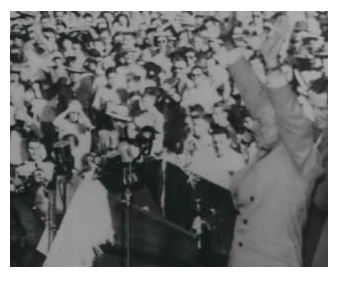
If Ike, Little Rock and September are considered, it is usually in reference to his role in the desegregation of Little Rock Central High in September 1957.  But five years earlier, he appeared in Little Rock on September 3, 1952.

General Eisenhower’s speech to 14,000 in MacArthur Park was the final leg in his swing through the South on his campaign for the White House.  He became the third presidential candidate to visit MacArthur Park in 1952 following General MacArthur (in his ill-fated attempt to gain traction as a GOP candidate during the delegate selection process) and Democratic nominee Adlai Stevenson.

He visited every southern state except Mississippi on this campaign jaunt.  In comments that neither he nor his audience could have foreseen as prescient, Eisenhower declared that he deplored the government meddling in areas in which it did not belong.  This remark was made in reference to race relations.  His stance was that some rights of minorities should be protected, but it was not necessarily the role of the federal government.

Ike proffered that if white southerners did not protect the rights of African Americans they were in danger of losing their own rights, too.  In the era of the Cold War when people were worried about the imminent loss of rights, this message seems to have crafted to appeal to those concerns.  While Eisenhower did not shy away from addressing civil rights, his Democratic opponent Adlai Stevenson was silent on the issue.  But with Alabama segregationist Senator John Sparkman as his running mate, it put Stevenson in a difficult position to try to bring it up.

In the end, Ike lost most of the South.  He did carry Maryland, Virginia, Tennessee and Florida. The only states Stevenson won were in the South.  Eisenhower’s 43.74% of the Arkansas popular vote was the highest any Republican had garnered since General Grant carried the state in 1868 and 1872.


Heritage Month – U.S. Arsenal Tower Building

MacPark ArsenalToday is Armed Forces Day.  It is an appropriate day to look at the U. S. Arsenal Tower Building.  Construction on the Little Rock Arsenal began in 1838 and was completed in 1840.  The complex grew to include more than thirty buildings. The arsenal building itself was a two story brick building with an unusual central octagonal tower between two wings. The tower was actually used to move munitions between floors of the building. Other buildings included office buildings, a storehouse, a magazine, a guardhouse, a hospital and other service structures. The hospital and service structures were built of wood.

On 25 Jul 1873 the Little Rock Arsenal became the Little Rock Barracks and remained that until the facility was abandoned 25 Sep 1890. The tower building was converted into married officer quarters. Douglas MacArthur was born 26 Jan 1880, in the tower building at the Little Rock Barracks to then Captain Arthur MacArthur, Jr. and his wife.

The site was turned over to the city 23 Apr 1892, stipulated for use as a city park. In return, the City of Little Rock gave the U.S. Government 1,000 acres  on which Fort Logan H. Roots was established by the U.S. Congress on the same date, 23 Apr 1892. All of the remaining buildings on the original site were sold or destroyed except the Arsenal Tower building.

The land became known as City Park and later MacArthur Park.  The Tower Building remained empty and in deteriorating condition until the late 1930s, when the City of Little Rock renovated the building.  For many years, the Aesthetic Club met in the building as the only tenant.  When others refused to pay the utilities, the Aesthetic Club members did.  The organization continues to meet in the building.

In 1942, the Museum of Natural History and Antiquities opened in the building; it had previously been located in Little Rock’s City Hall. The name of the museum changed in 1964 to the Museum of Science and Natural History, and again in 1983 to the Arkansas Museum of Science and History. In 1997, the museum moved to a new location in the River Market, where it now is known as the Museum of Discovery.

In May 2001, the MacArthur Museum of Arkansas Military History opened in the building.

The structure was listed in National Register of Historic Places on July 28, 1970.  It was designated a National Historic Landmark on April 19, 1994.

On Armed Forces Day – Visit the MacArthur Museum of Arkansas Military History

Today is Armed Forces Day.  It is a good day to visit Little Rock’s museum devoted to Arkansas’ military heritage.  Located in the historic Arsenal Tower in MacArthur Park, the MacArthur Museum of Arkansas Military History honors the Arkansans who have served in the armed forces.  Exhibits feature artifacts, photographs, weapons, documents, uniforms and other military items that vividly portray Arkansas’s military history at home and abroad.

The exhibits include:

  • From Turbulence to Tranquility: The Little Rock Arsenal
  • Capital In Crisis and Celebration: Little Rock and the Civil War
  • Alger Cadet Gun
  • Camden Expedition
  • David Owen Dodd
  • Through the Camera’s Eye: The Allison Collection of World War II Photographs
  • By the President in the Name of Congress: Arkansas’ Medal of Honor Recipients
  • Conflict and Crisis: The MacArthur- Truman Controversy
  • Duty, Honor and Country: General Douglas MacArthur
  • The Sun Never Sets on the Mighty Jeep: The Jeep During World War II
  • War and Remembrance: The 1911 United Confederate Veterans Reunion
  • First Call – American Posters of World War I
  • Undaunted Courage, Proven Loyalty: Japanese American Soldiers in World War II
  • Vietnam, America’s Conflict

The MacArthur Museum of Arkansas Military History is a museum of the City of Little Rock.  It is led by executive director Stephan McAteer who works with the MacArthur Military History Museum Commission.  The museum is open Tuesday through Friday from 9am to 4pm, Saturday from 10am to 4pm and Sunday from 1pm to 4pm.

Little Rock Look Back: MacArthur Returns….to Little Rock

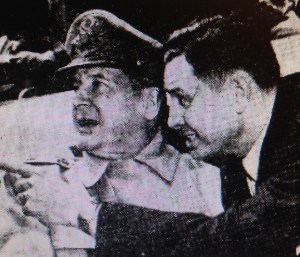
General MacArthur and Mayor Remmel

General MacArthur and Mayor Remmel

On Sunday, March 23, 1952, General Douglas MacArthur made his only post-infancy visit to Little Rock. He had previously been scheduled to visit Mississippi, and Little Rock Mayor Pratt Remmel had persuaded him to add a visit to Little Rock to the agenda. The fact that Little Rock now had a Republican mayor had apparently piqued the General’s interest.

General MacArthur, accompanied by his wife and son as well as several journalists and members of his military retinue, arrived at Little Rock Airport at 10:40 am. He was met by a delegation of civic leaders including Mayor Remmel. Alderman James Griffey made welcoming remarks on behalf of the city. Then the General and Mayor boarded an open car and led a motorcade from the airport to downtown.

The motorcade’s destination was Christ Episcopal Church at Capitol and Scott streets. It was at this church that MacArthur had been baptized as an infant. The delegation was greeted by the Episcopal Bishop R. Bland Mitchell, Rector J. Hodge Alves, and Rector Emeritus W. P. Witsell. (While he had been Rector, Dr. Witsell had garnered national attention by issuing an Easter blessing to Gen. MacArthur as he had been evacuating the Philippines at the height of World War II.) In order to gain admittance to the church that morning, church members and guests had to have tickets.

Following the worship service, the General and his party went to three events in the park named in his honor. The first was a tour of the Museum of Natural History (now the Museum of Discovery and located in the River Market; the current tenant of the building is the MacArthur Museum of Arkansas Military History), which was located in the building in which the General had been born. After the tour, he spoke at a dedication of a small rose garden adjacent to the museum. It was sponsored by the Little Rock City Beautiful Commission and the Garden Clubs of Greater Little Rock.

Though every stop of the General’s visit had featured crowds, the largest was at the third location in MacArthur Park. A crowd of several thousand greeted the General as he spoke from the Foster Bandshell in the park’s southwest corner. Chamber of Commerce president Richard C. Butler (brother-in-law of Mayor Remmel) was the master of ceremonies. Following an invocation by Methodist Bishop Paul Martin, the only other speaker was the General. In his remarks he spoke of his Southern heritage and of his appreciation for the support of the citizens of Little Rock over the years.

Several gifts were bestowed upon the MacArthurs at the ceremony. The City of Little Rock presented Mrs. MacArthur with an engraved silver serving tray.

Following the events in MacArthur Park, the family retired for a brief respite to the Hotel Marion. They then attended a luncheon buffet in their honor at the home of Howard and Elsie Stebbins on Edgehill Road. The General and Mrs. MacArthur circulated through the house greeting guests and then eschewed a special table in favor of balancing their plates on their laps and sitting in wingback chairs. Meanwhile Arthur MacArthur stayed upstairs and discussed stamp collecting and other hobbies with the Stebbins’ two teenage sons.

Following the luncheon, the MacArthur party went back to the airport and by 4:00pm, the plane was in the air.

Though this visit was coming at the end of a whirlwind of activities, by all accounts, the General and Mrs. MacArthur were very gracious and accommodating. The General was being mentioned as a potential GOP candidate for President, but purposefully steered clear of any political comments in his remarks. He and Mrs. MacArthur dutifully posed for photos not only for the media but also for amateur photographers. At lunch, the General even asked a Gazettephotographer to take a photo of him with his Little Rock Police motorcycle escorts so that they could have a souvenir of the visit.