Dinosaurs Abound at Clinton Center now through October

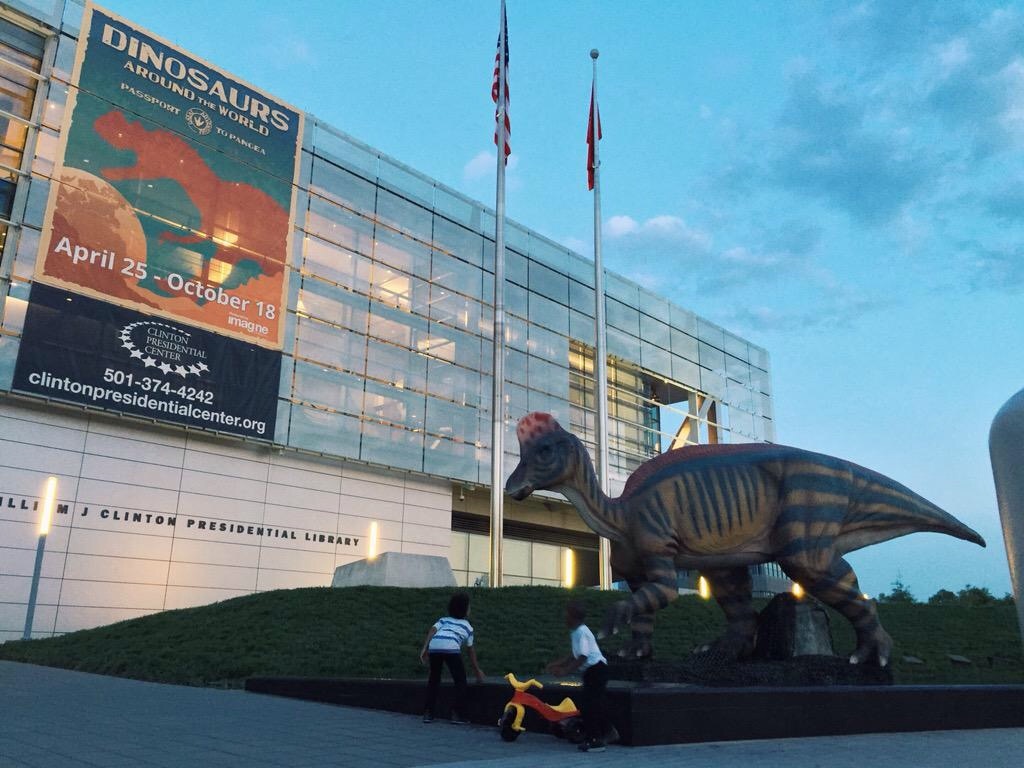
Clinton Dinos

Photo by the Clinton Presidential Center

The Clinton Presidential Center presents Dinosaurs Around the World through October 18.

Dinosaurs Around the World takes you back in time on a dinosaur adventure and a tour of an Earth very different from today – a time before the continents as we know them existed, when lush landscapes covered Africa and greenery was the norm in Antarctica! With 13 life-sized animatronics, a multi-layered narrative, fossils, authentic casts, cutting-edge research and immersive design elements, you’ll experience the Age of Reptiles as it comes to life!
Dinosaurs Around the World invites you to grab your prehistoric passport to Pangea and discover how continental splits driven by plate tectonics, land bridges revealed after sea level fluctuations, and new landforms created by volcanic activity allowed dinosaurs to disperse to all corners of the globe. These left each of the seven continents with its own unique selection of these giant reptiles. During their 172 million year reign, dinosaurs adapted into a variety of forms including enormous long-necked herbivores, the mighty T. rex, and more.
“We are thrilled to host the global premiere of Dinosaurs Around the World and look forward to sharing this interactive and scientific exhibit with our visitors,” said Stephanie S. Streett, executive director of the Clinton Foundation. “Our summer exhibits are highly anticipated by the community because they are specifically designed to appeal to the entire family.”
In addition to advanced animatronics, Dinosaurs Around the World also features information about the geologic time scale, geology, geography, and climatology. The exhibition questions how the dinosaurs lived on each continent, how they interacted with each other, how geography impacted their behavior and diets, and what the continents were really like at the time.
The exhibit also features an area that chronicles the accomplishments of four U.S. Presidents who worked to preserve the fossil-rich areas in North America where dinosaurs once roamed. Exhibit artifacts include items from the administrations of Presidents Bill Clinton, Dwight D. Eisenhower, Franklin D. Roosevelt, and Harry S. Truman. This display includes a dinosaur skull replica on loan from the Grand Staircase-Escalante National Monument, an area that President Clinton designated as a national monument in 1996.
Dr. Gregory M. Erickson, a world-renowned dinosaur paleontologist, is the Senior Scientific Advisor for Dinosaurs Around the World. Dr. Erickson received his Bachelor of Science degree from the University of Washington, a Master’s degree from Montana State University, and a Ph. D. in Integrative Biology from the University of California, Berkeley and conducted post-doctoral research at Stanford University and Brown University before joining the faculty at Florida State University in Tallahassee. Dr. Erickson is currently the curator for the Florida State University Museum and holds research appointments with the American Museum of Natural History in New York, The Field Museum in Chicago, and University of Alaska’s Museum of the North in Fairbanks. Dr. Erickson is working with Imagine Exhibitions as an advisor, writer, and editor of the paleontology copy for the Company’s Dinosaurs Around the World exhibition.
Dinosaurs Around the World is open daily to the public from 9 a.m. to 5 p.m., Monday through Saturday, and 1 to 5 p.m. on Sunday, through October 18, 2015. Tickets are available to purchase at the Clinton Center.
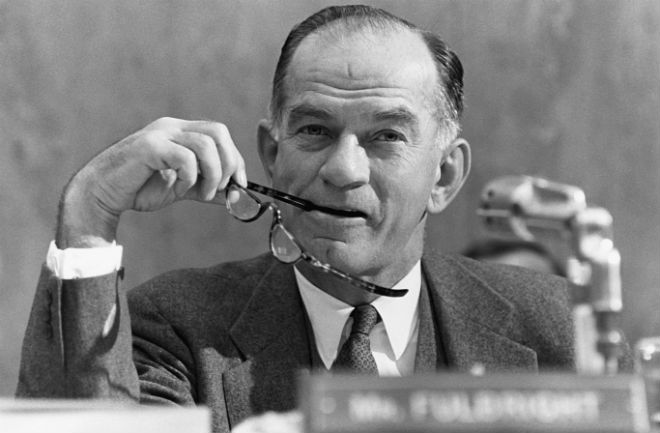
J. William Fulbright’s domestic, international politics is focus of Old State House Brown Bag Lunch Lecture today

Today at noon at the Old State House Museum, the next installment of their regular “Brown Bag Lunch Lecture” will take place.  

This edition features Micah Roberts discussing “Fulbright’s Balancing Act: How Domestic and International Politics Converged in 1959.”

Senator J. William Fulbright’s 1959 “Face the Nation” interview is used to assess how the Arkansas senator prioritized the Civil Rights agenda in Arkansas with his ambitions as a Cold War statesman. Response letters from Arkansans following the interview and also used to assess the importance of domestic vs. international politics for Arkansans.

Micah Roberts is a graduate student at the University of Arkansas where he studies United States foreign relations and politics during the Cold War, with special attention devoted to the Eisenhower-Khrushchev relationship and their use of personal and public diplomacy.

The Old State House is an agency of the Department of Arkansas Heritage.


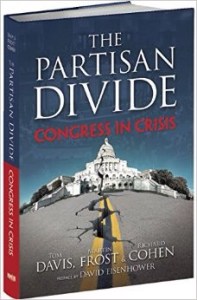
“The Partisan Divide: Congress in Crisis” with Reps. Martin Frost & Tom Davis today at the Clinton School at noon


Today at noon at the Clinton School, former Congressmen Martin Frost and Tom Davis will discuss their book The Partisan Divide: Congress on Crisis.

While the authors, Martin Frost and Tom Davis, share many common viewpoints, they come from opposite sides of the political spectrum. 

Tom Davis served in Congress from 1994 to 2008 representing Virginia’s 11th district. During that time, he chaired the National Republican Congressional Committee for two cycles (2000 and 2002), and was chairman of the House Committee on Government Reform and Oversight before retiring, as he likes to say, “undefeated and unindicted” in 2008. 

Martin Frost represented the Dallas–Ft. Worth area of North Texas in Congress for 26 years, serving four years as chairman of the Democratic Congressional Campaign Committee and four years as chair of the House Democratic Caucus. 

According to Frost and Davis, Congress is incapable of reforming itself without a good kick in the seat from the American public. They dissect the causes of legislative gridlock and offer a common sense, bipartisan plan for making our Congress function again. 

The preface by Pulitzer Prize finalist David Eisenhower, grandson of President Dwight D. Eisenhower, sets the stage for this powerful behind-the-scenes narrative that uncovers the road to the present political gridlock and then offers thought-provoking insights and possibilities for the way out.

Little Rock Look Back: General Douglas MacArthur

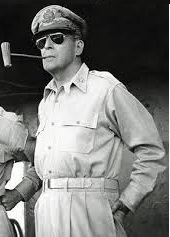
MacArthurOn January 26, 1880, Douglas MacArthur was born in the Arsenal Building while his father was stationed at the Little Rock Barracks.  Though he left Arkansas a few weeks later when his father was transferred, he returned to his birthplace on March 23, 1952. On that day he was greeted by crowds welcoming one of the USA’s most famous military figures.

Though Gen. MacArthur spent only a few weeks in Little Rock, he was baptized at Christ Episcopal Church.  The location of the baptism remains a mystery today because the church was meeting in temporary locations due to the first structure having been lost to a fire.

When the General returned to Little Rock in 1952, he did pay a brief visit to Christ Church.  He also spoke at the Foster Bandshell in the park which bore his name.  He was one of three presidential candidates to speak at the Foster Bandshell in 1952, the others were the eventual Democratic and Republican nominees Adlai Stevenson and Dwight Eisenhower.

When General MacArthur died, he was granted a state funeral.  He was one of the few non-Presidents to have been given this honor.

Today, the MacArthur Museum of Arkansas Military History is located in the Arsenal building.  It was created to interpret our state’s military heritage from its territorial period to the present.  Located in the historic Tower Building of the Little Rock Arsenal–the birthplace of General Douglas MacArthur–the museum preserves the contributions of Arkansas men and women who served in the armed forces.  Exhibits feature artifacts, photographs, weapons, documents, uniforms and other military items that vividly portray Arkansas’s military history at home and abroad.

Susan Eisenhower discusses energy policy at the Clinton School this evening

SE-forwebIn 1952, General Dwight Eisenhower visited Little Rock while campaigning for the presidency.  Tonight, one of his grandchildren visits Little Rock on a different type of campaign.  Susan Eisenhower will be speaking at the Clinton School discussing “Energy Infrastructure and Energy Security.”

Susan Eisenhower is the CEO and Chairman of The Eisenhower Group, Inc., a Washington D.C.-based consulting company that provides strategic counsel on business development, public affairs, and communications for Fortune 500 companies around the world.

She currently serves on MIT’s Energy Initiative Advisory Board, as the co-chair of the Department of Energy’s Nuclear Energy Advisory Board and is on the steering committee of the Energy Future Coalition and its Americans for Clean Energy Grid. The granddaughter of President Dwight Eisenhower, Susan has extensive knowledge of the energy industry and is a frequent speaker and author on public policy matters related to energy and national security.

This is a return visit to Little Rock for Ms. Eisenhower. In 2007, she was present for the activities commemorating the 50th anniversary of the desegregation of Little Rock Central High School.

Little Rock Look Back: Orval Eugene Faubus

FaubusOrval_fOn January 7, 1910, one of the most controversial figures in Arkansas history was born: future Governor Orval Eugene Faubus.

Faubus is today remembered for his role fighting for the continued segregation of the Little Rock public schools.  Raised in a socialist family, his staunch embrace of segregation was a surprise to many who viewed him as more of a moderate on the issue.  At the time, and later, it was viewed as more of an opportunistic move to head off a political challenge from segregationists such as Jim Johnson.  However, throughout the rest of his lifetime, as others such as George Wallace would recant and repent, Faubus continued to maintain he was “merely” upholding the law of the land (the Supreme Court striking down the law a few years earlier, notwithstanding).

Interestingly, Faubus was also known for hiring African Americans in state government for more than menial tasks. He worked to increase funding to historically black colleges and universities in Arkansas. He fought to abolish the predatory poll tax.

His segregation efforts curtailed Arkansas’ business recruitment for a few years in the late 50s and early 60s.  But a few years earlier, in 1955 Faubus had created the Arkansas Industrial Development Commission and appointed Winthrop Rockefeller to lead it.  He also increased teacher pay, overhauled the State Hospital, created the Arkansas Children’s Colony, expanded state parks, and stopped the Army Corps of Engineers from damming the Buffalo River.

In late 1965, by executive order, he created the Arkansas Arts and Humanities Council and funded it with his discretionary funds until the legislature would appropriate money in 1967. He also oversaw the creation of the state’s historic preservation program.

Certainly his efforts to flout federal law have tarnished his image. Looking at his accomplishments in the areas of industry, education reform and culture – one wonders what he could have accomplished if he had exerted even more efforts in those areas instead of fighting Eisenhower.  It is all moot, because he did not.  And the reality is that, yes had he supported Eisenhower, he might well have lost in 1958 to someone like Jim Johnson who would have continued fighting for segregation even more vehemently and would have been unlikely to champion these other issues.

Little Rock Look Back: Woodrow Mann, LR’s 53rd Mayor

IMG_3231Future Little Rock Mayor Woodrow Wilson Mann was born on November 13, 1916, in Little Rock.

In 1955, he ran as the Democratic nominee for Mayor of Little Rock and defeated two term incumbent Pratt C. Remmel, a Republican.  He took office in January 1956 and immediately set about to make a lot of changes.  In addition to revitalizing the City’s bus system, and removing some color barriers at City Hall, he oversaw the dismantling of the copper dome on top of Little Rock City Hall (as opposed to the repair of the dome championed by Mayor Remmel).

Mayor Mann was caught up in a grand jury investigation into purchasing practices at City Hall as well as within the City government in North Little Rock.  Partially in response to this, Little Rock voters approved a new form of government in late 1956.  Mayor Mann opposed the switch to the City Manager form and refused to set the election for the new officials but was ultimately compelled to do so.

He was also Mayor during the 1957 integration of Little Rock Central High School.  He sought to keep the peace and to broker a deal between President Dwight Eisenhower and Governor Orval Faubus.  His powers within the city were, no doubt, hampered because of his lame duck status as Mayor.  In November 1957 following the election of the new City Board of Directors, he chaired his last City Council meeting and left office.

In January of 1958, a series of articles written by Mayor Mann detailed his perspective on the events at Central High. These were carried by newspapers throughout the US.

Because of ill will toward him due to the Central High crisis and grand jury investigation, Mayor Mann felt it would be difficult to maintain his insurance business in Little Rock. He moved to Texas in 1959 and remained there the rest of his life.  He died in Houston on August 6, 2002.