
Black History Month – Florence Price and Robinson Center

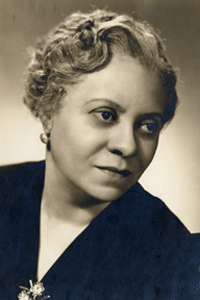
Florence-PriceOutside the William Grant Still Ballroom at Robinson Center is an atrium named for Florence Price.  It is fitting that these two childhood friends should be memorialized in adjoining spaces.

Florence Price was the first African-American female composer to have a symphonic composition performed by a major American symphony orchestra. She was born in Little Rock on April 9, 1887, to James H. Smith and Florence Gulliver Smith. Her father was a dentist in Little Rock, while her mother taught piano and worked as a schoolteacher and a businesswoman.

As a child, Smith received musical instruction from her mother, and she published musical pieces while in high school. She attended Capitol Hill School in Little Rock, graduating as valedictorian in 1903. Smith then studied at the New England Conservatory of Music in Boston, Massachusetts, In 1907, she received degrees as an organist and as a piano teacher.

After graduation, Smith returned to Arkansas to teach music. After stints in Cotton Plant, North Little Rock and Atlanta, GA, Smith returned to Little Rock in 1912 to marry attorney Thomas Jewell Price on September 25, 1912. Her husband worked with Scipio Jones.

While in Little Rock, Price established a music studio, taught piano lessons, and wrote short pieces for piano. Despite her credentials, she was denied membership into the Arkansas State Music Teachers Association because of her race.

The Prices moved to Chicago, Illinois, in 1927. There, Price seemed to have more professional opportunity for growth despite the breakdown and eventual dissolution of her marriage. She pursued further musical studies at the American Conservatory of Music and Chicago Musical College and established herself in the Chicago area as a teacher, pianist, and organist. In 1928, G. Schirmer, a major publishing firm, accepted for publication Price’s “At the Cotton Gin.” In 1932, Price won multiple awards in competitions sponsored by the Rodman Wanamaker Foundation for her Piano Sonata in E Minor, a large-scale work in four movements, and her more important work, Symphony in E Minor.

The latter work premiered with the Chicago Symphony Orchestra on June 15, 1933, and the orchestras of Detroit, Michigan; Pittsburgh, Pennsylvania; and Brooklyn, New York, performed subsequent symphonic works by Price. This was the first time a black woman had presented her work on such a stage. In this regard,

Price’s art songs and spiritual arrangements were frequently performed by well-known artists of the day. For example, contralto Marian Anderson featured Price’s spiritual arrangement “My Soul’s Been Anchored in the Lord” in her famous performance on the steps of the Lincoln Memorial in Washington DC on Easter Sunday, April 9, 1939. European orchestras later played Price’s works.

This national and international recognition made her more popular back home, and in 1935, the Alumni Association of Philander Smith College in Little Rock sponsored Price’s return to Arkansas, billing her as “noted musician of Chicago” and presenting her in a concert of her own compositions at Dunbar High School.

In her lifetime, Price composed more than 300 works, ranging from small teaching pieces for piano to large-scale compositions such as symphonies and concertos, as well as instrumental chamber music, vocal compositions, and music for radio. Price died in Chicago on June 3, 1953, while planning a trip to Europe.


RobinsoNovember: Florence Price

Florence-PriceOutside the William Grant Still Ballroom at Robinson Center is an atrium named for Florence Price.  It is fitting that these two childhood friends should be memorialized in adjoining spaces.

Florence Price was the first African-American female composer to have a symphonic composition performed by a major American symphony orchestra. She was born in Little Rock on April 9, 1887, to James H. Smith and Florence Gulliver Smith. Her father was a dentist in Little Rock, while her mother taught piano and worked as a schoolteacher and a businesswoman.

As a child, Smith received musical instruction from her mother, and she published musical pieces while in high school. She attended Capitol Hill School in Little Rock, graduating as valedictorian in 1903. Smith then studied at the New England Conservatory of Music in Boston, Massachusetts, In 1907, she received degrees as an organist and as a piano teacher.

After graduation, Smith returned to Arkansas to teach music. After stints in Cotton Plant, North Little Rock and Atlanta, GA, Smith returned to Little Rock in 1912 to marry attorney Thomas Jewell Price on September 25, 1912. Her husband worked with Scipio Jones.

While in Little Rock, Price established a music studio, taught piano lessons, and wrote short pieces for piano. Despite her credentials, she was denied membership into the Arkansas State Music Teachers Association because of her race.

The Prices moved to Chicago, Illinois, in 1927. There, Price seemed to have more professional opportunity for growth despite the breakdown and eventual dissolution of her marriage. She pursued further musical studies at the American Conservatory of Music and Chicago Musical College and established herself in the Chicago area as a teacher, pianist, and organist. In 1928, G. Schirmer, a major publishing firm, accepted for publication Price’s “At the Cotton Gin.” In 1932, Price won multiple awards in competitions sponsored by the Rodman Wanamaker Foundation for her Piano Sonata in E Minor, a large-scale work in four movements, and her more important work, Symphony in E Minor.

The latter work premiered with the Chicago Symphony Orchestra on June 15, 1933, and the orchestras of Detroit, Michigan; Pittsburgh, Pennsylvania; and Brooklyn, New York, performed subsequent symphonic works by Price. This was the first time a black woman had presented her work on such a stage. In this regard,

Price’s art songs and spiritual arrangements were frequently performed by well-known artists of the day. For example, contralto Marian Anderson featured Price’s spiritual arrangement “My Soul’s Been Anchored in the Lord” in her famous performance on the steps of the Lincoln Memorial in Washington DC on Easter Sunday, April 9, 1939. European orchestras later played Price’s works.

This national and international recognition made her more popular back home, and in 1935, the Alumni Association of Philander Smith College in Little Rock sponsored Price’s return to Arkansas, billing her as “noted musician of Chicago” and presenting her in a concert of her own compositions at Dunbar High School.

In her lifetime, Price composed more than 300 works, ranging from small teaching pieces for piano to large-scale compositions such as symphonies and concertos, as well as instrumental chamber music, vocal compositions, and music for radio. Price died in Chicago on June 3, 1953, while planning a trip to Europe.

Tonight at 7, Arkansas Sounds salutes composers Florence Price and William Grant Still at Ron Robinson Theater

AR Sounds price_stillTwo of the leading American classical music composers in the first half of the 20th Century were from Arkansas and were African American.  Tonight (February 26) Arkansas Sounds pays tribute to Florence B. Price and William Grant Still in a program at 7pm at the Ron Robinson Theater.

Arkansas Sounds pays tribute to two of Arkansas’s most highly acclaimed African American classical composers with a screening of The Caged Bird: The Life and Music of Florence B. Price followed by performances of Price’s and Still’s compositions by members of the Arkansas Symphony Orchestra (ASO) and the ASO Youth Orchestra. The film’s length is approximately 1 hour.

Little Rock native Florence Price (1887-1953) was the first African American female classical composer to have her composition played by a major American symphony orchestra. The Caged Bird: The Life and Music of Florence B. Price traces Price’s life, detailing her cultured childhood in an extraordinarily gifted family, her struggles and eventual departure from the South due to racial tension, and her great artistic impact and success. Her compositions were favored by famed soprano Marian Anderson, and in 1933, her “Symphony in E Minor” was performed at the Chicago World’s Fair by the Chicago Symphony.

Born in Woodville, Mississippi, and raised in Little Rock, William Grant Still (1895-1978) achieved national and international acclaim as a composer of symphonic and popular music and, as an African American, was hailed for breaking race barriers of his time. His Afro-American Symphony was the first symphony composed by an African American to be played by a major symphony orchestra and is still performed today. Still was a prolific composer whose work includes symphonies, ballets, operas, chamber music, and works for solo instruments, totaling nearly 200. He also received numerous honors and achievements such as the Guggenheim Fellowship in 1934, 1935, and 1938. He also received eight honorary degrees from institutions such as Oberlin College, the University of Arkansas, Pepperdine University, and the Peabody Conservatory of Music.

The Arkansas Symphony Orchestra (ASO) comprises the state’s most sought-after professional musicians and is celebrating its 50th season. The ASO Youth Orchestra comprises over 200 student musicians, ages 9-18, who travel from over thirty-seven communities throughout Arkansas.

Black History Month Spotlight – Arkansas Studies Institute

ASI CALS UALRThe new Arkansas Civil Rights History Audio Tour was launched in November 2015. Produced by the City of Little Rock and the University of Arkansas at Little Rock allows the many places and stories of the City’s Civil Rights history to come to life an interactive tour.  This month, during Black History Month, the Culture Vulture looks at some of the stops on this tour which focus on African American history.

The Arkansas Studies Institute building is a Central Arkansas Library System (CALS) facility. It houses both the Butler Center for Arkansas Studies (a CALS department) and the Center for Arkansas History and Culture, a department of the University of Arkansas at Little Rock (UALR).

Exterior and interior panels are featured showing Arkansas African American life through historic photographs. Both archives offer genealogy and photography collections, and visual, audio and reference materials relating to African American history and civil rights topics in Arkansas. The Encyclopedia of Arkansas History and Culture, a Butler Center project, has many entries on African American history.

The Arkansas Sounds music collection contains materials relating to black musicians William Grant Still, Florence Price, Louis Jordan, Sister Rosetta Tharpe, and Al Bell. The Butler Center’s galleries feature local art, jewelry and crafts, many by Arkansas black artists.

The UALR Center for Arkansas History and Culture contains extensive archives, including virtual exhibits relating to the Civil War, Gov. Winthrop Rockefeller, and the city of Little Rock. Adding another dimension to the struggle for civil rights are documents and art from the World War II Japanese American Relocation Camps at Rohwer and Jerome, Arkansas, and two large Jewish history collections.

The app, funded by a generous grant from the Arkansas Humanities Council, was a collaboration among UALR’s Institute on Race and Ethnicity, the City of Little Rock, the Mayor’s Tourism Commission, and KUAR, UALR’s public radio station, with assistance from the Little Rock Convention and Visitors Bureau.

Pianist to celebrate classic and contemporary in UALR recital Feb. 5

University of Arkansas at Little Rock professor Linda Holzer will perform a piano recital, “Ear-Opener! A Celebration of the Known and the New,” at 7:30 p.m Friday, Feb. 5, in Stella Boyle Smith Concert Hall.

Admission is free and open to the public.

Holzer enjoys presenting concerts that combine familiar repertoire with works that “deserve to be heard more often.”

Accompanied by baritone Ferris Allen, Holzer will open the concert with the premiere of a poignant new work, “Prayers and Blessings,” by composer Gwyneth Walker.

It is a setting of three texts: “Ubi Caritas,” “Lord Make Me an Instrument of Your Peace,” and “Gaelic Blessing.”

“We think this piece is a musical antidote for a turbulent world,” said Holzer.

The remainder of the program will feature solos by Holzer including the majestic piano Sonata in E Minor by celebrated composer and Little Rock native, Florence Price.

She will also perform selections by Scarlatti, Mozart, and Bach.

Holzer, a UALR faculty member since 1995, is an active soloist and chamber musician who has played in 30 states, and most recently, abroad in Melbourne, Australia. She was a featured performer at the Australasian Piano Pedagogy Conference held at the Victoria College of the Arts. An advocate for contemporary music, Holzer was featured in performance and as host on a special KLRE broadcast last summer, “A Celebration of American Music.”

For more information, contact the Music Department at 501.569.3294.

Documentary on LR native Florence Price screened tonight at Mosaic Templars

Florence-PriceTonight at 6 p.m. Mosaic Templars Cultural Center will play host to the premiere of the new documentary, The Caged Bird. Produced, written and edited by Dr. James Greeson, professor emeritus of music composition at the University of Arkansas in Fayetteville, The Caged Bird presents an in-depth look at the life and music of Florence Price, the first African American woman to have her music performed by a major symphony.

Born in Little Rock in 1887, Price and her family were the elite of black society or as historian Willard Gatewood referred to them, “Aristocrats of Color.” Through her travels, Price came into contact with some of the most influential African Americans in our nation’s history, including abolitionist Frederick Douglass, writer W.E.B. DuBois,one of the founders of the NAACP, author Langston Hughes and dancer Katherine Dunham. Price became a favorite composer of the great soprano Marian Anderson, whose 1939 concert on the steps of the Lincoln Memorial was a seminal moment in the civil rights movement.

In 1933, the world-famous Chicago Symphony, consisting entirely of white men, premiered Price’s “Symphony in E minor” at the Chicago World’s Fair. Even today this would be a huge achievement for any composer; but during the era of segregation it was a unprecedented feat for a women, in particular an African American woman, to have her music presented on the world stage by a prestigious orchestra. The screening will be followed by a Q&A with Dr. Greeson.

The Caged Bird is free and open to the public.

Mosaic Templars Cultural Center is a program of the Department of Arkansas Heritage.