Historian Dr. John Kirk is new director of UALR Institute on Race and Ethnicity

JohnKirk_history1aDr. John A. Kirk has been named the new director of the University of Arkansas at Little Rock’s Institute on Race and Ethnicity.  A native of Great Britain, he has garnered international acclaim for his research and writings on race and the civil rights movement — with a particular focus on Little Rock.

Kirk has been a member of the Chancellor’s Committee on Race and Ethnicity since he arrived at the university more than five years ago and has been involved with the institute since its inception about four years ago.

“I have a deep personal and professional commitment to the pursuit of racial and ethnic justice, and I think that should be the primary reason anyone takes on the job of director of UALR’s Institute on Race and Ethnicity — it is at the very heart of what the institute does,” Kirk said.

Kirk plans to connect with and engage as many students, faculty, and community members as possible in achieving the goals of the institute, which include:

  • Raising awareness of race and ethnicity issues
  • Providing research-based information and policy recommendations
  • Building bridges and seeking reconciliation through interracial and interethnic dialogue
  • Engaging students
  • Serving as a clearinghouse for on- and off-campus initiatives related to race and ethnicity
  • Holding UALR accountable for becoming a more diverse and multi-ethnic community.

For the past 25 years, Kirk has researched and written about issues of race and ethnicity in the United States, especially in Little Rock and Arkansas. He’s the author of numerous books, including “Race and Ethnicity in Arkansas: New Perspectives,” “Martin Luther King, Jr. and the Civil Rights Movement,” and “Beyond Little Rock: The Origins and Legacies of the Central High Crisis.” He also recently partnered with the BBC on its Martin Luther King Jr. web display that serves as an information resource for an international audience.

In announcing Kirk’s appointment, UALR Chancellor Joel E. Anderson noted the professor’s knowledge and passion for civil rights-related topics were ideal fits for the institute’s leadership role.

“It is a rare opportunity to work with someone who grew up in Great Britain but whose knowledge of Arkansas civil rights history is probably greater than anyone else’s in Arkansas or the United States,” Anderson said.  “Dr. John Kirk is a well-known resource in our community for his expertise on the many ways race has shaped our city and state. I am confident that under his leadership the UALR Institute on Race and Ethnicity will continue to grow in influence and will help shape a better future for the people of Arkansas.”

Kirk replaces Dr. Michael R. Twyman, who resigned in July to take a position at the Indiana Black Expo organization.

With Kirk’s new director responsibilities, he will remain the Donaghey Distinguished Professor of History  but no longer will serve as the UALR History Department chair.

“I am excited by the challenges and opportunities that the director’s job brings with it,” Kirk said. “I particularly look forward to getting to know more about and working with students, faculty, and community members who are learning, teaching, researching and serving on issues of race and ethnicity.”

Integration of Little Rock’s Junior Highs topic of panel today

Seven students who desegregated Little Rock’s junior high schools will discuss their experiences for the first time from 9 a.m. to noon Saturday, Feb. 21, at the Little Rock Central High School National Historic Site.

Laverne before and after

Dr. LaVerne Bell-Tolliver, first African American to attend Forest Heights Middle School in 1961 and currently an assistant professor in the UALR School of Social Work.

During the event, titled ”Phase II: The Desegregation of Little Rock Public Schools,” the former students will discuss their roles in the desegregation process in the early 1960s.  Between 1961 and 1962, 25 black students enrolled at junior high schools throughout Little Rock that had previously been closed to them.

Dr. LaVerne Bell-Tolliver, Judge Kathleen Bell, Henry Rodgers, Wilbunette Walls Randolph, Glenda Wilson, Dr. Kenneth Jones, and Judge Joyce Williams Warren will participate in the panel discussion to share their stories.  For many of them, this will be the first time they will discuss their experiences publicly.

The panel will be moderated by Rhonda Stewart, local history and genealogy expert at The Butler Center for Arkansas Studies.  Dr. John A. Kirk, George W. Donaghey Distinguished Professor of History and chair of the UALR Department of History, will provide an overview of the history of school desegregation in the area including the landmark Brown vs Board of Education decision and 1958, a so-called “lost year” when all schools in the district were closed in order to block integration.

In addition to the presentations and discussions, copies of historic documents and artifacts from the era will be on display for public viewing.

The program in sponsored in part by the Little Rock Central High School National Historic Site Visitors’ Center, the Central Arkansas Chapter of the National Association of Black Social Workers, and a grant from the Arkansas Humanities Council’s African American Heritage Fund.

“Racial Redistricting in Little Rock, Arkansas” is the focus of tonight’s UALR Evenings with History

Slum-AreaswebTonight Dr. John Kirk and Dr. Jess Porter discuss racial separation in Little Rock’s history as part of the 2014-2015 UALR Evening’s with History series.

This year marks the 24th year for the History Institutes’ Evenings with History.  This nationally recognized series has featured a variety of subjects.  The sessions take place at the Ottenheimer Auditorium of Historic Arkansas Museum. Refreshments are served at 7 with the program beginning at 7:30 pm. The cost is $50 for admission to all six programs.

The contemporary urban landscape of Little Rock evokes questions of racial separation because of the persistently high rates of ethnic separation in housing and a public-private race cleavage in the local schools. How can these patterns be explained? Has it always been this way? Is the 1957 desegregation crisis at Central High School a reason for the persistent patterns of geographic separation between African Americans and whites within the city?

In fact, the story of ethnic separation in Little Rock begins prior to the Central High Crisis. This talk begins with an examination of spatial patterns of racial segregation in the first half of the 20th century. It then discusses these patterns as they evolved in Little Rock and shows, in particular, the role of urban renewal in the mid-century decades in producing the separation of races that came into existence.

John A. Kirk joined the department as Chair and Donaghey Professor of History in 2010. He was born in Rochdale, Lancashire, in the United Kingdom, and holds an undergraduate degree in American Studies from the University of Nottingham and a PhD in American History from the University of Newcastle upon Tyne. Dr. Kirk taught at the University of Wales, Lampeter (1994-99) and Royal Holloway, University of London (1999-2010) before coming to UALR.

Dr. Kirk’s research focuses on the history of the civil rights movement in the United States, the South, and Arkansas, and the history of post-New Deal southern politics, society and culture. He has published five books and written in a wide variety of journals, edited book collections, and popular history magazines including BBC History, History Today and Historically Speaking. He has won a number of awards for his research including the F. Hampton Roy Award (1993) from the Pulaski County Historical Association, and the Walter L. Brown Award (1994), the J. G. Ragsdale Book Award (2003), and the Lucille Westbrook Award (2005) from the Arkansas Historical Association.

Jess Porter came to UALR in 2009 and holds a PhD from Oklahoma State University where he was awarded with the Susan Shaull Medal for Excellence in Teaching Geography. Prior to UALR, Dr. Porter taught at Oklahoma State University, developed and implemented geospatial curriculum for rural schools, worked as an environmental analyst and mapping specialist in the oil and gas industry, and was employed by an adventure tourism company in Colorado.

Dr. Porter’s research interests include the American Dust Bowl, geospatial technology education, and urban geography. His research on the Dust Bowl was featured in an episode of The Weather Channel’s When Weather Changed History. He has published four, interactive textbooks in the Encounter Geography series.

Friday, Eldredge, & Clark and the Union Pacific Railroad help make these lectures possible. Other sponsors are the Ottenheimer Library, University of Arkansas at Little Rock; Historic Arkansas Museum, a museum of the Department of Arkansas Heritage; UALR Public Radio—KUAR-KLRE; UALR public television; and Grapevine Spirits.

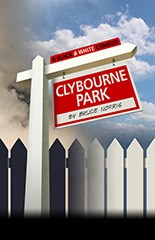
Ark Rep production of prize winning CLYBOURNE PARK focus at Clinton School today

ClybourneThe Arkansas Repertory Theatre works in partnership with the Clinton School of Public Service to participate in the UACS’s Distinguished Speaker Series, hosting educational panel discussions on various Rep productions. The latest in these takes place today, Thursday, January 23 at 12 noon at Sturgis Hall in Clinton Presidential Park.

Arkansas Repertory Theatre producing artistic director, Bob Hupp, will host a panel discussion on the upcoming production of Bruce Norris’ Clybourne Park, winner of the 2011 Pulitzer Prize and 2012 Tony Award for Best Play.

Clybourne Park is a bitingly funny and fiercely provocative new play about the volatile combination of race and real estate. In 1959, a white couple sells their home to a black family, causing uproar in their middle-class neighborhood. Fifty years later in 2009, the same house is changing hands again and neighbors wage battle over territory and legacy revealing how far our ideas about race and gentrification have evolved.

Panelists director Cliff Fannin Baker, Jess Porter and John Kirk from the UALR History Department, along with Bob Hupp, will discuss how Clybourne Park relates to issues of race, real estate, history, and legacy in our own community.

Clybourne Park opens tomorrow night (with previews last night and tonight). It runs through Sunday, February 9. Wednesday, Thursday and Sunday evening performances are at 7 p.m., Friday, Saturday evening performances are at 8 p.m. Sunday Matinees performances are at 2 p.m.

clinton-school-logo

Arts & Humanities Month: UALR History Department’s Evenings with History

This year marks the 21st year for the History Institutes’ Evenings with History.  This nationally recognized series has featured a variety of subject.  This year, the first three evenings comprise a mini-series focused on African-Americans in Arkansas.  The other evenings will take listeners around the world in geography and chronology. The sessions take place at the Ottenheimer Auditorium of Historic Arkansas Museum. Refreshments are served at 7 with the program beginning at 7:30 pm. The cost is $50 for admission to all six programs.

Tonight’s program features Carl Moneyhon speaking on “Freedom: Black Arkansans and the End of Slavery”

On November 1, Story Matkin-Rawn of the UCA History Department will present a program entitled “From Land Ownership to Legal Defense: The World War I Watershed in Black Arkansan Organizing”

John Kirk presents December’s program on the 6th: “A Movement is more than a Moment: Arkansas and the African American Civil Rights struggle since 1940”

The Evenings in History return on February 7 with Jeff Kyong-McClain’s “The Heavenly History of the Han, or How a Liberal Baptist from Green Forest, Arkansas Taught Racial and Ethnic Nationalism to the Chinese”

On March 6, Charles Romney will address “A Brief History of Human Rights”

The 2011-2012 sessions will conclude on April 3 with Edward Anson’s “Counter-Insurgency: The Lessons of Alexander the Great”

The corporate sponsors for the 2011-2012 season are Delta Trust, Union Pacific Railroad, the Little Rock School District—Teaching American History Program; the law firms of  Friday, Eldredge & Clark and Wright, Lindsey & Jennings. Support and gifts in kind have been provided by the UALR Ottenheimer Library; Historic Arkansas Museum, a museum of the Department of Arkansas Heritage; UALR Public Radio–KLRE-KUAR; and Grapevine Spirits.