Little Rock Look Back: Ike meets with Orval

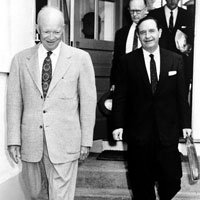
On September 14, 1957, in an attempt to end the stalemate in Arkansas, President Dwight D. Eisenhower met with Arkansas Governor Orval Faubus.  The meeting was brokered by Rep. Brooks Hays, whose district included Little Rock.

The meeting took place in Newport, Rhode Island, where the President was vacationing.  After exchanging pleasantries, the President and Governor adjourned to the Presidents office where they met privately for about twenty minutes.  During that conversation, Faubus proclaimed to the President that he was a law abiding citizen and discussed his own World War II service.  President Eisenhower suggested to Faubus that as a law abiding citizen, he should change the National Guard’s orders so that they protected the Little Rock Nine, not kept them from the building.  He reminded Faubus that the Justice Department was prepared to issue a injunction against him and that the governor would undoubtedly lose in court.

Following their conversation, Congressman Hays and U.S. Attorney General Herbert Brownell Jr.  joined the two in a larger office and continued conversations for approximately another 100 minutes.

When the meeting was over, the President felt like Faubus had agreed to refocus the mission of the National Guard and allow the Little Rock Nine to enter.  The President’s statement to the press thanked Faubus for his cooperation.  Upon returning to Little Rock, Faubus issued his own statement which did not address the President’s statement directly.  He did not even mention the National Guard or the students.

Apparently, President Eisenhower felt betrayed by the Governor’s actions.

The stage was set for these two to continue their face off.

Little Rock Look Back: September 12, 1958–a day of educational chaos in Little Rock

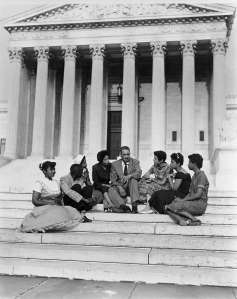
Thurgood Marshall, of the NAACP, sits on the steps of the Supreme Court Building after he filed an appeal in the integration case of Little Rock’s Central High School. (AP Photo, file)

The Court found that “the federal judiciary is supreme in the exposition of the law of the Constitution” and all state officials must adhere to the Court’s decisions and follow the rules laid down in those decisions in similar future cases.

Following the decision, the Little Rock School Board issued a statement that the schools would open as planned on Monday, September 15, 1958.  One of the School Board members, Henry V. Rath, resigned his position on the board that day. He was frustrated that the School Board was caught between federal law and state law.

Later that afternoon, Governor Faubus signed several bills into law which had been passed in a special session. These bills were designed to make it more difficult to integrate public schools.  One of them gave the Governor the authority to temporarily close schools to keep them segregated.  The Governor would then call a special election for the voters in that district to decide whether to remain closed or be opened and integrated. (One of the other laws, which would come in to play later during the school year, laid out the plans for a recall of school board members.)

Shortly after signing the law which gave him the authority to close the schools, Governor Faubus did just that.  He announced that Little Rock’s four public high schools would not open on Monday, September 15.  He set October 7 as the date for the special election about keeping the schools closed.

No one seemed to know what the next steps were.

That night, high school football took place, as previously scheduled.  Central came from behind to defeat West Monroe, Louisiana, by a score of 20 to 14.

Over the weekend, there were many meetings and phone conversations as people were trying to figure out what to do.

One meeting that took place on September 12 was at the home of Mrs. Adolphine Fletcher Terry.  She invited a few friends over to discuss what role the women of the city could play in solving this crisis.  The group decided to meet on the following Tuesday, September 16, at Terry’s house.  It would eventually grow to over 1,300 members and have the name of Women’s Emergency Committee to Open Our Public Schools.

Little Rock Look Back: 1959 Labor Day Bombings

Labor Day Bomb

ARKANSAS GAZETTE photos showing the exterior and interior of the LRSD building after the bomb blast.

A

On September 7, 1959, a peaceful Labor Day in Little Rock was shattered by the explosions of three dynamite bombs.

The locations were Fire Chief Gene Nalley’s driveway on Baseline Road at 10:20pm, Baldwin Company offices at Fourth and Gaines at 10:53pm (where Little Rock Mayor Werner Knoop was a partner–the company is now known as Baldwin Shell), and the School District offices at 10:58pm (then located at Eighth and Louisiana streets).

Given the three targets, it was fairly quickly assumed that there was a connection between the bombings and the lingering effects of the 1957 integration crisis. In light of that, police officers were stationed at the homes of all Little Rock City Directors and School Board members.

The investigation into the bombings turned up a purported fourth location for a bomb. That was the office of Letcher Langford. (Culture Vulture Editorializing Note:  This could have been a ploy to throw investigators off the scent. Langford was the only City Director who had been backed by segregationist candidates and had been openly hostile to the Women’s Emergency Committee — to the point of threatening them with legal action for not disclosing their membership rolls.)

Investigators determined that the bombing had been planned in late August by members of the Ku Klux Klan.  Five individuals were arrested.  They were J. D. Sims, Jesse Raymond Perry, John Taylor Coggins, Samuel Graydon Beavers, and E. A. Lauderdale.  The latter had twice been an unsuccessful candidate for the City Board of Directors.

Sims pleaded guilty and started serving a prison term later in September 1959.  Perry, Coggins and Beavers all went to trial in October and November.  Each was found guilty. Their terms ranged from three to five years.  Lauderdale was convicted, but appealed his decision. Though the Arkansas Supreme Court upheld the verdict against him, he did not start serving his sentence until the court decision in February 1961.

Governor Faubus commuted the sentences of Perry, Coggins and Beavers.  All three served less than six months.  Lauderdale’s sentence was reduced by Faubus so that he, too, was eligible for release after six months.  Sims, who was first to plead, served the longest: nearly two years.

Sadly, this would not be the last bombing in Little Rock tied to 1957. In February 1960, Carlotta Walls’ house was bombed.

Elizabeth Eckford Bench Dedicated Today

Sixty-one years ago today, Elizabeth Eckford took the long walk down Park Street as she was trying to enter Little Rock Central High for her first day of classes there.

Met by a mob and kept out of the school by the soldiers she thought were there to protect her, Eckford finally made her way to a bus bench at Sixteenth and Park Streets.

Today at 4:30 pm, a replica of that bench is being dedicated at that location.

Little Rock Central High School National Historic Site is collaborating with the Central High Memory Project students and additional partners for the ceremony.

September 4, 1957, was supposed to be the first day of school for the African American students who were selected to integrate Little Rock Central High School.  Due to the mobs gathered outside of the school and interference from Governor Orval Faubus, the students would not get in the school that day.

The most famous images from that day are the photos of Elizabeth Eckford walking in front of the school, only to be rebuffed by soldiers and tormented by the crowds. Elizabeth’s decision to walk through the mob of protesting segregationists to enter school, only to be turned away became world news. The story of the desegregation of Central High School was thrust into a defining role within the Civil Rights Movement. Elizabeth’s efforts to overcome the fear and uncertainty that she faced that morning resulted in her seeking refuge at a lonely bus stop bench.

In order to highlight this aspect of the story and create more personal connections with this turning point in history for students and visitors, the National Park Service and the Central High Memory Project Student Team will work with community partners in a new public history project.  The Bench Project includes building a replica of the bus stop bench, creating a mobile app for the students’ audio walking tour of eyewitness accounts of that first day of desegregation, and developing a storycorps recording booth for interviews and student podcasts.

The partnership includes: Bullock Temple C.M.E., Central High School and their EAST LAB, the Little Rock School District, the City of Little Rock, the Clinton School of Public Service, Central Arkansas Library System’s Butler Center for Arkansas Studies, Good Earth Garden Center, Friends of Central High Museum Inc., Home Depot, Little Rock Club 99 and other Rotary International Clubs,  Unity in the Community, and others.

The groundbreaking ceremony will be held at the corner of Park and 16th Street starting at 4:30 p.m. The program will include remarks by the NPS Superintendent and the directors of some of the partnering organizations regarding the projects that will be completed in connection with this effort. The Central High Memory Project Student Team will be on hand to meet the public and share details about their work.

Ben Piazza – born in LR 85 years ago

Actor-director-playwright-author Ben Piazza was born on July 30, 1933, in Little Rock.  Piazza graduated from Little Rock High School in 1951 as valedictorian. He also had starred in the senior play that year (The Man Who Came to Dinner) and edited the literary magazine.

Piazza attended college at Princeton University and graduated in 1955.  While there he continued acting, including an appearance in a Theatre Intime production of Othello.

In February 1958, he starred in Winesburg, Ohio sharing the National (now Nederlander) Theatre stage with James Whitmore, Dorothy McGuire, and Leon Ames. In April 1959, Piazza starred in Kataki at the Ambassador Theatre.  For his performance, Piazza received one of the 1959 Theatre World Awards.

Piazza started the 1960s on Broadway starring at the Eugene O’Neill Theatre in A Second String with Shirley Booth, Jean-Pierre Aumont, Nina Foch, Cathleen Nesbitt, and Carrie Nye.   Following that, he started his association with Edward Albee by appearing as the title character in The American Dream.  That play opened at the York Playhouse in January 1961.  Later that year, he appeared in Albee’s The Zoo Story opposite original cast member William Daniels at the East End Theatre.

In February 1963, he took over the role of Nick in the original run of Who’s Afraid of Virginia Woolf? when original actor George Grizzard left to play Hamlet at the Guthrie Theatre.  (He had participated in earlier readings of the play prior to it being mounted on Broadway.)

Piazza played Nick for the remainder of the run and acted with Uta Hagen, Arthur Hill, fellow Arkansan Melinda Dillon, Eileen Fulton, Nancy Kelly, Mercedes McCambridge, Rochelle Oliver and Sheppard Strudwick.

During the run of this show, Piazza’s novel The Exact and Very Strange Truth was published.  It is a fictionalized account of his growing up in Little Rock during the 1930s and 1940s.  The book is filled with references to Centennial Elementary, West Side Junior High, Central High School, Immanuel Baptist Church and various stores and shops in Little Rock during that era.  The Piazza Shoe Store, located on Main Street, was called Gallanti’s.

He appeared with Alfred Drake in The Song of the Grasshopper in September 1967.  In 1968, he returned to Albee and starred in The Death of Bessie Smith and The Zoo Story in repertory on Broadway at the Billy Rose Theatre.

Later that season, in March 1969, his one-acts: Lime Green/Khaki Blue opened at the Provincetown Playhouse.  Throughout the 1960s and early 1970s, Piazza toured in many plays nationally and internationally. As the 1970s progressed, he turned his focus to television and movies.

Piazza’s film debut was in a 1959 Canadian film called The Dangerous Age. That same year, his Hollywood film debut came opposite Gary Cooper, Karl Malden, Maria Schell and George C. Scott in The Hanging Tree.

Throughout the 1950s and 1960s, he appeared in a number of TV shows.  He had a recurring role during one season of Ben Casey and appeared on the soap opera Love of Life. In the 1970s, he starred in the films Tell Me That You Love Me, Junie Moon; The Candy Snatchers and I Never Promised You a Rose Garden.  He also starred as the City Councilman who recruits Walter Matthau to coach a baseball team inThe Bad News Bears.

Among his numerous TV appearances in the 1970s were The Waltons, Mannix, Switch, Barnaby Jones, Gunsmoke, Mod Squad and Lou Grant . In the 1980s, he appeared in The Blues Brothers, The Rockford Files, Barney Miller, Hart to Hart, Family Ties, The Winds of War, Dallas, Dynasty, Too Close for Comfort, The A Team, Saint Elsewhere, Santa Barbara, The Facts of Life, Mr. Belvedere, Moonlighting and Matlock.

Piazza’s final big screen appearance was in the 1991 film Guilty by Suspicion.  He played studio head Darryl Zanuck in this Robert DeNiro-Annette Bening tale of Hollywood during the Red scare.

Ben Piazza died on September 7, 1991.

In November 2016, a room at the Robinson Conference Center was dedicated to his memory.

New Off Broadway play LITTLE ROCK opens tonight in NYC

Tonight in New York City, the new play Little Rock, about the events in 1957, officially opens.

Written and directed by Rajendra Ramoon Maharaj, eleven years ago, he was in a residency at the Arkansas Repertory Theatre.  During that time, he created It Happened in Little Rock, which was performed at the Rep in September 2007.  It was their contribution the community events commemorating the fiftieth anniversary of the integration of Little Rock Central High.

Though Maharaj’s current production is different from the 2007 Rep production, it was inspired by his time in Little Rock and the connections he made during his residency.

The cast includes Rebekah Brockman, Justin Cunningham, Charlie Hudson III, Ashley Robinson, Stephanie Umoh (who starred in the Arkansas Rep production of Pal Joey), Shanice Williams, Peter O’Connor, Damian Jermaine Thompson (who starred in the Arkansas Rep productions of The Whipping Man and the Scottish Play), Kea Trevett and Anita Welch.

The production officially opens on June 6 and is scheduled for a limited run through September 8.

This production illustrates why theatre is important and Arkansas Repertory Theatre specifically is important.  One, theatre is a chance to explore and explain moments from our past and present.  The Rep saw a role it could play in telling a variety of stories and perspectives while molding a narrative about events in 1957 and progress that had been made (or not) since then.

Additionally, it is important that the Arkansas Repertory Theatre provided an artistic home for a playwright and director to learn.  In addition to working on It Happened in Little Rock, over the years Maharaj directed A Raisin in the Sun, Dreamgirls, and Intimate Apparel for Arkansas Rep.  It was through his experiences in Little Rock in 2004 and 2006, that he was inspired to collaborate with Bob Hupp, Leslie Golden and the Rep staff on It Happened in Little Rock.  Developing a play is not easy, cheap, or quick.  It is vital to the future of theatre to have artistic homes which can support these initiatives.

As the Arkansas Rep is preparing for its “Next Act” it is important to remember the impact it has had artistically and as an agent for community conversation on not only Little Rock but the state of Arkansas.  Sometimes theatre sparks ideas that no other art-form can, or no amount of reading or listening to speeches can.

Repertorium Praeter Theatrum

Anne Frank trees in Little Rock

On June 12, 1929, Anne Frank was born in Frankfurt, Germany.  Through her diary, she has inspired generations with her courage as her family was in hiding from the Nazis.  During the two years she and her family were in seclusion, she looked out and saw a white horse chestnut tree from her window.
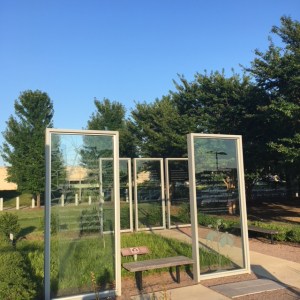
In 2009, the Anne Frank Center USA announced an initiative to place saplings from the tree at various locations throughout the United States.  Little Rock became the only city to receive two saplings.  One to be placed at Central High School, the other to be placed at the Clinton Presidential Center.

The Clinton Foundation and the Sisterhood of Congregation B’nai Israel, in conjunction with the Anne Frank Center USA, joined together to create a powerful exhibit, The Anne Frank Tree, located on the grounds of the Clinton Presidential Park.  The permanent installation, which surrounds the Anne Frank Tree sapling, was dedicated on October 2, 2015.

Anne’s tree would outlive her by more than 50 years before being weakened by disease and succumbing to a windstorm in 2010. But today, thanks to dozens of saplings propagated in the months before its death, Anne’s tree lives on in cities and towns around the world.

The Anne Frank Tree installation at the Clinton Center consists of five framed, etched glass panels – arranged to evoke the feeling of being inside a room – surrounded by complementary natural landscaping. The two front panels feature quotes from Anne Frank and President Clinton. The three additional panels convey the complex history of human rights in Arkansas through descriptions of the Indian Removal Act of 1830, the internment of Japanese Americans during World War II, and the Little Rock Central High School desegregation crisis of 1957. These panels feature quotes from Chief Heckaton, hereditary chief of the Quapaw during Arkansas’s Indian Removal; George Takei, Japanese-American actor who was interned at the Rohwer Relocation Center in Desha County, Arkansas, in 1942; and Melba Pattillo Beals, of the Little Rock Nine.

In collaboration with the Clinton Foundation, Little Rock landscape architect Cinde Bauer and Ralph Appelbaum Associates, exhibit designer for both the Center and The National Holocaust Museum, assisted in the design of the exhibit. The installation has been made possible thanks to the support of the Ben J. Altheimer Charitable Foundation, TRG Foundation, and other generous partners.