
MacArthur Museum of Arkansas Military History reopens after 5 months and $1.5 million in renovations

After several months of renovations to the building, the MacArthur Museum of Arkansas Military History reopens today.

The museum closed in March 2018 for five months of extensive structural work.  The $1.5 million renovation for the 178-year old structure included both interior and exterior upgrades.  The first phase of the project, which began last December, involved renovation to the north and south porches and was partially funded by a Historic Preservation Restoration Grant from the Department of Arkansas Heritage. The interior renovation includes upgrades to the heating and cooling systems, installation of new lighting, and repainting of interior gallery spaces.

Funding for the renovations came from proceeds of a hotel tax which was approved by Little Rock voters in February 2016.

The MacArthur Museum of Arkansas Military History was created to interpret our state’s military heritage from its territorial period to the present. It is a program of the City of Little Rock’s Department of Parks and Recreation.

Located in the historic Tower Building of the Little Rock Arsenal–the birthplace of General Douglas MacArthur–the museum preserves the contributions of Arkansas men and women who served in the armed forces.  Exhibits feature artifacts, photographs, weapons, documents, uniforms and other military items that vividly portray Arkansas’s military history at home and abroad.

In conjunction with the reopening, there will be a belated 125th birthday party for MacArthur Park. (The park actually opened on July 4, 1893.)  Originally known as Arsenal Park, it became known as City Park shortly thereafter. In 1942, it was renamed in honor of Gen. Douglas MacArthur, who was born there. At the time he was commanding US troops in the Pacific Theatre of Operations during World War II.

Activities include:

9:00 a.m. – 2:00 p.m. – Vintage Military Vehicle Show featuring military vehicles from the Arkansas Military Vehicle Preservation Association.

10:00 – 10:30 a.m.  –  Grand Re-opening of the MacArthur Museum of Arkansas Military History

  • Music provided by Five Star Brass Quintet of the 106th Army (Arkansas) Band
  • Remarks and Ribbon Cutting re-opening the military museum following a $1.55 million renovation

10:00 a.m. – 4:00 p.m.  –  MacArthur Park History Walk

Explore MacArthur Park using a “passport” to learn more about the park’s history during the territorial/Civil War periods, late 19th century/early 20th century periods, and World War II/Modern periods.  There will be eight “passport sites” in total, with other sites to visit as well. Passports and Park materials may be picked up at the MacPark Group Table.  Stamped passports to all eight sites may be turned in for raffle prizes from the Arkansas Arts Center, Little Rock Parks, Arkansas Paranormal Expo, MacArthur Museum of Arkansas Military History, Mac Park Group, Quapaw Quarter Association, and others.

  • AAC Friend Level Membership.
  • AAC Children’s Theatre Tickets (4).
  • Flat Screen Television- MacPark Group.
  • AAC class/workshop.
  • QQA- ticket to Spring Tour of Homes and ticket to Mother’s Day Brunch.
  • MMAMH- Gift basket and passes to the 8th Annual Paranormal Expo.
  • Parks and Rec- Round of Golf at Rebsamen Gold Course.

11:30 a.m. – 1:00 p.m. Woodmen Life will provide grilled hot dogs and chips to first 400 visitors.  Bottled water courtesy of Premium Refreshment Services.   Bluebell ice cream will be provided free.  Families are encouraged to bring picnic lunches.

12:00 – 2:00 p.m. – Concert by Funkle Sam of the 106th Army (Arkansas) Band on the North Plaza. Katie Sunshine will be hoop dancing with Funkle Sam.

4:00 – 8:00 p.m. – Evening German Biergarten.  Local breweries set up to sell beers. *Will have entry fee of $10 which will buy admission, three beer tokens, and a bratwurst plate.


Little Rock Look Back: War Memorial Stadium opens on Sept 18, 1948

On September 18, 1948, the Arkansas Razorbacks took on Abilene Christian and won the game by a score of 40 to 6.  It was the first game of the season, and the Razorbacks went into the game ranked #13. They maintained that ranking for four weeks before falling out of national standings.  The team ended up with a season record of five wins and five losses. Playing four of their games at War Memorial that season, they were two and two in Little Rock. They were one and two in Fayetteville and amassed a 2-1 record on the road.

Dedication ceremony in 1948. Photo courtesy of the War Memorial Stadium Commission.

Dedication ceremony in 1948. Photo courtesy of the War Memorial Stadium Commission.

Prior to the game, the stadium was dedicated to the veterans of World War I and World War II in a ceremony led by former Razorback standout and Medal of Honor recipient Maurice “Footsie” Britt.

Though Britt would later be known for entering politics and becoming Arkansas’ first Republican Lieutenant Governor, in his college days he was known statewide as an outstanding Razorback football and baseball athlete.  During World War II, his bravery and courage allowed him to become first person in American history to earn all the army’s top awards, including the Medal of Honor, while fighting in a single war.

Also participating in the opening ceremony were a mass of high school marching bands from across the state. Reports indicate up to forty bands were on the field to play the National Anthem as part of the event.

The construction of the stadium had been the brainchild of Razorback coach John Barnhill and Arkansas Secretary of State C. G. “Crip” Hall.  The duo shepherded it through the 1947 Arkansas General Assembly.   As a student at the University, Hall had been a team manager for the Razorbacks and had remained a longtime, active supporter.

In August of 1947, Little Rock was chosen as the location over Hot Springs and North Little Rock. West Memphis had abandoned its bid when it was unable to secure the necessary financial pledges.  Construction started in 1947 and continued up until opening day.  On the day of the game, newspaper photos showed heavy equipment grading the parking lot prior to paving.

The park in which the stadium sat would be renamed War Memorial Park in June 1949 and dedicated by President Harry S. Truman in a nationally-broadcast ceremony from War Memorial Stadium.

125 years of MacArthur Park

On July 4, 1893, Arsenal Park opened in Little Rock.  This was the City’s first municipal public park.  Though it predated the establishment of a formal Parks and Recreation Department by several decades, it is the oldest part of that department.
The land now known as MacArthur Park had originally served as a horse racetrack in the early days of Little Rock.  By 1836, the federal government purchased the land for construction of a military arsenal.  The flagship building, the Arsenal Tower building, is the only remaining structure from that time period.

The land served as a military outpost until 1892.  On April 23, 1892, a land swap took place where in the City of Little Rock was given the property with the stipulation that it would be “forever exclusively devoted to the uses and purposes of a public park.” (Never mind that the federal government took part of the land back for the construction of the Wilbur Mills Freeway.)  Congressman William L. Terry was active in negotiating the land swap.

In return for giving the City this land, the federal government took possession of land on the north side of the Arkansas River (then part of Little Rock) – that 1,000 acres became Fort Logan H. Roots.

The park officially opened on July 4, 1893, with the name Arsenal Park. Since it was the City’s first and only park at the time, residents started referring to it as City Park. In time, the designation Arsenal Park fell from use.  In fact, it is referred to as City Park exclusively and officially in City documents throughout the first 42 years of the 20th Century.

On March 9, 1942, Little Rock’s first public park was renamed by the Little Rock City Council.  By a vote of fourteen ayes, zero nays and four absent, the alderman approved Ordinance 6,388 which renamed the park in honor of General Douglas MacArthur.

In 1952, General MacArthur (contemplating a run for the GOP nomination for President) visited Little Rock in March.  Later that year, the eventual GOP nominee (and 34th US President) General Dwight Eisenhower visited the park.

Today, MacArthur Park is the anchor of the burgeoning MacPark district as well as the MacArthur Park Historic Distric.

Little Rock Parks Master Plan

The Little Rock Parks and Recreation Department is updating its master plan.  As part of this, it is conducting a survey.
SInce the arts and culture are part of the programming focus of LR Parks, the link to the survey is provided here to help spread the word.

Please consider filling out the survey.

Little Rock Look Back: President Truman dedicates War Memorial PARK in a national address

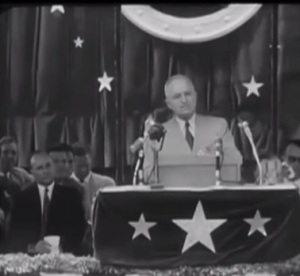
Though President Truman was in Little Rock for a military reunion, he did conduct some official business while here.  In his Presidential role, he spoke at the dedication of War Memorial Park on June 11, 1949.

(It is sometimes erroneously reported that he dedicated the stadium.  That took place in September 1948, at a Razorback game with former Razorback player and future Lt. Governor Maurice “Footsie” Britt delivering the keynote.)

President Truman’s address took place inside War Memorial Stadium at 2:30 p.m..   It was not a brief dedicatory speech, but instead was a lengthy treatise on foreign affairs.  The address was carried live on nationwide radio (though some radio networks opted to broadcast it later).  The text of his address can be found here.

The stadium was by no means full.  A major reason for that was that many thousand individuals had turned out to witness a parade downtown in which President Truman marched along side Governor Sid McMath.  The parade was in conjunction with the military reunion.  Given the June heat in Arkansas (in which parade spectators had been standing for several hours) and the difficulty of getting from the parade route to the stadium, most (if not all) parade spectators opted for skipping the presidential address.

Before the parade, President Truman (who was still riding high from his upset victory in the 1948 election) was asked by a local reporter if he would run in 1952. He refused to answer stating that the national media would think he had planted the question with a local member of the press.

Prior to the name War Memorial Park, the land had been known as Fair Park.  It was a former location of the State Fair.  In the 1930s, it had briefly been known as Overman Park in honor of then-Mayor R. E. Overman.  The City Council had named it for him as a tribute to his work on a variety of projects. When he displeased them, they reversed their decision and renamed it to Fair Park.

Armed Forces Day in Little Rock – Birthday of the MacArthur Museum of Arkansas Military History

Today is Armed Forces Day.

The third Saturday of May is designated each year as a day to celebrate the men and women who serve in the various branches of the United States armed forces.

On Saturday, May 19, 2001 (which was Armed Services Day that year), the City of Little Rock opened the MacArthur Museum of Arkansas Military History.  Today, the museum celebrates its 17th birthday.  However, it is temporarily closed to the public for renovations.

Though the museum is only 17 years old, the building in which it is located, is 170 years old.  It is undergoing a much-needed renovation and restoration in order to continue to serve for at least 170 more years.

Visitors to MacArthur Park today can still interact with the various outdoor memorials and monuments which pay tribute to various phases of Arkansas’ military history.

Little Rock Look Back: Land Swap Lands Park for Little Rock

April 23, 1892, marked the beginning of the City of Little Rock’s public park sLR City Parkystem.  On that date, the City officially took possession of land which would become what is now known as MacArthur Park.

The park land had originally served as a horse racetrack in the early days of Little Rock.  By 1836, the federal government purchased the land for construction of a military arsenal.  The flagship building, the Arsenal Tower building, is the only remaining structure from that time period.

The land served as a military outpost until 1892.  On April 23, 1892, a land swap took place where in the City of Little Rock was given the property with the stipulation that it would be “forever exclusively devoted to the uses and purposes of a public park.” (Never mind that the federal government took part of the land back for the construction of the Wilbur Mills Freeway.)  In return for giving the City this land, the federal government took possession of land on the north side of the Arkansas River (then part of Little Rock) – that 1,000 acres became Fort Logan H. Roots.

After clearing most of the buildings from the land and preparing it for recreation, the park opened on July 4, 1893, with the name Arsenal Park. Since it was the City’s first and only park at the time, residents started referring to it as City Park. In time, the designation Arsenal Park fell from use.  In fact, it is referred to as City Park exclusively and officially in City documents throughout the first 42 years of the 20th Century.

The City Council’s action to name it MacArthur Park in March 1942, was accompanied by petitions encouraging the action which were submitted by the Arkansas Authors and Composers Society, the Arkansas Engineers Club and the Pulaski County Republican Central Committee.

City records do not indicate if anyone registered opposition to the name change. It would be another decade before General MacArthur would return to the site of his birth, a place he had not visited since his infancy.