
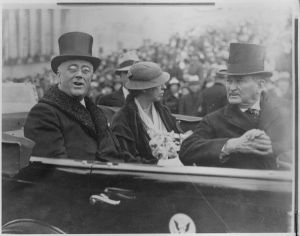
Gov. & Mrs. Roosevelt with Sen. Robinson en route to FDR taking oath as president.
On January 30, 1882, future U.S. President Franklin Delano Roosevelt was born. In 1936, he visited Little Rock as part of a statewide tour in conjunction with Arkansas’ Centennial celebration. While in the state he spent time outside of Hot Springs at Couchwood, the vacation home of Arkansas Power & Light founder Harvey Couch, who was the chair of the Centennial activities.
In honor of President Roosevelt’s visit, a portion of Highway 365 in Little Rock was designated Roosevelt Road. He followed part of that road while in the Capital City before making a public appearance.
President Roosevelt’s address on June 10, recounted Arkansas’ territorial and statehood history. At the end he paid tribute to his Senator Joseph Taylor Robinson. The Senator was a friend and confidant who often led the charge for FDR programs in congress. Indeed, it would be New Deal programs which would allow for the construction of a municipal auditorium in Little Rock, which would be named in memory of Sen. Robinson after his death in the summer of 1937. (As the Democratic leader of the Senate, it had been Robinson who accompanied FDR and Eleanor in the motorcade to the 1933 Presidential inauguration ceremony.) A quote by President Roosevelt upon learning of Senator Robinson’s death adorns a wall of Robinson Center.
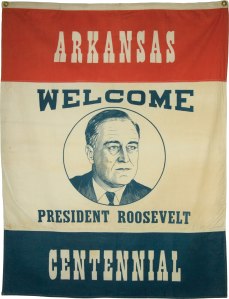 FDR’s visit to Arkansas had political implications as well. The late Senator Huey Long of neighboring Louisiana had been arguably FDR’s biggest adversary in Washington. Long was very popular in rural areas of Arkansas and had campaigned for Hattie Caraway when she ran for re-election to the Senate, to the dismay of many of Arkansas’ Democratic establishment. Harvey Couch had worked to bring about a detente between FDR and Long prior to the latter’s assassination in 1935. But between a lingering mistrust of FDR by Long supporters and discontent from some sectors based on New Deal programs, it was important for FDR to shore up Democratic support in Arkansas. At the time the state had nine electoral votes.
Earlier, President Roosevelt had sent a letter to be read at the grand opening of the Museum of Fine Arts in City Park (a forerunner to the Arkansas Arts Center). That facility was constructed with New Deal dollars.
FDR would return to Central Arkansas in 1943 to review troops at the military facility named for Sen. Robinson. That would be his final visit to Arkansas before his death in April 1945.
As a character in the musical Annie, FDR has been on the stage of Robinson on numerous occasions.
 On January 3, 1936, the ground was broken for the Museum of Fine Arts building in City Park. The facility would face Ninth Street and be to the west of the Arsenal Tower Building. That building was the one remaining structure of more than 30 which had populated the grounds when it was a federal military establishment.
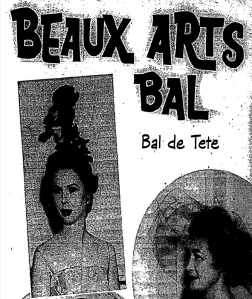 Snow covered highways throughout the state on Friday, December 12, 1958. However, the 400 guests at the Fine Arts Club’s first Beaux Arts Bal braved the roads and made their way to the blue drape bedecked ballroom of the Country Club of Little Rock. (Note, the event used the French spelling of Ball using only one “l.”)

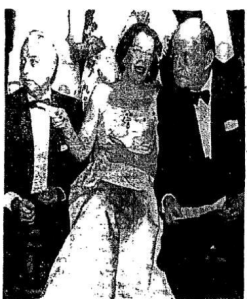
 On November 25, 1872, future Little Rock Mayor Horace A. Knowlton Jr. was born.
 Photo from the collection of Lally Brown.
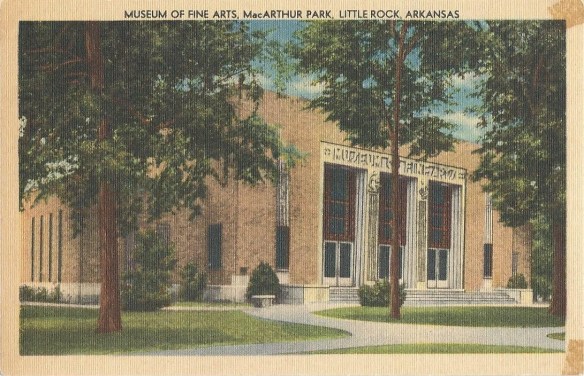 On Tuesday, October 5, 1937, the Fine Arts Club of Little Rock held its first meeting in the new Museum of Fine Arts. But it was not a typical meeting. It was an Open House and Dedication for the new building.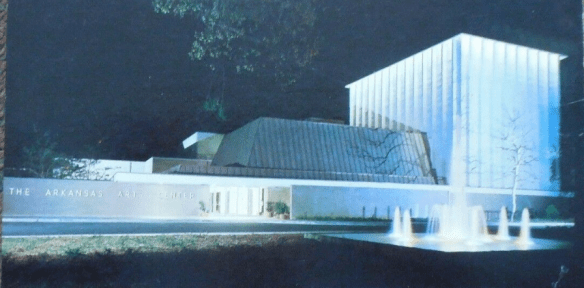

 Little Rock Culture Vulture