Last Chance in Osage County this weekend

THEREP_AUGUST (no credits)-page-001Before it was a movie, Tracy Letts’ August: Osage County was a Pulitzer and Tony winning play.  Running for over 600 performances on Broadway, it first enraptured audiences in Chicago.  Now, Little Rock audiences have the chance to laugh, cringe, be surprised and nod knowingly as the Weston family gathers to comfort and confront each other.

Directed by Rep Producing Artistic Director Bob Hupp, August: Osage County runs through June 21.

When the patriarch of the Weston clan disappears one hot summer night, the family reunites at the Oklahoma homestead, where long-held secrets are unflinchingly and uproariously revealed, dramatizing three generations of unfulfilled dreams and leaving each family member changed forever.

Rep founder Cliff Baker, who starred in the Rep’s first production of The Threepenny Opera returns to the stage as an actor to portray the mysterious patriarch of the Weston clan.  Joining him are Susanne Marley as matriarch Violet and LeeAnne Hutchison, Kathy McCafferty and Brenny Rabine as their three daughters.  Marc Carver, Michael McKenzie,  Mary Katelin Ward, Natalie Canerday, Richard Waddingham, Michael Patrick Kane, Grant Neale and Cassandra Seidenfeld play others who are drawn into the family drama.

The design team includes Mike Nichols (set), Marianne Custer (costumes), Yael Lubetzky (lighting), Allan Branson (sound) and Lynda J. Kwallek (props).  Other members of the creative team include fight director D. C. Wright (and there is plenty of physical sparring in addition to the verbal sparring) and dialect coach Stacy Pendergraft.

Prize winning AUGUST: OSAGE COUNTY now on stage at Arkansas Rep

August Osage CastoBefore it was a movie, Tracy Letts’ August: Osage County was a Pulitzer and Tony winning play.  Running for over 600 performances on Broadway, it first enraptured audiences in Chicago.  Now, Little Rock audiences have the chance to laugh, cringe, be surprised and nod knowingly as the Weston family gathers to comfort and confront each other.

Directed by Rep Producing Artistic Director Bob Hupp, August: Osage County opens tonight and runs through June 21.

When the patriarch of the Weston clan disappears one hot summer night, the family reunites at the Oklahoma homestead, where long-held secrets are unflinchingly and uproariously revealed, dramatizing three generations of unfulfilled dreams and leaving each family member changed forever.

Rep founder Cliff Baker, who starred in the Rep’s first production of The Threepenny Opera returns to the stage as an actor to portray the mysterious patriarch of the Weston clan.  Joining him are Susanne Marley as matriarch Violet and LeeAnne Hutchison, Kathy McCafferty and Brenny Rabine as their three daughters.  Marc Carver, Michael McKenzie,  and Mary Katelin Ward are family members of the three daughters.  Natalie Canerday, Richard Waddingham and Michael Patrick Kane play another branch of the family. Grant Neale and Cassandra Seidenfeld play two other residents of Osage County who are drawn into the family drama.

The design team includes Mike Nichols (set), Marianne Custer (costumes), Yael Lubetzky (lighting), Allan Branson (sound) and Lynda J. Kwallek (props).  Other members of the creative team include fight director D. C. Wright (and there is plenty of physical sparring in addition to the verbal sparring) and dialect coach Stacy Pendergraft.

Go see the show and decide for yourself “who’s in charge” of this family.

Today at Clinton School – Ark Rep production of AUGUST: OSAGE COUNTY

THEREP_AUGUST (no credits)-page-001The Arkansas Repertory Theatre works in partnership with the Clinton School of Public Service to participate in the UACS’s Distinguished Speaker Series, hosting educational panel discussions on various Rep productions.

The latest in these takes place today, Thursday, June 4 at 12 noon at Sturgis Hall in Clinton Presidential Park.  It focuses on the Rep’s upcoming production of Tracy Letts’ August: Osage County.

Arkansas Repertory Theatre producing artistic director, Bob Hupp, will host a panel discussion on the upcoming production of August: Osage County, winner of the 2008 Pulitzer Prize, Tony Award for Best Play, New York Drama Critics Circle Award for Best Play, and virtually every other theatre award possible.

The play focuses around the large Weston family when they unexpected reunite after dad disappears and their Oklahoman family homestead explodes in a maelstrom of repressed truths and unsettling secrets. Mix in Violet, the drugged-up, scathingly acidic matriarch, and you’ve got a major new play that unflinchingly – and uproariously – exposes the dark side of the Midwestern American family.

August: Osage County opens officially on Friday evening and runs through Sunday, June 21.

Tony Awards Week – SOUTH PACIFIC – “How Far Away from Little Rock A-r-k”

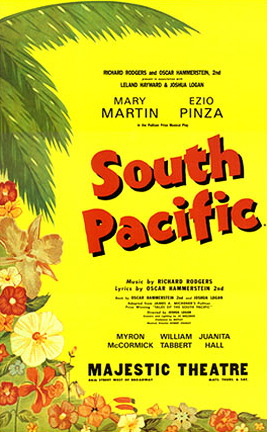
southpacific_obcSeveral Tony Awards have been won by a show with a main character from Little Rock.

South Pacific opened at the Majestic Theatre on April 7, 1949 and settled in for a run of 1925 performances. Based on the James Michener Pulitzer Prize winning novel Tales of the South Pacific, it featured a book by Oscar Hammerstein II and Joshua Logan, songs by Richard Rodgers and Hammerstein and direction by Logan. It was produced by Rodgers, Hammerstein, Logan and Leland Hayward. Set in the titular islands, it concerned the relationships of sailors, nurses, island natives and other island inhabitants.

The musical starred recent Tony winner Mary Martin as Little Rock native Nellie Forbush, opera star Ezio Pinza, stage veterans Myron McCormick and Juanita Hall, and stage newcomers William Tabbert and Betta St. John. Cloris Leachman was Martin’s understudy and would later succeed her in the part of Little Rock native Nellie Forbush.

Like other Rodgers and Hammerstein musicals, this show tackled tough themes – this one being prejudice. That did not set well with some theatergoers. Indeed, some potential investors did not put money into the show because of its stance. But Rodgers, Hammerstein, Logan and Hayward persisted. Their diligence paid off when the musical received the 1950 Pulitzer Prize in Drama, only the second musical to receive this designation. It is also the only Pulitzer Prize for Drama winner to be based on Pulitzer Prize winning source material. This was the first Rodgers & Hammerstein musical to not feature big dance numbers. In fact, there was no choreographer. The dance steps which existed were created by Martin, who had taught dance in her native Texas as a young mother.

Opening late in the season, South Pacific was named the 1949 New York Drama Critics Circle Best Musical, but was not part of the Tony Awards until 1950. (Though Jo Mielziner, who designed the set for South Pacific received a Tony for his set designs of shows during the 1948-49 season and South Pacific was one of the titles listed.) At the 1950 Tonys, it received six Tony Awards: Best Musical, Actor in a Musical (Pinza), Actress in a Musical (Martin), Featured Actor in a Musical (McCormick), Featured Actress in a Musical (Hall), and Director (Logan).

This is the only time that all four acting awards in the musical category went to performers in the same production. In fact, the other two acting trophies that year were incorrectly engraved as being from South Pacific out of habit. Logan’s win was also the first time that the Director Tony went for a musical, since at the time that award was not separated out among plays and musicals. Hall was the first African American to win a Tony Award for Acting.

In 1999 for the 50th anniversary and in 2008 for the opening of the first Broadway revival remaining cast members from the original production had reunions in New York City. At the 50th anniversary ceremony, a proclamation from Little Rock Mayor Jim Dailey was read declaring it South Pacific day in Little Rock and honoring the show. It is interesting to note that in 1949, there were two heroines on the Broadway stage from Little Rock: Nellie Forbush from South Pacific and Lorelei Lee from Gentlemen Prefer Blondes.

In 2008, Lincoln Center Theatre produced the first revival of South Pacific on Broadway. It opened on April 3, just four days shy of the musical’s 59th anniversary.  The cast was led by Paulo Szot, Kelli O’Hara (as Little Rock girl Nellie Forbush), Matthew Morrison (before “Glee”), Danny Burstein and Loretta Ables Sayre.  The production restored a song which had been written for the original Broadway production that had been dropped. “My Girl Back Home” was featured in the movie version and in this Broadway revival. In it O’Hara and Morrison sang of their hometowns of Little Rock and Philadelphia.  The production was nominated for 11 Tony Awards and won 7: Best Musical Revival, Actor in a Musical (Szot), Director of a Musical (Bartlett Sher), Scenic Design (Michael Yeargan), Costume Design (Catherine Zuber), Lighting Design (Donald Holder) and Sound Design (Scott Lehrer).

Sher, Yeargan, Zuber, Holder and Lehrer are all reuniting again next season to work on a revival of Fiddler on the Roof.  One of the producers of that is Little Rock native (and three time Tony winner) Will Trice.

While Trice has not starred in a production of South Pacific, his mother Judy Trice starred in a statewide tour in the 1970s. A few years later, his sister Kathryn Pryor, starred in the Central High production.

On Memorial Day pay tribute to Veterans who paid the ultimate price at Mount Holly or other cemeteries

MountHolly Memorial DayToday is Memorial Day – a time to pay tribute to the men and women in uniform who died in service to their country.

As a way to give this recognition, today would be a good day to visit a cemetery. One of Little Rock’s most storied cemeteries is Mount Holly Cemetery. There are veterans from all wars: Revolutionary, War of 1812, Mexican, Civil War, Spanish-American, World War I and II, Korean, Vietnam and Desert Storm.

Founded in 1843, Mount Holly has been called “The Westminster Abbey of Arkansas.” Thousands of visitors come each year. Those interested in history come to see the resting places of the territorial citizens of the state, including governors, senators, generals, black artisans, and even a Cherokee princess. For others the cemetery is an open air museum of artistic eras: Classical, Victorian, Art Deco, Modern––expressed in gravestone styles from simple to elaborate. Some come to read the epitaphs that range from heartbreaking to humorous to mysterious.

Though a City of Little Rock facility, the cemetery is maintained by the Mount Holly Cemetery Association, a non-profit organization with a volunteer Board of Directors. The cemetery is located at 1200 South Broadway in Little Rock. Gates are open from 8 a.m. until 5 p.m. in the summer and from 8 a.m. until 4 p.m. in the winter.

Interred within the rock walls of Mount Holly are 11 state governors, 15 state Supreme Court justices, four Confederate generals, seven United States senators and 22 Little Rock mayors, two Pulitzer Prize recipients, as well as doctors, attorneys, prominent families and military heroes.  Proving that death is the great equalizer (and the J. N. Heiskell lived a very long time) longtime Gazette owner and publisher J. N. Heiskell is buried near two different nemeses: Senator, Governor and demagogue Jeff Davis; and segregationist Congressman Dr. Dale Alford.

Tonight at Clinton School – Discussion of Thurgood Marshall and 1949 Groveland Boys Case

UACS DevilBefore he was on the Supreme Court, before he supported the Little Rock Nine, before Brown v. Board of Education, Thurgood Marshall was a longtime crusader not just for civil rights, but for human rights.  T

Tonight at the Clinton School, Pulitzer Prize-winning author Gilbert King, Justice Marshall’s son, Thurgood Marshall, Jr., will discuss the 1949 Groveland Boys case.

Gilbert King is the Pulitzer Prize-winning author of Devil in the Grove: Thurgood Marshall, the Groveland Boys and the Dawn of a New America. The book, about four black men falsely accused of raping Norma Lee Padgett, a 17-year-old white woman in Groveland, Fla. in 1949, unearthed a largely forgotten chapter in the long history of racial injustice in the United States, and explored, in painstaking details, the tactics used by Thurgood Marshall, the future Supreme Court Justice, to chip away at the foundations of Jim Crow law.

The program will begin at 6pm at the Clinton School of Public Service.  A book signing will follow.

Poetry Month: Albert Pike and “Night on the Arkansa”

PikeAlbert_fAlbert Pike was a lawyer who played a major role in the development of the early courts of Arkansas and played an active role in the state’s politics during the middle 19th Century.  He was also a soldier, a national leader of masonry, and poet & writer.

Born in Boston in December 1809, he grew up in the greater Boston area.  Pike was admitted to Harvard, but could not afford it. He began teaching school.  In 1831, he left Massachusetts for Mexico. After spending some time in Santa Fe, he headed east and ended up in Fort Smith.  Based on some political writings, he was invited to Little Rock by Charles Bertrand (a future Little Rock mayor).

In Little Rock he flourished as a writer and attorney. He also became involved in military matters first with the Mexican War and then with Confederate army during the Civil War.  He also married and fathered several children.  At the end of the Civil War, Pike moved to New York City, then for a short time to Canada. After receiving an amnesty from President Andrew Johnson on August 30, 1865, he returned for a time to Arkansas and resumed the practice of law. He then moved to Memphis and later Washington DC.

After he ceased practicing law, Pike’s real interest was the Masonic Lodge. He had become a Mason in 1850.  He held several national posts in the Mason organization.  Pike died at the Scottish Rite Temple in Washington DC on April 2, 1891. He was buried in Oak Hill Cemetery there. His Masonic brothers erected a statute to him in 1901 in Washington DC, making him the only former Confederate general to have a monument there.

The house he built in Little Rock still stands, and is known as the Pike-Fletcher-Terry House.  It was the boyhood home of Pulitzer Prize winning poet John Gould Fletcher.  Though he is buried in Washington DC, there is a memorial to him erected in Mount Holly Cemetery.  It can be seen every day, but especially today during the Mount Holly Rest in Perpetuity fundraiser picnic.

Pike began to write poetry as a young man, which he continued to do for the rest of his life.


NIGHT ON THE ARKANSA (1838)

Night comes upon the Arkansa with swift stride, —
Its dark and turbid waters roll along,
Bearing wrecked trees and drift, — deep, red, and wide.
The heavy forests sleeps on either side,
To the water’s edge low-stooping; and among
The patient stars the moon her lamps has hung,
Lit with the spirit of the buried sun.
No blue waves dance the stream’s dark bosom on,
Glittering like beauty’s sparkling starry tears;
No crest of foam, crowning the river dun,
Its misty ridge of frozen light uprears:
One sole relief in the great void appears —
A dark, blue ridge, set sharp against the sky,
Beyond the forest’s utmost boundary.


Not so wast thou, O, brave old Merrimac!
As I remember the; as thou art seen
By the Soul’s eyes, when, dreaming, I go back
To my old home, and see the small boats tack
On thy blue waters, gliding swift between
The old gray rocks that o’er them fondly lean,
Their foreheads scarred with lightning.  There, around
Grim capes the surly waterswhirl and bound;
And here and there grave patriarchal trees
Persuade the grass to clothe the reluctant ground
And frowning banks with green. Still villages
Sleep in the embraces of the cool sea-breeze: —
Ah, brave old stream! – thou seemest to infold
My heart within thy waters, as of old.