RobinsoNovember: Grady Manning

h-grady-manningIn 1938, the first Auditorium Commission was appointed to oversee the administration of Robinson Auditorium.  At the time, it was anticipated that the auditorium would be ready to open by no later than September 1939.  (Actually, the building was originally supposed to have been opened by June 1938 in order to fulfill a funding request.)

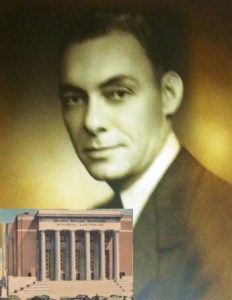
The first chairman of the Auditorium Commission was H. Grady Manning.  He was founder and president of Southwest Hotels, which included the Hotel Marion, Ben McGehee, Albert Pike, and Lafayette Hotels in Little Rock as well as the Arlington and Majestic Hotels in Hot Springs.

Manning was a native of Scott County. He moved to Fort Smith to attend a business college. To help defray expenses, he started working at the hotel in which he was staying. Enjoying this, he decided to make hotels his career.  Manning then moved to Hot Springs and worked at the Eastman Hotel before moving to Niagara Falls to work at the Queen Royal Hotel.  He returned to Arkansas in 1917 and became the assistant manager at the Hotel Marion.  In 1919, he became the manager of the Basin Park Hotel in Eureka Springs before moving to Fort Smith and managing the Goldman Hotel.

In the 1920s, he founded Southwest Hotels, Inc. which then started building and acquiring existing properties.  He and his wife, Ruth, resided in the Hotel Marion.  His daughter, Joy, grew up at the hotel.  With the proximity of his hotels to the forthcoming auditorium and his understanding of the convention business, Manning was a natural fit to lead the new auditorium commission.  As construction woes delayed the opening of the building, Manning struggled to keep the commission together.  The commission, by state statute, was not charged to oversee a construction project, but instead to administer a functioning building.

On Labor Day, 1939, Manning and his wife were enjoying the day at Lake Hamilton with some friends.  The boat they were in capsized, and Manning drowned at the age of 47.  The City was in mourning.  A City Council resolution was passed to memorialize his contributions.  In addition to being signed by Mayor J. V. Satterfield, it was signed by three members of the City Council–Aldermen E. W. Gibb, S. Major Dent, and Charles Davis.

Later in September, the remaining four members of the Auditorium Commission resigned. Since they had no building to manage and no leader, they decided it was best to disband.  Mayor Satterfield declined to name their replacements until the building got closer to opening.

A few years after his death, the Ben McGehee was renamed the Grady Manning Hotel.  That hotel, and the Hotel Marion were imploded in February 1980 to make way for the Statehouse Convention Center and the Excelsior Hotel.
RobinsoNovember: Mayor J. V. Satterfield Jr.

Satterfield AuditUpon taking office as mayor in April 1939, J. V. Satterfield felt he was getting a handle on Little Rock’s precarious financial situation. He would soon discover that it was more unstable than he had imagined.  Included in this was Robinson Auditorium, currently under construction across the street from his office in City Hall.  Mayor Satterfield disclosed that he had voted against the auditorium in 1937 because he felt the finances were not sufficient. But as the mayor, he promised to open the building.

By the summer of 1939, it was becoming apparent that there would not sufficient money to finish the construction.  Even with the issuance of the final round of approved bonds (which had been held back as a reserve), there would not be enough money.  The Mayor and Harvey Couch made plans to go to Washington DC to try to get more money from the federal government.  Mr. Couch was a personal friend of President Roosevelt as well as head of Arkansas Power & Light.  The pair made the trip but returned with no additional money.

At the same time, the Auditorium Commission, which had been appointed by Mayor Overman to oversee the governance of the building, resigned as a group. They said they had been appointed to administer a building, not a construction site. Since it was uncertain as to when the building would open, they stepped down.

Mayor Satterfield was able to negotiate a series of deals to get the necessary work completed for construction of the building to be completed. Part of it involved issuing another round of bonds after the building had been officially opened to finish furnishing the building as well as complete the landscaping.  In January 1940, with a new opening date becoming a stronger possibility, the mayor appointed a new Auditorium Commission.

At the same time, regular events started to take place in the lower level exhibition hall.  There had been a few in November and December, but with a lack of utilities and ongoing construction upstairs in the music hall, those were curtailed.

On February 16, 1940, Joseph Taylor Robinson Memorial Auditorium officially opened. Mayor Satterfield was joined onstage for the ribbon cutting with Senator Robinson’s widow and her sister-in-law, who was a member of the Auditorium Commission.

In April 1940, Little Rock voters approved the final round of bonds which allowed for the building to be finished.

After only two years in office, Mayor Satterfield chose not to seek another term. He left City Hall in April 1941 with finances in order and a new municipal auditorium across the street.

RobinsoNovember: Mayor W. E. Lenon

Mayor Lenon with the plans for the original City Hall/Auditorium and the temporary auditorium.

In 1904, Little Rock Mayor W. E. Lenon first proposed that Little Rock construct at municipal auditorium.  After considering some options, he decided it would be easiest to build it in conjunction with a new City Hall and Jail.  In 1906 plans proceeded in that direction until a lawsuit by J.N. Heiskell to stop it.

Following a judge’s ruling that a municipal auditorium was not deemed a proper use for public monies, the City changed course and constructed only a City Hall and Jail (sans auditorium) at the corner of Markham and Broadway. This building opened in 1908.

In 1906, the City gave permission to a private developer to build a temporary auditorium (which also served as a roller skating rink when the chairs were removed) adjacent to the City Hall site.  This opened in 1907.

Mayor Lenon left office in 1908.  He would later chair a committee involved in an auditorium proposal in 1925, but that one would come to naught, as well.  However, he planted the seed and started the public discourse which lasted for 36 years.  His daughter, Vivion, would be married to Joseph Brewer a nephew and aide of Joseph T. Robinson, after whom the eventual auditorium would be named.

RobinsoNovember: J. N. Heiskell

At the age of 87, J. N. Heiskell in 1960.

John Netherland (J. N.) Heiskell served as editor of the Arkansas Gazette for more than seventy years.  He was usually called “Mr. Heiskell” by all, but a very few confidantes felt confident to call him “Ned.”

Mr. Heiskell is the person most responsible for Robinson Center Music Hall being located at the corner of Markham and Broadway.  As Chair of the Planning Commission and editor of the Arkansas Gazette he had twin bully pulpits to promote this location when those on the City Council (who actually had the final say) were looking at other locations.  He felt the location would help create a cluster of public buildings with its proximity to the county courthouse and to City Hall.  Mr. Heiskell finally succeeded in winning over the mayor and aldermen to his viewpoint.

He was born on November 2, 1872, in Rogersville, Tennessee, to Carrick White Heiskell and Eliza Ayre Netherland Heiskell. He entered the University of Tennessee at Knoxville before his eighteenth birthday and graduated in three years at the head of his class on June 7, 1893.

His early journalism career included jobs with newspapers in Knoxville and Memphis and with the Associated Press in Chicago and Louisville. On June 17, 1902, Heiskell’s family bought controlling interest in the Arkansas Gazette. Heiskell became the editor, and his brother, Fred, became managing editor.

Governor George Donaghey appointed Heiskell to succeed Jeff Davis in the United States Senate after Davis’s death in office. Heiskell served from January 6, 1913, until January 29, 1913, when a successor was chosen by the Arkansas General Assembly.  His tenure is the shortest in the U. S. Senate history.  His first speech on the Senate floor was his farewell.  He was also only the second US Senator to live to be 100.

On June 28, 1910, Heiskell married Wilhelmina Mann, daughter of the nationally prominent architect, George R. Mann. The couple had four children: Elizabeth, Louise, John N. Jr., and Carrick.

In 1907, he joined a successful effort to build the city’s first public library. He served on the library board from that year until his death and was issued the first library card.  He also served on the City’s Planning Commission for decades.  In 1912, he was instrumental in bringing John Nolen to Little Rock to devise a park plan.

In the paper and in his own personal opinions, he crusaded on a variety of progressive causes.  Perhaps the most famous was the Gazette’s stance in the 1957 Central High desegregation crisis.  It was for this effort that the paper received two Pulitzer Prizes.

Although Heiskell stopped going to the office at age ninety-nine, he continued to take an active interest in the newspaper. He began by having a copy of the newspaper delivered to his home by messenger as soon as it came off the press each night. Eventually, he switched to having his secretary call him daily at his home and read the entire newspaper to him. He operated on the premise that “anyone who runs a newspaper needs to know what’s in it, even to the classified ads.”

A few weeks after turning 100, Heiskell died of congestive heart failure brought on by arteriosclerosis on December 28, 1972. He is buried in Little Rock’s Mount Holly Cemetery.  Interestingly, he is buried in the same cemetery as two of his most notable adversaries: Governor Jeff Davis, and segregationist Congressman Dale Alford.

Mr. Heiskell donated his vast papers to UALR. They are part of the Arkansas Studies Institute collection. These papers give insight into not only his career as a journalist, but also his political and civic affairs.  Thankfully he saved much of his paperwork. Without it, much insight into Little Rock in the 20th Century would be lost.


RobinsoNovember: Senator Joseph Taylor Robinson

150px-joseph_t-_robinson_croppedThis month, Robinson Center Music Hall will reopen after a two year renovation/restoration/remodeling/reconstruction.  To commemorate that, each day in November, the Culture Vulture will look at a person or event connected to Robinson Center Music Hall.

Up first, the eponym for the building.

Senator Joseph Taylor Robinson was born in Lonoke in 1872.  In 1894 Robinson was elected to the Arkansas General Assembly for one term.  From 1903 until 1913, he served in the US House of Representatives as a Congressman from Arkansas’ then-Sixth District.

He chose not to seek another term in Congress and ran for Governor in 1912.  On January 3, 1913, sitting US Senator Jeff Davis died in office.  Robinson was sworn in as Governor on January 16, 1913. Twelve days later he was chosen by the Arkansas General Assembly to become the next US Senator. He became the final US Senator to be selected by a legislator instead of popular vote.  At the time, Senate terms started in March, so Robinson served as governor until March 8, 1913.

He rose through the ranks of the Senate and eventually became the first person to hold the title of Senate Majority Leader.  In 1928, he was the Vice Presidential nominee for the Democratic Party.  Four years later, he rode with Franklin and Eleanor Roosevelt to the inauguration ceremonies before FDR took the oath.  He would be President Roosevelt’s go-to man on legislative issues.


Senator Robinson died in Washington D.C. on July 14, 1937.  His wife was in Little Rock making preparations for a trip the couple was to take. Following his demise, Mrs. Robinson went to Washington to accompany her husband’s body back to Arkansas.

The Senator was honored with a memorial service in the Senate chambers on Friday, July 17.  President Roosevelt and the cabinet joined members of the senate on the floor in what was described as a state funeral without pomp.  Mrs. Robinson sat with her brothers and two nephews as well as Bernard Baruch and Arkansas Power & Light’s Harvey Couch, who were Senator Robinson’s closest friends.  Eleanor Roosevelt was one of the many crowded in the senate galleries observing the service.  Following the service his body remained in the chambers until it was transferred to a train to make the journey to Little Rock.

The funeral train bore his body, his family, 50 senators and over twenty congressmen. It reached Little Rock around 8am on Sunday the 19th.  From there, Senator Robinson’s body was taken to his house on Broadway Street until noon.  It subsequently lay in state at the Arkansas State Capitol until being escorted by military to First Methodist Church.

As the funeral procession reached Roselawn Cemetery, thunder echoed. The skies which had alternated between sun and rain that day, returned to rain. A deluge greeted the end of the service and sent visitors hurrying for shelter at the end.

It was not until December 1937, that Senator Robinson’s name became attached to the municipal auditorium which Little Rock voters had approved in January 1937.

Get FREE tickets to Ark Symphony concert

aso-nov-30On Tuesday, November 1, starting at 10am, the Arkansas Symphony Orchestra will be giving away FREE tickets to their November 30 “Thank You to Little Rock” concert.

The tickets will be available on the front steps of Robinson from 10am until 6pm. If they run out of tickets earlier than 6pm, they will end it earlier.  So don’t wait until evening Rush Hour!

This November 30 concert will be presented to thank Little Rock voters for their support of the Restore Robinson project. It is also in appreciation of continued patronage by audiences as the Symphony has been performing in other venues.

Don’t miss on this opportunity to attend a historic event in the restored Robinson Center Music Hall!


Little Rock Look Back: Miss America comes to Little Rock

miss america axumToday, Miss America 2017 Savvy Shields comes to Little Rock as part of her official homecoming to Arkansas after winning the crown.  In honor of that, we take a look back to the first visit to Arkansas by Donna Axum, who was the first Miss Arkansas to win the title of Miss America.

A native of El Dorado and a student at the University of Arkansas, during her reign as Miss America Miss Axum (or simply Donna as the newspaper headlines referred to her) made four public visits to Little Rock.  As the first Miss Arkansas to become Miss America, the state’s Capitol City was very interested in giving her a warm welcome.

After being crowned on September 7, 1963, her first visit to Arkansas was November 1 through 3.  In addition to stops in Hot Springs and El Dorado, she appeared in Little Rock to attend events including an Arkansas Razorback football game at War Memorial Stadium.  Her entourage included the top four runners up from the Miss America pageant.

In February 1964, she made a brief appearance in Little Rock which included a press conference.

Donna Axum spent nearly two weeks in Arkansas in May 1964 attending several pageants as well as spending time with family.  During that visit she appeared in Little Rock twice.  The second time she headlined a concert with the Arkansas Symphony (not related to the current Arkansas Symphony Orchestra) and the Arkansas Choral Society. It took place at Robinson Auditorium.