Robinson Redux – April

RCMH AprilWhile Robinson Center Music Hall is closed for renovations, the Culture Vulture is taking a monthly look at past performances. Today’s entry looks at Aprils from 1940 to 2010 in years that end in a “0” or “5.”

Edward Everett Horton kicked off April 1940 at Robinson Auditorium on the 1st with the comedy Springtime for Henry. The performance was marred by the sound of the new building’s air conditioning system, which was being used for the first time during a performance.  Five years later, on April 1, 1945, the auditorium was home to An Evening of Sigmund Romberg which featured the composer in person with performers singing some of his songs.  April 1945 also saw a performance of Earl Carroll Vanities (the 3rd) and Carmen featuring the Metropolitan Opera singers (the 16th.)

Tenor James Melton performed on April 25, 1950.  In April 1955, the lineup included William Bendix in The Caine Mutiny Court-Martial on the 23rd. The next night the Spring Music Festival took place. It featured school children performing.

On April 25 1960, The Coasters, Bo Diddley, LaVerne Baker and others. The month ended with a youth concert aimed at children. April 1970 included a production of Arthur Miller’s The Price (the 6th), the Southwest Regional Ballet Festival (April 11) and drummer Buddy Rich (April 18).  In April 1975 (the 6th) Hair returned to Robinson for one performance. This time there was no controversy such as had met the first visit a few years earlier.

April 1985 was very busy. On the 13th, there was a Ballet Festival Gala. April 20 & 21 featured an Arkansas Symphony Orchestra classical concert.  A touring production of the musical Gigi performed on the 22nd.  It starred Louis Jourdan (who had appeared in the Oscar winning film, albeit in a different part), Betsey Palmer and Taina Elg. The ASO was back on April 28 with a children’s music concert.

Cathy Rigby flew into Robinson Center with a tour of Peter Pan from April 10 to 12.  On April 4, 1995, the Community Concert Association brought the Russian Seasons Dance Company for a performance.  The Arkansas Symphony Orchestra performed Verdi’s Requiem Mass in Memory of Manzoni on April 8 & 9, 1995. Singer Millie Jackson wrote and appeared in the play Young Man, Older Woman, which played on April 30 of that year.

Several Contemporary Christian music acts performed on April 3. The Arkansas Symphony Orchestra closed their 1999-2000 season on April 8 & 9 with a concert featuring Carolyn Brown on flute. On April 27, 2000, President Clinton headlined a memorial service for civil rights activist Daisy Bates.

April 2005 was full of a variety of performances. Natalie Cole was in concert on April 3 with the Arkansas Symphony Orchestra.  On William Shatner narrated David Itkin’s Exodus with the Arkansas Symphony Orchestra on April 9 & 10, 2005. Arkansan Kyle Dean Massey starred in the tour of 42nd Street which started its performances at Robinson Center on April 18, 2005. In conjunction with an exhibit at the Old State House Museum, a gospel concert featuring the Racy Brothers and the Hunter Brothers closed out April 2005 on the 30th.

David Itkin bid farewell to conducting the Arkansas Symphony Orchestra in April 10 & 11, 2010, with a performance of Mahler’s Resurrection Symphony.  On April 15, the Electrify Your Strings! concert took place. Comedian Gabriel Iglasias and his Fluffy Shop Tour stopped at Robinson on April 24.

A MILLION DOLLAR QUARTET is in town this weekend

MDQMillion Dollar Quartet, the Tony winning musical, has been brought to Central Arkansas by Celebrity Attractions this weekend.

It is inspired by the electrifying true story of the famed recording session that brought together rock ‘n’ roll icons Elvis Presley, Johnny Cash, Jerry Lee Lewis and Carl Perkins for the first and only time.

Featuring  timeless hits including “Blue Suede Shoes,” “Ring of Fire,” “That’s All Right,” “Sixteen Tons,” “Great Balls of Fire,” “I Walk the Line,” “Whole Lotta Shakin’ Goin’ On,” “See Ya Later, Alligator,” “Fever,” “Folsom Prison Blues,” “Hound Dog” and more, this thrilling musical brings you inside the recording studio with four major talents who came together as a red-hot rock ‘n’ roll band for one unforgettable night. Rock and Roll’s best kept secret… revealed, MILLION DOLLAR QUARTET!

Performances are at 8pm on Friday (4/24) and Saturday (4/25) and 2pm matinees on Saturday (4/25) and Sunday (4/26). Though all four of the legendary singers played at Robinson Auditorium, due to that facility’s renovation, this production will be held at the Maumelle Performing Arts Center.

The Little Rock Convention and Visitors Bureau is the presenting sponsor of Million Dollar Quartet in Little Rock.

Little Rock Look Back: First proposal for a municipal auditorium

On April 12, 1904, Mayor W. E. Lenon made what was the first official proposal for a municipal auditorium in Little Rock.  Little did he know at the time that it would take from April 1904 until February 1940 to make this dream a reality.

Elected as a progressive, Lenon was focused on not just providing city services, but also had an interest in initiatives which would move the city forward.  With that background it is not surprising that Mayor Lenon would be a champion for the construction of both a new city hall as well as a municipal auditorium building.  During his first annual address to the City Council in April 1904 he noted:

Recently a number of our citizens have taken an active interest in building an auditorium in our city.  This being a project of such worthy consideration should not go unnoticed by us.  Apparently this is one of the greatest needs.  Our business, social, commercial and financial interests, in fact, our entire city, would be benefitted by the building of same.  It has therefore occurred to me that an auditorium might be built in conjunction with a new city hall.

The mayor further discussed that these new structures could either be built on the site of the current City Hall or at a new location.  He also touched on possible financing options including the collection of a one percent assessment.

The mayor would bring this up again in his 1905 annual address.  It would not be until December 1905 that the City Council would officially take any action on the plan.


Little Rock Look Back: Special Election to finish funding Robinson Auditorium construction

jtrma-c.jpgThough Joseph Taylor Robinson Memorial Auditorium opened in February 1940, there was still money that needed to be raised to finish the construction and the building’s furnishing.  Ten days after the auditorium opening, the City Council approved an ordinance to call a special election on April 2, 1940, for the purposes of approving bonds for three separate projects.  One of these was for $30,000 for the completion of the auditorium; the bonds would not require any additional tax levy.

At the same meeting, a letter was read from the Young Men’s Business Association expressing support for the auditorium in the election, which was to be held in conjunction with the annual municipal general election. The Auditorium Commission had previously asked the City Council to consider issuing the bonds to pay for additional equipment for the building.  In their request to the aldermen, the members stressed that due to the current bond structure, these new bonds would not necessitate any tax increase.

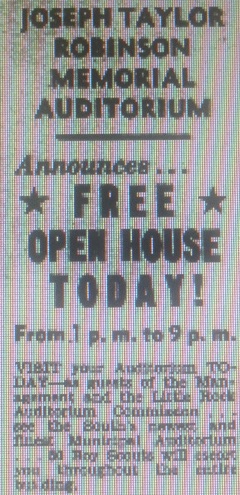
The campaign for the new bonds used a similar structure and message as the 1937 election to build the auditorium.  There were newspaper ads by the steering committee (this time simply called the Citizen’s Committee and led by Omar Throgmorton) and support from civic organizations.  One thing very different from the 1937 campaign was the presence of an actual building.  On Sunday, March 31, just two days before the election, there was an open house for the public to explore the edifice.  From 1:00 p.m. to 9:00 p.m., members of various Little Rock Boy Scout troops led 4,000 visitors on tours of the auditorium.  Visitors were shown all over the building; one scout calculated that the walking tour equated to two miles.  Though most people were from Little Rock, the guest registry indicated visitors from California and Pennsylvania.

On April 2, 1940, Little Rock voters approved the new bonds 1,413 to 423.  Every precinct in every ward of the city voted in favor of the new bonds.  Shortly after the election, the bonds were issued.  The auditorium construction which had first been broached in 1904 was now completed in 1940.

Little Rock Look Back: Open House at Robinson Auditorium

open house adOn March 31, 1940, the City of Little Rock and the Auditorium Commission threw open the doors of Joseph Taylor Robinson Memorial Auditorium to the public for an open house.

The building had officially opened in February 1940, and events had been taking place in the lower level since October 1939. But this was the first time that the public could tour the entire facility from top to bottom.

The event took place on a Sunday from 1pm to 9pm.  Curiously, it took place two days before a special election to approve the bonds to finish the auditorium. Though no one at the time was cynical enough to comment on the connection.

Members of various Little Rock Boy Scout troops led 4,000 visitors on tours of the auditorium.  Visitors were shown all over the building; one scout calculated that the walking tour equated to two miles.  Though most people were from Little Rock, the guest registry indicated visitors from California and Pennsylvania.  Among the last guests to sign the register were Mayor J. V. Satterfield and his family.

The idea for the open house had first been floated in December by Alderman E. W. Gibb after taking a tour of the construction site. He had enthusiastically professed that everyone should be able to tour and see what a magnificent structure it was going to be.  Mayor Satterfield had to tamper the alderman’s enthusiasm. Hagreed with Mr. Gibb that it was a fine building but stated that a public open house could not be scheduled for a few weeks because there was still much work to be done.  Mayor Satterfield noted that the seats in the music hall were going to have to be removed and then reinstalled because they needed to be anchored bette

Robinson Redux March

Blackstone adWhile Robinson Center Music Hall is closed for renovations, the Culture Vulture blog is taking a look back at previous bookings in the facility each month.

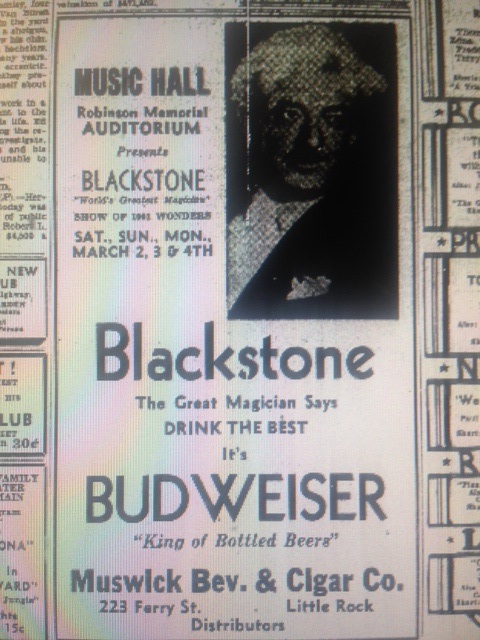
March 1940 was the first full month that Robinson Auditorium was open.  The month started with Blackstone the magician in performances from March 2 through 4. In addition to his appearance touted by the auditorium, Muswick Beverage & Cigar Company promoted his appearance, and the fact that he endorsed Budweiser beer.  Later that month, appearances included the Shrine Circus, the AAU girls basketball championship, and the Saint Louis Symphony.

March 1950 was a particularly busy month. It featured singer Vaughn Monroe on the 6th and the Arkansas State Symphony playing Beethoven’s Ninth Symphony on the 7th.  On the lower level, a circus took up residency from the 7th through 10th.  Back upstairs in the music hall, Ballet Theatre visited performing Balanchine’s “Theme and Variations” featuring ballerina Nora Kaye and conductor Max Goberman.  The month concluded on the 27th with James Dunn starring in the Pulitzer Prize winning Harvey.

In 1955, Jose Greco and His Spanish Dancers entertained audiences on March 7. Five years later, the Chicago Ballet was featured on March 26, 1960. Earlier that month (the 16th), Max Rudolf conducted the Cincinnati Symphony Orchestra. March 1965 feautured the Chicago Opera Ballet (on the 2nd) and an evening of country music stars including Buck Owens and Kitty Wells (on the 10th).

In March 1970, the national tour of the Broadway musical Mame starring Sheila Smith launched the month on the 6th and 7th. Later that month The Florida Boys were in concert. March 1975 saw much activity at Robinson Center. Guy Lombardo and his orchestra appeared on the 2nd and Richard Fredricks, baritone, gave a recital on the 4th, under the auspices of the Community Concert Series. On March 5 & 6, a statewide touring production of South Pacific played at Robinson. Produced by Vince Insalaco, it starred Judy Pryor (now Judy Trice) as Little Rock native Nellie Forbush. The month closed out with the national tour of Fiddler on the Roof.

March 1980 saw Dawn Wells starring in Neil Simon’s Chapter Two on the 8th. The Arkansas Symphony Orchestra performed on the 15th and 16th with pianist Lorin Hollander as guest artist. Five years later, Marilyn Horne appeared with the ASO on March 2, 1985. At the same time that evening, the Shriners Ball was taking place on the lower level. Later that month a national tour of Sophisticated Ladies stopped by Robinson on the 12th. The ASO returned on March 20 & 21 with pianist Garrick Ohlsson.

The Sharks and the Jets lept on the stage on March 20, 1990, as a tour of West Side Story came to Robinson Center. The month concluded with pianist Jose Carlos Cocarelli in concert with the ASO.

Marilyn Horne returned to Little Rock, ten years and one day after her previous appearance, and performed with the ASO again on March 3, 1995. The month also included The Will Rogers Follies on March 10-12, Jazz Explosion II (with George Duke, Dianne Reeves, Phil Perry, Howard Hewett, and George Howard) on March 15, and the ASO in concert with cellist Jeffrey Solow on March 18 & 19. On March 22, the musical Raisin was performed. The cast included Peabo Bryson, Jeffrey Osborne and Lynette Hawkins.

As the 2000s rolled around, Robinson Center continued to feature an eclectic mix. In March 2000, Ann Hampton Callaway performed with the ASO on March 4 & 5. Later that month the original cast of Red, White & Tuna played at Robinson from March 14 through 19. In 2005, the national tour of Mamma Mia! played at Robinson from March 1-6. Later that month the ASO performed Broadway a la Carte with an eveningn of songs from the Great White Way (on March 18 & 19).

In 2010, the ASO performed a concert version of Porgy & Bess on March 12 & 13. It was the first time that title had ever been performed in its entirity in Arkansas. Irish dance took the stage the next night as Lord of the Dance took up residence at Robinson Center.

Little Rock Look Back: President Clinton performs with Arkansas Symphony

Former U.S. President Bill Clinton addresses the audience after reciting Martin Luther King's famous speech, 'I Have A Dream', to the music of Alexander L. Miller at Robinson Auditorium March 25, 2003 in Little Rock, Arkansas. Clinton was the honored guest for a performance by the Arkansas Symphony Orchestra to benefit the William Jefferson Clinton Presidential Foundation. (Photo by Karen E. Segrave/Getty Images)

Former U.S. President Bill Clinton addresses the audience after reciting Martin Luther King’s famous speech, ‘I Have A Dream’, to the music of Alexander L. Miller at Robinson Auditorium March 25, 2003 in Little Rock, Arkansas. Clinton was the honored guest for a performance by the Arkansas Symphony Orchestra to benefit the William Jefferson Clinton Presidential Foundation. (Photo by Karen E. Segrave/Getty Images)

On March 25, 2003, former President Bill Clinton took the stage of Robinson Center Music Hall to perform with the Arkansas Symphony Orchestra. Entitled “Let Freedom Ring – A Patriotic Celebration,” the evening was a joint fundraiser for the Symphony and the Clinton Foundation.

Before a packed house of over 1700, Clinton narrated Aaron Copland’s A Lincoln Portrait which weaves excerpts from Lincoln speeches with Copland’s own unique classical take on American heartland music.  Clinton also narrated Let Freedom Ring, a symphonic setting by Alexander Miller of Martin Luther King’s “I Have A Dream” speech.

The evening also consisted of Broadway veteran and Little Rock favorite Lawrence Hamilton singing “Wheels of a Dream” from the musical Ragtime.  On Broadway and on national tour, Hamilton had previously sung the song.  The Arkansas Symphony Orchestra also performed An American in Paris by George Gershwin and “Jupiter” from The Planets by Gustav Holst.  This final selection was a tribute to the seven astronauts who had died in the crash of the space shuttle Columbia on February 1, 2003.

David Itkin, who was then the musical director of the ASO, conducted the concert.