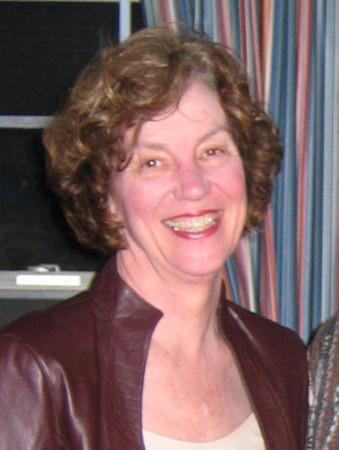
Creative Class 2016: Ruth Shepherd

cc16-shepherdThough Arts & Humanities Month ended yesterday, today is a bonus for the Creative Class 2016.  Ruth D. Shepherd has spent her career utilizing the arts and creativity to spread joy, messages of hope, and to change hearts and minds.

She is “retiring” later this year after having served as Director of Just Communities of Arkansas since 2000.  Though she will leave that post, her work in Little Rock and Arkansas will continue.

In her other careers, she has been a school teacher and worked in various non-profits.  She is probably most closely identified with the Arkansas Repertory Theatre having served as a volunteer, staff member, and Board member off and on for most of its 40 years of existence.  She has also served as Tabriz co-chair for the Arkansas Arts Center.

Ruth has graced several Little Rock stages including UALR (where she was in Hair), Community Theatre of Little Rock, the Weekend Theatre, and the Phoenix Theatre among others.  The Culture Vulture’s favorite performance was her riveting portrayal of a frustrated and frustrating matriarch in Edward Albee’s Three Tall Women.

While wrapping up her current role with JCA, she is busy putting the finishing touches on next Sunday’s Walk for CommUNITY.  It is not too late to sign up.  For more information on that and other JCA projects and programs, visit their website.

Creative Class 2016: Jason Willey

cc16-willeyJason Willey often has people howling with laughter when he performs with Red Octopus Theater.

As one of the movers and shakers behind this troupe for the past decade or so, Jason often writes and produces and directs for this topical sketch comedy troupe in addition to acting in it.  He can also usually be found cranking out press releases for it and doing whatever needs to be done.

In addition to appearing with Red Octopus, Jason has been a fixture on the local theatre scene. He has appeared in many productions with The Weekend Theater as well as on other local stages.

Jason has also appeared in numerous Arkansas-based films over the past few years.  He has lent his talents on many film crews as well.  He is an avid supporter of local film festivals as well.

In short, if it comes to an aspect of the acting profession in Arkansas, Jason has probably been involved.

Today is #ArkansasGives Day

Arkansas GivesIf you are like me, you’ve been receiving notifications about Arkansas Gives Day for months.  Well, today is the day!  From 8am until 8pm, you can help grow the love for Arkansas’s nonprofit organizations by making a donation to the charity of your choice.  The event is sponsored by the Arkansas Community Foundation.

As a special incentive to give, each gift made through ArkansasGives on April 7, 2016 will be matched with additional bonus dollars; the more you give, the more bonus dollars your favorite charity will receive.

Nonprofit organizations and other tax-exempt charitable organizations may participate if they:

  • Are headquartered in Arkansas or have a base of operations in Arkansas.
  • Are a member of the Arkansas Nonprofit Alliance.
  • Have 501c3 tax exempt status under IRS code AND are qualified as a 509(a)(1), (a)(2) or (a)(3) organization or as a private operating foundation.

The minimum amount is $25; there is no maximum amount you may give. You may designate up to 10 charities per transaction.

Accepted Forms of Payment: Visa, MasterCard, Discover and American Express credit cards online.
You will receive an email receipt of your gift; please retain it for tax purposes. Unless you choose to remain anonymous, your donor information will be sent to the nonprofits to which you give.

Here is a list of cultural organizations which offer services within the boundaries of the City of Little Rock.

There are MANY MANY MANY other worthy nonprofits which are participating. But since this is a culture blog, only the cultural institutions are listed.  But please consider visiting the website and perusing the entire list.

Drive (or walk or bike) to MISS DAISY

TWT DMDBecause of the success and awards of the movie version, and the way some of the lines have entered the vernacular especially as comic punch lines, it is easy to forget that Alfred Uhry’s Driving Miss Daisy is a quiet, unassuming play. He did not set out to write a “great” play or a social screed, in fact it was quite a surprise when it won the 1988 Pulitzer Prize for Drama.

The Weekend Theater brings Uhry’s episodic drive through the decades to life in its current offering. Under Andy Hall’s deft direction, it avoids the treacly trap that can often befall productions of this three-hander.

It is not that Hall’s production is without sentiment, but the emotions on stage are grounded in the moment. There is no mawkish lingering when the characters make an emotional connection. Considering that the script calls for cyclical closeness and distance among the trio, keeping emotions in check and in the moment serves the story and the playwright.

The plot, as if anyone needs a précis, involves a well-off (but don’t call her rich) Jewish widow, her businessman son, and the African American chauffer engaged by said son to transport said mother. Even if the audience was unfamiliar with the plot, it is pretty obvious that the titular matron and her driver will move from adversaries to unlikely friends. While the destination may be a formulaic and foregone conclusion, just like taking a trip, joy can be found in the journey.

Jermaine McClure plays the driver, Hoke. He avoids the stereotype of being the long-suffering, noble, simple-but-wise, African American. Though the part is not written that way, it has often been acted that way. His Hoke is kind, respectful, joyous, and a bit mischievous. McClure is obviously enjoying his part as much as Hoke enjoys interacting with both Daisy and her son. As he ages in the play, he doesn’t try to take on too much affectation—his character may move a bit slower—but he adds little touches such as prolonged squinting to show failing eyesight.

The role of the son, Boolie, is part instigator, part comic relief, and part time-filler so that the other two actors can be made to look older backstage. But Jay Clark imbues him with depth and pathos. He clearly enjoys the more comic moments (including wearing the most ridiculous Christmas outfit this side of Christmas Vacation), while also bringing heart and humanity to his quieter moments as well. Clark has a strong connection with each of his co-stars.

As good as the two gentlemen are, the evening clearly belongs to Judy Trice as Daisy Werthen. Her Daisy is a woman who has always been in control and is now grappling with the loss of that power. Her fussiness comes from frustration rather than from malice. Daisy is a complex woman who can see the biases in others without recognizing her own. Trice is not trying to be the lovable “little old lady” of heartwarming literature nor the stern battle-axe with a heart that needs to be awakened. Instead she presents a multi-faceted woman who is set in her ways but still has a desire to live a fulfilling life. With a sly smile and a drawn out word, she can be dangerous as she drops a veiled insult or commit theatrical larceny by stealing a scene through uttering a simple witticism.

Trice seems to get physically frailer as the play progresses, but that is not the most remarkable part of her transformation. Throughout the play her eyes sparkle with a vivacity that substantiates the sharp tongue and sharper mind of the heroine. Those eyes glimmer, that is, until the final scene. As she sits in near silence with a vacant, unfocused stare, it is hard to believe this is the same actress who has been so full of life throughout the rest of the play. Yet moments later the twinkle returns as she steps out to take her well-earned bow at the curtain call.

This production serves as a reminder that an enjoyable experience at the theatre does not need bells and whistles. It merely needs a strong story, adept actors, and a director who is able to meld the two.

Driving Miss Daisy continues at the Weekend Theater through April 17. Performances are at 7:30 on Fridays and Saturdays and Sunday matinees at 2:30.

LR Look Back: HAIR flows at Robinson Auditorium in 1972

Ad for the original production of HAIR in Little Rock. Note the ticket prices. And that they could be purchased at Moses Music Shops.

Ad for the original production of HAIR in Little Rock. Note the ticket prices. And that they could be purchased at Moses Music Shops.

Forty-four years ago today, on January 18, 1972, the musical Hair settled in for a week-long run at Robinson Auditorium.  The saga to bring the national tour to Little Rock had actually begun eleven months earlier.

In February 1971, a young Little Rock attorney named Phil Kaplan petitioned the Little Rock Board of Censors to see if it would allow a production of Hair to play in the city. He was asking on behalf of a client who was interested in bringing a national tour to Arkansas’ capital city. The show, which had opened on Broadway to great acclaim in April 1968 after an Off Broadway run in 1967, was known for containing a nude scene as well for a script which was fairly liberally sprinkled with four-letter words. The Censors stated they could not offer an opinion without having seen a production.

By July 1971, Kaplan and his client (who by then had been identified as Southwest Productions) were seeking permission for a January 1972 booking of Hair from the City’s Auditorium Commission which was charged with overseeing operations at Robinson Auditorium. At its July meeting, the Commissioners voted against allowing Hair because of its “brief nude scene” and “bawdy language.”

Kaplan decried the decision. He stated that the body couldn’t “sit in censorship of legitimate theatrical productions.” He noted courts had held that Hair  could be produced and that the Auditorium Commission, as an agent for the State, “clearly can’t exercise prior censorship.” He proffered that if the production was obscene it would be a matter for law enforcement not the Auditorium Commission.

The Commission countered that they had an opinion from City Attorney Joseph Kemp stating they had the authority. One of the Commissioners, Mrs. Grady Miller (sister-in-law of the building’s namesake the late Senator Robinson, she had served on the Commission since 1940), expressed her concern that allowing Hair would open the door to other productions such as Oh! Calcutta!

On July 26, 1971, Southwest Productions filed suit against the Auditorium Commission. Four days later there was a hearing before federal Judge G. Thomas Eisele. At that hearing, Auditorium Commission member Lee Rogers read aloud excerpts from the script he found objectionable. Under questioning from Kaplan, a recent touring production of Neil Simon’s Plaza Suite was discussed. That play has adultery as a central theme of one of its acts. Rogers admitted he found the play funny, and that since the adultery did not take place on stage, he did not object to it. Among those testifying in favor of it was Robert Reddington, who was director of performing arts at the Arkansas Arts Center.

Judge Eisele offered a ruling on August 11 which compelled the Auditorium Commission to allow Hair to be performed. Prior to the ruling, some of the Auditorium Commissioners had publicly stated that if they had to allow Hair, they would close it after the first performance on the grounds of obscenity. To combat this, Judge Eisele stated that the Commission had to allow Hair to perform the entire six day engagement it sought.

Upon hearing of the Judge’s ruling, Commissioner Miller offered a succinct, two word response. “Oh, Dear!”

In the end, the production of Hair at Robinson would not be the first performance in the state.  The tour came through Fayetteville for two performances in October 1971 at Barnhill Arena.

On January 18, 1972, Hair played the first of its 8 performances over 6 days at Robinson Auditorium.  In his review the next day, the Arkansas Gazette’s Bill Lewis noted that Hair “threw out all it had to offer” and that Little Rock had survived.

The ads promoting the production carried the tagline “Arkansas will never be the same.”  Tickets (from $2 all the way up to $8.50) could be purchased at Moses Melody Shops both downtown and in “The Mall” (meaning Park Plaza). That business is gone from downtown, but the scion of that family, Jimmy Moses, is actively involved in building downtown through countless projects. His sons are carrying on the family tradition too.

Little Rock was by no means unique in trying to stop productions of Hair.  St. Louis, Birmingham, Los Angeles, Tallahassee, Boston, Atlanta, Charlotte NC, West Palm Beach, Oklahoma City, Mobile and Chattanooga all tried unsuccessfully to stop performances in their public auditoriums.  Despite Judge Eisele’s ruling against the City of Little Rock, members of the Fort Smith City Council also tried to stop a production later in 1972 in that city. This was despite warnings from City staff that there was not legal standing.

Within a few years, the Board of Censors of the City of Little Rock would be dissolved (as similar bodies also were disappearing across the US). Likewise, the Auditorium Commission was discontinued before Hair even opened with its duties being taken over by the Advertising and Promotion Commission and the Convention & Visitors Bureau staff.  This was not connected to the Hair decision; it was, instead, related to expanding convention facilities in Robinson and the new adjacent hotel.  Regardless of the reasons for their demise, both bygone bodies were vestiges of earlier, simpler and differently focused days in Little Rock.

Documentary on David O. Dodd and play about him to be shown at MacArthur Museum tonight

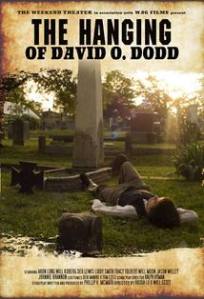
Hanging of DODTonight, January 7, at 6:30 pm, the MacArthur Museum of Arkansas Military History will host a screening of the film The Hanging of David O. Dodd.

The 2015 documentary The Hanging of David O. Dodd tells the story of 17 yr old confederate spy David Dodd who is remembered as a martyr of the confederacy. In cooperation with the Weekend Theater, a play written for the stage by playwright Phillip H. McMath. The film blends the two and looks at how he is remembered 150 years after his death.

The movie was directed by Xuixa Lu and Will Scott.  The cast features Johnnie Brannon, Will Koberg, Jason Willey, Alan Rackley, Michael Pere, Hannah Lackoff, Tracy Tolbert, Jeff Lewellen, Aron Long, William Moon, Ryan Hoyle, Jerry Rice and Libby Smith.

The event is free and open to the public.

Creative Class of 2015: Erin Martinez

erin54Moving with ease from a portraying a frustrated actress to an earthy Italian strumpet, Erin Martinez has had a memorable 2015 on Little Rock stages. Along the way, this singer/musician, actor, and music teacher has performed cabaret at various Little Rock night spots as well.

​During her childhood she spent many hours singing, composing, or teaching herself to play various instruments. She has been actively involved in performing in orchestra, band, jazz band, and theatre arts well into her adulthood.

In addition to appearing earlier this year in The Studio Theatre productions of The Last 5 Years and Nine, ​Erin has acted in theatrical productions (sometimes even in shows without numbers in the title) with several Central Arkansas companies such as The Weekend Theater, The Royal Players, The Community Theater of Little Rock. She made her NYC debut in November 2013 at 54 Below with Broadway composer Jason Robert Brown.

​Erin received a Bachelor of Music Performance, Bachelor of Music Education, and a Bachelor of Arts in Spanish from The University of Central Arkansas. She enjoys a career teaching elementary music to children ages 4-12 and is very passionate about the importance of fine arts education.