
 One hundred and seven years ago today, Winthrop Rockefeller was born in New York. After moving to Arkansas in the early 1950s, he would establish himself as a positive force for the development of the state.
Perhaps his most obvious cultural impact was helping to transform the provincial Little Rock Museum of Fine Arts into the first rate Arkansas Arts Center. He and his family were generous donors of money and art to this effort.
But that was not all. And his legacy continues. Through the effort of the Winthrop Rockefeller Foundation, many cultural institutions have received funds for programming which has reached into every county and every corner of this state. For instance, one of the Arkansas Symphony Orchestra’s string quartets is the Rockefeller Quartet.
It is hard to quantify what impact his efforts had on cultural institutions which did not even exist in his lifetime. Without the elevation of the arts and the understanding of their impact, it is doubtful that endeavors such as the Arkansas Repertory Theatre, Arkansas Opera Theatre (now Wildwood Park for the Arts) and Ballet Arkansas would have had success with donors in their nascent days.
Among the many functions of the Winthrop Rockefeller Institute atop Petit Jean Mountain is to provide a place for people to gather and exchange ideas. Often cultural topics are part of those discussions.
Through his son, Winthrop Paul Rockefeller, and his grandchildren, the Rockefeller legacy has continued since his death in 1973. Recently, Skip Rutherford hosted a conversation at the Clinton School with one of WR’s grandsons Will Rockefeller along side Adams Pryor (grandson of another Arkansas political titan, David Pryor). A video of that conversation can be viewed here.

 Dr. Sybil Jordan Hampton made history as the first African American student to attend each high school year at and graduate from Little Rock Central High School. But her impact on history exceeds that and extends into classrooms throughout Arkansas.
 In 1976, Anne Bartley was sworn in as the first director of what was then known as the Department of Arkansas Natural and Cultural Heritage. In that capacity, she was the first woman to serve in an Arkansas Governor’s cabinet. She had encouraged Governor David Pryor to propose establishing the department and then had lobbied the Arkansas General Assembly to create it. (Her oath of office was administered by the first woman on the Arkansas Supreme Court, Justice Elsijane Trimble Roy.)
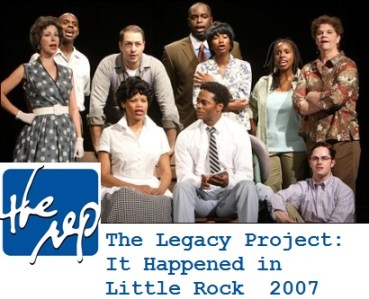 Since today is Elizabeth Eckford’s birthday, the past Arkansas Rep production that is featured is 2007’s The Legacy Project: It Happened in Little Rock.
 Little Rock Culture Vulture